
Academic Affairs OfficeAccessory DesignAnimationArchitecture and Urban DesignArt EducationCenter for Flat TechnologiesCeramicsCultural Heritage and ConservationDepartmentsDesign and Technology FuturesDoctoral SchoolDrawingFacilities and WorkshopsFaculty of ArchitectureFaculty of Art and CultureFaculty of DesignFaculty of Fine ArtsFashion DesignFinancial DepartmentGalleryGlass ArtGraphic ArtGraphic DesignInstallation and SculptureInstitute of Art History and Visual CultureInternational OfficeIT OfficeJewellery and BlacksmithingLandscape ArchitectureLibraryLinnaehitus @enMaking SpaceNew MediaOffice of the RectorateOpen AcademyPaintingPerforming ArtsPhotographyProduct DesignRectorateResearch and Development OfficeScenographySupport UnitsTextile DesignUncategorizedUrban PlanningUrban Studies
Category: Research and Development Office
15.04.2024
T4EU discussion “How to Make Science More Engaging and Social?”
Research and Development Office
Transform4Europe discussion on Monday, April 15th from 10:00 AM to 4:45 PM (EEST) via Teams.
The training is divided into two parts. The first part focuses on citizen science, introducing its concept, limitations, and problems. The second part focuses on improving science communication skills. The program is led by experts from various institutions, aiming to increase participants’ ability to convey scientific information and navigate the challenges of today’s media landscape. International speakers including Kert Viiart (Estonian Academy of Arts) and Veljo Runnel (University of Tartu) will participate with presentations.
10:45–11:15 AM (EEST)
Exploring the Role of Private Natural History Collections in Citizen Science: Opportunities and Challenges. Veljo Runnel, Citizen Science Expert (University of Tartu, Estonia)
2:45–3:45 PM (EEST)
Navigating the Landscape of Visual Misinformation (Lecture/Seminar). Kert Viiart, Associate Professor, Graphic Designer and Visual Artist (Estonian Academy of Arts)
The full program can be found here. Pre-registration is required for the discussion. Reminders and login information will be sent 3–5 days before the event.
The program is in Central European Time (CET), which is one hour behind Estonian time.
Posted by Triin Käo — Permalink
T4EU discussion “How to Make Science More Engaging and Social?”
Monday 15 April, 2024
Research and Development Office
Transform4Europe discussion on Monday, April 15th from 10:00 AM to 4:45 PM (EEST) via Teams.
The training is divided into two parts. The first part focuses on citizen science, introducing its concept, limitations, and problems. The second part focuses on improving science communication skills. The program is led by experts from various institutions, aiming to increase participants’ ability to convey scientific information and navigate the challenges of today’s media landscape. International speakers including Kert Viiart (Estonian Academy of Arts) and Veljo Runnel (University of Tartu) will participate with presentations.
10:45–11:15 AM (EEST)
Exploring the Role of Private Natural History Collections in Citizen Science: Opportunities and Challenges. Veljo Runnel, Citizen Science Expert (University of Tartu, Estonia)
2:45–3:45 PM (EEST)
Navigating the Landscape of Visual Misinformation (Lecture/Seminar). Kert Viiart, Associate Professor, Graphic Designer and Visual Artist (Estonian Academy of Arts)
The full program can be found here. Pre-registration is required for the discussion. Reminders and login information will be sent 3–5 days before the event.
The program is in Central European Time (CET), which is one hour behind Estonian time.
Posted by Triin Käo — Permalink
26.02.2024 — 28.02.2024
International wooden construction conference Forum Wood Building Baltic 2024
Architecture and Urban Design
Forum Wood Building Baltic
26 February – 28 February 2024
Tallinn, Estonia
https://www.forum-woodbaltic.com/
We invite you to participate in the Forum Wood Building Baltic 2024 to be held on February 27 and 28 in Tallinn, Estonia. This year we have more than 40 speakers from 15 countries.
There is also an opportunity to participate in the thematic excursions on February 26th. Forum Wood Building Baltic is the main conference for architecture and engineering topics of wooden buildings in the Baltic region. The overarching theme of Forum Wood Building Baltic 2024 is integrated design where different disciplines come together with their own possibilities and limitations to cooperate and push the boundaries of innovation in timber construction.
The main technical topics will be:
- introduction to the second generation of Eurocode 5 (by the authors of different parts)
- design for manufacturing and assembly
- building physics of wooden houses
- energy performance, fire safety etc.
The conference is a part of the international organization Forum Holzbau. Local hosts are Estonian Academy of Arts and Tallinn University of Technology.
Registration to the conference can be easily done here: https://www.forum-woodbaltic.com
The gala dinner on February 27th is included in all tickets.
Posted by Anna Tommingas — Permalink
International wooden construction conference Forum Wood Building Baltic 2024
Monday 26 February, 2024 — Wednesday 28 February, 2024
Architecture and Urban Design
Forum Wood Building Baltic
26 February – 28 February 2024
Tallinn, Estonia
https://www.forum-woodbaltic.com/
We invite you to participate in the Forum Wood Building Baltic 2024 to be held on February 27 and 28 in Tallinn, Estonia. This year we have more than 40 speakers from 15 countries.
There is also an opportunity to participate in the thematic excursions on February 26th. Forum Wood Building Baltic is the main conference for architecture and engineering topics of wooden buildings in the Baltic region. The overarching theme of Forum Wood Building Baltic 2024 is integrated design where different disciplines come together with their own possibilities and limitations to cooperate and push the boundaries of innovation in timber construction.
The main technical topics will be:
- introduction to the second generation of Eurocode 5 (by the authors of different parts)
- design for manufacturing and assembly
- building physics of wooden houses
- energy performance, fire safety etc.
The conference is a part of the international organization Forum Holzbau. Local hosts are Estonian Academy of Arts and Tallinn University of Technology.
Registration to the conference can be easily done here: https://www.forum-woodbaltic.com
The gala dinner on February 27th is included in all tickets.
Posted by Anna Tommingas — Permalink
30.06.2023 — 14.09.2023
EKAs competition of applied research and development projects
Research and Development Office
Each year, the Estonian Academy of Arts Research and Development Office, in conjunction with the Tallinn Strategic Management Office, holds an applied research and development projects competition to motivate the Academy’s members to apply to a greater extent the results of their academic and research work in the public, business and third sectors; to increase the quality and extent of knowledge services provided by the Academy to society and businesses and to raise public awareness of the application of the Academy’s know-how in the economy and society.
The author(s) of the best project are awarded 1000€. If numerous outstanding works are submitted for the competition, additional work(s) will be awarded.
The competition is open for EKA’s students, whose course or graduation project has reached the stage of developing an applied output, i.e. the results of the work can be applied in businesses or other organisations. The competition welcomes applied research or projects by all employees and researchers.
The works must be completed between 01.09.2022–31.08.2023.
To submit a project to the competition a completed form together with additional materials must be sent to koostoo@artun.ee no later than 14 September 2023. The e-mail addresses of all authors of the work must be included among the e-mail recipients.
See last year’s winners HERE.
Materials for applying:
Procedure for Competition of Applied Research and Development Works
Posted by Irene Hütsi — Permalink
EKAs competition of applied research and development projects
Friday 30 June, 2023 — Thursday 14 September, 2023
Research and Development Office
Each year, the Estonian Academy of Arts Research and Development Office, in conjunction with the Tallinn Strategic Management Office, holds an applied research and development projects competition to motivate the Academy’s members to apply to a greater extent the results of their academic and research work in the public, business and third sectors; to increase the quality and extent of knowledge services provided by the Academy to society and businesses and to raise public awareness of the application of the Academy’s know-how in the economy and society.
The author(s) of the best project are awarded 1000€. If numerous outstanding works are submitted for the competition, additional work(s) will be awarded.
The competition is open for EKA’s students, whose course or graduation project has reached the stage of developing an applied output, i.e. the results of the work can be applied in businesses or other organisations. The competition welcomes applied research or projects by all employees and researchers.
The works must be completed between 01.09.2022–31.08.2023.
To submit a project to the competition a completed form together with additional materials must be sent to koostoo@artun.ee no later than 14 September 2023. The e-mail addresses of all authors of the work must be included among the e-mail recipients.
See last year’s winners HERE.
Materials for applying:
Procedure for Competition of Applied Research and Development Works
Posted by Irene Hütsi — Permalink
13.06.2023
Open Seminar: Artistic Research in EKA
Doctoral School
The seminar taking place as part of the Transform4Europe Week of the European Universities Alliance will present the research projects carried out at EKA, which reveal the special nature of knowledge creation based on creative practices.
The seminar is open to everyone!
(The seminar is held in English)
10.00-10.15 Opening words, Dr. Anu Allas, Vice-Rector of Research, Head of Doctoral School
10.15-10.35 “Semi-urban communities: a methodology for increasing the biodiversity of cities with landscape architecture solutions” – Karin Bachmann, PhD student of Architecture and Urban Planning programme
10.35-10.55 “The Reconstruction and Artistic Development of the Historical Relief Print Technique” – Dr. Jaana Päeva, Researcher at Design Faculty
10.55-11.15 “Understanding How Artistic Research Helps to Discover Innovative Roles in Hybrid Performances” – Taavet Jansen, PhD student of Art and Design programme
11.15-11.35 “Bedroom Sketches: Sleep Tracking and Surveillance Capitalism” – Tõnis Jürgens, PhD student of Art and Design programme
11.35-12.00 Q&A
Posted by Piret-Klea Velleste — Permalink
Open Seminar: Artistic Research in EKA
Tuesday 13 June, 2023
Doctoral School
The seminar taking place as part of the Transform4Europe Week of the European Universities Alliance will present the research projects carried out at EKA, which reveal the special nature of knowledge creation based on creative practices.
The seminar is open to everyone!
(The seminar is held in English)
10.00-10.15 Opening words, Dr. Anu Allas, Vice-Rector of Research, Head of Doctoral School
10.15-10.35 “Semi-urban communities: a methodology for increasing the biodiversity of cities with landscape architecture solutions” – Karin Bachmann, PhD student of Architecture and Urban Planning programme
10.35-10.55 “The Reconstruction and Artistic Development of the Historical Relief Print Technique” – Dr. Jaana Päeva, Researcher at Design Faculty
10.55-11.15 “Understanding How Artistic Research Helps to Discover Innovative Roles in Hybrid Performances” – Taavet Jansen, PhD student of Art and Design programme
11.15-11.35 “Bedroom Sketches: Sleep Tracking and Surveillance Capitalism” – Tõnis Jürgens, PhD student of Art and Design programme
11.35-12.00 Q&A
Posted by Piret-Klea Velleste — Permalink
13.06.2023 — 17.06.2023
Transform4Europe Study Week “Design and Sustainability” in EKA
International Office
The Estonian Academy of Arts organizes the Transform4Europe (T4EU) European Universities’ study week “Design & Sustainability” in June 13–17. Students and support staff from ten European universities are invited to the week full of the best lectures and workshops, and students’ works also presented at the TASE ’23 Grad Show exhibition and at the ERKI Fashion Show.
The theme of the study week is “design and sustainability”. Sustainability is one of EKA’s core values – in its development, it is based on the environmental friendliness of the art academy, which is the sustainable way of thinking. Design and the design process are an important part of the solution to the ecological crisis.
As part of the week, creative research will be introduced, students can participate in a creative research writing workshop and workshops on clothing repair, documenting cultural heritage, etc.
EKA students are also invited to take part in the T4EU week, which has three options:
1. The main program (June 13-17) includes mandatory general subjects and workshops and seminars with a limited number of participants. (Program link HERE)
2. Weekly seminar “Care, community and colonialism in the art museum” (June 12-15).
In addition, core program courses may also be taken if the schedule allows. (Introduction to the seminar is HERE)
3. Weekly workshop “Cultural heritage documentation solutions workshop” (June 12-16).
In addition, core program courses may also be taken if the schedule allows. (Introduction to the workshop is HERE)
Before the course, it is possible to watch pre-recorded video interviews with experts (20-30 minute interviews, 7 interviews in total) on different aspects of sustainability.
Those who complete the course receive 3 credit points, which can be transferred to a free subject.
NB! The courses are in English.
The student can register HERE until June 4th or until the semester continues.
Detailed information about the study week in English can be found on the EKA website:
Posted by Andres Lõo — Permalink
Transform4Europe Study Week “Design and Sustainability” in EKA
Tuesday 13 June, 2023 — Saturday 17 June, 2023
International Office
The Estonian Academy of Arts organizes the Transform4Europe (T4EU) European Universities’ study week “Design & Sustainability” in June 13–17. Students and support staff from ten European universities are invited to the week full of the best lectures and workshops, and students’ works also presented at the TASE ’23 Grad Show exhibition and at the ERKI Fashion Show.
The theme of the study week is “design and sustainability”. Sustainability is one of EKA’s core values – in its development, it is based on the environmental friendliness of the art academy, which is the sustainable way of thinking. Design and the design process are an important part of the solution to the ecological crisis.
As part of the week, creative research will be introduced, students can participate in a creative research writing workshop and workshops on clothing repair, documenting cultural heritage, etc.
EKA students are also invited to take part in the T4EU week, which has three options:
1. The main program (June 13-17) includes mandatory general subjects and workshops and seminars with a limited number of participants. (Program link HERE)
2. Weekly seminar “Care, community and colonialism in the art museum” (June 12-15).
In addition, core program courses may also be taken if the schedule allows. (Introduction to the seminar is HERE)
3. Weekly workshop “Cultural heritage documentation solutions workshop” (June 12-16).
In addition, core program courses may also be taken if the schedule allows. (Introduction to the workshop is HERE)
Before the course, it is possible to watch pre-recorded video interviews with experts (20-30 minute interviews, 7 interviews in total) on different aspects of sustainability.
Those who complete the course receive 3 credit points, which can be transferred to a free subject.
NB! The courses are in English.
The student can register HERE until June 4th or until the semester continues.
Detailed information about the study week in English can be found on the EKA website:
Posted by Andres Lõo — Permalink
14.09.2022
EKA’s competition of applied research and development projects
Research and Development Office
Each year, the Estonian Academy of Arts Research and Development Office, in conjunction with the Tallinn City Enterprise Department, holds an applied research and development projects competition to motivate the Academy’s members to apply to a greater extent the results of their academic and research work in the public, business and third sectors; to increase the quality and extent of knowledge services provided by the Academy to society and businesses and to raise public awareness of the application of the Academy’s know-how in the economy and society.
The author(s) of the best project are awarded 1000€. If numerous outstanding works are submitted for the competition, additional work(s) will be awarded.
The competition is open for EKA’s students, whose course or graduation project has reached the stage of developing an applied output, i.e. the results of the work can be applied in businesses or other organisations. The competition welcomes applied research or projects by all employees and researchers.
The works must be completed between 01.09.2021–31.08.2022.
To submit a project to the competition a completed form together with additional materials must be sent to koostoo@artun.ee no later than 14 September 2022. The e-mail addresses of all authors of the work must be included among the e-mail recipients.
Materials for applying:
Posted by Irene Hütsi — Permalink
EKA’s competition of applied research and development projects
Wednesday 14 September, 2022
Research and Development Office
Each year, the Estonian Academy of Arts Research and Development Office, in conjunction with the Tallinn City Enterprise Department, holds an applied research and development projects competition to motivate the Academy’s members to apply to a greater extent the results of their academic and research work in the public, business and third sectors; to increase the quality and extent of knowledge services provided by the Academy to society and businesses and to raise public awareness of the application of the Academy’s know-how in the economy and society.
The author(s) of the best project are awarded 1000€. If numerous outstanding works are submitted for the competition, additional work(s) will be awarded.
The competition is open for EKA’s students, whose course or graduation project has reached the stage of developing an applied output, i.e. the results of the work can be applied in businesses or other organisations. The competition welcomes applied research or projects by all employees and researchers.
The works must be completed between 01.09.2021–31.08.2022.
To submit a project to the competition a completed form together with additional materials must be sent to koostoo@artun.ee no later than 14 September 2022. The e-mail addresses of all authors of the work must be included among the e-mail recipients.
Materials for applying:
Posted by Irene Hütsi — Permalink
16.08.2022 — 20.08.2022
Bio-Integrated Design
Ongoing Research Projects
Cirrus Intensive on the coastline of Saaremaa Island 16-20 August, 2022
Start your Autumn semester with a 5-day intensive on how to incorporate the principles of ecology and living system thinking into bio-integrated and -informed design processes.
Coinciding with the season of seaweed foraging in Estonia, the intensive is embedded within the biosphere of Saaremaa Island, where algae and algae-derived materials can be explored in the broadest sense – from open-ended design speculation to hands-on craftsmanship.
Upon completion of the intensive, you will:
– have an overview of the emerging technologies in algae biology, biomass production, cultivation, harvesting, and extraction (on the example of a local seaweed industry and farm;
– understand the impacts of their (design) decisions into the environment and the society;
– be able to derive material-specific concepts and applications for algal biomasses.
Part of a semester-long course originally developed as a MA-level studio at the Faculty of Design at Academy of Arts, Bio-integrated Design is co-led by the designers’ collective Studio Aine (Kärt Ojavee, Annika Kaldoja, Marie Vihmar), and equals to 3 ECTS.
Applications to the intensive will be accepted on a rolling basis until 27 June 2022 (23:59 GMT+3). The number of IC participants is limited.
No previous field knowledge is required.
Participants´ travel and accommodation costs will be covered by the Nordic-Baltic network of Art and Design – Cirrus.
To apply for the intensive, please follow the link here
Posted by Andres Lõo — Permalink
Bio-Integrated Design
Tuesday 16 August, 2022 — Saturday 20 August, 2022
Ongoing Research Projects
Cirrus Intensive on the coastline of Saaremaa Island 16-20 August, 2022
Start your Autumn semester with a 5-day intensive on how to incorporate the principles of ecology and living system thinking into bio-integrated and -informed design processes.
Coinciding with the season of seaweed foraging in Estonia, the intensive is embedded within the biosphere of Saaremaa Island, where algae and algae-derived materials can be explored in the broadest sense – from open-ended design speculation to hands-on craftsmanship.
Upon completion of the intensive, you will:
– have an overview of the emerging technologies in algae biology, biomass production, cultivation, harvesting, and extraction (on the example of a local seaweed industry and farm;
– understand the impacts of their (design) decisions into the environment and the society;
– be able to derive material-specific concepts and applications for algal biomasses.
Part of a semester-long course originally developed as a MA-level studio at the Faculty of Design at Academy of Arts, Bio-integrated Design is co-led by the designers’ collective Studio Aine (Kärt Ojavee, Annika Kaldoja, Marie Vihmar), and equals to 3 ECTS.
Applications to the intensive will be accepted on a rolling basis until 27 June 2022 (23:59 GMT+3). The number of IC participants is limited.
No previous field knowledge is required.
Participants´ travel and accommodation costs will be covered by the Nordic-Baltic network of Art and Design – Cirrus.
To apply for the intensive, please follow the link here
Posted by Andres Lõo — Permalink
09.06.2022 — 12.06.2022
Exhibition “REKrulli: Reconstructing spatial culture”
Architecture and Urban Design
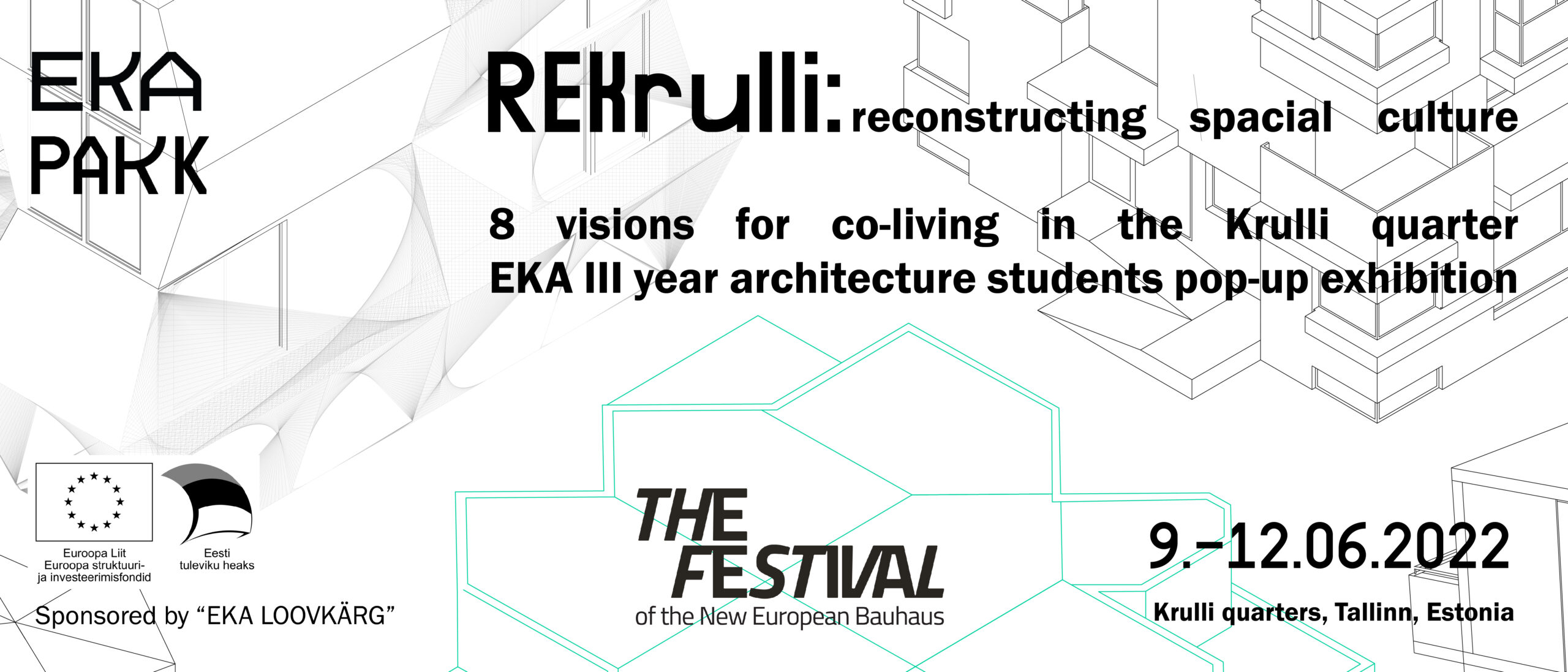
On Thursday, June 9, at 6 pm, we will open an exhibition of works by architecture students of the Estonian Academy of Arts in the Krull Quarter. In the evening, the first introduction of the Timber Architecture Research Center PAKK will take place.
The pop-up exhibition “REKrulli: reconstructing spacial culture” is an official side event of the New European Bauhaus Festival and it will remain open until June 12.
The REKrulli studio’s objective was to develop flexible architecture from sustainable materials, based on digital design and fabrication. We were looking at possible ways of living together beyond the usual apartment association home ownership model, while developing contemporary building structures that can produce adaptable and efficient solutions for the creation of high quality spaces with a positive environmental impact.
REKrulli superstudio supports the ongoing research project “sLender” at EKA PAKK which examines what type of apartment building does Tallinn need today and how to solve a new apartment building using the best knowledge of the Estonian wooden house industry and architects.
SCHEDULE OF THE OPENING EVENT:
15.00 Presentations of the five best works of the Estonian Pavilion of the Venice Architecture Biennale *
17.30 Opening of the installation “Steampunk” *
Exhibition:
18.00 Introduction of the EKA Wooden Architecture Competence Center PAKK, researchers and guests speak.
18.30 Students of the Faculty of Architecture of EKA will present the visions of apartment buildings and the results of the REKrull superstudio.
THE EXHIBITION IS OPEN:
Thursday, June 9, 6 p.m. – Opening night
Friday, June 10, 10 a.m. to 6 p.m.
Saturday, June 11, from 10 a.m. to 6 p.m.
Sunday, June 12, 10 a.m. to 4 p.m.
Students:
Triinu Amboja, Mariia Babur, Grete Daut, Simon Eiland, Roosmarii Kukk, Helin Kuldkepp, Patrick Liik, Kristina Lillepea, Maria Helena Luiga, Mattias Ots, Mariia Paslova, Yelyzaveta Perel, Yelyzaveta Peresada, Daria Polonska, Anna Pushkarska, Mikael Ristmets, Martin Sepp, Sander Sinnep, Kaari Maria Tirmaste, Cristin Marii Titma, Aneth Traumann, Mariia Ufimtseva, Liispet Viira, Laura Liis Vilbiks, Dalia Viškelyt
Tutors:
Architectural planning: Siim Tuksam, Sille Pihlak
Structural analysis and energy design: Adam Orlinski (Bollinger+Grohmann)
Anthropological analysis: Mattias Malk
Landscape architecture: Karin Bachmann
* The opening of the exhibition will be preceded at 3 pm by the public presentations of the five best works of the Estonian Pavilion for the Venice Architecture Biennale and the opening of the installation “Steampunk” in the Krull Quarter. The event is organized by the Estonian Center of Architecture.
Posted by Anna Tommingas — Permalink
Exhibition “REKrulli: Reconstructing spatial culture”
Thursday 09 June, 2022 — Sunday 12 June, 2022
Architecture and Urban Design
On Thursday, June 9, at 6 pm, we will open an exhibition of works by architecture students of the Estonian Academy of Arts in the Krull Quarter. In the evening, the first introduction of the Timber Architecture Research Center PAKK will take place.
The pop-up exhibition “REKrulli: reconstructing spacial culture” is an official side event of the New European Bauhaus Festival and it will remain open until June 12.
The REKrulli studio’s objective was to develop flexible architecture from sustainable materials, based on digital design and fabrication. We were looking at possible ways of living together beyond the usual apartment association home ownership model, while developing contemporary building structures that can produce adaptable and efficient solutions for the creation of high quality spaces with a positive environmental impact.
REKrulli superstudio supports the ongoing research project “sLender” at EKA PAKK which examines what type of apartment building does Tallinn need today and how to solve a new apartment building using the best knowledge of the Estonian wooden house industry and architects.
SCHEDULE OF THE OPENING EVENT:
15.00 Presentations of the five best works of the Estonian Pavilion of the Venice Architecture Biennale *
17.30 Opening of the installation “Steampunk” *
Exhibition:
18.00 Introduction of the EKA Wooden Architecture Competence Center PAKK, researchers and guests speak.
18.30 Students of the Faculty of Architecture of EKA will present the visions of apartment buildings and the results of the REKrull superstudio.
THE EXHIBITION IS OPEN:
Thursday, June 9, 6 p.m. – Opening night
Friday, June 10, 10 a.m. to 6 p.m.
Saturday, June 11, from 10 a.m. to 6 p.m.
Sunday, June 12, 10 a.m. to 4 p.m.
Students:
Triinu Amboja, Mariia Babur, Grete Daut, Simon Eiland, Roosmarii Kukk, Helin Kuldkepp, Patrick Liik, Kristina Lillepea, Maria Helena Luiga, Mattias Ots, Mariia Paslova, Yelyzaveta Perel, Yelyzaveta Peresada, Daria Polonska, Anna Pushkarska, Mikael Ristmets, Martin Sepp, Sander Sinnep, Kaari Maria Tirmaste, Cristin Marii Titma, Aneth Traumann, Mariia Ufimtseva, Liispet Viira, Laura Liis Vilbiks, Dalia Viškelyt
Tutors:
Architectural planning: Siim Tuksam, Sille Pihlak
Structural analysis and energy design: Adam Orlinski (Bollinger+Grohmann)
Anthropological analysis: Mattias Malk
Landscape architecture: Karin Bachmann
* The opening of the exhibition will be preceded at 3 pm by the public presentations of the five best works of the Estonian Pavilion for the Venice Architecture Biennale and the opening of the installation “Steampunk” in the Krull Quarter. The event is organized by the Estonian Center of Architecture.
Posted by Anna Tommingas — Permalink
18.02.2022
EKA Research Cafe: What do urbanists do?
Research and Development Office
EKA Research Cafe:
What do urbanists do? From urban research to practice
Urban Studies have been taught at the Estonian Academy of Arts for sixteen years, 48 students have altogether received a master’s degree. Urbanists educated in Estonia work in research, in public and private sectors, here and all over the world. We invite you to take part in an evening of discussions where we will explore expressions of this interdisciplinary speciality situated at the border of theory and practice and talk about what do urbanists do.
We ask, what are the most relevant research directions on the field today, is there anything specific about Estonian Urbanism and what is the role of the urban studies curriculum in understanding and developing the field.
The head of the curriculum, Prof. Maroš Krivý will talk about his own research, including Marie Skłodowska-Curie early stage researcher grant for contemporary urban history. Lecturers Keiti Kljavin and Kaija-Luisa Kurik will give an insight into their practices as educators and urbanists. Additionally, Mattias Malk and Sean Tyler, both PhD students of urban studies, will join the discussion.
We offer coffee and snacks!
The event is in English.
The event is supported by the European Regional Development Fund.
Posted by Andres Lõo — Permalink
EKA Research Cafe: What do urbanists do?
Friday 18 February, 2022
Research and Development Office
EKA Research Cafe:
What do urbanists do? From urban research to practice
Urban Studies have been taught at the Estonian Academy of Arts for sixteen years, 48 students have altogether received a master’s degree. Urbanists educated in Estonia work in research, in public and private sectors, here and all over the world. We invite you to take part in an evening of discussions where we will explore expressions of this interdisciplinary speciality situated at the border of theory and practice and talk about what do urbanists do.
We ask, what are the most relevant research directions on the field today, is there anything specific about Estonian Urbanism and what is the role of the urban studies curriculum in understanding and developing the field.
The head of the curriculum, Prof. Maroš Krivý will talk about his own research, including Marie Skłodowska-Curie early stage researcher grant for contemporary urban history. Lecturers Keiti Kljavin and Kaija-Luisa Kurik will give an insight into their practices as educators and urbanists. Additionally, Mattias Malk and Sean Tyler, both PhD students of urban studies, will join the discussion.
We offer coffee and snacks!
The event is in English.
The event is supported by the European Regional Development Fund.
Posted by Andres Lõo — Permalink
14.09.2020
NEW DEADLINE 14.09! Competition of applied research and development projects of EKA
Research and Development Office
Each year, the Estonian Academy of Arts Research and Development Office, in conjunction with the Tallinn City Enterprise Department, holds an applied research and development projects competition to motivate the Academy’s members to apply their academic and research activity in the public and business sectors and to highlight successful collaborative projects.
This year the competition welcomes research and development projects and students’ graduation works with a clear applied output – projects benefitting a company or an institution or with potential to better social well-being in a broader sense.
The works must be completed between 01.09.2019–31.08.2020.
The author(s) of the best project are awarded 1000€, the author(s) of the second best work a prize of 800€.
To submit a project to the competition a completed form together with additional materials must be sent to tao@artun.ee no later than 14 September 2020. The e-mail addresses of all authors of the work must be included among the e-mail recipients.
Posted by Irene Hütsi — Permalink
NEW DEADLINE 14.09! Competition of applied research and development projects of EKA
Monday 14 September, 2020
Research and Development Office
Each year, the Estonian Academy of Arts Research and Development Office, in conjunction with the Tallinn City Enterprise Department, holds an applied research and development projects competition to motivate the Academy’s members to apply their academic and research activity in the public and business sectors and to highlight successful collaborative projects.
This year the competition welcomes research and development projects and students’ graduation works with a clear applied output – projects benefitting a company or an institution or with potential to better social well-being in a broader sense.
The works must be completed between 01.09.2019–31.08.2020.
The author(s) of the best project are awarded 1000€, the author(s) of the second best work a prize of 800€.
To submit a project to the competition a completed form together with additional materials must be sent to tao@artun.ee no later than 14 September 2020. The e-mail addresses of all authors of the work must be included among the e-mail recipients.
Posted by Irene Hütsi — Permalink