
EKKM’s new exhibition explores the poetic and personal as a counterforce to political reality.
On 9 October at 7 pm, the Contemporary Art Museum of Estonia (EKKM) will open the group exhibition We Have a Land of Words [1]. Making a long-distance call to Southwest Asia, the exhibition approaches a complex subject by moving from generalised media narratives and ideological frameworks to the stories and lived experiences of individuals. Curator Evelyn Raudsepp shaped the exhibition through video interviews with Palestinian curators, drawing on the observations, experiences and reflections that emerge through personal conversations.
The exhibition brings together works by several internationally acclaimed artists whose relationships to the region are inseparable from their artistic practices. In Mona Hatoum’s work, intimate correspondence with her mother reveals how political conflict permeates even the most private domestic spheres of everyday life. Larissa Sansour’s film, which shows her family gathered around the dinner table, demonstrates just how short the distance from soup to politics can be.
Writing, storytelling, singing, and cooking can become everyday practices of resistance, sustaining connections with a land torn apart. In the hypnotic video installation by Basel Abbas and Ruanne Abou-Rahme, songs and dances carry intergenerational memory while offering ways of coping, both mentally and physically, with colonial violence. Jumana Manna’s quilted and embroidered flags weave together different forms of collective resistance, holding within it the Palestinian spirit of defiance.
Across the exhibition, words also bring lost places back into view. Forensic Architecture uses digital 3D modelling and architectural analysis to reconstruct a Palestinian historian’s home village, destroyed in 1948, from his memories and testimony. Dahaleez Collective’s sound work reimagines a street in Gaza through field recordings and local descriptions, tracing a place that has been transformed beyond recognition, both visually and sonically.
Stories from the Southwest Asia reach Estonia largely through mediated forms: conflicting news reports, statistics, and a relentless audiovisual stream of violence. The exhibition seeks to interrupt this distance by foregrounding human experience and creating possibilities for more direct forms of contact. Through the intimate act of shaping clay, a connection is forged between two artists separated by distance – one in Gaza, the other in Tallinn. Due to restrictions on the movement of both materials and people, Yasmeen Al Daya’s sculpture has been recreated in local clay by Keithy Kuuspu, in close collaboration with the artist.
New works by Estonian artists draw connections with their earlier encounters with the region. Laura Põld brings together experiences from artist residencies in Iran with discoveries from her family archive. Dénes Farkas presents photographs taken before he became an artist, including images of places in Israel and the occupied Palestinian territories that are now inaccessible, alongside more recent works that have circulated internationally. The exhibition’s archival layer traces the fragmented history of knowledge and perceptions of Palestine in Estonia, asking what has shaped them at different times.
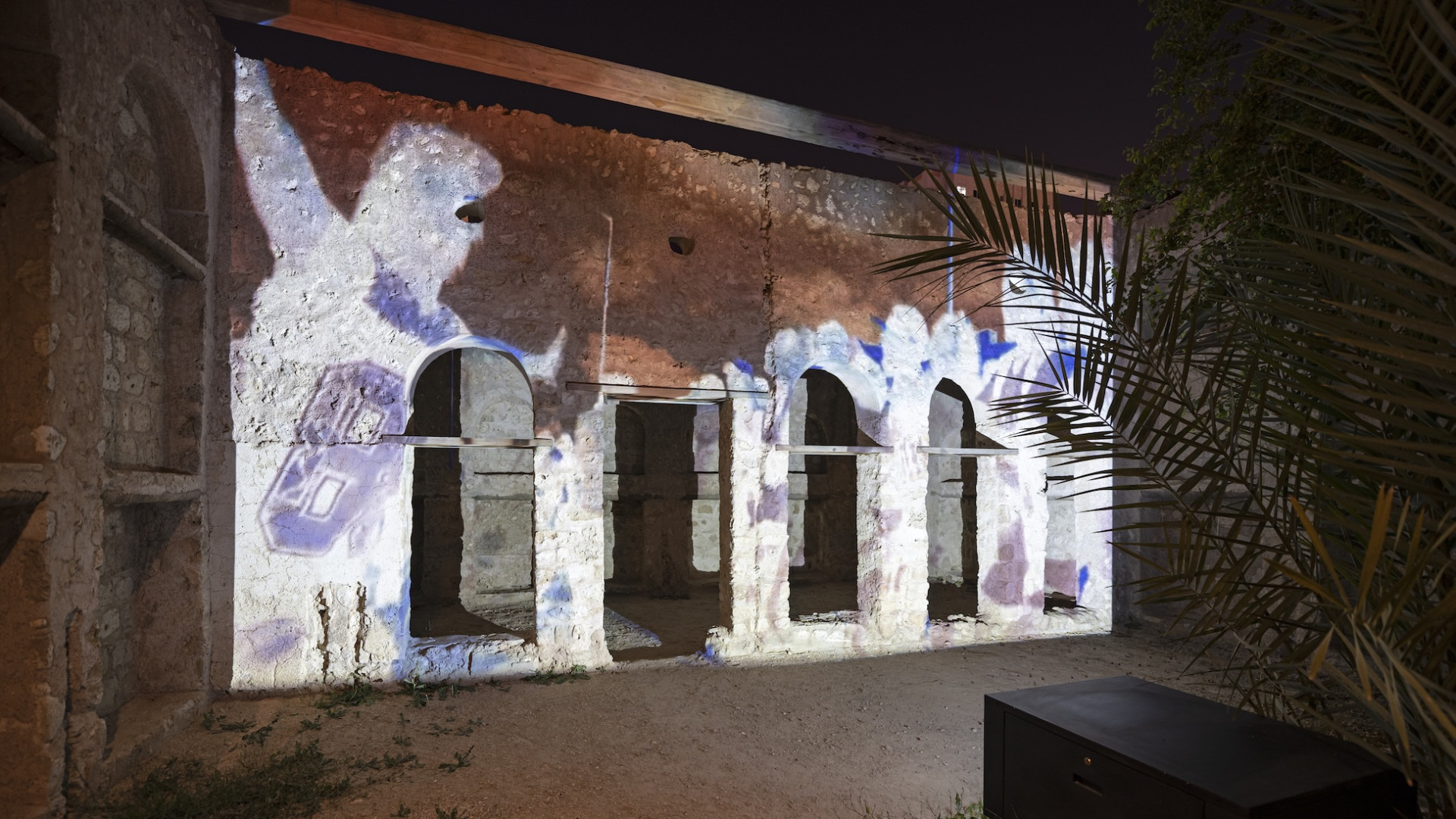
The exhibition design by artist Anu Vahtra works with the historical layers embedded in EKKM’s spaces, continuing, in the museum’s anniversary year, to foreground its raw and flexible backbone – a space willing to engage with society’s uncomfortable pressure points.
We Have a Land of Words is grounded in the idea that when political reality reaches an impasse, collective imagination can act as a poetic counterforce and an active process through which we can envision both the past and the future differently – rewriting historical narratives, preserving cultural memory, and means of imagining social relationships beyond the limits imposed by political reality. If we have the possibility to create a land out of words, what kind of world do we want to build together?
Opening night programme on 9 October
18:00 Exhibition opens
18:00–20:00 Music selected by the curator
19:00 Opening remarks and an introduction to the exhibition by the curator
20:00–22:00 DJ Shah Rud b2b Dharma Doom (Shelter)
Artists: Basel Abbas ja Ruanne Abou-Rahme, Dahaleez Collective, Dénes Farkas, Forensic Architecture, Jumana Manna, Keithy Kuuspu, Larissa Sansour, Laura Põld, Mona Hatoum, Yasmeen Al Daya
Curator: Evelyn Raudsepp
Consultants: Ahmad Alaqra, Amer Shomaly, Lara Khaldi, Noor Abed, Yasmin Huleileh, Yazan Khalili,
Exhibition designer: Anu Vahtra
Public programme curators: Anita Kodanik, Sanna Kartau and Evelyn Raudsepp
Curated book corner in collaboration with the Estonian Academy of Arts Library.
Special thanks to: Ahmad Hussein, Aline Khoury, Daniel Vaarik, Linda Kaljundi, Maria-Kristiina Soomre, OTO Museum, Paul O’Neill, Meelis Oidsalu, Sif Lindblad and others
Supported by: Cultural Endowment of Estonia, Estonian Ministry of Culture, City of Tallinn
[1] The title is taken from the Estonian-language poetry collection of the same name by Mahmoud Darwish, one of Palestine’s best-known poets. It is also the only book by a Palestinian author published in Estonian. Compiled and translated by Amar Annus; published by the Estonian Language Foundation / EKSA, 2011.