
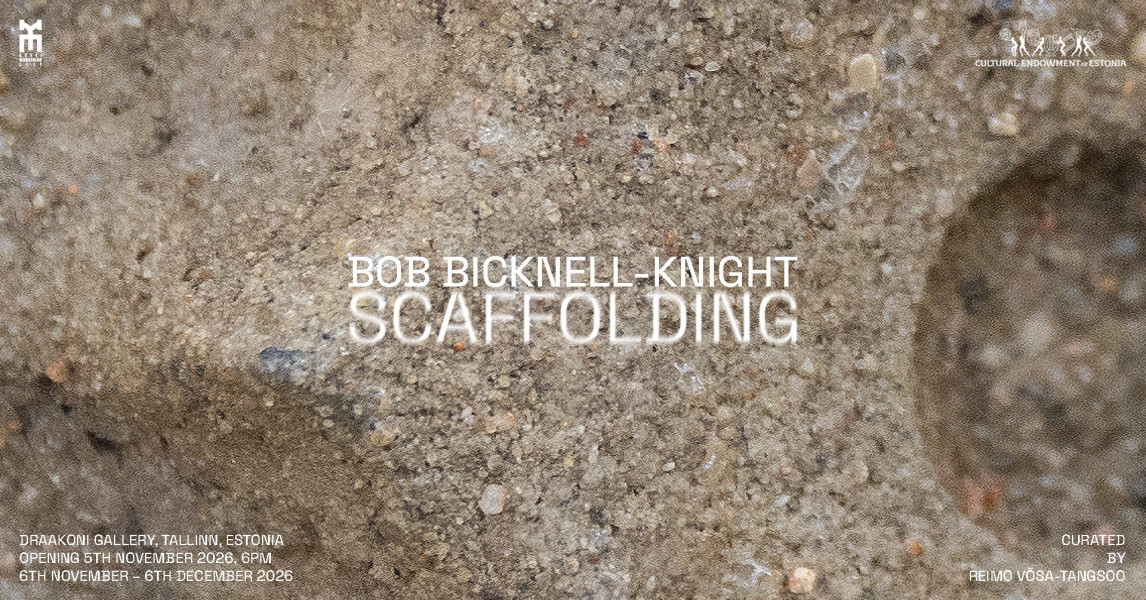
Opening on 5 November at 6pm at Draakon Gallery, Scaffolding brings together a selection of new and recent works by British artist Bob Bicknell-Knight, currently based in Tallinn. At the centre of the exhibition is the artist’s largest, most labour-intensive and technically ambitious sculpture to date, which is still somewhat a work in progress.
There is something strangely familiar about Bicknell-Knight’s sculptures. One might recognise an organ console, a wall clock or a chandelier, yet they could just as easily be architectural models, fragments removed from the façade of an unknown building, or mysterious supporting structures whose actual purpose remains elusive. These are objects that seem to belong somewhere else, although exactly where is difficult to say. Their forms evoke both sacred architecture and industrial structures, a distant, speculative past as much as the future of some dystopian parallel reality.
In Bicknell-Knight’s practice, the virtual and physical worlds intertwine. His works may take their starting point from objects found in video games, or borrowed from their visual language, which in turn imitate elements extracted from the real world. These are objects whose original purpose have been altered or lost entirely within the virtual environment. Clocks that do not tell the time, or objects whose sole reason for existing is to make an imaginary world more believable. Brought out of the virtual realm, they acquire a new physical presence, but not necessarily a clearer meaning. Quite the opposite: familiar forms become even more alien, as though they have passed through several different realities, losing something of their original nature along the way while acquiring something new.
The surfaces of these objects appear to bear the traces of time. In places, they suggest wear and erosion; elsewhere, the gradual accumulation of dust and detritus. Yet it is difficult to tell whether these are traces of a past existence or whether they have been part of the objects from the very moment of their creation. A strange temporal contradiction emerges: objects that may have no actual past appear to originate from a time that has never existed.
Time is a recurring, though not always immediately perceptible, theme in Bicknell-Knight’s work. It manifests itself in stopped clocks, burning candles and the seemingly weathered surfaces of his objects. Equally important are questions of control and functionality. What happens when an object that is supposed to do something no longer does? When a light fixture itself needs to be illuminated, or a clock exists in a world where time does not move?
Scaffolding presents objects whose origins, purposes and place in time remain unresolved. They might be remnants of something long since vanished, fragments of a future yet to come, or perhaps objects from a world that has never existed at all.
Bob Bicknell-Knight (b. 1996, Ipswich, United Kingdom) is a British artist and curator based in Tallinn, whose practice moves between the boundaries of digital and physical worlds. Working across sculpture, installation, painting, video and digital environments, he explores questions surrounding time, control and decay. Video game worlds, their underlying mechanics, and the ways in which virtual environments reflect and distort our understanding of reality play a central role in his practice.
Bicknell-Knight graduated from Chelsea College of Arts in London (2018) and is currently pursuing a Master’s degree in Contemporary Art at the Estonian Academy of Arts (2024–2027). His solo exhibitions have taken place in London, Berlin, Paris, Copenhagen, Klaipėda, Sofia, Brno and Kassel. Alongside his artistic practice, he is the founder and director of isthisit?, a platform dedicated primarily to digital art, established in 2016. Through the platform, he has collaborated with hundreds of artists and curated exhibitions across Europe and the United States.
Reimo Võsa-Tangsoo (b. 1976) earned his Master’s degree from the Department of Photography at the Estonian Academy of Arts in 2011 and has been working in the department since 2003. His artistic work explores photographic perception, politics and interaction. From these interests has grown a focus on augmented and virtual reality, as well as the digital afterlife of exhibitions in physical space. He has been a member of the Estonian Artists’ Association since 2010.
Supported by the Cultural Endowment of Estonia.
The gallery is supported by the Estonian Ministry of Culture, the Cultural Endowment of Estonia, AS Liviko and the City of Tallinn. The gallery’s activities are managed by the Estonian Artists’ Association.
Special thanks to: Rosa-Maria Nuutinen, Les Bicknell, Jayne Knight, Reimo Võsa-Tangsoo, Elliott Burns, Tuukka Kaila, Lilian Hiob-Küttis, Theresa Roth, Catinca Malaimare, Estonian Artists’ Association and Estonian Academy of Arts.