
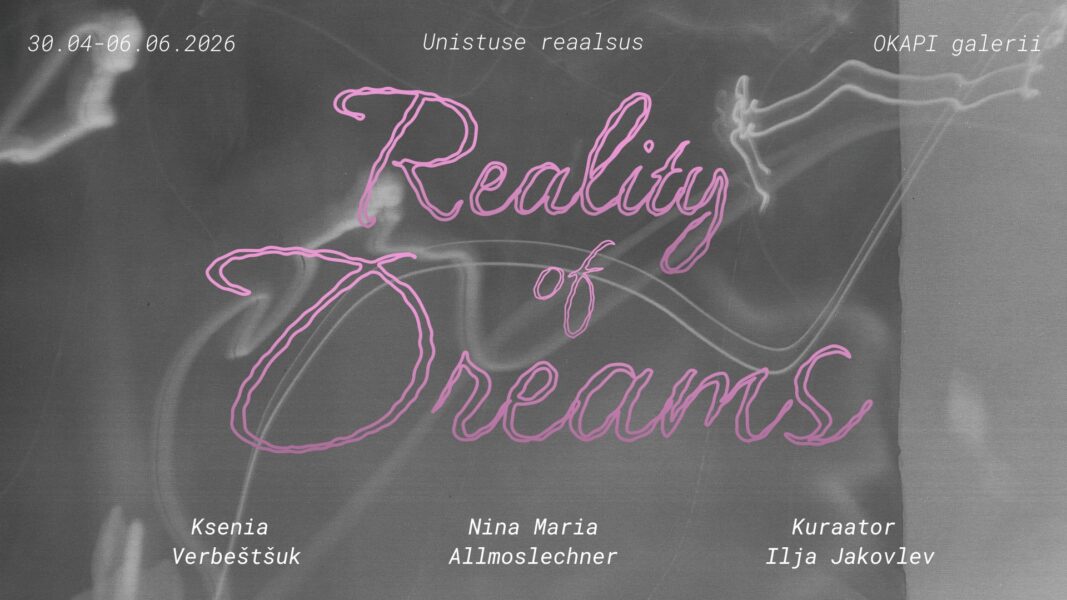
Opening of the exhibition “Reality of Dreams” at 18:00 at OKAPI Gallery in Tallinn
Participating artists: Ksenia Verbeštšuk, Nina Maria Allmoslechner
Curator: Ilja Jakovlev
Graphic design: Ksenia Kvitko
In the Victorian era, amateur photography became one of the hobbies of the “new and progressive” age that was socially acceptable for women. Initially, men believed that, much like drawing or embroidery, photography would serve as a pastime through which women could distract themselves from daily duties and engage in it playfully. However, quite quickly, women moved from depicting flowers, domestic animals, and garden views to more serious statements and visual experimentation. This has come down to us today through the work of outstanding Victorian women photographers such as Anna Atkins and Julia Margaret Cameron.
Somewhat later, women began to use photography for even bolder forms of expression, often in subtle and veiled ways, almost creating their own dreamlike worlds, sharply social self-portraits, or revealing the “double bottom” of existing reality, as seen in the works of Francesca Woodman and Diane Arbus.
Since its inception, analogue photography has undergone several periods of technological modification, and at a certain point it became an “alternative” way of capturing reality (or its altered states) against the backdrop of the growing popularity of digital photography. In the 21st century, film photography experienced a new rise, becoming extremely popular among followers of countercultural movements. Nevertheless, throughout all these periods, analogue photography has retained its power to enchant. It is practiced, studied, pursued professionally, and chosen as the primary medium in artistic work. The essence of analogue photography lies in its depth, the uniqueness of each frame, and the complex relationships between the environment, the author, and the final work.
Nina Maria Allmoslechner and Ksenia Verbeštšuk work with analogue photography, using it as a way of archiving different, sometimes liminal states of reality. For them, this manual photography is a process of creating a personal album of memory, within which their own dreamlands unfold.
Both artists, exhibiting together for the first time, enter into a dialogue about the interpretation of perceiving and understanding reality through the act of analogue photography—not so much from an aesthetic perspective as through the prism of mental states and emotions.
Nina Maria presents a series of tomograms of her brain alongside photographs of nature and self-portraits in the forest. She is interested in the relationship between human nature and the surrounding environment through the form of the brain, both visually and conceptually. Here, the brain is an ambivalent form: on the one hand an organ, on the other a portal between the “self” and the “surrounding.” The question is how one transforms into the other, where the boundary between these worlds lies, and whether it exists at all. After all, it is the brain that ultimately creates our personal reality, which is then recorded again on film. Nina Maria also reflects on the experience of derealization, raising the question of how a person perceives their place in “reality” and what happens when this perception is disrupted.
Ksenia interprets the creation of her reality through the very act of photography. The choice of composition, framing, subject matter, and the attempt to convey the play of light and shadow does not emerge from nowhere—it is a complex process that also takes place in our minds. By photographing people, animals, and landscapes, she archives her memory, creating a kind of album of places and events. In a sense, their analogue photographs are themselves tomographic self-portraits that exist inseparably from the surrounding environment they construct—sometimes almost surreal in nature.
An important theme for both artists is also their work with text. Ksenia keeps a personal diary and often accompanies her works with excerpts from it. This year, Nina Maria published the book When White Blankets. In the exhibition, they “meet” not only through photographs but also through text—large handwritten sentences on the wall.
Drinks at the opening are provided by PÕHJALA!
Exhibition dates:
30.04–06.06.2026
Wed–Fri 12:00–18:00
Sat 12:00–16:00
OKAPI Gallery
Niguliste tn 2, 10146, Tallinn
We thank the exhibition supporters:
OKAPI Gallery, PÕHJALA