
Academic Affairs OfficeAccessory DesignAnimationArchitecture and Urban DesignArt EducationCenter for Flat TechnologiesCeramicsContemporary ArtCultural Heritage and ConservationDepartmentsDesign and Technology FuturesDoctoral SchoolDrawingFacilities and WorkshopsFaculty of ArchitectureFaculty of Art and CultureFaculty of DesignFaculty of Fine ArtsFashion DesignFinancial DepartmentGalleryGlass ArtGraphic ArtGraphic DesignInstallation and SculptureInstitute of Art History and Visual CultureInternational OfficeIT OfficeJewellery and BlacksmithingLandscape ArchitectureLibraryLinnaehitus @enMaking SpaceNew MediaOffice of the RectorateOpen AcademyPaintingPerforming ArtsPhotographyProduct DesignRectorateResearch and Development OfficeScenographySupport UnitsTextile DesignUncategorizedUrban PlanningUrban Studies
Tartu Illustration Festival 2026
25.09.2026 — 26.09.2026
Tartu Illustration Festival 2026
Faculty of Design

Tartu Illustration Festival (TIF) is taking place for the third time this year and, for the first time, as a two-day festival on September 25–26 at Aparaaditehas in Tartu.
The festival brings together illustrators, designers and visual artists from Estonia and elsewhere in Europe, welcoming professionals, students and anyone interested in illustration. TIF 2026 focuses on playful patterns, exploring textures, repetition and rhythm while encouraging experimentation with different techniques, materials and approaches. Over the two days, the programme includes hands-on workshops, talks and a panel discussion, with opportunities to create a board game using screen printing, make collages inspired by the architecture of Annelinn, take part in a croquis drawing session with dogs, and join a speed-meeting event for writers and illustrators.
Visitors can also explore the international exhibition “A Bright Memory” and an illustration market. Among the festival guests are Finnish pattern designer Lotta Maija, British illustrator and designer Ryan Chapman, and Slovenian picture-book illustrator Damijan Stepančič.
TIF is a meeting place where professionals and curious visitors can come together to explore the possibilities of visual storytelling and illustration.
More information: illustrationfestival.com
Posted by Andres Lõo — Permalink
Tartu Illustration Festival 2026
Friday 25 September, 2026 — Saturday 26 September, 2026
Faculty of Design
Tartu Illustration Festival (TIF) is taking place for the third time this year and, for the first time, as a two-day festival on September 25–26 at Aparaaditehas in Tartu.
The festival brings together illustrators, designers and visual artists from Estonia and elsewhere in Europe, welcoming professionals, students and anyone interested in illustration. TIF 2026 focuses on playful patterns, exploring textures, repetition and rhythm while encouraging experimentation with different techniques, materials and approaches. Over the two days, the programme includes hands-on workshops, talks and a panel discussion, with opportunities to create a board game using screen printing, make collages inspired by the architecture of Annelinn, take part in a croquis drawing session with dogs, and join a speed-meeting event for writers and illustrators.
Visitors can also explore the international exhibition “A Bright Memory” and an illustration market. Among the festival guests are Finnish pattern designer Lotta Maija, British illustrator and designer Ryan Chapman, and Slovenian picture-book illustrator Damijan Stepančič.
TIF is a meeting place where professionals and curious visitors can come together to explore the possibilities of visual storytelling and illustration.
More information: illustrationfestival.com
Posted by Andres Lõo — Permalink
09.09.2026 — 13.09.2026
EKA team at the Ars Electronica Campus Exhibition
Faculty of Design


House of Negotiated Selves
Estonian Academy of Arts (EE)
Ars Electronica campus exhibition
Linz University of the Arts, Hauptplatz 8 (West Building)
House of Negotiated Selves explores the boundary between human autonomy and machine representation. As artificial intelligence becomes increasingly prevalent in mediating and shaping our interactions, creation, and decision-making, there is a constant negotiation taking place.
In response to the 2026 theme “NEGOTIATING HUMANITY – THE FUTURE BEGINS”, House of Negotiated Selves frames this negotiation as an embodied experience. Through the metaphor of the distorted mirrors of an amusement park, our own reflections appear similar, but ultimately deceive us. The installation asks when our reflection becomes a substitute and when a machine begins to speak for us.
Visitors enter a world where their presence is perceived and interpreted. At first, the system seems to be a mirror of their true selves and presence. Gradually, the reflection begins to wander, predicting, distorting, and misrepresenting the visitor. What begins as recognition becomes ambiguity and displacement. Rather than correcting one form of distortion, the work allows it to emerge, revealing to the visitor a disturbing experience of representation that no longer belongs to them.
House of Negotiating Selves explores AI-mediated representation and the erosion of human agency. Situated at the intersection of interaction design, critical AI research, and sensory art, the project translates an abstract discussion into a tangible experience that is not about what AI is, but rather how it will come to represent us, whether we agree with it or not.
//
DANUBEN TRIANGLE
This year’s Ars Electronica team (Product Design + ixd students):
Paula Jürgens
Martin Orav
Tõnis Bender (IXD)
Kulla Kangur
Anett Elis Männil
Carina Schipai
Hendra Raud (IXD)
Sara De Simone (IXD)
Paul Pank
Markus Hunt
Gustav Villem Kalberg
Supervisors: Carol Tikerperi and Bob Bicknell-Knight
Support and assistance: Björn Koop, Kätlin Leokin, Kaspar Pulk
Posted by Sandra — Permalink
EKA team at the Ars Electronica Campus Exhibition
Wednesday 09 September, 2026 — Sunday 13 September, 2026
Faculty of Design
House of Negotiated Selves
Estonian Academy of Arts (EE)
Ars Electronica campus exhibition
Linz University of the Arts, Hauptplatz 8 (West Building)
House of Negotiated Selves explores the boundary between human autonomy and machine representation. As artificial intelligence becomes increasingly prevalent in mediating and shaping our interactions, creation, and decision-making, there is a constant negotiation taking place.
In response to the 2026 theme “NEGOTIATING HUMANITY – THE FUTURE BEGINS”, House of Negotiated Selves frames this negotiation as an embodied experience. Through the metaphor of the distorted mirrors of an amusement park, our own reflections appear similar, but ultimately deceive us. The installation asks when our reflection becomes a substitute and when a machine begins to speak for us.
Visitors enter a world where their presence is perceived and interpreted. At first, the system seems to be a mirror of their true selves and presence. Gradually, the reflection begins to wander, predicting, distorting, and misrepresenting the visitor. What begins as recognition becomes ambiguity and displacement. Rather than correcting one form of distortion, the work allows it to emerge, revealing to the visitor a disturbing experience of representation that no longer belongs to them.
House of Negotiating Selves explores AI-mediated representation and the erosion of human agency. Situated at the intersection of interaction design, critical AI research, and sensory art, the project translates an abstract discussion into a tangible experience that is not about what AI is, but rather how it will come to represent us, whether we agree with it or not.
//
DANUBEN TRIANGLE
This year’s Ars Electronica team (Product Design + ixd students):
Paula Jürgens
Martin Orav
Tõnis Bender (IXD)
Kulla Kangur
Anett Elis Männil
Carina Schipai
Hendra Raud (IXD)
Sara De Simone (IXD)
Paul Pank
Markus Hunt
Gustav Villem Kalberg
Supervisors: Carol Tikerperi and Bob Bicknell-Knight
Support and assistance: Björn Koop, Kätlin Leokin, Kaspar Pulk
Posted by Sandra — Permalink
11.09.2026 — 24.10.2026
Banasińska, Kaubi, Januševičiūtė “Familiar Stranger”
Faculty of Fine Arts
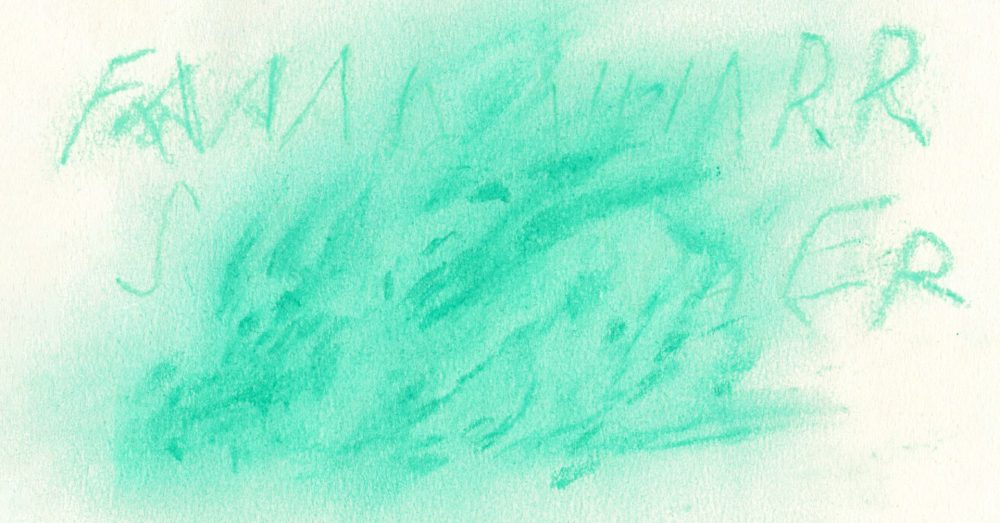
On Friday, 11 September, at 6pm, Editorial (Latako 3, Vilnius) will open the exhibition Familiar Stranger, curated by Milda Januševičiūtė. The exhibition is part of the Vilnius Gallery Weekend programme.
Familiar Stranger brings together works by Zuza Banasińska, Loora Kaubi, Sarah Neumann and Milda Januševičiūtė, to look at memory as an unstable process through which personal and collective identities are continually reconstructed. The exhibition lingers between family histories, inherited images, bodily memory and digital archives, asking what happens when the past reaches out through fragments: a story repeated by relatives, an image whose details no longer agree, a gesture inherited without explanation, or a file stored somewhere in the clouds. Memory here is less an archive of what happened, and more an ongoing negotiation between what is remembered, forgotten, altered and passed on.
The exhibition is interested in the shift between embodied and externalised memory. What was once held in stories, objects and bodies increasingly also exists on corporate servers, accessible through passwords, subscriptions and infrastructures that we rarely see. Forgetting may be a basic condition of being human; data storage has made it into a service.
Rather than treating memory as reliable evidence, Familiar Stranger considers how remembering is shaped by repetition, omission, technology, and the moment from which it looks back. The familiar can return slightly changed; someone else’s memory can quietly enter our own; an inherited story can feel simultaneously intimate and strangely foreign. The exhibition does not propose the recovery of an original, intact past. Instead, it asks how to live with what remains, what has already been rewritten, and what we choose, or allow other systems, to remember for us.
The exhibition can be seen at Editorial (Latako 3, Vilnius) until 24 October.
Familiar Stranger
Artists: Zuza Banasińska, Milda Januševičiūtė, Loora Kaubi, Sarah Neumann
Curator: Milda Januševičiūtė
Architect: Ona Juciūtė
Designer: Monika Janulevičiūtė
Language Editor: Joseph Everatt
The exhibition is funded by the Lithuanian Council for Culture
The exhibition will be accompanied by a programme of events: follow us for updates at www.editorial.lt.
Posted by Andres Lõo — Permalink
Banasińska, Kaubi, Januševičiūtė “Familiar Stranger”
Friday 11 September, 2026 — Saturday 24 October, 2026
Faculty of Fine Arts
On Friday, 11 September, at 6pm, Editorial (Latako 3, Vilnius) will open the exhibition Familiar Stranger, curated by Milda Januševičiūtė. The exhibition is part of the Vilnius Gallery Weekend programme.
Familiar Stranger brings together works by Zuza Banasińska, Loora Kaubi, Sarah Neumann and Milda Januševičiūtė, to look at memory as an unstable process through which personal and collective identities are continually reconstructed. The exhibition lingers between family histories, inherited images, bodily memory and digital archives, asking what happens when the past reaches out through fragments: a story repeated by relatives, an image whose details no longer agree, a gesture inherited without explanation, or a file stored somewhere in the clouds. Memory here is less an archive of what happened, and more an ongoing negotiation between what is remembered, forgotten, altered and passed on.
The exhibition is interested in the shift between embodied and externalised memory. What was once held in stories, objects and bodies increasingly also exists on corporate servers, accessible through passwords, subscriptions and infrastructures that we rarely see. Forgetting may be a basic condition of being human; data storage has made it into a service.
Rather than treating memory as reliable evidence, Familiar Stranger considers how remembering is shaped by repetition, omission, technology, and the moment from which it looks back. The familiar can return slightly changed; someone else’s memory can quietly enter our own; an inherited story can feel simultaneously intimate and strangely foreign. The exhibition does not propose the recovery of an original, intact past. Instead, it asks how to live with what remains, what has already been rewritten, and what we choose, or allow other systems, to remember for us.
The exhibition can be seen at Editorial (Latako 3, Vilnius) until 24 October.
Familiar Stranger
Artists: Zuza Banasińska, Milda Januševičiūtė, Loora Kaubi, Sarah Neumann
Curator: Milda Januševičiūtė
Architect: Ona Juciūtė
Designer: Monika Janulevičiūtė
Language Editor: Joseph Everatt
The exhibition is funded by the Lithuanian Council for Culture
The exhibition will be accompanied by a programme of events: follow us for updates at www.editorial.lt.
Posted by Andres Lõo — Permalink
04.09.2026 — 04.10.2026
Loora Kaubi and Erik Hõim “Cobbled Together, Stumbling”
Contemporary Art
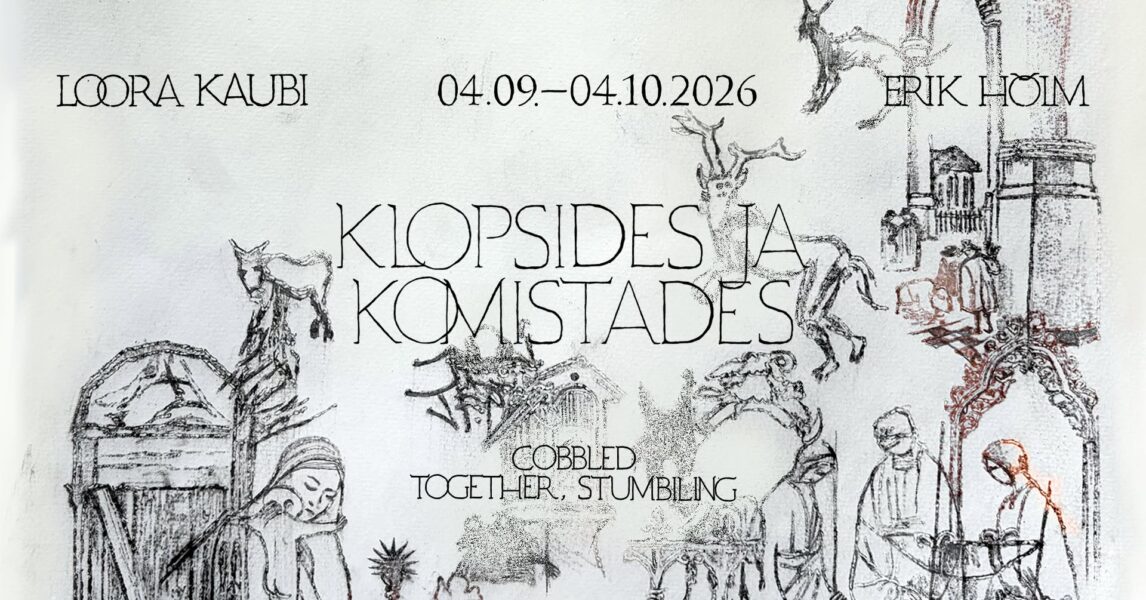
Loora Kaubi’s and Erik Hõim’s joint exhibition “Cobbled together, stumbling” is open till October 4th in the Monumental Gallery of the Tartu Art House.
The exhibition is inspired by memories of various places and stories. These stories speak to age-old needs: how to be with people when they can no longer be with us, and how to say the words that have come too late.
We believe in that which we hope for. We believe that our memory will always shine with the same brightness. We believe that we will forever hold a place in this rapidly changing, aching world. Faith is a small and stubborn thing. It is a load which we bear. This faith can become a chapel-shaped house, not built in memory of a single person, but as a tribute to all those who have ever been longed for.
It is hard to say why mortal humans build houses for those who are no longer here, shelters in which one can continue to believe in the possibility of good, quiet worlds, filled with small gestures for humanity, cobbled together bit by bit from whatever happens to be at hand, without trying to adorn that which we still do not know, or force any meaning onto anything. But still, small stones, lines, pieces from familiar places say: someone was here. They did exist. And maybe in the end that is the meaning of faith: we hope that something stays.
Loora Kaubi (b. 1998) is an artist working in Tallinn. Her work explores themes of sleep, personal and collective memory and fatigue. Kaubi holds an MA in fine arts from the LUCA School Of Arts, a BA degree from the painting department of the Estonian Academy of Arts, has completed a portion of her studies in the Vienna Academy of Arts and did an internship in Mexico City.
Erik Hõim (b. 2001) has a bachelor’s degree in photography from the Estonian Academy of Arts and has furthered his studies in photography in Prague, at FAMU. He has received the Estonian Youth Contemporary Art Association’s weekly award, the audience award of the Summer Exhibition and has participated in exhibitions in Tallinn, Võru, Urbino and Prague. He is part of the fictional artist Uru Valter and a member of the Estonian Youth Contemporary Art Association.
Graphic design: Diandra Rebase
Thanks: Hanna Samoson, the Contemporary Art Museum of Estonia, António Tainha, Mette Mari Kaljas and Deviis OÜ
The exhibition is being supported by the Cultural Endowment of Estonia.
Posted by Andres Lõo — Permalink
Loora Kaubi and Erik Hõim “Cobbled Together, Stumbling”
Friday 04 September, 2026 — Sunday 04 October, 2026
Contemporary Art
Loora Kaubi’s and Erik Hõim’s joint exhibition “Cobbled together, stumbling” is open till October 4th in the Monumental Gallery of the Tartu Art House.
The exhibition is inspired by memories of various places and stories. These stories speak to age-old needs: how to be with people when they can no longer be with us, and how to say the words that have come too late.
We believe in that which we hope for. We believe that our memory will always shine with the same brightness. We believe that we will forever hold a place in this rapidly changing, aching world. Faith is a small and stubborn thing. It is a load which we bear. This faith can become a chapel-shaped house, not built in memory of a single person, but as a tribute to all those who have ever been longed for.
It is hard to say why mortal humans build houses for those who are no longer here, shelters in which one can continue to believe in the possibility of good, quiet worlds, filled with small gestures for humanity, cobbled together bit by bit from whatever happens to be at hand, without trying to adorn that which we still do not know, or force any meaning onto anything. But still, small stones, lines, pieces from familiar places say: someone was here. They did exist. And maybe in the end that is the meaning of faith: we hope that something stays.
Loora Kaubi (b. 1998) is an artist working in Tallinn. Her work explores themes of sleep, personal and collective memory and fatigue. Kaubi holds an MA in fine arts from the LUCA School Of Arts, a BA degree from the painting department of the Estonian Academy of Arts, has completed a portion of her studies in the Vienna Academy of Arts and did an internship in Mexico City.
Erik Hõim (b. 2001) has a bachelor’s degree in photography from the Estonian Academy of Arts and has furthered his studies in photography in Prague, at FAMU. He has received the Estonian Youth Contemporary Art Association’s weekly award, the audience award of the Summer Exhibition and has participated in exhibitions in Tallinn, Võru, Urbino and Prague. He is part of the fictional artist Uru Valter and a member of the Estonian Youth Contemporary Art Association.
Graphic design: Diandra Rebase
Thanks: Hanna Samoson, the Contemporary Art Museum of Estonia, António Tainha, Mette Mari Kaljas and Deviis OÜ
The exhibition is being supported by the Cultural Endowment of Estonia.
Posted by Andres Lõo — Permalink
10.09.2026
Cast Iron 2026
Faculty of Design
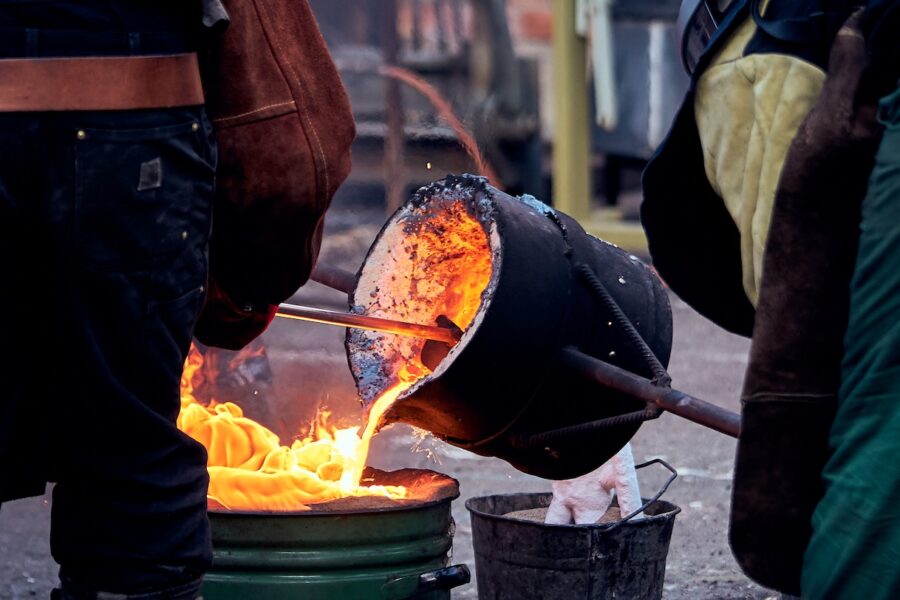
On September 10, the Estonian Academy of Arts (EAA) will host a spectacular finale of the iron casting course at the Raja Street outdoor studio, where metal will be cast and creative and technological experiments completed during the course will be presented. Over 40 students and professionals from Estonia and abroad will participate in the international course.
Iron casting is primarily common in heavy industry, but despite its complexity, artists and designers are also involved in it. In the pursuit of efficiency and clear definitions, such areas between the highly standardized and the creative-experimental tend to disappear, but in order to maintain cultural integrity, it is important to keep these spaces – to maintain existing competencies and at the same time strengthen diversity.
The course, which will take place from August 31 to September 11, will explore iron casting technologies at different levels – starting with learning about iron casting as a basic metalworking technology and its various processes, and moving on to metal alloys, technological possibilities and creative experiments on different scales.
The course is attended by students from EKA and other higher education institutions, as well as professionals from Estonia and abroad. Among the participants are students from Germany, Sweden, Norway and Japan, as well as students from EKA’s jewellery and blacksmithing, craft studies and contemporary art departments, and Erasmus students. Professionals have come to the course from, among others, the Czech Republic, Latvia, Germany and the United States.
The course is supervised by Nils Hint (EKA) and David Snoo Wilson (UK). The technological research is being conducted by lecturers from Ostrova University of Technology and Riga Academy of Arts, artist Peter Bauhuis from Germany and members of the international iron casting organization ICCCIA.
On Thursday, September 10 at 6:00 PM, the public final of the course will take place at the EKA’s Raja Street outdoor studio.
The iron casting course has been held at EKA since 2016. Over the past ten years, Estonian iron casting practice has become increasingly visible in Estonia, Europe and internationally. As a next important step, the EKA Department of Jewelry and Blacksmithing, in cooperation with ICCCIA, will organize an international iron casting symposium in Tallinn in 2028.
Posted by Andres Lõo — Permalink
Cast Iron 2026
Thursday 10 September, 2026
Faculty of Design
On September 10, the Estonian Academy of Arts (EAA) will host a spectacular finale of the iron casting course at the Raja Street outdoor studio, where metal will be cast and creative and technological experiments completed during the course will be presented. Over 40 students and professionals from Estonia and abroad will participate in the international course.
Iron casting is primarily common in heavy industry, but despite its complexity, artists and designers are also involved in it. In the pursuit of efficiency and clear definitions, such areas between the highly standardized and the creative-experimental tend to disappear, but in order to maintain cultural integrity, it is important to keep these spaces – to maintain existing competencies and at the same time strengthen diversity.
The course, which will take place from August 31 to September 11, will explore iron casting technologies at different levels – starting with learning about iron casting as a basic metalworking technology and its various processes, and moving on to metal alloys, technological possibilities and creative experiments on different scales.
The course is attended by students from EKA and other higher education institutions, as well as professionals from Estonia and abroad. Among the participants are students from Germany, Sweden, Norway and Japan, as well as students from EKA’s jewellery and blacksmithing, craft studies and contemporary art departments, and Erasmus students. Professionals have come to the course from, among others, the Czech Republic, Latvia, Germany and the United States.
The course is supervised by Nils Hint (EKA) and David Snoo Wilson (UK). The technological research is being conducted by lecturers from Ostrova University of Technology and Riga Academy of Arts, artist Peter Bauhuis from Germany and members of the international iron casting organization ICCCIA.
On Thursday, September 10 at 6:00 PM, the public final of the course will take place at the EKA’s Raja Street outdoor studio.
The iron casting course has been held at EKA since 2016. Over the past ten years, Estonian iron casting practice has become increasingly visible in Estonia, Europe and internationally. As a next important step, the EKA Department of Jewelry and Blacksmithing, in cooperation with ICCCIA, will organize an international iron casting symposium in Tallinn in 2028.
Posted by Andres Lõo — Permalink
02.10.2026
DiMa at Tallinn Design Week: How Can We Make the Textile Industry More Sustainable?
Ringdisain
On 2 October from 13.00–15.00, the Disainiöö programme at Põhjala Factory will host “Sustainable Textile Counselor: A New Learning Opportunity in the Textile Sector”, introducing a new international educational initiative focused on supporting sustainable transformation in the textile sector.
The textile industry faces an urgent need for new knowledge, skills and approaches to make production and consumption more sustainable. The Sustainable Textile Counselor (STC) project offers a practical learning pathway for professionals who want to support companies and organisations in developing more sustainable textile practices.
The event will introduce the STC project and its independent learning opportunities, while also exploring what it means to work as a sustainable textile counselor. The event will also celebrate the completion of Estonia’s first STC pilot programme, with diplomas presented to the newly trained counselors.
The programme will conclude with a hands-on workshop led by the new sustainable textile counselors. Participants will have the opportunity to explore practical approaches, knowledge and methods developed during the pilot programme.
The event is free and open to everyone interested in sustainable textiles.
Põhjala Factory
2 October
13.00–15.00
More information: https://www.sustainabletextilecounselor.com/
The event is organised by DiMa, EKA’s Circular Design and Materials Research Group.
Posted by Andres Lõo — Permalink
DiMa at Tallinn Design Week: How Can We Make the Textile Industry More Sustainable?
Friday 02 October, 2026
Ringdisain
On 2 October from 13.00–15.00, the Disainiöö programme at Põhjala Factory will host “Sustainable Textile Counselor: A New Learning Opportunity in the Textile Sector”, introducing a new international educational initiative focused on supporting sustainable transformation in the textile sector.
The textile industry faces an urgent need for new knowledge, skills and approaches to make production and consumption more sustainable. The Sustainable Textile Counselor (STC) project offers a practical learning pathway for professionals who want to support companies and organisations in developing more sustainable textile practices.
The event will introduce the STC project and its independent learning opportunities, while also exploring what it means to work as a sustainable textile counselor. The event will also celebrate the completion of Estonia’s first STC pilot programme, with diplomas presented to the newly trained counselors.
The programme will conclude with a hands-on workshop led by the new sustainable textile counselors. Participants will have the opportunity to explore practical approaches, knowledge and methods developed during the pilot programme.
The event is free and open to everyone interested in sustainable textiles.
Põhjala Factory
2 October
13.00–15.00
More information: https://www.sustainabletextilecounselor.com/
The event is organised by DiMa, EKA’s Circular Design and Materials Research Group.
Posted by Andres Lõo — Permalink
17.09.2026
Talk: Emma Sarpaniemi
Photography
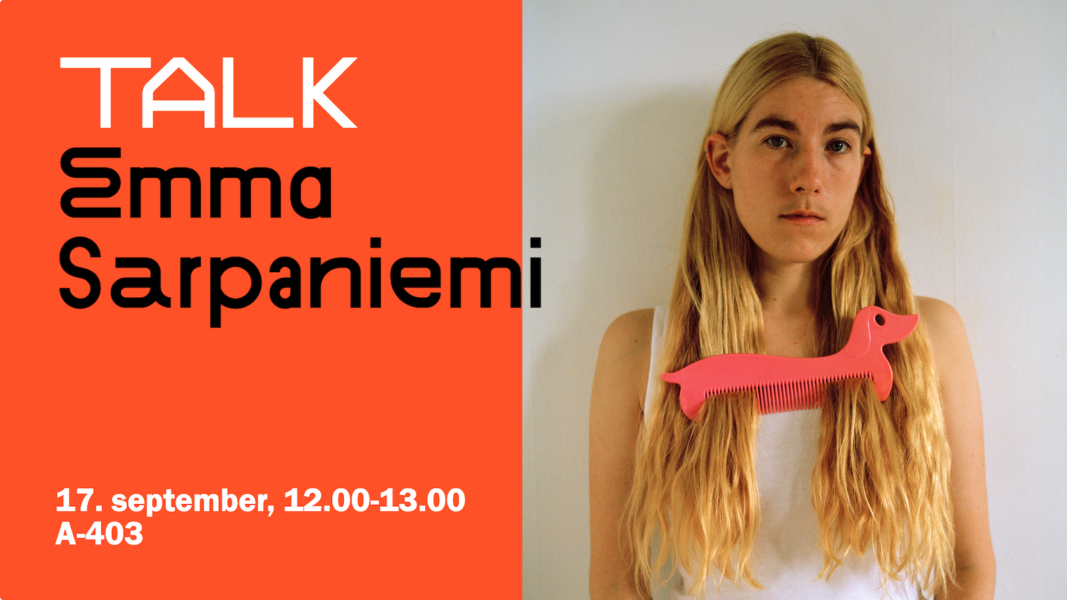
Koht: A-403
Aeg: N 17.9. kell 12:00-13:00
Emma Sarpaniemi is a visual artist based between Helsinki and Reykjavík. Sarpaniemi received a BA in photography from the Royal Academy of Art, The Hague (KABK) in 2019. In her practice, Sarpaniemi explores womanhood and definitions of femininity through performative self-portraits. For her, self-portraiture is a playground, a realm for exploring representation and resisting conventions of the gaze. The portrayed characters offer the possibility to continuously reconstruct oneself. The shutter release cable, often clearly visible in her photographs, serves as a symbol of the subject being in control of their own image. The characters she creates are fictional, but they are not alter egos. For her it’s inevitable that she regoznised herself in the images, where identity, reality and imagination intertwine.
For Sarpaniemi, photography is a medium of joy and playfulness, empowering to dream of new possibilities of femininity, gender roles and the gaze. Collaboration and collectivity also hold important roles in her work. Traces of friends’ presence appear in individual portraits through elements such as a painted house, wooden frames, or a friend focusing behind the camera. Her works have been extensively exhibited in galleries, museums, and festivals throughout Europe and are included in notable public art collections as well as numerous private collections.
Emma Sarpaniemi will participate in the Foto Tallinn art fair on September 18-20, where she will be represented by the Helsinki Contemporary Gallery.
Posted by Andres Lõo — Permalink
Talk: Emma Sarpaniemi
Thursday 17 September, 2026
Photography
Koht: A-403
Aeg: N 17.9. kell 12:00-13:00
Emma Sarpaniemi is a visual artist based between Helsinki and Reykjavík. Sarpaniemi received a BA in photography from the Royal Academy of Art, The Hague (KABK) in 2019. In her practice, Sarpaniemi explores womanhood and definitions of femininity through performative self-portraits. For her, self-portraiture is a playground, a realm for exploring representation and resisting conventions of the gaze. The portrayed characters offer the possibility to continuously reconstruct oneself. The shutter release cable, often clearly visible in her photographs, serves as a symbol of the subject being in control of their own image. The characters she creates are fictional, but they are not alter egos. For her it’s inevitable that she regoznised herself in the images, where identity, reality and imagination intertwine.
For Sarpaniemi, photography is a medium of joy and playfulness, empowering to dream of new possibilities of femininity, gender roles and the gaze. Collaboration and collectivity also hold important roles in her work. Traces of friends’ presence appear in individual portraits through elements such as a painted house, wooden frames, or a friend focusing behind the camera. Her works have been extensively exhibited in galleries, museums, and festivals throughout Europe and are included in notable public art collections as well as numerous private collections.
Emma Sarpaniemi will participate in the Foto Tallinn art fair on September 18-20, where she will be represented by the Helsinki Contemporary Gallery.
Posted by Andres Lõo — Permalink
25.09.2026
Seminar: How Should We Commemorate the Tartu Concentration Camp?
Cultural Heritage and Conservation
**Please take note: this event is in Estonian only, no translation provided on location**
How should a concentration camp and its victims be commemorated in the urban landscape of Estonia today? During the German occupation, between 3,500 and 4,000 people were executed at the Tartu concentration camp. The victims included people who had collaborated with the Soviet authorities, Jewish and Roma families from Tartu, and Jewish men, women and children brought to Tartu from Latvia.
Today, few traces of the camp are visible in the public landscape. The main sites of remembrance are the Soviet-era memorial at Lemmatsi outside Tartu (1964, designed by Elmar Rebane and Väino Tamm) and two smaller memorial stones at the Jewish cemetery in Lohkva. Yet the concentration camp was not confined to a single site: its network of facilities extended across the city.
In light of recent historical research, the ways in which the Tartu concentration camp has been remembered in independent Estonia call for renewed attention, both in cultural memory and in public space.
This seminar brings together historians, scholars of memory and urban space, and artists to examine the history of the Tartu concentration camp and its place in the memory landscape of Tartu and Estonia. Its broader aim is to explore how the various sites associated with the camp might be connected into a coherent framework—both conceptually and spatially—within the contemporary city.
As a first step, the seminar seeks to create a space for dialogue between experts from different fields and the citizens of Tartu, providing a foundation for future decisions and initiatives aimed at making the history of the concentration camp more visible.
How should we approach Soviet-era memorial sites today? How can difficult histories be represented in public space in ways that reflect recent historical research and changing social and cultural contexts?
Alongside presentations and discussions, the seminar programme includes a guided bus tour of sites connected with the Tartu concentration camp and a visit to the Lemmatsi Memorial.
PROGRAMME
11:15
Welcome and opening remarks
Risto Lehiste (Tartu City Museum)
Kristo Nurmis (Tallinn University)
SESSION I
The Tartu Concentration Camp: Historical Perspectives
11:30–11:50
Riho Västrik (Tallinn University)
The Concentration Camp System in Estonia during the German Occupation
11:50–12:10
Kristo Nurmis (Tallinn University)
The Concentration Camp and Communal Violence in Tartu during the German Occupation
12:10–12:30
Meelis Maripuu (Estonian Institute of Historical Memory)
Soviet Rule and the Tartu Concentration Camp
12:30–12:45
Discussion
Moderated by David Ilmar Lepasaar Beecher (University of Tartu)
12:45–13:30
Lunch
SESSION II
Commemorating Concentration Camps: Comparative Perspectives
13:30–13:50
Kädi Talvoja (Estonian Academy of Arts)
The Lemmatsi Memorial: An Art-Historical Perspective
13:50–14:10
Eneken Laanes (Tallinn University)
Conceptual Approaches in Cultural Memory to Commemorating the German Occupation
14:10–14:30
Hellar Lill (Estonian War Museum – General Laidoner Museum)
Exhumation and Reburial of the Victims of the Second World War
14:30–14:45
Discussion
Moderated by Gregor Taul (Estonian Academy of Arts)
14:45–15:00
Coffee break
SESSION III
How Should the Tartu Concentration Camp Be Commemorated in Public Space?
15:00–16:00
Panel discussion
Moderated by Mariann Raisma (University of Tartu Museum)
Participants:
Ants Siim (Tartu City Museum)
Karin Bachmann (Kino Landscape Architects)
Kertu Vuks (Tartu City Government)
Gennadi Gramberg (Estonian Jewish Museum)
Taavi Piibemann (Pallas University of Applied Sciences)
16:15–18:00
Guided bus tour
A bus tour of sites associated with the Tartu concentration camp, followed by a visit to the Lemmatsi Memorial. The tour will be led by Indrek Mustimets.
The tour begins and ends at Tartu City Museum.
Participation in the seminar is free of charge, but advance registration is required. Please register HERE by 20 September. **Please take note: this event is in Estonian only, no translation provided on location**
The event is organised by Tartu City Museum, Tartu City Government, and “How to Reframe Monuments,” a joint project of the Estonian Academy of Arts and Tallinn University.

Posted by Triin Männik — Permalink
Seminar: How Should We Commemorate the Tartu Concentration Camp?
Friday 25 September, 2026
Cultural Heritage and Conservation
**Please take note: this event is in Estonian only, no translation provided on location**
How should a concentration camp and its victims be commemorated in the urban landscape of Estonia today? During the German occupation, between 3,500 and 4,000 people were executed at the Tartu concentration camp. The victims included people who had collaborated with the Soviet authorities, Jewish and Roma families from Tartu, and Jewish men, women and children brought to Tartu from Latvia.
Today, few traces of the camp are visible in the public landscape. The main sites of remembrance are the Soviet-era memorial at Lemmatsi outside Tartu (1964, designed by Elmar Rebane and Väino Tamm) and two smaller memorial stones at the Jewish cemetery in Lohkva. Yet the concentration camp was not confined to a single site: its network of facilities extended across the city.
In light of recent historical research, the ways in which the Tartu concentration camp has been remembered in independent Estonia call for renewed attention, both in cultural memory and in public space.
This seminar brings together historians, scholars of memory and urban space, and artists to examine the history of the Tartu concentration camp and its place in the memory landscape of Tartu and Estonia. Its broader aim is to explore how the various sites associated with the camp might be connected into a coherent framework—both conceptually and spatially—within the contemporary city.
As a first step, the seminar seeks to create a space for dialogue between experts from different fields and the citizens of Tartu, providing a foundation for future decisions and initiatives aimed at making the history of the concentration camp more visible.
How should we approach Soviet-era memorial sites today? How can difficult histories be represented in public space in ways that reflect recent historical research and changing social and cultural contexts?
Alongside presentations and discussions, the seminar programme includes a guided bus tour of sites connected with the Tartu concentration camp and a visit to the Lemmatsi Memorial.
PROGRAMME
11:15
Welcome and opening remarks
Risto Lehiste (Tartu City Museum)
Kristo Nurmis (Tallinn University)
SESSION I
The Tartu Concentration Camp: Historical Perspectives
11:30–11:50
Riho Västrik (Tallinn University)
The Concentration Camp System in Estonia during the German Occupation
11:50–12:10
Kristo Nurmis (Tallinn University)
The Concentration Camp and Communal Violence in Tartu during the German Occupation
12:10–12:30
Meelis Maripuu (Estonian Institute of Historical Memory)
Soviet Rule and the Tartu Concentration Camp
12:30–12:45
Discussion
Moderated by David Ilmar Lepasaar Beecher (University of Tartu)
12:45–13:30
Lunch
SESSION II
Commemorating Concentration Camps: Comparative Perspectives
13:30–13:50
Kädi Talvoja (Estonian Academy of Arts)
The Lemmatsi Memorial: An Art-Historical Perspective
13:50–14:10
Eneken Laanes (Tallinn University)
Conceptual Approaches in Cultural Memory to Commemorating the German Occupation
14:10–14:30
Hellar Lill (Estonian War Museum – General Laidoner Museum)
Exhumation and Reburial of the Victims of the Second World War
14:30–14:45
Discussion
Moderated by Gregor Taul (Estonian Academy of Arts)
14:45–15:00
Coffee break
SESSION III
How Should the Tartu Concentration Camp Be Commemorated in Public Space?
15:00–16:00
Panel discussion
Moderated by Mariann Raisma (University of Tartu Museum)
Participants:
Ants Siim (Tartu City Museum)
Karin Bachmann (Kino Landscape Architects)
Kertu Vuks (Tartu City Government)
Gennadi Gramberg (Estonian Jewish Museum)
Taavi Piibemann (Pallas University of Applied Sciences)
16:15–18:00
Guided bus tour
A bus tour of sites associated with the Tartu concentration camp, followed by a visit to the Lemmatsi Memorial. The tour will be led by Indrek Mustimets.
The tour begins and ends at Tartu City Museum.
Participation in the seminar is free of charge, but advance registration is required. Please register HERE by 20 September. **Please take note: this event is in Estonian only, no translation provided on location**
The event is organised by Tartu City Museum, Tartu City Government, and “How to Reframe Monuments,” a joint project of the Estonian Academy of Arts and Tallinn University.
Posted by Triin Männik — Permalink
09.09.2026
The Summer School Reader: Book Launch in Tallinn
Graphic Design
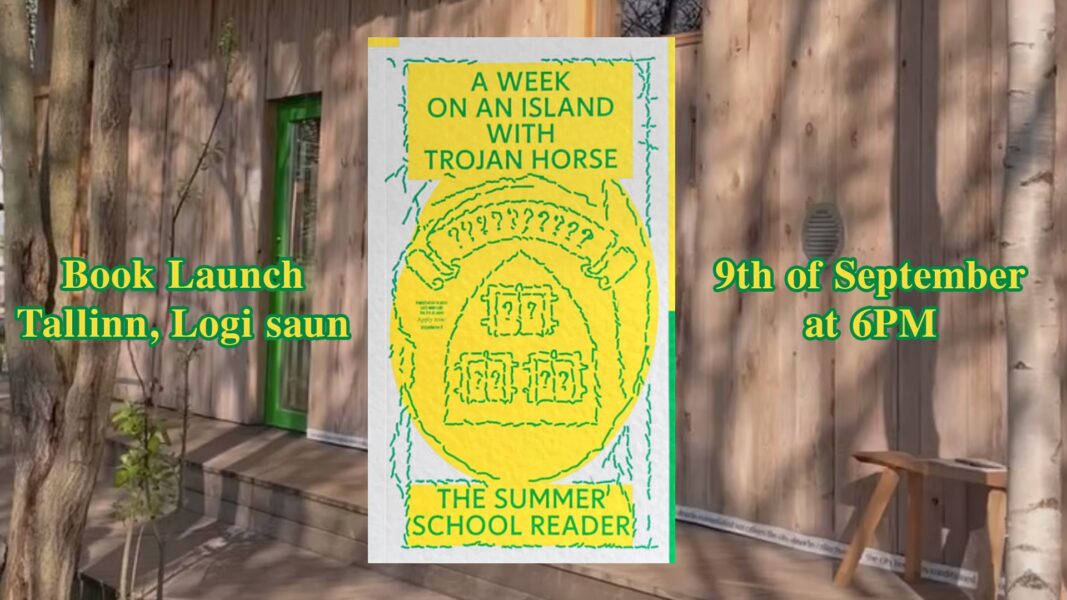
The summer school season is coming to an end, and we’re bringing the Summer School Reader to Tallinn!
Join us on 9 September at 6PM at Logi Saun for an evening of readings, conversation and sauna.
Trojan Horse is an autonomous educational platform based in Helsinki, working across architecture, design and art. It organises summer schools, workshops, reading circles and live action role-plays, creating spaces for learning and exchange outside more conventional educational settings. The Trojan Horse Summer Schools bring together participants from different backgrounds for an intensive week on an island, where they read and discuss together, share their own interests and research, organise workshops, and take part in the everyday routines of living together, from cooking and cleaning to swimming and going to the sauna.
The A Week on An Island With Trojan Horse – The Summer School Reader grew out of these experiences. Rather than documenting the themes, workshops and events of the summer schools, the publication gathers personal memories, reflections and interpretations of what happens around and in between them. It is a collection of different perspectives on those intense weeks of living, working, talking, learning and being together, and on what remains after everyone returns home.
During the launch, we’ll introduce the publication and hear some of the texts from the book. After the introduction and reading session, the warm sauna will be waiting for us.
9 September · 6PM
Logi saun, Tallinn
Come say goodbye to the summer with us!
Edited by: Ott Kagovere, Hanan Mahbouba, Arlene Tucker, Jaroslav Toussaint, Andre Vicentini, and Tommi Vasko
Texts by: Hanan Mahbouba, Marianna Maruyama and Arlene Tucker, Jaroslav Toussaint, Andre Vicentini, and Tommi Vasko
Graphic design: Ott Kagovere and Kert Viiart-Õllek.
Posted by Andres Lõo — Permalink
The Summer School Reader: Book Launch in Tallinn
Wednesday 09 September, 2026
Graphic Design
The summer school season is coming to an end, and we’re bringing the Summer School Reader to Tallinn!
Join us on 9 September at 6PM at Logi Saun for an evening of readings, conversation and sauna.
Trojan Horse is an autonomous educational platform based in Helsinki, working across architecture, design and art. It organises summer schools, workshops, reading circles and live action role-plays, creating spaces for learning and exchange outside more conventional educational settings. The Trojan Horse Summer Schools bring together participants from different backgrounds for an intensive week on an island, where they read and discuss together, share their own interests and research, organise workshops, and take part in the everyday routines of living together, from cooking and cleaning to swimming and going to the sauna.
The A Week on An Island With Trojan Horse – The Summer School Reader grew out of these experiences. Rather than documenting the themes, workshops and events of the summer schools, the publication gathers personal memories, reflections and interpretations of what happens around and in between them. It is a collection of different perspectives on those intense weeks of living, working, talking, learning and being together, and on what remains after everyone returns home.
During the launch, we’ll introduce the publication and hear some of the texts from the book. After the introduction and reading session, the warm sauna will be waiting for us.
9 September · 6PM
Logi saun, Tallinn
Come say goodbye to the summer with us!
Edited by: Ott Kagovere, Hanan Mahbouba, Arlene Tucker, Jaroslav Toussaint, Andre Vicentini, and Tommi Vasko
Texts by: Hanan Mahbouba, Marianna Maruyama and Arlene Tucker, Jaroslav Toussaint, Andre Vicentini, and Tommi Vasko
Graphic design: Ott Kagovere and Kert Viiart-Õllek.
Posted by Andres Lõo — Permalink
01.09.2026 — 01.10.2026
“Plastic Archive”, curator Marite Kuus-Hill
Library
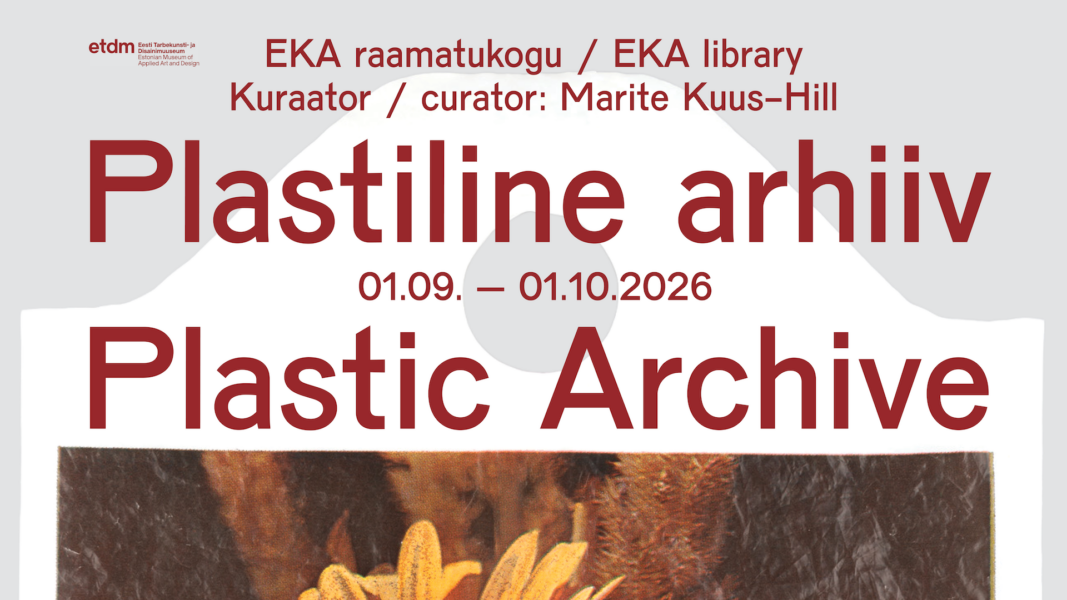
Plastic bags are nowaday’s symbols of disposability, an object we associate with overconsumption and wastefulness. The plastic bag’s association with Western consumerism is precisely what made it an object of value during the Soviet period in Estonia. Behind the iron curtain, anything linked to the West was desirable because it signified modernity and freedom. The plastic bag thus became a currency, an accessory, a collectible and now, it’s a documentation of a bygone era.
The bags in this exhibition are originally from private collections and most of them are now in the collection of the Estonian Museum of Applied Arts and Design. They are examples of Estonian product design and applied graphic art, yet their designs also illustrate the daily culture of Soviet life in Estonia. The value that was attached to these bags was a reflection of its time which is remembered for its scarcity and repression. Our shift in perspective towards plastic bags reflects the shift in the world around us, both in everyday realities as well as political ideology. Plastic is known for its plasticity, its ability to shapeshift and morph. The reputation of plastic bags is plastic – it has changed from revolutionary wonder-material and object of desire to useless, disposable trash, associated with deteriorating over-production. In a way, every archive is plastic, because the way we see the objects is ever changing.
The texts of the exhibition are based on the supporting materials of the exhibition “Kile kotti! / Plastic into Bag!” which was shown at the Estonian National Museum and Estonian Museum of Applied Art and Design in 2004 and 2005, especially the interviews conducted by Kristi Kaljumägi and the exhibition text written by Pille-Triin Männik.
Thank you to Helen Adamson, Kristi Kaljumägi, Marvi Meriniit, Anu Järs, Chloé Gourvennec, Eva Mahhov, Marit Hololei and Katri Kuus. Research for this project has been supported by the Estonian Cultural Endowment.
Graphic design by Chloé Gourvennec.
Posted by Andres Lõo — Permalink
“Plastic Archive”, curator Marite Kuus-Hill
Tuesday 01 September, 2026 — Thursday 01 October, 2026
Library
Plastic bags are nowaday’s symbols of disposability, an object we associate with overconsumption and wastefulness. The plastic bag’s association with Western consumerism is precisely what made it an object of value during the Soviet period in Estonia. Behind the iron curtain, anything linked to the West was desirable because it signified modernity and freedom. The plastic bag thus became a currency, an accessory, a collectible and now, it’s a documentation of a bygone era.
The bags in this exhibition are originally from private collections and most of them are now in the collection of the Estonian Museum of Applied Arts and Design. They are examples of Estonian product design and applied graphic art, yet their designs also illustrate the daily culture of Soviet life in Estonia. The value that was attached to these bags was a reflection of its time which is remembered for its scarcity and repression. Our shift in perspective towards plastic bags reflects the shift in the world around us, both in everyday realities as well as political ideology. Plastic is known for its plasticity, its ability to shapeshift and morph. The reputation of plastic bags is plastic – it has changed from revolutionary wonder-material and object of desire to useless, disposable trash, associated with deteriorating over-production. In a way, every archive is plastic, because the way we see the objects is ever changing.
The texts of the exhibition are based on the supporting materials of the exhibition “Kile kotti! / Plastic into Bag!” which was shown at the Estonian National Museum and Estonian Museum of Applied Art and Design in 2004 and 2005, especially the interviews conducted by Kristi Kaljumägi and the exhibition text written by Pille-Triin Männik.
Thank you to Helen Adamson, Kristi Kaljumägi, Marvi Meriniit, Anu Järs, Chloé Gourvennec, Eva Mahhov, Marit Hololei and Katri Kuus. Research for this project has been supported by the Estonian Cultural Endowment.
Graphic design by Chloé Gourvennec.
Posted by Andres Lõo — Permalink