
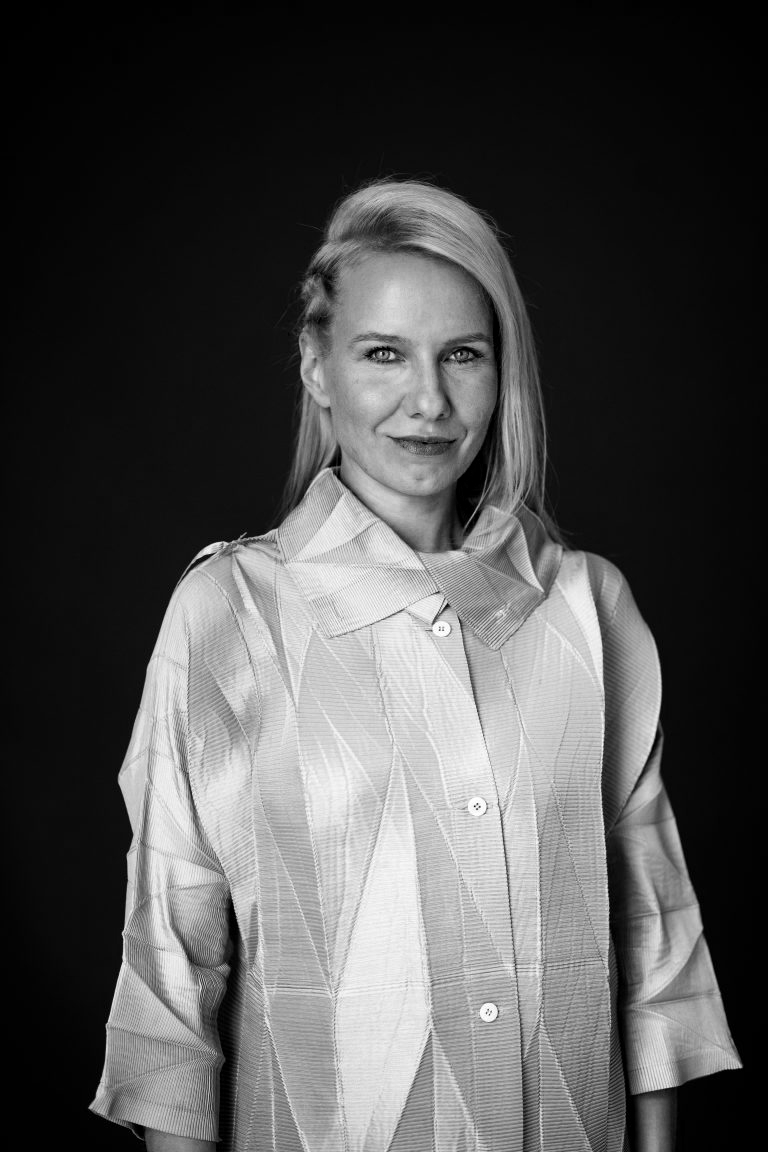
Kaja Pae is an architect, physicist (PhD, 2024), and spatial visionary whose work bridges architecture, science, and societal vision-building. She holds an MA in Architecture and Urban Planning from the Estonian Academy of Arts and a PhD in Physics from the University of Tartu. Since 2013, she has taught the course Contemporary Architectural Texts at the Estonian Academy of Arts and led the Interior Architecture Master’s Studio from 2020 to 2022.
For more than two decades, she has explored how architecture and spatial thinking can respond to changing societal needs. She has written and edited over 3,000 pages of books and journals on spatial creation (including serving as Editor-in-Chief of MAJA from 2017 to 2022), curated research-driven exhibitions (including representing Estonia at the Venice Architecture Biennale), organized public discussion forums, and worked in architectural offices in both design and planning. Her work has been recognized with numerous professional awards, including the “Mõtestaja” Medal from the Estonian Association of Architects and several distinctions from the Cultural Endowment of Estonia, including the Ela ja sära (“Live and Shine”) grant.
Alongside her academic and creative work, she has served at the state level leading the Department of Construction and Living Environment from 2022 to 2025 (first at the Ministry of Economic Affairs and Communications, later at the Ministry of Climate), focusing on advancing the quality of the living environment and evidence-based spatial development. She contributed to the establishment of the Estonian Land and Spatial Development Board and the position of the State Architect, and led the integration of spatial quality principles into national legislation.
A consistent thread in her work is the search for new possibilities and the invention of tools that enable spatial creation to evolve integrally — shaping environments that are meaningful, resonant, and capable of touching people’s lives. Her interdisciplinary background allows her to see connections across scales and disciplines, and to operate creatively at the intersection of strategy and culture, dialogue and decision-making, vision and implementation.
Her research in theoretical physics focuses on solid-state theory, particularly non-adiabatic effects in solids and molecular systems. Since 2016, she has also served as ajudge of the science popularization television program Rakett 69.