
A-101
Start Date:
18.03.2026
Start Time:
18:00
End Date:
18.03.2026
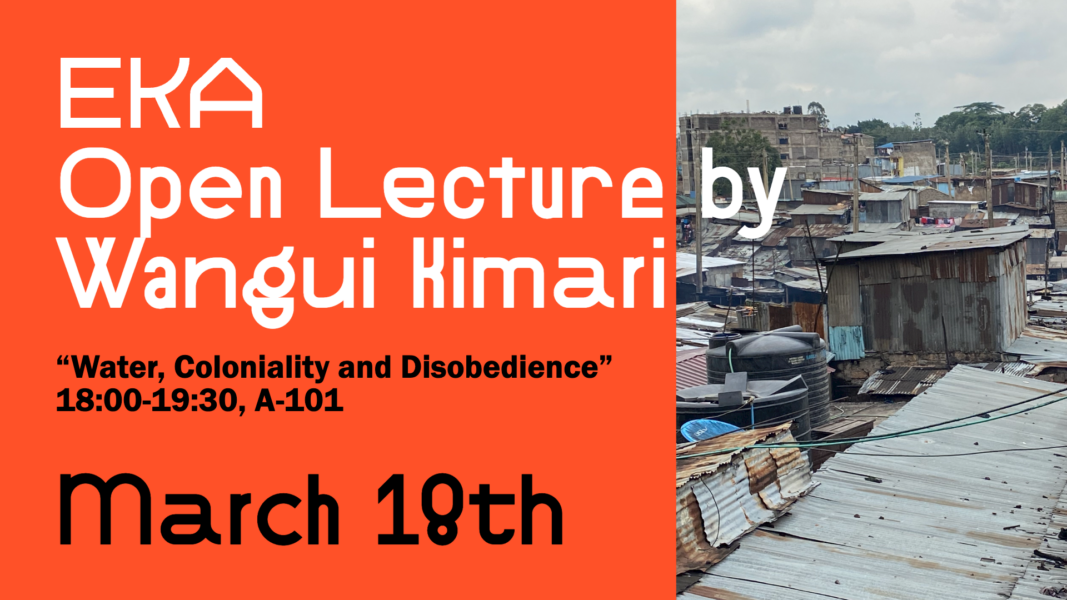
Nairobi, a city of close to five million people, congregates many hopes, experiences and struggles. Yet, across the colonial archive, its challenges have been defined primarily as those concerning ‘vagrants’ and ‘squatters,’ for instance; identities that congregate in the figure of the African. Following independence, the targets of formal city management lament and destruction remain similar: the ‘slum,’ ‘informality’ and urban ‘vice,’ whose geographies map onto the homes and bodies of those long targeted by colonial authorities. Informed by the “abolition ecology” community work of many of this city’s residents, and long-term research in its ontological margins, in this presentation I think about Nairobi’s dynamics through water. Ultimately, my argument is that while the “problem” of the “native,” squatter, vagrant or slum is seen to be defining of this urban agglomeration across the years, when Nairobi is thought from its experiences of water, coloniality and disobedience emerge as its primary dialectical currents, allowing for more (un)just histories to come into view that can allow us to vision more equal belongings and materialities in this East African city.
The Open lecture is being organized by EKA Urban Studies and TLU School of Humanities.
Wangui Kimari is an anthropologist based at the American University Nairobi Abroad Program. She is also a research associate at the African Centre for Cities (ACC), University of Cape Town. Her work draws on many local histories and interdisciplinary theoretical approaches – including oral narratives, assemblage theory, urban political ecology and the black radical tradition – to think through urban spatial management in Nairobi from the vantage point of its most marginalized residents. Wangui is also a regional editor of the online publication Africa Is a Country (AIAC), an Urban Studies Foundation (USF) trustee, on the editorial collective of Antipode and Urban Political Ecology journals, and a co-organizer of the UTA-Do African Cities Workshop.