
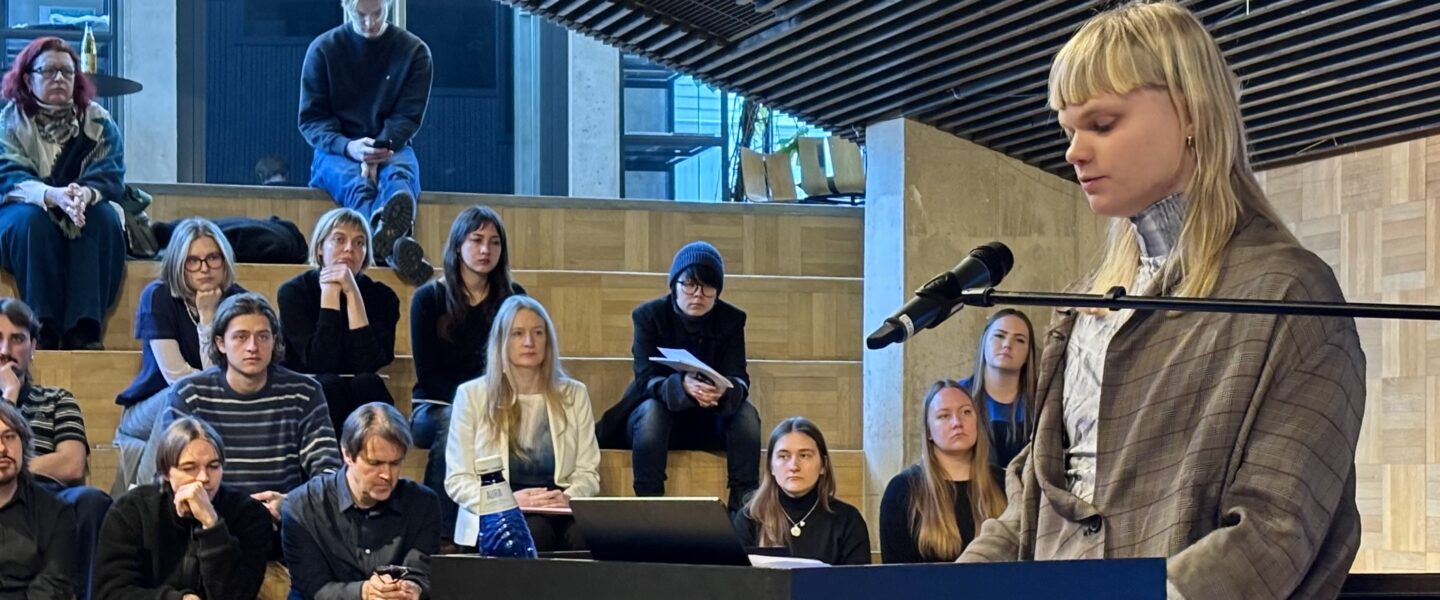
Reedel, 20. veebruaril tähistas Eesti Kunstiakadeemia Eesti Vabariigi 108. aastapäeva aktusega. Peokõnelejaks oli EKA vilistlane, disainer ja moekunstnik Karl Joonas Alamaa, kelle kõne kõlas järgnevalt.
Tere, ja suur tänu kutsumast! Olgugi, et meil on täna Eesti Vabariigi aastapäev, lähen ma peagi üle ingliskeele peale. Ja ma kohe selgitan, miks ma seda teha otsustasin. Palju on räägitud, eriti viimasel ajal, mida tähendab olla eestlane, ning sellest, kuidas noored lähevad siit minema. Kuidas hinnad on kõrged ja palgad madalad, inglise keel infiltreerub märkamatult meie kõnekeelde ning nii ongi selle Eestiga varsti kõik.
Ja ometi pean ma oma kõne inglise keeles.
Ma elan hetkel peaasjalikult Belgias. Kuid see ei takista mul seismast selle paiga ja siinsete inimeste eest. Sellise Eesti eest, mis on avatud ja lahke, mis on meie kõigi Eesti, mitte üksnes sinisilmne ja blondipäine nagu mina. Ma usun avatust, sest kui mingil veidral kombel, peale sajanditepikkuseid allasurumisi peaks eesti rahvas nüüd, läbi aegade kõige vabamas Eestis välja surema, siis seda küll ainult sellepärast, et ta on kinnine ja kade.
EKA on Eesti üks rahvusvahelisemaid ülikoole ja ma usun, et siin on praegu ka palju neid, kes tähistavad täna oma esimest Eesti Vabariigi aastapäeva. Selle kõne eestikeelne tõlge on nähtav ekraanil. Niiet selle kõnega proovin liikuda kõigi selle kooliga seotud inimeste suunas ja avatuse poole, mida ise ootan.
From time to time, especially in the format of the Independence Day speech, a mature and experienced person is invited to reflect on what we can learn from the past and how to move forward. To be fair, I’m not really breaking that tradition content-wise. But I feel the weight of this role being placed on me today, so I will try my best, let’s see how it goes. Sorry in advance if it’s a bit wonky, I don’t find myself in that role every day.
While writing this speech, I kept encountering the same question in different situations — in workshops, podcasts, conversations on trains: why do we do what we do? Writing is not my natural medium; I usually write only for my own practice, and I already feel I have more on my desk than I can handle. So why did I say yes to another obligation, however a very honorable one? It’s an honor, of course, but I’ve always seen myself more as someone who belongs backstage. Today, I will try to share my optimistic-realistic view of Estonia and the world we inhabit.
I was born in Tallinn to an Estonian-speaking middle-class family, and grew up in a boring suburb outside the city. I went to school here, also studied at EKA. Later I had the chance to move to Belgium, where I continued my studies. I am a non-binary queer person, working as an artistic researcher at the Royal Academy of Fine Arts Antwerp and as a guest lecturer here at EKA. I am an artist, costume and fashion designer. I am a friend, a brother, a son, a partner, and so on, and I am very grateful for that. I am only 25. In many ways, I am still in a similar position as many of you. Yet, taken together, I find myself in a position of great privilege. And when I wondered what I could possibly speak about today, I returned to this thought: how privilege obliges.
The world in which we operate is in such great and constant change that it is very difficult to predict where any of us will end up. The poet Antonio Machado once said, “Walker, there is no path, the path is made by walking.” And although such things are probably said every Independence Day, there is much truth in it: Estonia too has at times had to feel its way in the dark, to find the best among the worst, to create something out of nothing.
And yet it makes me, and I believe many people here today, sad to see Estonia moving toward an increasingly closed and solitary world. Because we know very well what happens when you are left alone.
Privilege obliges us to speak about things that otherwise go unheard; it obliges us to care and to be present. Our current freedom obliges us to stand for those who have not been able to, or still cannot, stand for themselves. Creative work, which we cultivate here, is one of the few fields where it is possible to create your own truth, present a new truth, and build a new world from scratch. The Academy is and should be the ground for critical discussions.
We are storytellers. We can choose which stories we tell and which worlds we thereby create. The art of being fully conscious in one’s personal life means noticing stories and becoming their narrator, instead of letting them remain invisible forces dictating what to do and how to be. But contrary to the myths of individualism and the lonely genius, art is by nature collective. Humans cannot function in isolation. We are social beings. We need to communicate our thoughts, to be seen and heard. And part of being a creator, a storyteller, is to break open and look beneath and between existing stories and narratives.
It has been just over 30 years since some of the most powerful public actions and protest movements took place in Estonia, also in the context of the whole world, such as the Singing Revolution and the Baltic Chain. Estonians probably know them well, but The Singing Revolution was a series of mass, nonviolent protests in the late 1980s where Estonians united through song to reclaim independence from Soviet rule. And the Baltic Chain was a 600-kilometer human chain formed in 1989 by people across the Baltics. Yet, it feels as if now we have begun to grow numb or powerless. In a world where the news seems darker every day, hopelessness can feel inevitable. But somehow, 37 years ago people did feel the need to fight for tomorrow despite fear. While now, in a completely different situation, we sometimes feel as if it is pointless? Art is an extraordinarily powerful way to challenge those existing narratives and mentalities.
Part of being a creator and storyteller is investigating the stories beneath the story you are working with, making them visible and sometimes freeing yourself from their grip. Destruction can sometimes be as creative an act as creation. People often say that the world is made of stories, but the world is only as beautiful as the stories themselves. Some stories bind us, make us feel unworthy and powerless: stories that say white people are better than others, that one religion is the only true one, that “boys will be boys”, that children raised by queer parents are somehow lacking, and so on. It’s up to those of us who have freedom, therefore also have responsibility for the stories we tell, the messages we pass on, which stories we try to break and which we empower.
The past is in the past, and it is often written by the powerful. We may not always be able to piece it back together and are left with fragments of narratives, yet when hope comes with action, the future depends on what we do here and now. And just as privilege obliges, so does our heritage, it obliges us to act and to stand up. As my great-aunt Leili, who was deported to Siberia at the age of 16 in the early years of the Soviet occupation, and sentenced to two years of exile and five years in a strict-regime labor camp said, her motto during those years was: “No matter what burdens are placed on my shoulders, I dare to live.”
That personal sentence carries a powerful message of hope, resistance, resilience, the courage to live and to resist. Our heritage is something to learn from, because the countries we so often consider “better or stronger” than our small Estonia often carry exploitative and colonial burdens that enabled them to become the way they are now. In the case of injustice, the worst thing to do is to remain silent and quietly bear what’s happening. Like with bullying, it can only happen with the participation of the silent bystanders who, by saying “I won’t interfere” or “that’s just how they are,” give the bully permission and strength to continue. We see this increasingly in the world politics and, painfully, also in Estonia.
Hope goes hand in hand with responsibility and action. You have a responsibility to spread and cultivate the hope you yourself receive. Hope can be adopted as an active and constructive tool, not as a passive feeling used to push away despair that too easily justifies inaction. As writer and activist Rebecca Solnit has beautifully said: “Hope is not a lottery ticket you can sit on the sofa and clutch, feeling lucky… it is an axe you break down doors with in an emergency.”
Too often we bury hope before anything has even had a chance to happen. Together we have great power to challenge prevailing narratives and make the invisible visible. Hopelessness is a form of surrender that does not serve our interests, whereas hope means embracing uncertainty and acting despite it. Around the world, forces favoring stagnation are gaining momentum, wishing to return to a world we never want to go back to and it is in their interest that hopelessness would prevail and be dismissed as naïveté. As writer Maria Popova put it, “critical thinking without hope is cynicism, but hope without critical thinking is naïveté.”
Who, if not Estonians, who only a generation ago experienced what it means to live without freedom, can afford to remain silent about others sharing a similar fate? We have a responsibility, a duty to our ancestors.
Obstacles to believing in tomorrow are often constructed; the apocalypse is not actually here and we still have power to change things. Consider those who truly live in difficult conditions, the generation that defied Soviet power 38-36 years ago, or today the peoples of small Pacific islands fighting rising sea levels for their very existence. They do not give up because giving up would have immediate consequences.
Perhaps one of the most radical acts today is simply to refuse despair.
It is easy to say it is too late, that Ukraine should concede territory, that Palestinians should give up, that recycling is pointless — such attitudes are excuses for passivity. Yet change is often born at the margins, as Rebecca Solnit has said. And although the quote “First they ignore you, then they laugh at you, then they fight you, then you win,” is oftentimes mistakenly credited to Mahatma Gandhi was actually said by American labor activist Nicholas Klein in 1918. That was the year Estonia gained its independence. The quote shows broadly how fighting for a better future and changing the narrative does work. Activists have worked tirelessly, often in competition with far wealthier and louder voices, achieving remarkable progress in Estonia as well. The day Estonia became the first former Soviet-occupied country to recognize marriage equality is unforgettable to me, and it would not have happened without long, tireless activism. We forget how much we can do, especially when we come together. About half of my own portfolio consists of collaborative projects that would never have existed alone. As artists and creative people, we have immense power to participate, to find new ways of communication, to give hope.
In the documentary by director Jaan Tootsen President Ilves said that Estonians have a kind of “lawnmower syndrome” — the feeling that everyone must be uniformly the same, complain equally, not shine out equally, not disrupt the status quo equally. One of art’s most important contributions is offering a more sensitive approach to ourselves, others, and the world. I truly believe that in a world that feels like a ship rocking in a violent storm, one of the most radical and important things we can do is not to lose hope and humanity, and we, as creative people, have a crucial role in keeping and spreading it.
None of us stand here alone, and the voice I have today was shaped by the people and places that came before me. This is the reason why I decided to come to talk here today, because this place, with all its contradictions and possibilities, is part of my story too. Hope only becomes real when we choose to act on it, by showing up, by speaking, and by refusing to believe that our voices do not matter.
The stories we tell create the world we live in. Because freedom is not only something we received. Freedom is something we must continue to create.
Kõne tõlke leiad siin.