
28. augustil kell 11.00-12.30 toimub kunsti ja disaini doktorant-nooremteaduri Aman Asifi juhtumiuuringu “Micro-Scores: Exploring the potential of Scoring as a method for practicing attunement to microbes and more than human agencies” eelretsenseerimine zoomis (Meeting ID: 679 9371 2195, Passcode: 441130)
Eelretsensendid on Nesli Oktay, PhD (EKA) ja Julia Lohmann, PhD (Aalto Ülikool)
Doktoritöö juhendajad on prof Kärt Ojavee ja dr Valentina Guccini
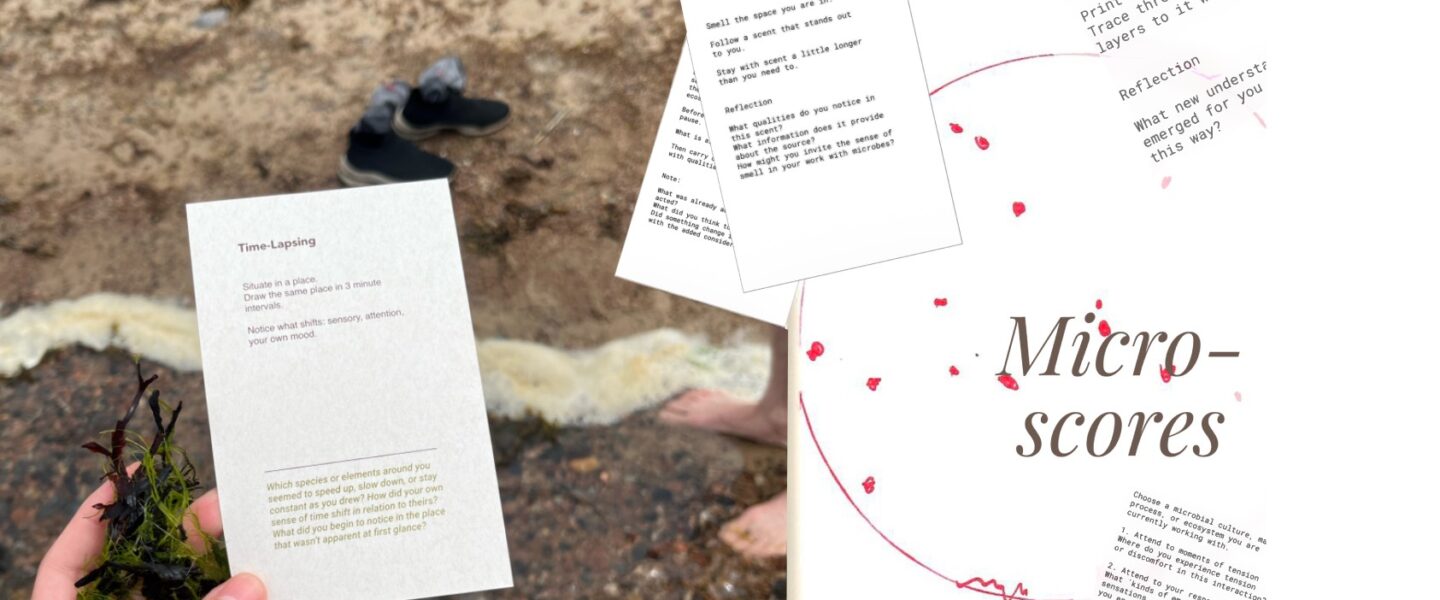
MicroScores marks Aman Asif’s second peer review event, where she experiments with scores and their potential as a method for practicing attunement in more-than-human encounters.
If a more-than-human design orientation highlights questions around who and what design attends to, then it also raises methodological questions for how we encounter and relate with/in more-than-human worlds. Attunement offers a useful way to think through this challenge. The process of attunement involves deep sensing with the body in order to become more aware of and responsive to other humans and nonhumans so that we can connect and nurture relationships. Practicing attunement then requires methods that engage the sensing body.
Aman explores this proposition through the development of MicroScores, a series of written scores and prompts developed around qualities of attunement such as creating bodily awareness, relational attention and multisensory engagement, alongside more playful provocations that might challenge habitual ways of engaging. For this case study, Aman tested the MicroScores approach with different groups, including designers, a public hiking group and scientists who have already established relationships with microbes through their research. She will discuss the affordances and challenges of the approach, as well as the fruitful tensions that came up when MicroScores were brought into a laboratory environment that has its own ethos and protocols for encountering microbes.
The case study considers both what the method of scoring might contribute to more-than-human design and what happens when creative methods travel across disciplinary boundaries. This question is increasingly relevant as collaborations between design, art, and science become more common in response to complex ecological challenges that call for interdisciplinary forms of knowledge exchange.