
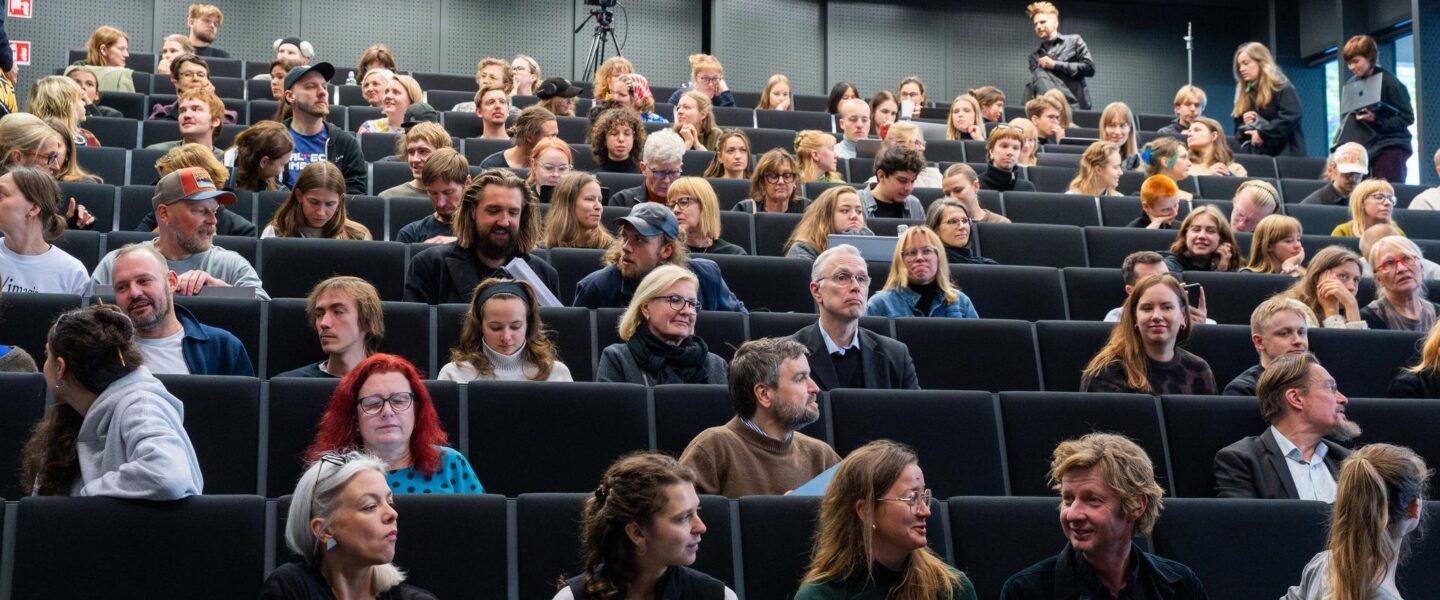
Photo: Paul Klooren
EKA, A101
Start Date:
02.04.2026
Start Time:
09:00
End Date:
02.04.2026
EKA Doctoral School Conference will take place on 2nd April 2026
Please register by 29th March.
Conference will be held in English.
PROGRAMME
08.40 Registration
09.00 Welcome by Prof. Linda Kaljundi (EKA Vice Rector for Research, Head of Doctoral School)
09.10 Opening Lecture
Moderator Prof. Linda Kaljundi
Dr. Anna Carolina Jensen “In-Between Chaos and Control”(EKA, postdoctoral researcher)
Abstract
In my talk I will present my doctoral thesis Encyclopedia of In-Betweenness: An Exploration of a Collective Artistic Research Practice (Aalto University, 2023) and my postdoctoral research project City Is the Thing Bodies and Time Move Through: Concrete Structures of In-Betweenness. While my doctoral thesis explored curating as a (collective) research method and through its form, encyclopedia, the multiplicity of networks and knowledges which constitute the practice, the postdoctoral research studies how environments, architectures, and leisure spaces perform, shape and structure historical layers, and in what ways does the past continue to haunt everyday life in the present. In my research I use Narva as a case study and perceive a city as a place that times and bodies, ideologies and societal systems move through, and consider methods and methodologies that happen in the space in-between chaos and control, knowledge and non-knowledge, language, translations and things and experiences that escape naming. By creating research situations that enable emergent events, practice-led artistic research embraces uncertainty as constitutive of knowledge, operating in the fertile tension between chaos and control, structure and openness.
Panel 1: Art History & Visual Culture
Moderator Prof. Andres Kurg
10.10 Rahul Sharma “Peripheral In-Between Identities on the Eastern Borderlands: Films of Eléonore de Montesquiou” (supervisors Dr. Mari Laanemets, Prof. Linda Kaljundi).
Abstract
The talk delves into liminal identity representations of the Russian-Estonian ethno-linguistic minority in works of the French-Estonian artist and documentary filmmaker Eléonore de Montesquiou (b. 1970), in particular focusing on Olga and Olga (2017) and Eksperiment Katja. (2020). I analyse how liminal border identities are affected by opposing notions of Euclidean and relational time-space, and the concept of the Möbius strip. Deploying close-textual analysis, I, then, analyse the formal characteristics of the films by close-reading the usage of cinematic apparatus and film processes to create varied layers of both bordered identities and the bordered spaces inhabited by the depicted characters. Finally, I reflect on de Montesquiou’s own ‘non-political subjectivised third-positionality’ via her gaze and epistemological construct that creates liminal and ambiguous layers of identities within her represented characters.
10.45 Mie Mortensen “A Philosophy of Sponges: The Influence of Ernst Haeckel on Ivan Leonidov” (supervisor Prof. Andres Kurg).
Abstract
Due to lack of description and information, Soviet architect Ivan Leonidov’s final project — a series of images with the alleged title City of the Sun (1942-59) — is often interpreted in the light of the eponymous novel by Tomasso Campanella. While this Renaissance philosopher was indeed important to the architect’s thinking, Leonidov drew his inspiration from a wide range of disciplines. This presentation explores the particular case of the German zoologist Ernst Haeckel’s work on marine invertebrates vis-a-vis the architect’s projects. Not only do Leonidov’s plans and drawings contain patterns resembling Haeckel’s illustrations, as I try to demonstrate as part of my dissertation, Leonidov’s philosophy of architecture can be said to mirror the German zoologist’s theories of ontogenesis.
11.20 Coffee break
11.40 Anneli Porri “How to Explain Pictures… to Ourselves?
Mediating the Artwork and Supporting Meaning-Making in Art History Education” (supervisor Prof. Linda Kaljundi).
Abstract
In art history teaching at the general education level, factual knowledge and the complexity of historical context often dominate. Within a multilayered and demanding visual–verbal learning situation, there is a risk of losing the personal, emotional, and cognitively demanding experience of encountering art that supports the construction of meaning. In my teaching practice, I am interested in how foundational knowledge of art history can be combined with creative interpretation so that, through open-ended questions, visual noticing, comparison, and justification, learning in both general and extracurricular art education can support learners’ personal meaning-making. In this presentation, I introduce an action research project conducted in an extracurricular art school. Based on observation, students’ creative work, and their feedback, the study explores which strategies of cognitive activation can be applied in art history education and how these strategies influence the participation, sense-making, and development of visual competence among students aged 13–17.
12.15 Marten Esko “The Contemporary as Method: Use, Abuse, and Critical Afterlife” (supervisor Prof. Virve Sarapik).
Abstract
The presentation examines the contemporary as a critical-theoretical concept and as a potential methodological problem. Over the past two decades, the contemporary has become a widely circulating framework in art history, cultural studies, literary criticism, and social theory. Initially introduced to challenge linear modernity and historicism and to conceptualize the temporal complexity of the present, the concept has, over time, become an imprecise and diffuse signifier rather than a more concretely defined one—particularly in the context of contemporary art. However, before considering the abandonment of the term, the presentation—drawing on the ideas of Giorgio Agamben, Zsuzsa Barossi, Jacob Lund, Peter Osborne, and Lionel Ruffel—proposes understanding contemporaneity as a method: as a critical, non-modern relationship to time that is attentive to the coexistence of multiple temporalities, histories and historicities. Understood in this way, the contemporary no longer functions as a periodizing label or a marker of temporal novelty, but rather as a potential diagnostic tool for the critical analysis of contemporary art.
12.50 Rahel Aerin Eslas “The Aesthetics of Nature in Denis Diderot’s Philosophy and Art Criticism” (supervisors Prof. Krista Kodres, Prof. Frédéric Ogée).
Abstract
Denis Diderot (1713–1784) was a philosopher and encyclopedist in Enlightenment France, who believed that nature should act as the lead example in all areas of society and culture. In my dissertation, I am researching the role of nature in Diderot’s aesthetics in his works on philosophy and art criticism. In my presentation, I will introduce a chapter from my dissertation, “Nature in Diderot’s Language of Criticism,” which looks at how nature influenced the artistic terminology used by Diderot. Diderot thought that an accurate imitation of nature should be the main achievement for all artists, as through this skill of studying and understanding nature, the artist will have the ability to enhance the perception and experience of it. This chapter points out and elaborates on the instances when an aspect of painting must adhere to nature’s laws, and when the artist needs to distance themselves from nature by enhancing the traits they observe.
13.25 Lunch
Panel 2: Art & Design
Moderator Dr. Jaana Päeva
14.00 Kadri Liis Rääk “The Artist’s Body as a Sensory Threshold” (supervisor Dr. Liina Unt).
Abstract
In this presentation, the artist’s body is positioned as a sensory threshold, a porous membrane between the self and the world. I examine how the creation-in-making process is structured and how to pinpoint the tactile place of origin of art. Through a shift in habitual patterns and a withdrawal into performative artistic ascesis, the practice resists demands for constant productivity and visibility. This becomes an incision into the nature of the creative process, in which agency shifts from a maker of objects toward a mediator of attention. The threshold state is proposed as a specific mode of being that addresses openness, vulnerability, and an attentive co-existence with the more-than-human, while working with resistance and uncertainty.
14.35 Taavi Varm “Co-creative video game creation as a practice of care” (supervisors Dr. Varvara Guljajeva, Dr. Helen Uusberg).
Abstract
My research examines how the co-creative video game creation process can function as a practice of care that supports psychological well-being. Well-being is approached not as a fixed outcome, but as something that emerges through creative processes and reflective engagement. By focusing on the co-creative process, the study examines how care is enacted through collaboration, decision-making, and attention to lived experience within the creative process itself. Looking at game creation as an artistic practice, explained through a case study in project EVA Lab, my main thesis in the talk is that psychological wellbeing and creative sustainability can be understood as an emergent quality of creative processes, rather than solely as a measurable outcome.
15.10 Eva Liisa Kubinyi “Wondering Pathways Toward Community-Based Service Designing from Rõuge” (supervisor Associate Prof. Josina Vink).
Abstract
The Dominant Service Design phenomenon overemphasis step-by-step procedures led by design experts. While community-based design approaches exist, these strategies overlook the everyday struggle of detaching from modernist design legacies. Without a clearer understanding of how to move toward community-based modalities, the profession risks erasing otherness. Drawing on a nine-month programmatic research-through-design project in South-Eastern Estonia, this paper conceptualizes wondering pathways—simultaneous yet contradictory movements toward community-based practices. This research contributes to service design by demonstrating multiple directions to community-based approaches and building compassion for messy in-between spaces of transformation. Moving toward community-based approaches requires ongoing openness to resisting dominant design practices that often reveal themselves gradually and through practice.
15.45 Aman Asif “Beyond the Visible Spectrum: Algal Entanglements” (supervisor Prof. Kärt Ojavee).
Abstract
Positioned within a more-than-human design framework, this research asks: how might designers attune to microbial others (algal) through creative practices to explore conditions and values for multispecies thriving? This presentation focuses on insights developed from practice-led research analysing my design works from the peer review exhibition Algal Phycosphere. The findings are grounded in reflection-on-action to surface methods and considerations that are relevant for practicing attunement to microbes and designing with living systems. The analysis was conducted on eleven design works using guided questions along with written reflections to identify key themes. The research contributes to relational approaches and developing ethics for multispecies thriving in more-than-human design contexts.
16.20 Coffee break
Panel 3: Architecture & Urban Planning
Moderator Dr. Eik Hermann
16.40 Alvin Järving “The Value-Space of Extending Building Lifespans: Locating Architectural Practice in a Conflicted Field” (supervisor Dr. Siim Tuksam).
Abstract
This paper articulates the value-space of extending building lifespans and opens up positioning architectural creative practice within an interdisciplinary field of longevity. Building longevity is not a singular concept but a contested domain where legal, constructional, cultural, and urban values intersect. Moreover, architecture and buildings are not synonymous: discourses on design, reuse, adaptation, and preservation overlap and often conflict within a broad conceptual field. Through a structured literature review, the paper systematizes key concepts, terms and ideas related to building lifespan across architecture and adjacent disciplines to a conceptual map. The framework clarifies how architects can locate their practice within this field and identify operative vectors of agency through design decisions.
17.15 Jaak-Adam Looveer “Urban Planning in the Comfort Zone: The Case of Tallinn” (supervisors Dr. Siim Tuksam, Dr. Priit-Kalev Parts).
17.50 Roundtable: Dr. Eik Hermann, Prof. Andres Kurg, Prof. Linda Kaljundi, Dr. Jaana Päeva
Contact:
Aljona Gineiko aljona.gineiko@artun.ee
Ragne Soosalu ragne.soosalu@artun.ee