
Teams link:
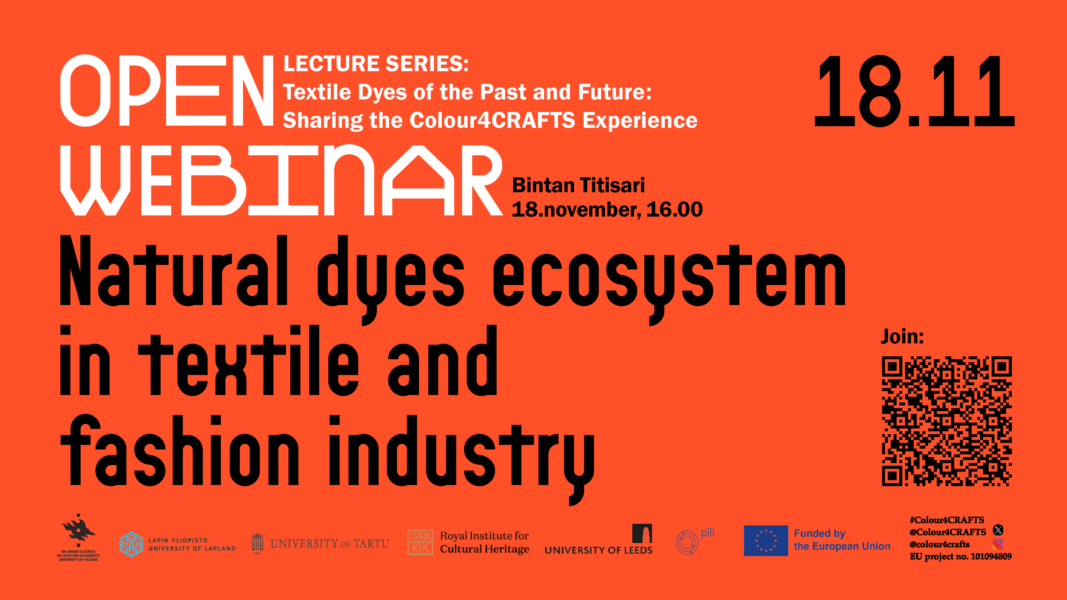
Bintan Titisari (Postdoctoral researcher, University of Leeds, Colour4CRAFTS)
“Natural dyes ecosystem in textile and fashion industry” (in English, online)
Description: Natural dyeing is one of the oldest traditions in European textiles, deeply tied to cultural heritage and local craftsmanship. Today, it is re-emerging as an important practice in the textile and fashion industries, extending from small workshops into larger-scale production. This lecture examines the broader ecosystem of natural dyes, exploring how they intersect with heritage, sustainability, design practice, and trend forecasting. The relationship between artisanal and industrial approaches can appear divided, yet each contributes valuable knowledge and innovation. By recognising these interconnections, we can better understand how natural dyes offer not only a link to tradition but also a pathway toward more sustainable and creative futures for fashion and textiles.
Bintan Titisari (PhD), University of Leeds, postdoctoral researcher. Bintan Titisari (PhD) is a postdoctoral researcher at the School of Design, University of Leeds. Her research interests are in the textile and fashion design industry, focusing on the interdisciplinary aspects of textile design, colourants, sustainable practices, and consumer behaviour. With over a decade of academic experience in Indonesia, Brunei, and the UK, she has taught and developed courses in sustainable fashion, craft design, resist dyeing, and smart textiles. In her textile-making practice, she combines natural dyes with the resist dyeing technique to create unique textiles. She is a member of the EU Horizon project Colour4CRAFTS.
–
The lecture is part of a series “Textile Dyes of the Past and Future: sharing the Colour4CRAFTS Experience” begins, initiated by the EU Horizon project Colour4CRAFTS.
The webinar series brings together EU Horizon project Colour4CRAFTS members and important guests to discuss and share their knowledge on textile dyes of the past and future. The series is brought together by the University of Tartu and Viljandi Culture Academy in collaboration with the Estonian Academy of Arts.
EU Horizon project Colour4CRAFTS combines a multidisciplinary team of experts from research institutes and R&D companies to carry out studies of bio-based textile colouration in traditional historic perspective and in combination with cutting-edge technologies of colourants biosynthesis and waterless applications techniques. Colour4CRAFTS members are the University of Helsinki, University of Lapland, University of Tartu, KIK-IRPA, University of Leeds and PILI Bio.