
Calendar
Ongoing
17.02.2026 — 12.03.2026
Preparatory Course for PhD Applicants 2026
Doctoral School invites candidates interested in applying to the creative research PhD at EKA to participate in a preparatory course.
Creative research (artistic and practice-based research) is rooted in the professional practice of artists, designers, and/or architects, generating new knowledge that takes shape both in creative practice (artwork, creative process, product, service, etc.) and in a written dissertation.
The course focuses on designing and developing a creative research project, introducing completed and ongoing doctoral dissertations. It also helps participants clarify how to connect their research problem, methods, and creative practice.
The course consists of four seminars and consultations. Seminars are led by Dr. Jaana Päeva, head of the art and design PhD program, and Dr. Liina Unt. In addition to the theoretical part, doctoral students with a background in art and design will present their ongoing research. In the consultation, applicants will receive individual feedback on their research project proposal.
NB! The course takes place on-site at EKA.
Preparatory course schedule:
17.02 17:45-19:15 A-302
Introduction to artistic and practice-based research.
18.02 17:45-19:15 A-403
Research problem and framework. Example of a practice-based research (Katrin Kabun).
25.02 17:45-19:15 A-403
Integrating theory and practice through research question and methods. Example of a practice-based research (Sofja Hallik).
26.02 17:45-19:15 A-202
Example of a practice-based research. Practitioner´s viewpoint (Jane Remm).
08.03 Deadline 08:00
Submitting research proposal drafts for consultations.
12.03 Individual consultations (Jaana Päeva, Liina Unt, Kristi Kuusk).
To participate, please send a short introduction (max 1.5 pages) to irene.hutsi@artun.ee by 12.02.2026. The text should address your motivation, previous experience and the potential topic of your research. The number of places is limited, the acceptance will be confirmed by 13.02.2026.
The course will be held in English.
Preparatory Course for PhD Applicants 2026
Tuesday 17 February, 2026 — Thursday 12 March, 2026
Doctoral SchoolDoctoral School invites candidates interested in applying to the creative research PhD at EKA to participate in a preparatory course.
Creative research (artistic and practice-based research) is rooted in the professional practice of artists, designers, and/or architects, generating new knowledge that takes shape both in creative practice (artwork, creative process, product, service, etc.) and in a written dissertation.
The course focuses on designing and developing a creative research project, introducing completed and ongoing doctoral dissertations. It also helps participants clarify how to connect their research problem, methods, and creative practice.
The course consists of four seminars and consultations. Seminars are led by Dr. Jaana Päeva, head of the art and design PhD program, and Dr. Liina Unt. In addition to the theoretical part, doctoral students with a background in art and design will present their ongoing research. In the consultation, applicants will receive individual feedback on their research project proposal.
NB! The course takes place on-site at EKA.
Preparatory course schedule:
17.02 17:45-19:15 A-302
Introduction to artistic and practice-based research.
18.02 17:45-19:15 A-403
Research problem and framework. Example of a practice-based research (Katrin Kabun).
25.02 17:45-19:15 A-403
Integrating theory and practice through research question and methods. Example of a practice-based research (Sofja Hallik).
26.02 17:45-19:15 A-202
Example of a practice-based research. Practitioner´s viewpoint (Jane Remm).
08.03 Deadline 08:00
Submitting research proposal drafts for consultations.
12.03 Individual consultations (Jaana Päeva, Liina Unt, Kristi Kuusk).
To participate, please send a short introduction (max 1.5 pages) to irene.hutsi@artun.ee by 12.02.2026. The text should address your motivation, previous experience and the potential topic of your research. The number of places is limited, the acceptance will be confirmed by 13.02.2026.
The course will be held in English.
05.02.2026 — 14.03.2026
Anu Jakobson’s Solo Exhibition “Downloads Folder”
Jakobson’s solo exhibition Downloads Folder creates a personal digital archive from random, hastily taken screenshots by preserving them on canvas.
The exhibition approaches painting as a way of remaining in continuous dialogue with a personal digital archive that was not originally intended for display. Through rapid circulation, the original purpose of downloaded files disappears; they persist more out of habit than meaning. The exhibition is concerned less with the images themselves than with their unsystematic accumulation and their slowing down through the act of being fixed in paint.
In a late-capitalist world oriented towards economic growth, productivity has become a sacred cow. Living within a constant flow of information, an ever-increasing pace of work, and social pressure demand more and more from us, without allowing time for reflection or interpretation. Transferring casually taken screenshots onto canvas is a conscious choice to slow down rather than rush, offering the possibility to organise what has been produced so far in a meaningful way and to take a pause.
The randomly selected images that form the basis of the paintings function as source material that is reworked through the artist’s process. The repetition of anonymous and temporary images through multiple layers of irony and subjectivity creates new images that no longer carry their former meaning and have lost their original, quickly consumable function.
Curator: Adrian Abner
Design: @gertworld
Anu Jakobson (b. 2005) is an Estonian visual artist currently in her second year of studies at the Estonian Academy of Arts. Her practice focuses on exploring online culture and its visual language, which she approaches through experimental painting methods, primarily using an airbrush. This technique allows her to capture the haziness and ephemerality characteristic of internet imagery. She works with images saved as screenshots from the internet and edits them according to her vision, in a way similar to how memes circulate, transferring this process onto the canvas. This method situates her work within the context of collective culture, as the circulation of memes reflects current events and broader value systems.
The exhibition is supported by the Cultural Endowment of Estonia.
Anu Jakobson’s Solo Exhibition “Downloads Folder”
Thursday 05 February, 2026 — Saturday 14 March, 2026
Faculty of Fine ArtsJakobson’s solo exhibition Downloads Folder creates a personal digital archive from random, hastily taken screenshots by preserving them on canvas.
The exhibition approaches painting as a way of remaining in continuous dialogue with a personal digital archive that was not originally intended for display. Through rapid circulation, the original purpose of downloaded files disappears; they persist more out of habit than meaning. The exhibition is concerned less with the images themselves than with their unsystematic accumulation and their slowing down through the act of being fixed in paint.
In a late-capitalist world oriented towards economic growth, productivity has become a sacred cow. Living within a constant flow of information, an ever-increasing pace of work, and social pressure demand more and more from us, without allowing time for reflection or interpretation. Transferring casually taken screenshots onto canvas is a conscious choice to slow down rather than rush, offering the possibility to organise what has been produced so far in a meaningful way and to take a pause.
The randomly selected images that form the basis of the paintings function as source material that is reworked through the artist’s process. The repetition of anonymous and temporary images through multiple layers of irony and subjectivity creates new images that no longer carry their former meaning and have lost their original, quickly consumable function.
Curator: Adrian Abner
Design: @gertworld
Anu Jakobson (b. 2005) is an Estonian visual artist currently in her second year of studies at the Estonian Academy of Arts. Her practice focuses on exploring online culture and its visual language, which she approaches through experimental painting methods, primarily using an airbrush. This technique allows her to capture the haziness and ephemerality characteristic of internet imagery. She works with images saved as screenshots from the internet and edits them according to her vision, in a way similar to how memes circulate, transferring this process onto the canvas. This method situates her work within the context of collective culture, as the circulation of memes reflects current events and broader value systems.
The exhibition is supported by the Cultural Endowment of Estonia.
10.03.2026 — 14.03.2026
Spacetuning. A Practice of Co-Becoming
I am my own space. I will be space for you, and you for me. We will gather in this room to offer ourselves and the other a space that listens and responds. We meet the challenge of embodying a practice that shapeshifts with the participants’ body-selves. To respond and be response-able. We are aware that bodies materialize – become – within relations, that the body and space share a story of formation. Space and body tune and tone one another, hold one another. What kind of space are we crafting here with our presences and engagements, for oneself and for others? Space is always an affective doing. We invite into play on the porous boundary of self and space, where the self-process becomes part of the we-process and the other way around (if and when did they become separated?). If you dare to open the surfaces of your cells, diverse body tones field into space, touch others and re-form the boundaries of our practice and inform what becomes emergent. I add a heightened squeal. Here, space can also ooze into you. Re-pattern you. If you decide to let it. What kind of space do you need for becoming…?
***
From March 10–14, ARS Art Factory Studios 98 and 53 will transform into inclusive spaces for embodied being and engagement. Daily somatic artistic research sessions focused on contemporary embodiment – Spacetuning. A Practice of Co-Becoming – are held and open for joining.
Spacetuning. A practice of co-becoming is the 2nd artistic research project of Joanna Kalm’s doctoral studies at Estonian Academy of Arts.
Rooted in body-based self- and other-perception, the practice brings attention to the materialization process of body-selves in relation to the environment and offers possibilities for alternate ways of co-becoming. The practice is embodied by dance artists Helina Karvak, Joanna Kalm, Nele Kotli, Laura Kvelstein, and Rasmus Stenager Jensen. Together, they take on the challenge of embodying a space that listens and responds, capable of transforming alongside the body-selves present.
The practice welcomes diverse forms of participation guided by an individual’s perception of the moment, while inviting awareness of one’s role as a witness, experiencer, and co-creator.
Schedule of practice room:
10.03 3pm open space*, 4-6pm practice, 6pm open space
11.03 3pm open space, 4-6pm practice, 6pm open space
12.03 11am open space, 12-2pm practice, 2pm break, 3pm open space, 4-6pm practice, 6pm open space
13.03 3pm open space, 4-6pm practice, 6pm open space
14.03 11am open space, 12-2pm practice, 2pm break, 3pm open space, 4-6pm practice, 6pm open space
*The room is open one hour before and after practice in support of calm and gradual arrival into embodied presence and the space, affording free time for being-engaging and for becoming acquainted with the surroundings.
Register your participation: https://fienta.com/et/o/5991
Spacetuning. A practice of co-becoming is based on somatic self- and other-awareness, supports embodied being-engagement and somatic sense-making, which in turn grounds the collaborative process of how the practice framework forms and is formed in relations. One of the key focuses of research and practice is response-ability – to one’s own process and to the group members as well as to spatial dynamics. Given that the body and the environment are co-emergent and in intra-active relationships, to what extent do we allow ourselves to truly participate in this co-becoming? Do we know how and dare to affect the becoming of the environment with our own processes? And to what extent is the environment (as a socio-material process) capable of considering and responding to the differences of its participants? Thus, this practice is an attempt to move beyond the invisible and silent boundary (is it real or habitual?) between oneself and space, where personal processes are kept within (to what extent is personal really personal?), and where the environment tends to perceive and respond only to a small extent. It is an attempt to move from embodied presence and awareness to engagement with – to inclusive action, response and co-becoming, where the body-self is more broadly involved.
Spacetuning. A practice of co-becoming is the 2nd artistic research project of Joanna Kalm’s doctoral studies at Estonian Academy of Arts. Kalm’s artistic research draws on somatic co- and self-regulation theory and is grounded in the organism’s capacity for self-organization—manifesting both at the level of the body-self and the group—with the aim of co-creating inclusive, body-based practices and spaces. One focus of the research is to examine the possible modes of materialization of the body-self, grounded in attentive somatic self-listening and the organically dynamic processes of the body-self (somatic agency). The second focus addresses the intra-active relationship between somatic embodiment and practice conceived (apparatus), asking: what kind of practice supports body-based co- and self-regulation, and how does creative somatic embodiment shape the functioning of practice and shared spaces? Kalm approaches somatic embodiment through posthumanist and new materialist philosophy, as well as through theories of cellular consciousness and organism-oriented ontology.
Spacetuning. A Practice of Co-Becoming
Tuesday 10 March, 2026 — Saturday 14 March, 2026
Doctoral SchoolI am my own space. I will be space for you, and you for me. We will gather in this room to offer ourselves and the other a space that listens and responds. We meet the challenge of embodying a practice that shapeshifts with the participants’ body-selves. To respond and be response-able. We are aware that bodies materialize – become – within relations, that the body and space share a story of formation. Space and body tune and tone one another, hold one another. What kind of space are we crafting here with our presences and engagements, for oneself and for others? Space is always an affective doing. We invite into play on the porous boundary of self and space, where the self-process becomes part of the we-process and the other way around (if and when did they become separated?). If you dare to open the surfaces of your cells, diverse body tones field into space, touch others and re-form the boundaries of our practice and inform what becomes emergent. I add a heightened squeal. Here, space can also ooze into you. Re-pattern you. If you decide to let it. What kind of space do you need for becoming…?
***
From March 10–14, ARS Art Factory Studios 98 and 53 will transform into inclusive spaces for embodied being and engagement. Daily somatic artistic research sessions focused on contemporary embodiment – Spacetuning. A Practice of Co-Becoming – are held and open for joining.
Spacetuning. A practice of co-becoming is the 2nd artistic research project of Joanna Kalm’s doctoral studies at Estonian Academy of Arts.
Rooted in body-based self- and other-perception, the practice brings attention to the materialization process of body-selves in relation to the environment and offers possibilities for alternate ways of co-becoming. The practice is embodied by dance artists Helina Karvak, Joanna Kalm, Nele Kotli, Laura Kvelstein, and Rasmus Stenager Jensen. Together, they take on the challenge of embodying a space that listens and responds, capable of transforming alongside the body-selves present.
The practice welcomes diverse forms of participation guided by an individual’s perception of the moment, while inviting awareness of one’s role as a witness, experiencer, and co-creator.
Schedule of practice room:
10.03 3pm open space*, 4-6pm practice, 6pm open space
11.03 3pm open space, 4-6pm practice, 6pm open space
12.03 11am open space, 12-2pm practice, 2pm break, 3pm open space, 4-6pm practice, 6pm open space
13.03 3pm open space, 4-6pm practice, 6pm open space
14.03 11am open space, 12-2pm practice, 2pm break, 3pm open space, 4-6pm practice, 6pm open space
*The room is open one hour before and after practice in support of calm and gradual arrival into embodied presence and the space, affording free time for being-engaging and for becoming acquainted with the surroundings.
Register your participation: https://fienta.com/et/o/5991
Spacetuning. A practice of co-becoming is based on somatic self- and other-awareness, supports embodied being-engagement and somatic sense-making, which in turn grounds the collaborative process of how the practice framework forms and is formed in relations. One of the key focuses of research and practice is response-ability – to one’s own process and to the group members as well as to spatial dynamics. Given that the body and the environment are co-emergent and in intra-active relationships, to what extent do we allow ourselves to truly participate in this co-becoming? Do we know how and dare to affect the becoming of the environment with our own processes? And to what extent is the environment (as a socio-material process) capable of considering and responding to the differences of its participants? Thus, this practice is an attempt to move beyond the invisible and silent boundary (is it real or habitual?) between oneself and space, where personal processes are kept within (to what extent is personal really personal?), and where the environment tends to perceive and respond only to a small extent. It is an attempt to move from embodied presence and awareness to engagement with – to inclusive action, response and co-becoming, where the body-self is more broadly involved.
Spacetuning. A practice of co-becoming is the 2nd artistic research project of Joanna Kalm’s doctoral studies at Estonian Academy of Arts. Kalm’s artistic research draws on somatic co- and self-regulation theory and is grounded in the organism’s capacity for self-organization—manifesting both at the level of the body-self and the group—with the aim of co-creating inclusive, body-based practices and spaces. One focus of the research is to examine the possible modes of materialization of the body-self, grounded in attentive somatic self-listening and the organically dynamic processes of the body-self (somatic agency). The second focus addresses the intra-active relationship between somatic embodiment and practice conceived (apparatus), asking: what kind of practice supports body-based co- and self-regulation, and how does creative somatic embodiment shape the functioning of practice and shared spaces? Kalm approaches somatic embodiment through posthumanist and new materialist philosophy, as well as through theories of cellular consciousness and organism-oriented ontology.
20.02.2026 — 22.03.2026
“Image Is for Illustrative Purposes Only” at EKA Gallery 21.02.–22.03.2026
“Image Is for Illustrative Purposes Only. Interventions in the Monumental Murals of the Old Airport Terminal’s Central Waiting Hall at Tallinn Airport”
EKA Gallery 21.02.–22.03.2026
Open Tue–Sat 12–6 pm Sun 12–4 pm, free entry (NB! EKA Gallery is closed on February 24.)
Opening: Friday, February 20 at 1 pm
Guided tour: Thursday, February 26 at 3.30 pm
What should be done with the legacy of totalitarian regimes? Should it be intervened in? And if so, in what circumstances – and how?
The exhibition grew out of a practical need to engage with two ideologically charged socialist realist monumental paintings in the old terminal of Tallinn Airport. One is View of Moscow by Viktor Karrus and the other View of Tallinn by Richard Sagrits (both 1955). In 2025, in cooperation with Tallinn Airport, a competition was held to create intervening artworks, but the winning proposal was ultimately not realised by decision of the commissioning body. For the exhibition, the paintings have been loaned to the Estonian Academy of Arts to present artists’ interventions in dialogue with the original works. Additional layers are revealed through archival materials related to the airport. After the exhibition, the painting will be given to the Art Museum of Estonia.
The exhibition has been created as part of “How to Reframe Monuments”, a collaborative project between the Estonian Academy of Arts and Tallinn University, funded by the Estonian Ministry of Culture.
Artists: Hanna Piksarv, Kati Saarits, Anna Škodenko, Sigrid Viir, Jevgeni Zolotko and Viktor Karrus, Richard Sagrits
Curators: Linda Kaljundi, Kirke Kangro
Curator of archival materials: Jarmo Kauge
Designer: Anna Škodenko
Technical support: Margus Elizarov, Erik Hõim, Ain Kilk, Priit Laanekivi, Oliver Kanniste, Madis Kaasik, Visa Nurmi, Sofia Schneider-Sepping, Mattias Veller
Graphic designer: Kristjan Mändmaa
Language editors: Phillip Marsdale, Hille Saluäär
Näituse töörühm: Merike Kallas, Taavi Tiidor, Annika Tiko, Maris Veeremäe
The exhibitions at EKA Gallery are supported by Tallinn City and Sadolin Estonia.
Opening drinks from mirai™ and Põhjala Brewery.
“Image Is for Illustrative Purposes Only” at EKA Gallery 21.02.–22.03.2026
Friday 20 February, 2026 — Sunday 22 March, 2026
Cultural Heritage and Conservation“Image Is for Illustrative Purposes Only. Interventions in the Monumental Murals of the Old Airport Terminal’s Central Waiting Hall at Tallinn Airport”
EKA Gallery 21.02.–22.03.2026
Open Tue–Sat 12–6 pm Sun 12–4 pm, free entry (NB! EKA Gallery is closed on February 24.)
Opening: Friday, February 20 at 1 pm
Guided tour: Thursday, February 26 at 3.30 pm
What should be done with the legacy of totalitarian regimes? Should it be intervened in? And if so, in what circumstances – and how?
The exhibition grew out of a practical need to engage with two ideologically charged socialist realist monumental paintings in the old terminal of Tallinn Airport. One is View of Moscow by Viktor Karrus and the other View of Tallinn by Richard Sagrits (both 1955). In 2025, in cooperation with Tallinn Airport, a competition was held to create intervening artworks, but the winning proposal was ultimately not realised by decision of the commissioning body. For the exhibition, the paintings have been loaned to the Estonian Academy of Arts to present artists’ interventions in dialogue with the original works. Additional layers are revealed through archival materials related to the airport. After the exhibition, the painting will be given to the Art Museum of Estonia.
The exhibition has been created as part of “How to Reframe Monuments”, a collaborative project between the Estonian Academy of Arts and Tallinn University, funded by the Estonian Ministry of Culture.
Artists: Hanna Piksarv, Kati Saarits, Anna Škodenko, Sigrid Viir, Jevgeni Zolotko and Viktor Karrus, Richard Sagrits
Curators: Linda Kaljundi, Kirke Kangro
Curator of archival materials: Jarmo Kauge
Designer: Anna Škodenko
Technical support: Margus Elizarov, Erik Hõim, Ain Kilk, Priit Laanekivi, Oliver Kanniste, Madis Kaasik, Visa Nurmi, Sofia Schneider-Sepping, Mattias Veller
Graphic designer: Kristjan Mändmaa
Language editors: Phillip Marsdale, Hille Saluäär
Näituse töörühm: Merike Kallas, Taavi Tiidor, Annika Tiko, Maris Veeremäe
The exhibitions at EKA Gallery are supported by Tallinn City and Sadolin Estonia.
Opening drinks from mirai™ and Põhjala Brewery.
25.02.2026 — 22.03.2026
Animation short films at the EKA Gallery video booth 25.02.–22.03.2026
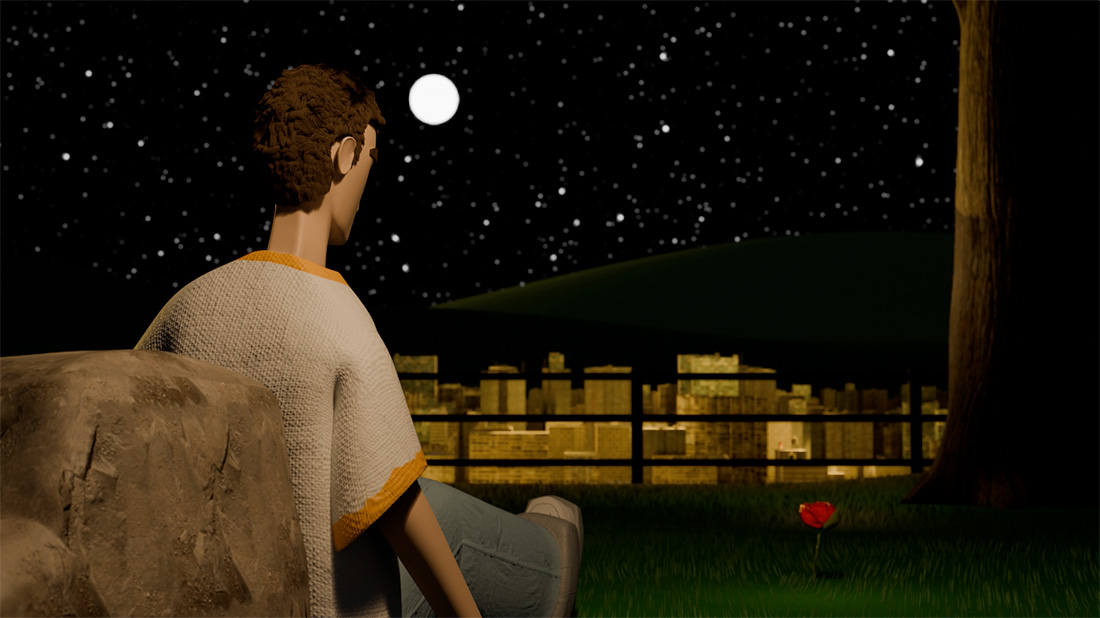
Short films developed in 3D and puppet animation techniques by the 2nd year students of animation
EKA Gallery video booth 25.02.–22.03.2026
Open Tue–Sat 12–6 pm Sun 12–4 pm, free of charge
The films present intriguing characters, relatable situations, inner dialogues, beauty and absurdity. Quite literally, they take the viewer on a journey from outer space to a drop of water, from the macro world to the micro world. It is especially fascinating to observe how different techniques influence one another. Digital and material spaces enter into dialogue through form, texture, rhythm and atmosphere.
Step into the cinema space and allow yourself to be carried into the worlds created by these emerging filmmakers.
Participants: Paolo D’Angelo, Ailin Budõlina, Kätri Jaaguman, Maibrit Kaur, Aleksandra Nikolajeva, Tobias Oblikas, Karl Erik Pajo, El Soosalu
3D course supervisor: Hleb Kuftseryn
Supervisors of the puppet animation course: Anu-Laura Tuttelberg and Francesco Rosso.
Screened films:
- “Fiore (Flower)” (3D) by Paolo D’Angelo
- “Tangled Senses” (Puppet film) Maibrit Kaur, Aleksandra Nikolajeva
- “Creature Therapy” (3D) by Maibrit Kaur and Aleksandra Nikolajeva
- “A Nail in the Table” (3D) by Karl Erik Pajo
- “Pain Killer” (Puppet film) by Paolo D’Angelo, Tobias Oblikas
- “Still Raining” (3D) by Tobias Oblikas
- “One More Time” (Puppet film) El Soosalu, Kätri Jaaguman
- “Lost and Found” (3D) by El Soosalu and Kätri Jaaguman
- “Inner Wolf” (Puppet film) Karl Erik Pajo, Ailin Budõlina
The total duration of the films is 21 minutes.
Animation short films at the EKA Gallery video booth 25.02.–22.03.2026
Wednesday 25 February, 2026 — Sunday 22 March, 2026
AnimationShort films developed in 3D and puppet animation techniques by the 2nd year students of animation
EKA Gallery video booth 25.02.–22.03.2026
Open Tue–Sat 12–6 pm Sun 12–4 pm, free of charge
The films present intriguing characters, relatable situations, inner dialogues, beauty and absurdity. Quite literally, they take the viewer on a journey from outer space to a drop of water, from the macro world to the micro world. It is especially fascinating to observe how different techniques influence one another. Digital and material spaces enter into dialogue through form, texture, rhythm and atmosphere.
Step into the cinema space and allow yourself to be carried into the worlds created by these emerging filmmakers.
Participants: Paolo D’Angelo, Ailin Budõlina, Kätri Jaaguman, Maibrit Kaur, Aleksandra Nikolajeva, Tobias Oblikas, Karl Erik Pajo, El Soosalu
3D course supervisor: Hleb Kuftseryn
Supervisors of the puppet animation course: Anu-Laura Tuttelberg and Francesco Rosso.
Screened films:
- “Fiore (Flower)” (3D) by Paolo D’Angelo
- “Tangled Senses” (Puppet film) Maibrit Kaur, Aleksandra Nikolajeva
- “Creature Therapy” (3D) by Maibrit Kaur and Aleksandra Nikolajeva
- “A Nail in the Table” (3D) by Karl Erik Pajo
- “Pain Killer” (Puppet film) by Paolo D’Angelo, Tobias Oblikas
- “Still Raining” (3D) by Tobias Oblikas
- “One More Time” (Puppet film) El Soosalu, Kätri Jaaguman
- “Lost and Found” (3D) by El Soosalu and Kätri Jaaguman
- “Inner Wolf” (Puppet film) Karl Erik Pajo, Ailin Budõlina
The total duration of the films is 21 minutes.
06.03.2026 — 22.03.2026
Young Sculptor Prize Exhibition 2026 | Metamorphosis
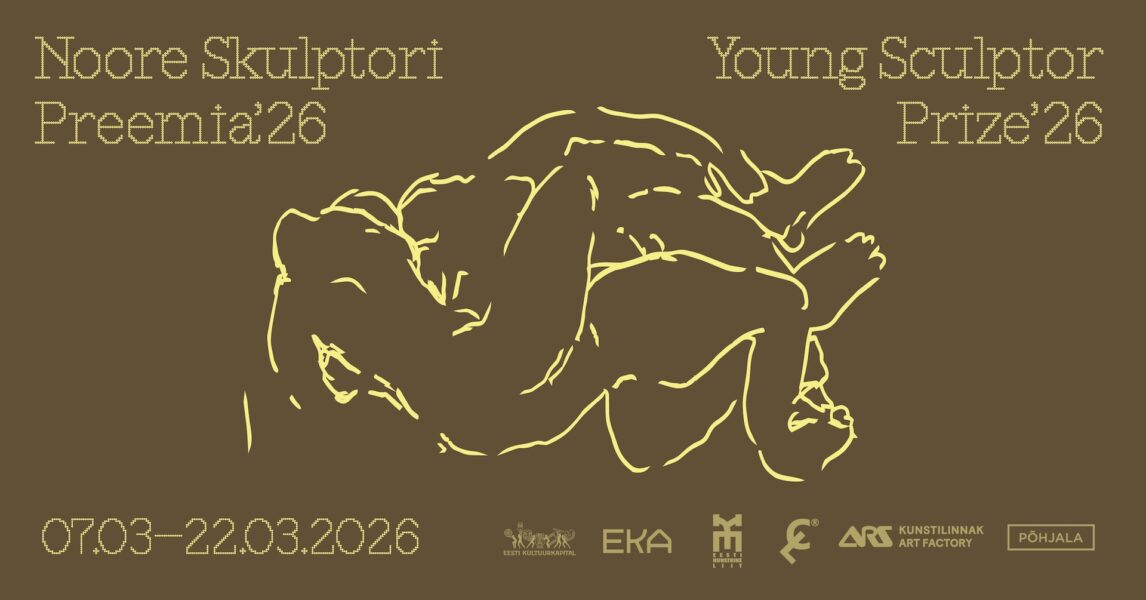
Artists: Rover Indigo Bertels-Andréa, Þórey Björk Halldórsdóttir, Denis Kudrjašov, Ivor Mikker, Daniil Musesovs, Elise Marie Olesk, Kertu Rannula, Lotta Karoliina Räsänen, Éric-Olivier Thériault, Kail Timusk, Lume Tuum, Elo Vahtrik, Ats-Anton Varustin, Maria Wrang-Rasmussen
Metamorphosis – simultaneous disintegration and formation; melting, bending, flowing, estrangement from function.
Emerging sculpture explores transformation, transitions, and continuous, uncertain in-between states – in the body, in material, and in space. Traditional techniques and materials encounter synthetic, industrial, and technological elements, generating tension between the organic and the artificial, the rural and the urban, the past and the present.
The works address questions of perception and adaptation: how to find direction in fog, in subterranean layers, or within internal transformations? How do we orient ourselves in a world where the visible is no longer the primary source of knowledge? Can disintegration and fading serve as prerequisites for creation and becoming? What role do ritual, tradition, and vanishing skills play in a technologically charged everyday life? Where does the body end and the environment begin – or does such a boundary still exist?
Established in 2012, the award aims to highlight and recognize emerging sculptors and installation artists currently pursuing their studies. The exhibition presents works created during the 2025/26 academic year by the 14 shortlisted artists. The exhibition is organized by the Sculpture and Installation Department of the Estonian Academy of Arts. A Grand Prix as well as second and third prizes will be awarded.
The exhibition is open to visitors at ARS Project Space from 7–22 March, 12:00–18:00. At the opening of NSPN on 6 March at 4:00 PM, the Grand Prix as well as the 2nd and 3rd prizes will be awarded. A special prize will also be presented by the Estonian Association of Young Contemporary Art.
Exhibition team: Laura Põld, Kirke Kangro, Taavi Talve, Visa Nurmi, Eva Mahhov
Supported by: Estonian Cultural Endowment, Estonian Academy of Arts, Estonian Artists’ Association, Põhjala, Vaskjala Creative Residency
Special thanks: Kunst.ee magazine, ARS Project Space
Young Sculptor Prize Exhibition 2026 | Metamorphosis
Friday 06 March, 2026 — Sunday 22 March, 2026
Faculty of Fine ArtsArtists: Rover Indigo Bertels-Andréa, Þórey Björk Halldórsdóttir, Denis Kudrjašov, Ivor Mikker, Daniil Musesovs, Elise Marie Olesk, Kertu Rannula, Lotta Karoliina Räsänen, Éric-Olivier Thériault, Kail Timusk, Lume Tuum, Elo Vahtrik, Ats-Anton Varustin, Maria Wrang-Rasmussen
Metamorphosis – simultaneous disintegration and formation; melting, bending, flowing, estrangement from function.
Emerging sculpture explores transformation, transitions, and continuous, uncertain in-between states – in the body, in material, and in space. Traditional techniques and materials encounter synthetic, industrial, and technological elements, generating tension between the organic and the artificial, the rural and the urban, the past and the present.
The works address questions of perception and adaptation: how to find direction in fog, in subterranean layers, or within internal transformations? How do we orient ourselves in a world where the visible is no longer the primary source of knowledge? Can disintegration and fading serve as prerequisites for creation and becoming? What role do ritual, tradition, and vanishing skills play in a technologically charged everyday life? Where does the body end and the environment begin – or does such a boundary still exist?
Established in 2012, the award aims to highlight and recognize emerging sculptors and installation artists currently pursuing their studies. The exhibition presents works created during the 2025/26 academic year by the 14 shortlisted artists. The exhibition is organized by the Sculpture and Installation Department of the Estonian Academy of Arts. A Grand Prix as well as second and third prizes will be awarded.
The exhibition is open to visitors at ARS Project Space from 7–22 March, 12:00–18:00. At the opening of NSPN on 6 March at 4:00 PM, the Grand Prix as well as the 2nd and 3rd prizes will be awarded. A special prize will also be presented by the Estonian Association of Young Contemporary Art.
Exhibition team: Laura Põld, Kirke Kangro, Taavi Talve, Visa Nurmi, Eva Mahhov
Supported by: Estonian Cultural Endowment, Estonian Academy of Arts, Estonian Artists’ Association, Põhjala, Vaskjala Creative Residency
Special thanks: Kunst.ee magazine, ARS Project Space
29.01.2026 — 28.03.2026
Birgit Kaleva, Keiu Maasik, Mark Raidpere “Greetings from Kanepi! Wish U Were Here”
On Thursday, 29 January at 6 PM, we will open the exhibition Greetings from Kanepi! Wish u were here by Birgit Kaleva, Keiu Maasik and Mark Raidpere at FOKU gallery.
A father’s diary from the 60s, postcards from Kanepi, Colin McRae Rally 2.0. Abstracted movements, run down household appliances, a ghost car. Driftwood Songs, a spider plant, a life stored in virtuality.
The works of Birgit Kaleva, Keiu Maasik and Mark Raidpere open up insights into the stories of family lines, or rather into fragments or excerpts of these stories. The (auto)biographical is intertwined with fiction, perhaps we cannot know for certain what is based on real life and what is imaginary – and maybe it doesn’t matter either.
In Birgit Kaleva’s photo series Weizenbergi 51 (2025), we see views of the artist’s birthplace in Kanepi – a parish in South Estonia – where she still lives with her parents. To work through the shame that stems from living with her parents, Kaleva directs her gaze to the space around her instead of hanging her head in embarassment. Keiu Maasik’s video work A Ghost Story (2022) tells the story of a son and father that took place in an old rally game. A story where after his father’s death, the son at some point found his father’s ghost car in the game – a seemingly living part of his father stored in virtuality. Mark Raidpere’s video Lachrimae/Driftwood Songs (2017) combines abstracted movements with the longing diaries of a young man written in the 1960s, Tõnu Kõrvits’s arrangement Driftwood Songs and seven tears, e.g John Dowland’s Lachrimae from the late 16th century.
The title of the exhibition is borrowed from the accompanying text of Birgit Kaleva’s work Weizenbergi 51 (2025).
The exhibition will remain open until 28 March 2026.
Birgit Kaleva (b. 1996), working under the artist name motoerotica, uses herself and her immediate surroundings as the basis of her artistic practice. Through a spontaneous and angular approach, she reframes autobiographical material, creating distance from personal experience and offering a clearer perspective on its underlying structures. Her work is informed by an interest in visual rawness and awkwardness in unexpected compositions. Kaleva graduated from the Pallas University of Applied Sciences with a degree in Photography (2024).
Keiu Maasik (b. 1992) has degrees in Photography (BA) and Contemporary Art (MA) from the Estonian Academy of Arts. In her work, she has explored themes such as the impact of documentation on memory, identity and interpersonal relationships. In her recent projects, Maasik has focused on the virtual world, using computer game recordings or similar aesthetics in her video works and installations to reveal the different aspects of virtual life. She is one of the nominees of the Köler Prize 2026.
Mark Raidpere (b. 1975) is a photographer and video artist, exploring the dilemmas and fears of the human soul, insurmountable loneliness and the tragedy of fate with great sensitivity and insight. Raidpere’s research often draws on his family’s universe, but sometimes takes on a social dimension, focusing on the marginalized, urban violence and street life. In 2005, Raidpere represented Estonia at the 51st Venice Biennale. His works have been exhibited in numerous international group and solo exhibitions and he has received several prestigious awards both in Estonia and abroad.
FOKU Gallery is a gallery-showroom focused on contemporary lens-based art. FOKU Gallery is run by the Estonian Union of Photography Artists (FOKU).
Supporters:
Cultural Endowment of Estonia, Peenjoogivabrik Nudist
Partner:
Rüki galerii
Technical support:
Reigo Nahksepp
Thanks to:
Artproof, EKA Gallery, Estonian Artists’ Association, Karel Koplimets, Kaisa Maasik-Koplimets, Madis Kurss, Tõnu Kõrvits
Birgit Kaleva, Keiu Maasik, Mark Raidpere “Greetings from Kanepi! Wish U Were Here”
Thursday 29 January, 2026 — Saturday 28 March, 2026
Faculty of Fine ArtsOn Thursday, 29 January at 6 PM, we will open the exhibition Greetings from Kanepi! Wish u were here by Birgit Kaleva, Keiu Maasik and Mark Raidpere at FOKU gallery.
A father’s diary from the 60s, postcards from Kanepi, Colin McRae Rally 2.0. Abstracted movements, run down household appliances, a ghost car. Driftwood Songs, a spider plant, a life stored in virtuality.
The works of Birgit Kaleva, Keiu Maasik and Mark Raidpere open up insights into the stories of family lines, or rather into fragments or excerpts of these stories. The (auto)biographical is intertwined with fiction, perhaps we cannot know for certain what is based on real life and what is imaginary – and maybe it doesn’t matter either.
In Birgit Kaleva’s photo series Weizenbergi 51 (2025), we see views of the artist’s birthplace in Kanepi – a parish in South Estonia – where she still lives with her parents. To work through the shame that stems from living with her parents, Kaleva directs her gaze to the space around her instead of hanging her head in embarassment. Keiu Maasik’s video work A Ghost Story (2022) tells the story of a son and father that took place in an old rally game. A story where after his father’s death, the son at some point found his father’s ghost car in the game – a seemingly living part of his father stored in virtuality. Mark Raidpere’s video Lachrimae/Driftwood Songs (2017) combines abstracted movements with the longing diaries of a young man written in the 1960s, Tõnu Kõrvits’s arrangement Driftwood Songs and seven tears, e.g John Dowland’s Lachrimae from the late 16th century.
The title of the exhibition is borrowed from the accompanying text of Birgit Kaleva’s work Weizenbergi 51 (2025).
The exhibition will remain open until 28 March 2026.
Birgit Kaleva (b. 1996), working under the artist name motoerotica, uses herself and her immediate surroundings as the basis of her artistic practice. Through a spontaneous and angular approach, she reframes autobiographical material, creating distance from personal experience and offering a clearer perspective on its underlying structures. Her work is informed by an interest in visual rawness and awkwardness in unexpected compositions. Kaleva graduated from the Pallas University of Applied Sciences with a degree in Photography (2024).
Keiu Maasik (b. 1992) has degrees in Photography (BA) and Contemporary Art (MA) from the Estonian Academy of Arts. In her work, she has explored themes such as the impact of documentation on memory, identity and interpersonal relationships. In her recent projects, Maasik has focused on the virtual world, using computer game recordings or similar aesthetics in her video works and installations to reveal the different aspects of virtual life. She is one of the nominees of the Köler Prize 2026.
Mark Raidpere (b. 1975) is a photographer and video artist, exploring the dilemmas and fears of the human soul, insurmountable loneliness and the tragedy of fate with great sensitivity and insight. Raidpere’s research often draws on his family’s universe, but sometimes takes on a social dimension, focusing on the marginalized, urban violence and street life. In 2005, Raidpere represented Estonia at the 51st Venice Biennale. His works have been exhibited in numerous international group and solo exhibitions and he has received several prestigious awards both in Estonia and abroad.
FOKU Gallery is a gallery-showroom focused on contemporary lens-based art. FOKU Gallery is run by the Estonian Union of Photography Artists (FOKU).
Supporters:
Cultural Endowment of Estonia, Peenjoogivabrik Nudist
Partner:
Rüki galerii
Technical support:
Reigo Nahksepp
Thanks to:
Artproof, EKA Gallery, Estonian Artists’ Association, Karel Koplimets, Kaisa Maasik-Koplimets, Madis Kurss, Tõnu Kõrvits
01.03.2026 — 31.03.2026
Natalia Mirzoyan’s exhibition “Winter in March”
On March 1st, Natalia Mirzoyan’s exhibition “Winter in March” will be opened in Telliskivi Container Gallery.
The art exhibition Winter in March is inspired by the short animated film Winter in March, created at the Estonian Academy of Arts and produced by film studio Rebel Frame. The film premiered at the Cannes Film Festival in May 2025 and has since won nearly twenty international awards at animation and film festivals around the world. It also received the Estonian Cultural Endowment’s annual award for Best Animated Film of 2025.
The exhibition expands the poetic and political world created in the film, exploring helplessness and existential fear experienced by individuals living under a repressive regime. The film tells the true story of a young couple from St. Petersburg, Kirill and Dasha. Russia’s invasion of Ukraine shakes their lives. Dasha finds the strength to protest, while Kirill withdraws into himself, sinking deeper and deeper into depression. They decide to leave their homeland and set off for Georgia. The journey is metaphysical the train travels along the Russian-Ukrainian border, where the landscape outside the window is filled with symbols of war. Meanwhile, fellow passengers behave as if nothing is happening. Through snowstorms and fear, the most painful moment arrives at the border: will they be allowed to continue? Although they eventually reach Georgia, their greatest fear catches up with them in another way — from an unexpected place.
The exhibition offers visitors the opportunity to immerse themselves in this world of imagery and emotional associations. The space is designed as a journey, leading the viewer from intimate memory fragments into a broader political and poetic dimension. The aim of the exhibition is to create an immersive experience that connects the film and the exhibition into one whole. It is also important to provide the audience with an opportunity to perceive the personal and collective experiences of war, repression, and migration, and thereby initiate discussion about democracy, memory, and resistance.
Artist Natalia Mirzoyan
Curator Santa Zukker
Artist Team: Rebecca Kruus, Alexander Toodu, Kadi Rebane, Annaliisa Lepik, Katrina Oll, Marina Hirv, Dashka Dementeva, Saskia Sikk
Natalia Mirzoyan’s exhibition “Winter in March”
Sunday 01 March, 2026 — Tuesday 31 March, 2026
AnimationOn March 1st, Natalia Mirzoyan’s exhibition “Winter in March” will be opened in Telliskivi Container Gallery.
The art exhibition Winter in March is inspired by the short animated film Winter in March, created at the Estonian Academy of Arts and produced by film studio Rebel Frame. The film premiered at the Cannes Film Festival in May 2025 and has since won nearly twenty international awards at animation and film festivals around the world. It also received the Estonian Cultural Endowment’s annual award for Best Animated Film of 2025.
The exhibition expands the poetic and political world created in the film, exploring helplessness and existential fear experienced by individuals living under a repressive regime. The film tells the true story of a young couple from St. Petersburg, Kirill and Dasha. Russia’s invasion of Ukraine shakes their lives. Dasha finds the strength to protest, while Kirill withdraws into himself, sinking deeper and deeper into depression. They decide to leave their homeland and set off for Georgia. The journey is metaphysical the train travels along the Russian-Ukrainian border, where the landscape outside the window is filled with symbols of war. Meanwhile, fellow passengers behave as if nothing is happening. Through snowstorms and fear, the most painful moment arrives at the border: will they be allowed to continue? Although they eventually reach Georgia, their greatest fear catches up with them in another way — from an unexpected place.
The exhibition offers visitors the opportunity to immerse themselves in this world of imagery and emotional associations. The space is designed as a journey, leading the viewer from intimate memory fragments into a broader political and poetic dimension. The aim of the exhibition is to create an immersive experience that connects the film and the exhibition into one whole. It is also important to provide the audience with an opportunity to perceive the personal and collective experiences of war, repression, and migration, and thereby initiate discussion about democracy, memory, and resistance.
Artist Natalia Mirzoyan
Curator Santa Zukker
Artist Team: Rebecca Kruus, Alexander Toodu, Kadi Rebane, Annaliisa Lepik, Katrina Oll, Marina Hirv, Dashka Dementeva, Saskia Sikk
04.03.2026 — 31.03.2026
Katariin Mudist “Temporary Solution”
5–31 March 2026
On Wednesday, 4 March at 18:00, Katariin Mudist’s exhibition “Temporary Solution”(Ajutine lahendus) will open at ARS Showcase Gallery.
“Temporary Solution” brings together doorholders collected from various institutions, mainly from Estonia’s cultural field. Doorholders are born out of necessity: something needs to be held open for a moment, something needs to be let through. Yet a temporary solution tends to become permanent without anyone noticing. In this way, an accidental form and material can become surprisingly universal.
The exhibition focuses on small moments of annoyance: when your bike tyre is flat again; when you forget your towel, but discover it at the gym; when you have to return the shirt you ordered; when the internet keeps buffering during a film; when someone explains something you already know; when, at the grocery store, the line you chose is the slowest, or when the doorholder is missing. This annoyance is a minor disturbance that, through repetition, begins to shape attention, movement, and one’s attitude toward space. A door has been kept open for years with the help of an apparently insignificant piece of material. But one day, arms full of things, that familiar wooden block is no longer there. There is a brief delay and mild irritation: something else is quickly found as a substitute, the door is held open again, and work continues. The moment passes and is very likely forgotten immediately.
Over the course of a year, the collected doorholders have held open different kinds of doors (main entrances, side doors, back doors, etc.) and operate according to different principles: as a wedge, as a threshold stopper, or as weight. What unites these objects is that they come from institutions where doors are not merely architectural elements but tools of access and work organisation. Doorholders are small, unofficial spatial interventions that make movement smoother and signal for whom a space “works. ” Removing them and gathering them into one room reveals a layer of temporary solutions on which institutional space quietly depends.
The door to the exhibition is always (temporarily) open.
Katariin Mudist is an interdisciplinary Estonian artist who believes that the most telling things are often those that usually remain behind the door. She is interested in small annoyances that arise, for example, when a door refuses to cooperate- whether it’s an automatic door that won’t open or a missing doorstop. Humour and irony run through her practice. She examines social norms and the practices and meanings of being an artist within the context of the cultural field and its institutions, using material and process-based approaches. She is currently studying in the Fine Arts Studio programme at the Estonian Academy of Arts, searching for common ground between visual and material-centred art. Mudist holds an MA in Contemporary Art (EKA, 2022) and a BA in Media and Advertising Design (Pallas University of Applied Sciences, 2018). She has received the Adamson-Eric Scholarship (2025) and the Young Sculptor Award (2025). In 2026, together with Keithy Kuuspu, she received the main prize of the Visual and Applied Arts Endowment for the exhibition “Unfortunately, You Were Not Selected This Time” (2025) and the performative Awards Gala (2025).
Exhibition team:
Exhibition design and production assistance: Alden Jõgisuu
Graphic design: Katariin Mudist
Supporters: Punch Club, Põhjala, Estonian Artists’ Association
Special thanks: Alan Voodla, Johanna Mudist, Eva Nava, Keithy Kuuspu, Maria Elise
Remme, Helena Pass, and all the institutions from which the collected doorholders originate.
Exhibition open:
5–31 March 2026
Mon–Fri 12–18, Sat 12–16
Katariin Mudist “Temporary Solution”
Wednesday 04 March, 2026 — Tuesday 31 March, 2026
Contemporary Art5–31 March 2026
On Wednesday, 4 March at 18:00, Katariin Mudist’s exhibition “Temporary Solution”(Ajutine lahendus) will open at ARS Showcase Gallery.
“Temporary Solution” brings together doorholders collected from various institutions, mainly from Estonia’s cultural field. Doorholders are born out of necessity: something needs to be held open for a moment, something needs to be let through. Yet a temporary solution tends to become permanent without anyone noticing. In this way, an accidental form and material can become surprisingly universal.
The exhibition focuses on small moments of annoyance: when your bike tyre is flat again; when you forget your towel, but discover it at the gym; when you have to return the shirt you ordered; when the internet keeps buffering during a film; when someone explains something you already know; when, at the grocery store, the line you chose is the slowest, or when the doorholder is missing. This annoyance is a minor disturbance that, through repetition, begins to shape attention, movement, and one’s attitude toward space. A door has been kept open for years with the help of an apparently insignificant piece of material. But one day, arms full of things, that familiar wooden block is no longer there. There is a brief delay and mild irritation: something else is quickly found as a substitute, the door is held open again, and work continues. The moment passes and is very likely forgotten immediately.
Over the course of a year, the collected doorholders have held open different kinds of doors (main entrances, side doors, back doors, etc.) and operate according to different principles: as a wedge, as a threshold stopper, or as weight. What unites these objects is that they come from institutions where doors are not merely architectural elements but tools of access and work organisation. Doorholders are small, unofficial spatial interventions that make movement smoother and signal for whom a space “works. ” Removing them and gathering them into one room reveals a layer of temporary solutions on which institutional space quietly depends.
The door to the exhibition is always (temporarily) open.
Katariin Mudist is an interdisciplinary Estonian artist who believes that the most telling things are often those that usually remain behind the door. She is interested in small annoyances that arise, for example, when a door refuses to cooperate- whether it’s an automatic door that won’t open or a missing doorstop. Humour and irony run through her practice. She examines social norms and the practices and meanings of being an artist within the context of the cultural field and its institutions, using material and process-based approaches. She is currently studying in the Fine Arts Studio programme at the Estonian Academy of Arts, searching for common ground between visual and material-centred art. Mudist holds an MA in Contemporary Art (EKA, 2022) and a BA in Media and Advertising Design (Pallas University of Applied Sciences, 2018). She has received the Adamson-Eric Scholarship (2025) and the Young Sculptor Award (2025). In 2026, together with Keithy Kuuspu, she received the main prize of the Visual and Applied Arts Endowment for the exhibition “Unfortunately, You Were Not Selected This Time” (2025) and the performative Awards Gala (2025).
Exhibition team:
Exhibition design and production assistance: Alden Jõgisuu
Graphic design: Katariin Mudist
Supporters: Punch Club, Põhjala, Estonian Artists’ Association
Special thanks: Alan Voodla, Johanna Mudist, Eva Nava, Keithy Kuuspu, Maria Elise
Remme, Helena Pass, and all the institutions from which the collected doorholders originate.
Exhibition open:
5–31 March 2026
Mon–Fri 12–18, Sat 12–16
31.10.2025 — 01.04.2026
Exhibition “Abandoned Landscapes: Joaveski Paper Factory”
We are opening the exhibition “Abandoned Landscapes. Joaveski Paper Factory” on October 31st at 3:00 PM at the Joaveski Community Center, at Lahemaa.
The exhibition presents projects and models by students of the EKA Architecture and Urban Design curriculum, which explore how to value and revitalize the historic Joaveski paper factory.
The Estonian Academy of Arts’ Faculty of Architecture and the Department of Heritage Protection and Conservation organized the interdisciplinary “Abandoned Landscapes” workshop for the fourteenth time at the beginning of this year, where efforts are being made to find modern solutions for disused building complexes. This year’s workshop, professional studio and exhibition were created in collaboration with the Joaveski Village NPO, which has taken it upon itself to value the abandoned paper factory as a landmark.
The authors of the completed projects are now 3rd year architecture and urban design students: Maria Johanna Ahtijainen, Oskar Toomet-Björck, Elisabeth Ersling, Nele Lisette Hera, Heidi Jagus, Katariina Klammer, Eliis Kurvits, Lilian Källo, Lisandra Lipp, Marie Elle Melioranski, Mark Metsa, Mart Nael, Joonas Ott, Elenor Pihlak, Harriet Piirmets, Robin Pints, Elisabeth Tomingas, Katariina Vaher, Aliis Vatku, Martin Vatku.
The projects were supervised by architects Joel Kopli, Koit Ojaliiv and Juhan Rohtla from the architectural office KUU, advised by LCA consultant Anni Oviir, and the landscape architecture section was supervised by Katrin Koov and Arvi Anderson. Andres Õis welcomed and introduced the history of Joaveski.
The exhibition is supported by MTÜ Joaveski küla and AS Maru.
The exhibition will remain open at the Joaveski community center during library opening hours until April 1, 2026. Open Monday and Friday 9:00 – 16:00 and Wednesday 11:00 – 15:00.
About the history of the Joaveski factory
The construction of the Joaveski cardboard factory began in 1899 and is a vivid example of how the feudal Loobu manor adapted to the new capitalist economic environment at the end of the 19th century, which resulted in the establishment of an industrial enterprise. Joaveski developed into a small industrial village in a place of natural beauty. Today, a hydroelectric power plant operates at the heart of the factory, but most of the rooms have lost their purpose.
Exhibition “Abandoned Landscapes: Joaveski Paper Factory”
Friday 31 October, 2025 — Wednesday 01 April, 2026
Architecture and Urban DesignWe are opening the exhibition “Abandoned Landscapes. Joaveski Paper Factory” on October 31st at 3:00 PM at the Joaveski Community Center, at Lahemaa.
The exhibition presents projects and models by students of the EKA Architecture and Urban Design curriculum, which explore how to value and revitalize the historic Joaveski paper factory.
The Estonian Academy of Arts’ Faculty of Architecture and the Department of Heritage Protection and Conservation organized the interdisciplinary “Abandoned Landscapes” workshop for the fourteenth time at the beginning of this year, where efforts are being made to find modern solutions for disused building complexes. This year’s workshop, professional studio and exhibition were created in collaboration with the Joaveski Village NPO, which has taken it upon itself to value the abandoned paper factory as a landmark.
The authors of the completed projects are now 3rd year architecture and urban design students: Maria Johanna Ahtijainen, Oskar Toomet-Björck, Elisabeth Ersling, Nele Lisette Hera, Heidi Jagus, Katariina Klammer, Eliis Kurvits, Lilian Källo, Lisandra Lipp, Marie Elle Melioranski, Mark Metsa, Mart Nael, Joonas Ott, Elenor Pihlak, Harriet Piirmets, Robin Pints, Elisabeth Tomingas, Katariina Vaher, Aliis Vatku, Martin Vatku.
The projects were supervised by architects Joel Kopli, Koit Ojaliiv and Juhan Rohtla from the architectural office KUU, advised by LCA consultant Anni Oviir, and the landscape architecture section was supervised by Katrin Koov and Arvi Anderson. Andres Õis welcomed and introduced the history of Joaveski.
The exhibition is supported by MTÜ Joaveski küla and AS Maru.
The exhibition will remain open at the Joaveski community center during library opening hours until April 1, 2026. Open Monday and Friday 9:00 – 16:00 and Wednesday 11:00 – 15:00.
About the history of the Joaveski factory
The construction of the Joaveski cardboard factory began in 1899 and is a vivid example of how the feudal Loobu manor adapted to the new capitalist economic environment at the end of the 19th century, which resulted in the establishment of an industrial enterprise. Joaveski developed into a small industrial village in a place of natural beauty. Today, a hydroelectric power plant operates at the heart of the factory, but most of the rooms have lost their purpose.
16.01.2026 — 05.04.2026
Mari Männa and Maria Erikson “Imprint of Vulnerability”
You are warmly invited to the opening of the exhibition Imprint of Vulnerability on Friday, 16 January at 6 pm at Tallinn City Gallery.
The joint exhibition by Mari Männa and Maria Erikson approaches material as an active participant. Fragility and delicacy operate here as working methods: form emerges through cracking, breaking, and acts of care. Drying, deformation, and the formation of imprints are not deviations or failures, but part of a process through which material remembers, transforms, and shapes its own rhythm. The exhibition is curated by Madli Ljutjuk.
“Imprint of Vulnerability approaches fertility beyond biological or gender-defined terms. Here, fertility is understood as an existential condition: the capacity to change, to be receptive, and to remain within uncertainty. The exhibition invites viewers to experience fragility and delicacy not as weakness, but as sources of vitality and renewal, fostering a sense of connection to a bodily, cyclical understanding of life,” explains curator Madli Ljutjuk.
Working together for the first time, the artists approach the same question from different angles. In Männa’s works, a logic of emergence unfolds: the world is born from disintegration and transitional states in which life has not yet settled into its final form. Erikson begins with the wound – the moment when a surface is opened and forced to remember. For both artists, form is not an end point but a temporary condition, something still in the process of becoming.
Through sculptural and printmaking processes, the exhibition reveals how form emerges where something is broken or unfinished. Cracking, drying, imprinting, and deformation do not signify rupture, but a generative dynamic. The exhibition speaks of two modes of becoming – emergence and the wound – as different manifestations of the same process.
The exhibition is set against a world in which fixed boundaries are dissolving. The human no longer stands at the centre, but exists as one participant among bodies and materials in an entangled network. In such a world, fertility becomes receptivity – the ability to remain open even when the outcome is uncertain. Imprint of Vulnerability invites us to slow down and notice how life emerges precisely through interruption.
The exhibition will remain open until 5 April 2026.
Mari Männa and Maria Erikson “Imprint of Vulnerability”
Friday 16 January, 2026 — Sunday 05 April, 2026
Faculty of Fine ArtsYou are warmly invited to the opening of the exhibition Imprint of Vulnerability on Friday, 16 January at 6 pm at Tallinn City Gallery.
The joint exhibition by Mari Männa and Maria Erikson approaches material as an active participant. Fragility and delicacy operate here as working methods: form emerges through cracking, breaking, and acts of care. Drying, deformation, and the formation of imprints are not deviations or failures, but part of a process through which material remembers, transforms, and shapes its own rhythm. The exhibition is curated by Madli Ljutjuk.
“Imprint of Vulnerability approaches fertility beyond biological or gender-defined terms. Here, fertility is understood as an existential condition: the capacity to change, to be receptive, and to remain within uncertainty. The exhibition invites viewers to experience fragility and delicacy not as weakness, but as sources of vitality and renewal, fostering a sense of connection to a bodily, cyclical understanding of life,” explains curator Madli Ljutjuk.
Working together for the first time, the artists approach the same question from different angles. In Männa’s works, a logic of emergence unfolds: the world is born from disintegration and transitional states in which life has not yet settled into its final form. Erikson begins with the wound – the moment when a surface is opened and forced to remember. For both artists, form is not an end point but a temporary condition, something still in the process of becoming.
Through sculptural and printmaking processes, the exhibition reveals how form emerges where something is broken or unfinished. Cracking, drying, imprinting, and deformation do not signify rupture, but a generative dynamic. The exhibition speaks of two modes of becoming – emergence and the wound – as different manifestations of the same process.
The exhibition is set against a world in which fixed boundaries are dissolving. The human no longer stands at the centre, but exists as one participant among bodies and materials in an entangled network. In such a world, fertility becomes receptivity – the ability to remain open even when the outcome is uncertain. Imprint of Vulnerability invites us to slow down and notice how life emerges precisely through interruption.
The exhibition will remain open until 5 April 2026.
05.03.2026 — 12.04.2026
Jana Ribkina, Irmak Semiz “Soovikaev”
“To feel the pull of desire is to feel the presence of absence.”
-Anne Carson, “Eros The Bitterweet”
It was the gods’ punishment to separate the whole being into two, condemned to fit the chase of our ideal fullness into one lifetime — and pathetically, we turn back to gods to show us the ways we can be united again. Some say this love belongs only to gods themselves. Still, we defy that notion treacherously, and we face whatever form of divinity we believe in, to plea:
“I wish.”
To wish is to indulge in the lack. The lover does not only wish for the ephemeral sense of fulfillment, but eventually wishing itself serves to satisfy the lover’s hunger. The wish transforms into the sustenance and our appetite refuses to act as a form of weakness, but as devotion.
The exhibition “The Wishing Well” is simultaneously a practice ground and a receipt of reverence. Light a candle, throw a coin, count the petals and make your wish.
opening 05.03.2026 at 6PM
06.03. – 12.04.2026
open Wed-Sun 12.00-18.00
KETT gallery / Aparaaditehas, Kastani 42, Tartu
Irmak Semiz (b. 1997, Istanbul) is a multidisciplinary artist living in Tallinn, currently pursuing a master’s degree in contemporary art at the Estonian Academy of Arts. Working primarily through sculpture, installation, and animation, their practice focuses on expressing contradictory identities, decisions, and emotional states, processed through the lens of humor, connection, and myth-making.
Jana Ribkina (b. 1995, Riga) is a multidisciplinary artist living and working in Riga. Working primarily with ceramics, textiles, and illustration, she explores reflections from her daily life through a playful approach, while drawing inspiration from folklore and fantasy. Her work seeks to weave the personal and the mythical into one continuous thread.
Graphic design: Paul Graßler
The exhibition is supported by the City of Tartu and the Cultural Endowment of Estonia.
Jana Ribkina, Irmak Semiz “Soovikaev”
Thursday 05 March, 2026 — Sunday 12 April, 2026
Contemporary Art“To feel the pull of desire is to feel the presence of absence.”
-Anne Carson, “Eros The Bitterweet”
It was the gods’ punishment to separate the whole being into two, condemned to fit the chase of our ideal fullness into one lifetime — and pathetically, we turn back to gods to show us the ways we can be united again. Some say this love belongs only to gods themselves. Still, we defy that notion treacherously, and we face whatever form of divinity we believe in, to plea:
“I wish.”
To wish is to indulge in the lack. The lover does not only wish for the ephemeral sense of fulfillment, but eventually wishing itself serves to satisfy the lover’s hunger. The wish transforms into the sustenance and our appetite refuses to act as a form of weakness, but as devotion.
The exhibition “The Wishing Well” is simultaneously a practice ground and a receipt of reverence. Light a candle, throw a coin, count the petals and make your wish.
opening 05.03.2026 at 6PM
06.03. – 12.04.2026
open Wed-Sun 12.00-18.00
KETT gallery / Aparaaditehas, Kastani 42, Tartu
Irmak Semiz (b. 1997, Istanbul) is a multidisciplinary artist living in Tallinn, currently pursuing a master’s degree in contemporary art at the Estonian Academy of Arts. Working primarily through sculpture, installation, and animation, their practice focuses on expressing contradictory identities, decisions, and emotional states, processed through the lens of humor, connection, and myth-making.
Jana Ribkina (b. 1995, Riga) is a multidisciplinary artist living and working in Riga. Working primarily with ceramics, textiles, and illustration, she explores reflections from her daily life through a playful approach, while drawing inspiration from folklore and fantasy. Her work seeks to weave the personal and the mythical into one continuous thread.
Graphic design: Paul Graßler
The exhibition is supported by the City of Tartu and the Cultural Endowment of Estonia.
06.03.2026 — 15.05.2026
Estonian Academy of Arts Graphic Art Department Exhibition: “Artists’ Books”
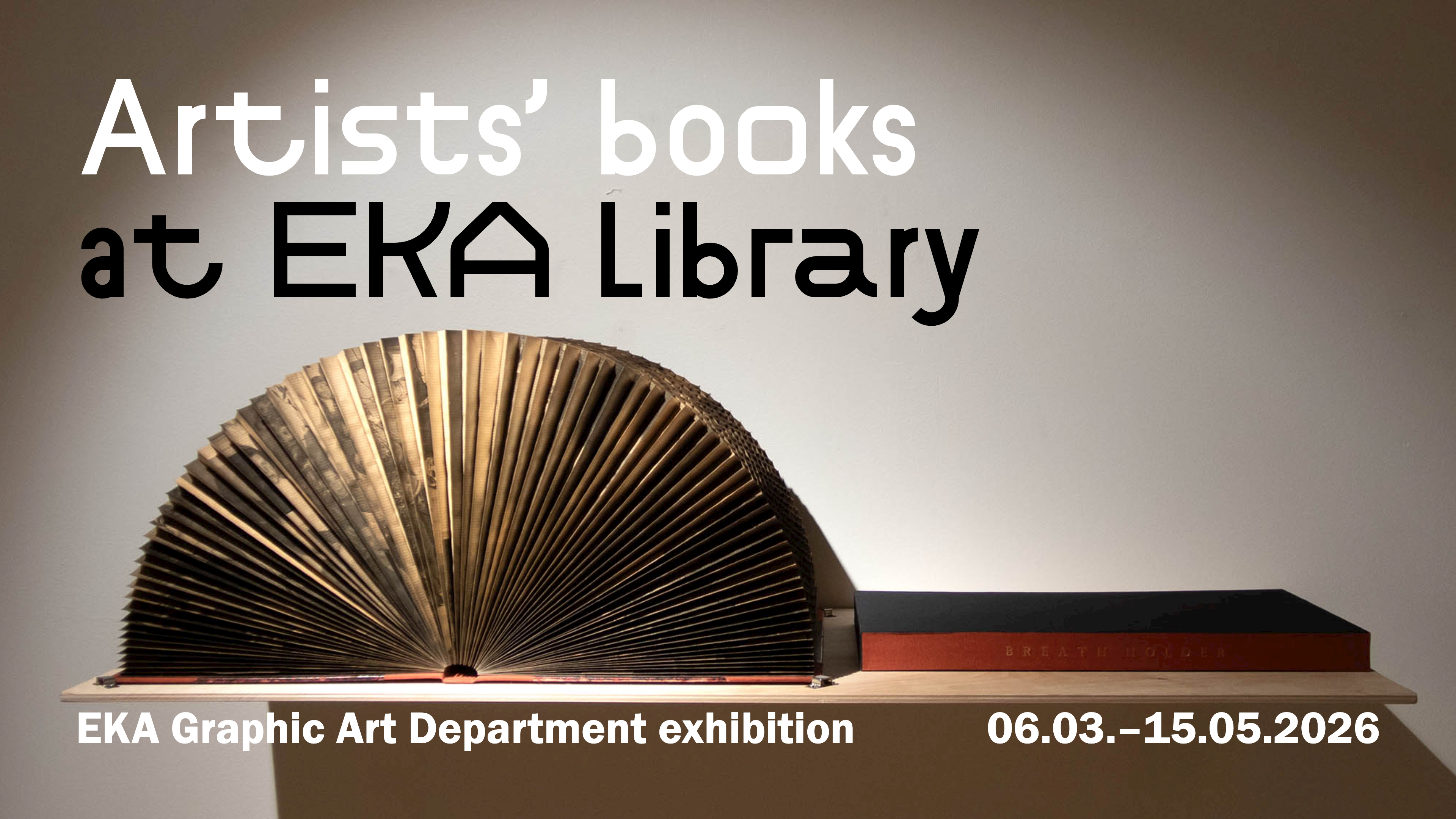
3rd-year Graphic Art students are showcasing the artists’ book as an independent medium of visual art and an original artwork. The authors draw from personal experiences and memories, exploring themes of physicality, history, and ethical boundaries:
- Aliisa Ahtiainen presents a grandfather’s life story in risography and a “breathing” book inspired by her grandmother’s experience in a tuberculosis sanatorium.
- Jacqueline-Desiree Rosenthal exhibits a piece made of tattooed pigskin rawhide, raising questions about morality and the parallels between animals and humans.
- Olga Dubrovskaja utilizes her background as an intensive care doctor to explore the experience of death through her own and her colleagues’ perspectives. In her second book titled “Delight”, she focuses on the moments of life.
- Adriana Jinmao Biosca Sánchez examines the volatility of memory through materiality and layers of printing.
- Robin August Vöörmann deals with gender identity, drawing parallels with changes in nature.
Supervisors: Eve Kask, Eve Kaaret (binding) and Viktor Gurov.
Exhibition dates: 6.03.–15.05.2025
Estonian Academy of Arts Graphic Art Department Exhibition: “Artists’ Books”
Friday 06 March, 2026 — Friday 15 May, 2026
Graphic Art3rd-year Graphic Art students are showcasing the artists’ book as an independent medium of visual art and an original artwork. The authors draw from personal experiences and memories, exploring themes of physicality, history, and ethical boundaries:
- Aliisa Ahtiainen presents a grandfather’s life story in risography and a “breathing” book inspired by her grandmother’s experience in a tuberculosis sanatorium.
- Jacqueline-Desiree Rosenthal exhibits a piece made of tattooed pigskin rawhide, raising questions about morality and the parallels between animals and humans.
- Olga Dubrovskaja utilizes her background as an intensive care doctor to explore the experience of death through her own and her colleagues’ perspectives. In her second book titled “Delight”, she focuses on the moments of life.
- Adriana Jinmao Biosca Sánchez examines the volatility of memory through materiality and layers of printing.
- Robin August Vöörmann deals with gender identity, drawing parallels with changes in nature.
Supervisors: Eve Kask, Eve Kaaret (binding) and Viktor Gurov.
Exhibition dates: 6.03.–15.05.2025
06.03.2026 — 15.05.2026
EKA Print Exchange exhibition Looking Forward to Hearing From You
EKA library, 6.03.–15.05.2026
Dear friend,
It has been a long time since we last heard from you. Last time we spoke, you were working on some prints in the graphic arts workshop with a roller in your hand and ink on your fingers. How is it going? We would love to see some trials or progress pictures. At the moment we are also in the process of doing some tests. I have added a sample in the envelope. Check it out and tell us what you think!
Let’s keep in touch.
The exhibition shows works from the EKA Print Exchange project initiated by the department of Graphic Art at the Estonian Academy of Arts. Printmaking students from different universities were invited to take part and submit an original print edition. Each print was shipped to Tallinn, sorted and sent back to participants, so everyone received a random selection of ten prints.
The vision of this project was to create new connections between printmaking departments and students through collaboration and sharing physical works. So, we wrote to our penpals and were curious what students of other universities were up to. Depictions of current ideas, projects or any experiments were warmly welcomed as a response.
Four universities participated in the exchange: Estonian Academy of Arts (EKA),
Oslo National Academy of the Arts (KHiO), University of the West of England (UWE), The Eugeniusz Geppert Academy of Art and Design in Wrocław.
Exhibitions of the Print Exchange have taken place at the universities participating in the exchange, and the first presentation in Estonia took place in June-July 2025 at the TYPA Balcony Gallery in Tartu.
We would like to thank EKA graafika, TYPA, Anna Kodź, Aleksandra Janik and Angie Butler.
Organisers of the EKA Print Exchange: Alona Chuprina, Margarita Feofanova, Chantal Gerschuetz, Merit Himmelreich, Triin Mänd, Helena Pass, Marten Prei, Sandra Puusepp and our supervisor Charlotte Biszewski.
Exhibition design at the EKA library: Sandra Puusepp and Marten Prei.
EKA Print Exchange exhibition Looking Forward to Hearing From You
Friday 06 March, 2026 — Friday 15 May, 2026
Graphic ArtEKA library, 6.03.–15.05.2026
Dear friend,
It has been a long time since we last heard from you. Last time we spoke, you were working on some prints in the graphic arts workshop with a roller in your hand and ink on your fingers. How is it going? We would love to see some trials or progress pictures. At the moment we are also in the process of doing some tests. I have added a sample in the envelope. Check it out and tell us what you think!
Let’s keep in touch.
The exhibition shows works from the EKA Print Exchange project initiated by the department of Graphic Art at the Estonian Academy of Arts. Printmaking students from different universities were invited to take part and submit an original print edition. Each print was shipped to Tallinn, sorted and sent back to participants, so everyone received a random selection of ten prints.
The vision of this project was to create new connections between printmaking departments and students through collaboration and sharing physical works. So, we wrote to our penpals and were curious what students of other universities were up to. Depictions of current ideas, projects or any experiments were warmly welcomed as a response.
Four universities participated in the exchange: Estonian Academy of Arts (EKA),
Oslo National Academy of the Arts (KHiO), University of the West of England (UWE), The Eugeniusz Geppert Academy of Art and Design in Wrocław.
Exhibitions of the Print Exchange have taken place at the universities participating in the exchange, and the first presentation in Estonia took place in June-July 2025 at the TYPA Balcony Gallery in Tartu.
We would like to thank EKA graafika, TYPA, Anna Kodź, Aleksandra Janik and Angie Butler.
Organisers of the EKA Print Exchange: Alona Chuprina, Margarita Feofanova, Chantal Gerschuetz, Merit Himmelreich, Triin Mänd, Helena Pass, Marten Prei, Sandra Puusepp and our supervisor Charlotte Biszewski.
Exhibition design at the EKA library: Sandra Puusepp and Marten Prei.
16.02.2026 — 17.05.2026
“Dancing with the Stars!” EKA Billboard Gallery 16.02.–17.05.2026
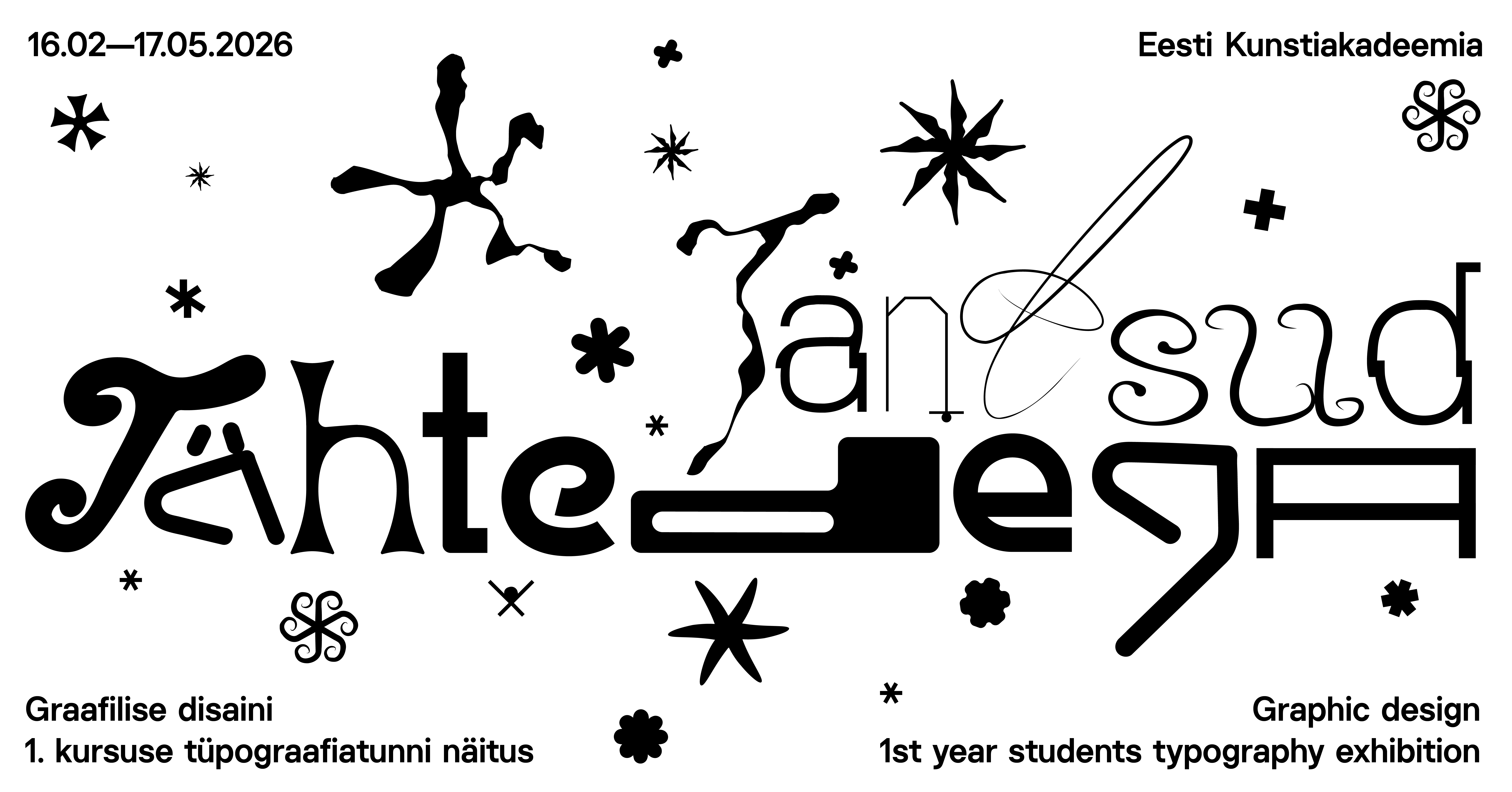
DANCING WITH THE STARS!
EKA Billboard Gallery 16.02.–17.05.2026
Open 24/7, free admission
The exhibition “Dancing with the Stars!” by the 1st year students of graphic design showcases the designed letters and the process of the class Typography I. During 14 weeks, several exercises and experimentations were carried out, drawing was done both by hand and on the computer, using things like stencils, feathers, rocks, nail polish or even keys.
While the first seven weeks were dedicated to experimentation and playing, the last seven focused on creating an entire alphabet and going through the whole letter design process. Vectorised letters were created which in turn were made into working font files during a week-long workshop.
Students: Johannes Adrik, Art Allik, Helen Forsel, Mia Klooren, Art Kruus, Adele Markova, Ischa Mestdagh, Jaako Lauri Puudist, Ann Aotäht Sarv, Mia Greta Sepp,Ariana Sigin, Linnea Süvari, Jakob Tüür, Karol Henrik Vana, Rei Helin Varres
Supervisor: Agnes Isabelle Veevo
Supervisor of the workshop: Patrick Zavadskis
The fonts can be downloaded for free from the SUVA Type Foundry website: suvatypefoundry.ee
SUVA Type Foundry makes the typefaces designed by EKA GD students public.
“Dancing with the Stars!” EKA Billboard Gallery 16.02.–17.05.2026
Monday 16 February, 2026 — Sunday 17 May, 2026
Graphic DesignDANCING WITH THE STARS!
EKA Billboard Gallery 16.02.–17.05.2026
Open 24/7, free admission
The exhibition “Dancing with the Stars!” by the 1st year students of graphic design showcases the designed letters and the process of the class Typography I. During 14 weeks, several exercises and experimentations were carried out, drawing was done both by hand and on the computer, using things like stencils, feathers, rocks, nail polish or even keys.
While the first seven weeks were dedicated to experimentation and playing, the last seven focused on creating an entire alphabet and going through the whole letter design process. Vectorised letters were created which in turn were made into working font files during a week-long workshop.
Students: Johannes Adrik, Art Allik, Helen Forsel, Mia Klooren, Art Kruus, Adele Markova, Ischa Mestdagh, Jaako Lauri Puudist, Ann Aotäht Sarv, Mia Greta Sepp,Ariana Sigin, Linnea Süvari, Jakob Tüür, Karol Henrik Vana, Rei Helin Varres
Supervisor: Agnes Isabelle Veevo
Supervisor of the workshop: Patrick Zavadskis
The fonts can be downloaded for free from the SUVA Type Foundry website: suvatypefoundry.ee
SUVA Type Foundry makes the typefaces designed by EKA GD students public.
Future
12.03.2026
Open Architecture Lecture: Eero Paloheimo
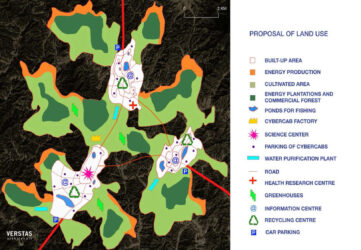
On March 12 at 6 pm, Finnish engineer, scientist and environmental researcher Eero Paloheimo will give a special lecture “Ecological city planning” in the EKA auditorium.
Eero Kalervo Paloheimo has defended his doctoral theses at the University of Munich and the University of Helsinki.
He worked at the company Eero Paloheimo & Matti Ollila from 1965 to 1994, and then was a professor (timber construction) at the Helsinki University of Technology from 1995 to 2000. In 2009, Paloheimo founded Eero Paloheimo EcoCity Ltd., a company specializing in the research and construction of eco-cities.
As a researcher of environmental problems and sustainable development opportunities, Paloheimo has traveled throughout Europe, Africa and Asia. Since 2007, he has consulted on the establishment of eco-cities in China, based on the ideas he originally presented in his book “Syntymättötien sukupolvien Eurooppa” (1996, in Estonian 2004 ). He has also repeatedly introduced the possibilities of establishing eco-cities in Estonia.
Paloheimo served as a representative of the Green Party Vihreä Liitto in the Finnish Parliament from 1987 to 1995 and has been a member of several authoritative international committees dealing with environmental problems.
He is the author of more than ten books on the nature and state of the world.
The lecture will be held in English and is free and open to all interested parties.
On March 12 at 6 pm, Finnish engineer, scientist and environmental researcher Eero Paloheimo will give a special lecture “Ecological city planning” in the EKA auditorium.
Eero Kalervo Paloheimo has defended his doctoral theses at the University of Munich and the University of Helsinki.
He worked at the company Eero Paloheimo & Matti Ollila from 1965 to 1994, and then was a professor (timber construction) at the Helsinki University of Technology from 1995 to 2000. In 2009, Paloheimo founded Eero Paloheimo EcoCity Ltd., a company specializing in the research and construction of eco-cities.
As a researcher of environmental problems and sustainable development opportunities, Paloheimo has traveled throughout Europe, Africa and Asia. Since 2007, he has consulted on the establishment of eco-cities in China, based on the ideas he originally presented in his book “Syntymättötien sukupolvien Eurooppa” (1996, in Estonian 2004 ). He has also repeatedly introduced the possibilities of establishing eco-cities in Estonia.
Paloheimo served as a representative of the Green Party Vihreä Liitto in the Finnish Parliament from 1987 to 1995 and has been a member of several authoritative international committees dealing with environmental problems.
He is the author of more than ten books on the nature and state of the world.
The lecture will be held in English and is free and open to all interested parties.
18.03.2026
Peer-review of Kristina Norman’s performance “The Dew Point”
Kristina Norman invites audiences to the English-language version of her performance The Dew Point at Kanuti Gildi Saal on 18 and 19 March at 19:30. The performance on 18 March will be followed by a public pre-review of the work as part of the artist’s doctoral project, provisionally titled Making strategic entanglements and inhabiting heterotopia within creative practice as research.
Reviewers: Victoria Donovan and Madli Pesti
Doctoral supervisor: Dr. Linda Kaljundi (Estonian Academy of Arts)
The central question of Norman’s research concerns the emancipatory potential of strategically interweaving life stories and spaces as a structure-generating method within her artistic practice. In her doctoral work, Norman aims to analyse and conceptualize how these entanglements of spaces and voices emerge and are activated through creative-practice-as-research, and how they contribute to the deconstruction and decolonization of existing narratives and environments.
The performance The Dew Point was developed around the concept of liminality, which has been extended to spatial and built environments, geographical contexts, everyday and historical experiences and practices, as well as collective historical memory. In this work, Norman employs the entanglement of testimonies and spaces connected to wars and militarism as a method for examining the enduring presence of Soviet militarism and its intergenerational impact.
Against the backdrop of ongoing and accelerating militarization, the piece explores the potential for creating shared sites of memory within a divided society by bringing together spatial environments and voices from different memory communities.
More information about the performance and tickets: https://saal.ee/en/performance/the-dew-point-2006/
Peer-review of Kristina Norman’s performance “The Dew Point”
Wednesday 18 March, 2026
Doctoral SchoolKristina Norman invites audiences to the English-language version of her performance The Dew Point at Kanuti Gildi Saal on 18 and 19 March at 19:30. The performance on 18 March will be followed by a public pre-review of the work as part of the artist’s doctoral project, provisionally titled Making strategic entanglements and inhabiting heterotopia within creative practice as research.
Reviewers: Victoria Donovan and Madli Pesti
Doctoral supervisor: Dr. Linda Kaljundi (Estonian Academy of Arts)
The central question of Norman’s research concerns the emancipatory potential of strategically interweaving life stories and spaces as a structure-generating method within her artistic practice. In her doctoral work, Norman aims to analyse and conceptualize how these entanglements of spaces and voices emerge and are activated through creative-practice-as-research, and how they contribute to the deconstruction and decolonization of existing narratives and environments.
The performance The Dew Point was developed around the concept of liminality, which has been extended to spatial and built environments, geographical contexts, everyday and historical experiences and practices, as well as collective historical memory. In this work, Norman employs the entanglement of testimonies and spaces connected to wars and militarism as a method for examining the enduring presence of Soviet militarism and its intergenerational impact.
Against the backdrop of ongoing and accelerating militarization, the piece explores the potential for creating shared sites of memory within a divided society by bringing together spatial environments and voices from different memory communities.
More information about the performance and tickets: https://saal.ee/en/performance/the-dew-point-2006/
18.03.2026
Open Lecture by Wangui Kimari “Water, Coloniality and Disobedience”
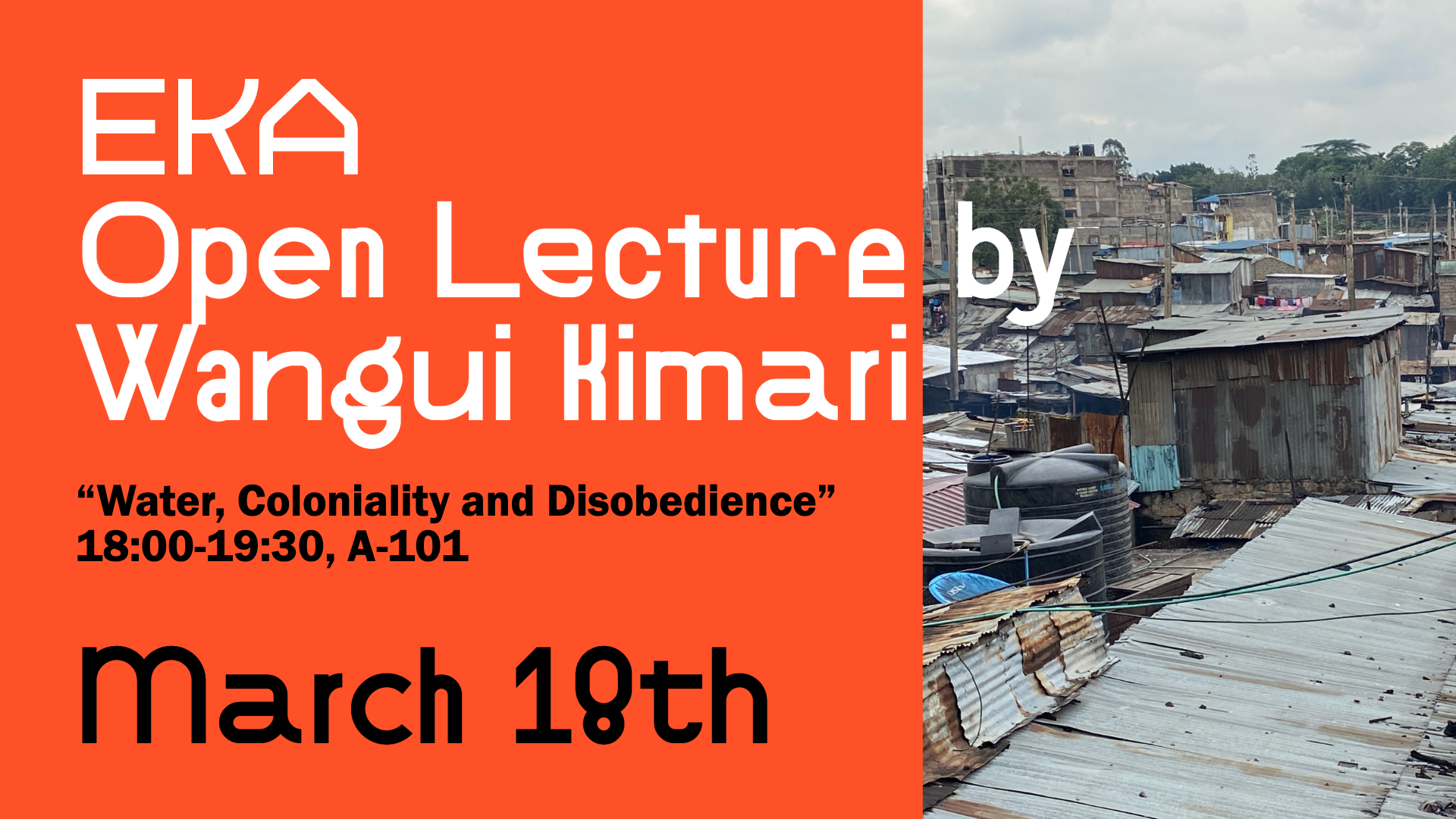
Nairobi, a city of close to five million people, congregates many hopes, experiences and struggles. Yet, across the colonial archive, its challenges have been defined primarily as those concerning ‘vagrants’ and ‘squatters,’ for instance; identities that congregate in the figure of the African. Following independence, the targets of formal city management lament and destruction remain similar: the ‘slum,’ ‘informality’ and urban ‘vice,’ whose geographies map onto the homes and bodies of those long targeted by colonial authorities. Informed by the “abolition ecology” community work of many of this city’s residents, and long-term research in its ontological margins, in this presentation I think about Nairobi’s dynamics through water. Ultimately, my argument is that while the “problem” of the “native,” squatter, vagrant or slum is seen to be defining of this urban agglomeration across the years, when Nairobi is thought from its experiences of water, coloniality and disobedience emerge as its primary dialectical currents, allowing for more (un)just histories to come into view that can allow us to vision more equal belongings and materialities in this East African city.
The Open lecture is being organized by EKA Urban Studies and TLU School of Humanities.
Wangui Kimari is an anthropologist based at the American University Nairobi Abroad Program. She is also a research associate at the African Centre for Cities (ACC), University of Cape Town. Her work draws on many local histories and interdisciplinary theoretical approaches – including oral narratives, assemblage theory, urban political ecology and the black radical tradition – to think through urban spatial management in Nairobi from the vantage point of its most marginalized residents. Wangui is also a regional editor of the online publication Africa Is a Country (AIAC), an Urban Studies Foundation (USF) trustee, on the editorial collective of Antipode and Urban Political Ecology journals, and a co-organizer of the UTA-Do African Cities Workshop.
Open Lecture by Wangui Kimari “Water, Coloniality and Disobedience”
Wednesday 18 March, 2026
Urban StudiesNairobi, a city of close to five million people, congregates many hopes, experiences and struggles. Yet, across the colonial archive, its challenges have been defined primarily as those concerning ‘vagrants’ and ‘squatters,’ for instance; identities that congregate in the figure of the African. Following independence, the targets of formal city management lament and destruction remain similar: the ‘slum,’ ‘informality’ and urban ‘vice,’ whose geographies map onto the homes and bodies of those long targeted by colonial authorities. Informed by the “abolition ecology” community work of many of this city’s residents, and long-term research in its ontological margins, in this presentation I think about Nairobi’s dynamics through water. Ultimately, my argument is that while the “problem” of the “native,” squatter, vagrant or slum is seen to be defining of this urban agglomeration across the years, when Nairobi is thought from its experiences of water, coloniality and disobedience emerge as its primary dialectical currents, allowing for more (un)just histories to come into view that can allow us to vision more equal belongings and materialities in this East African city.
The Open lecture is being organized by EKA Urban Studies and TLU School of Humanities.
Wangui Kimari is an anthropologist based at the American University Nairobi Abroad Program. She is also a research associate at the African Centre for Cities (ACC), University of Cape Town. Her work draws on many local histories and interdisciplinary theoretical approaches – including oral narratives, assemblage theory, urban political ecology and the black radical tradition – to think through urban spatial management in Nairobi from the vantage point of its most marginalized residents. Wangui is also a regional editor of the online publication Africa Is a Country (AIAC), an Urban Studies Foundation (USF) trustee, on the editorial collective of Antipode and Urban Political Ecology journals, and a co-organizer of the UTA-Do African Cities Workshop.
19.03.2026
Peer-review of Joanna Kalm’s doctoral project “Spacetuning. A practice of co-becoming”
On March 19, from 11:30 a.m. to 1:00 p.m., Joanna Kalm’s 2nd artistic research project, Spacetuning. A practice of co-becoming will take place via Zoom (link, passcode 167423).
The doctoral thesis supervisors are Liina Unt, PhD (University of Tartu) and Leena Rouhiainen, DA (University of the Arts Helsinki).
The project reviewers are Ilmari Kortelainen, PhD (University of the Arts Helsinki) and Giacomo Veronesi, PhD (Estonian Academy of Music and Theatre).
During 10th-14th of March, Spacetuning. A practice of co-becoming, will be presented at ARS Art Factory Studios 98 and 53. The somatic practice sessions, open to visitors, will take place daily at 4pm and on Saturday both at 12pm and 4pm.
More information and registration: https://fienta.com/et/ruumitoonimine-kaaskujunemise-praktika
Peer-review of Joanna Kalm’s doctoral project “Spacetuning. A practice of co-becoming”
Thursday 19 March, 2026
Doctoral SchoolOn March 19, from 11:30 a.m. to 1:00 p.m., Joanna Kalm’s 2nd artistic research project, Spacetuning. A practice of co-becoming will take place via Zoom (link, passcode 167423).
The doctoral thesis supervisors are Liina Unt, PhD (University of Tartu) and Leena Rouhiainen, DA (University of the Arts Helsinki).
The project reviewers are Ilmari Kortelainen, PhD (University of the Arts Helsinki) and Giacomo Veronesi, PhD (Estonian Academy of Music and Theatre).
During 10th-14th of March, Spacetuning. A practice of co-becoming, will be presented at ARS Art Factory Studios 98 and 53. The somatic practice sessions, open to visitors, will take place daily at 4pm and on Saturday both at 12pm and 4pm.
More information and registration: https://fienta.com/et/ruumitoonimine-kaaskujunemise-praktika
26.03.2026
KVI + ARH Open Lecture: Jos Boys “Doing Disability Differently in Architecture”
The 2025/2026 academic year open lecture series will be held in collaboration with the Institute of Art History and Visual Culture and the Faculty of Architecture. The theme of this academic year is “Architecture and the Ethics of Care” and the lectures will be curated by KVI Senior Researcher Dr. Ingrid Ruudi.
On March 26 at 6 pm Jos Boys will give a lecture “Doing Disability Differently in Architecture” at EKA lecture hall A-101.
Disabled people are almost always treated as an afterthought in built environment education and practice. But what if we instead start from disability, valuing our rich bio- and neurodiversity as a creative generator for design and as a critical means of challenging normative building and urban design? In this talk, Jos will explore how, over the last 18 years, DisOrdinary Architecture has been collaborating internationally with disabled artists, designers and architects to co-develop innovative and even radical ways of thinking and doing architecture.
Dr. Jos Boys is co-founder and co-director, with disabled artist Zoe Partington, of The DisOrdinary Architecture Project, a UK-based platform which brings disabled artists into built environment education and practice to critically and creatively re-think access and inclusion. Originally trained in architecture, she was co-founder of Matrix feminist architecture and research collective in London UK in the 1980s, and currently leads on the development of the Matrix Open online archive. Always a design activist, Jos has also been a journalist, critic, researcher, consultant, educator, photographer and artist; and has published many books and articles. These include authoring Doing Disability Differently: an alternative handbook on architecture, dis/ability, and designing for everyday life (Routledge 2014); editing Disability, Space, Architecture: A Reader (Routledge 2017) and co-editing Neurodivergence and Architecture (Elsevier 2022).
Within the framework of a series of open lectures, the Faculty of Architecture of EKA presents a dozen unique practitioners and valued theorists in the field in Tallinn every academic year.
The lectures are intended for all disciplines, not only for students and professionals in the field of architecture.
Spring programme:
- 26.02 at 18:00 in A-101 Kaisa Karvinen “From Care to Concrete: Exhibiting Architecture”
- 26.03 at 18:00 in A-101 Jos Boys (London)
- 9.04 at 18:00 in A-101 Katarina Bonnevier (Stockholm)
- 30.04 at 18:00 in A-101 Emma Cheatle (The University of Sheffield) “Lying in the Dark Room: Architectures of British Maternity”
- 14.05 at 18:00 in A-101 Iulia Statica (The University of Sheffield)
All lectures are held on Thursdays at 6 pm in the EKA main auditorium. All lectures are in English and free of charge.
The lecture series is supported by the Cultural Endowment of Estonia.
Previous open architecture lectures can be viewed at www.avatudloengud.ee
KVI + ARH Open Lecture: Jos Boys “Doing Disability Differently in Architecture”
Thursday 26 March, 2026
Architecture and Urban DesignThe 2025/2026 academic year open lecture series will be held in collaboration with the Institute of Art History and Visual Culture and the Faculty of Architecture. The theme of this academic year is “Architecture and the Ethics of Care” and the lectures will be curated by KVI Senior Researcher Dr. Ingrid Ruudi.
On March 26 at 6 pm Jos Boys will give a lecture “Doing Disability Differently in Architecture” at EKA lecture hall A-101.
Disabled people are almost always treated as an afterthought in built environment education and practice. But what if we instead start from disability, valuing our rich bio- and neurodiversity as a creative generator for design and as a critical means of challenging normative building and urban design? In this talk, Jos will explore how, over the last 18 years, DisOrdinary Architecture has been collaborating internationally with disabled artists, designers and architects to co-develop innovative and even radical ways of thinking and doing architecture.
Dr. Jos Boys is co-founder and co-director, with disabled artist Zoe Partington, of The DisOrdinary Architecture Project, a UK-based platform which brings disabled artists into built environment education and practice to critically and creatively re-think access and inclusion. Originally trained in architecture, she was co-founder of Matrix feminist architecture and research collective in London UK in the 1980s, and currently leads on the development of the Matrix Open online archive. Always a design activist, Jos has also been a journalist, critic, researcher, consultant, educator, photographer and artist; and has published many books and articles. These include authoring Doing Disability Differently: an alternative handbook on architecture, dis/ability, and designing for everyday life (Routledge 2014); editing Disability, Space, Architecture: A Reader (Routledge 2017) and co-editing Neurodivergence and Architecture (Elsevier 2022).
Within the framework of a series of open lectures, the Faculty of Architecture of EKA presents a dozen unique practitioners and valued theorists in the field in Tallinn every academic year.
The lectures are intended for all disciplines, not only for students and professionals in the field of architecture.
Spring programme:
- 26.02 at 18:00 in A-101 Kaisa Karvinen “From Care to Concrete: Exhibiting Architecture”
- 26.03 at 18:00 in A-101 Jos Boys (London)
- 9.04 at 18:00 in A-101 Katarina Bonnevier (Stockholm)
- 30.04 at 18:00 in A-101 Emma Cheatle (The University of Sheffield) “Lying in the Dark Room: Architectures of British Maternity”
- 14.05 at 18:00 in A-101 Iulia Statica (The University of Sheffield)
All lectures are held on Thursdays at 6 pm in the EKA main auditorium. All lectures are in English and free of charge.
The lecture series is supported by the Cultural Endowment of Estonia.
Previous open architecture lectures can be viewed at www.avatudloengud.ee
25.03.2026 — 28.03.2026
Musical “Carmen Electra” by ants1 at EKA Gallery on March 25, 26 and 28
“Carmen Electra” – like a bolt from the blue!
The band ants1 will perform their musical “Carmen Electra” at EKA Gallery three more times in March! The act combines contemporary dance, colorful costumes, disturbing music, and scandalous statements into its magical world. The libretto was collaboratively written by members of ants1, with the lead role performed by the eternally young and immortal Anumai Raska.
“Carmen Electra explores themes that feel both familiar and melancholic to a generation coming of age in a time when Europe is once again at war. It is a time when leaders of great nations won’t acknowledge climate change, when carrots cost more in Estonian grocery stores than in Belgium – even though the average income here is three times lower,” says a rabbit who wished to remain anonymous, commenting on the background of the production. “What will become of us like this?”
The band ants1 is a collective that emerged from the Estonian Academy of Arts, whose members work in various fields of contemporary art. When they come together, the collective is called ants1, whose music connects contemporary social problems with the painful yet fun language of punk music.
The musical “Carmen Electra” is not recommended for children under 12.
Performers: Ekke Janisk, Ats Kruusing, Andreas Kübar, Eke Ao Nettan, Anumai Raska, Henri Särekanno, Mattias Veller
Costumes by: Lisette Sivard
Light design by: Leon Allik
Sound design by: Roman Belov
Co-producer: elektron.art
Supported by: Estonian Cultural Endowment, City of Tallinn
Performances will take place on March 25, 26 and 28 at the EKA Gallery (Põhja pst 7, Tallinn). The performance is in Estonian with English subtitles. Entrance through the EKA lobby (from Põhja puiestee).
Tickets are available at Fienta:
https://fienta.com/ants1-muusikal-carmen-electra-156400
More info: https://elektron.art/projects/carmen
Musical “Carmen Electra” by ants1 at EKA Gallery on March 25, 26 and 28
Wednesday 25 March, 2026 — Saturday 28 March, 2026
“Carmen Electra” – like a bolt from the blue!
The band ants1 will perform their musical “Carmen Electra” at EKA Gallery three more times in March! The act combines contemporary dance, colorful costumes, disturbing music, and scandalous statements into its magical world. The libretto was collaboratively written by members of ants1, with the lead role performed by the eternally young and immortal Anumai Raska.
“Carmen Electra explores themes that feel both familiar and melancholic to a generation coming of age in a time when Europe is once again at war. It is a time when leaders of great nations won’t acknowledge climate change, when carrots cost more in Estonian grocery stores than in Belgium – even though the average income here is three times lower,” says a rabbit who wished to remain anonymous, commenting on the background of the production. “What will become of us like this?”
The band ants1 is a collective that emerged from the Estonian Academy of Arts, whose members work in various fields of contemporary art. When they come together, the collective is called ants1, whose music connects contemporary social problems with the painful yet fun language of punk music.
The musical “Carmen Electra” is not recommended for children under 12.
Performers: Ekke Janisk, Ats Kruusing, Andreas Kübar, Eke Ao Nettan, Anumai Raska, Henri Särekanno, Mattias Veller
Costumes by: Lisette Sivard
Light design by: Leon Allik
Sound design by: Roman Belov
Co-producer: elektron.art
Supported by: Estonian Cultural Endowment, City of Tallinn
Performances will take place on March 25, 26 and 28 at the EKA Gallery (Põhja pst 7, Tallinn). The performance is in Estonian with English subtitles. Entrance through the EKA lobby (from Põhja puiestee).
Tickets are available at Fienta:
https://fienta.com/ants1-muusikal-carmen-electra-156400
More info: https://elektron.art/projects/carmen
25.03.2026 — 28.03.2026
Musical “Carmen Electra”
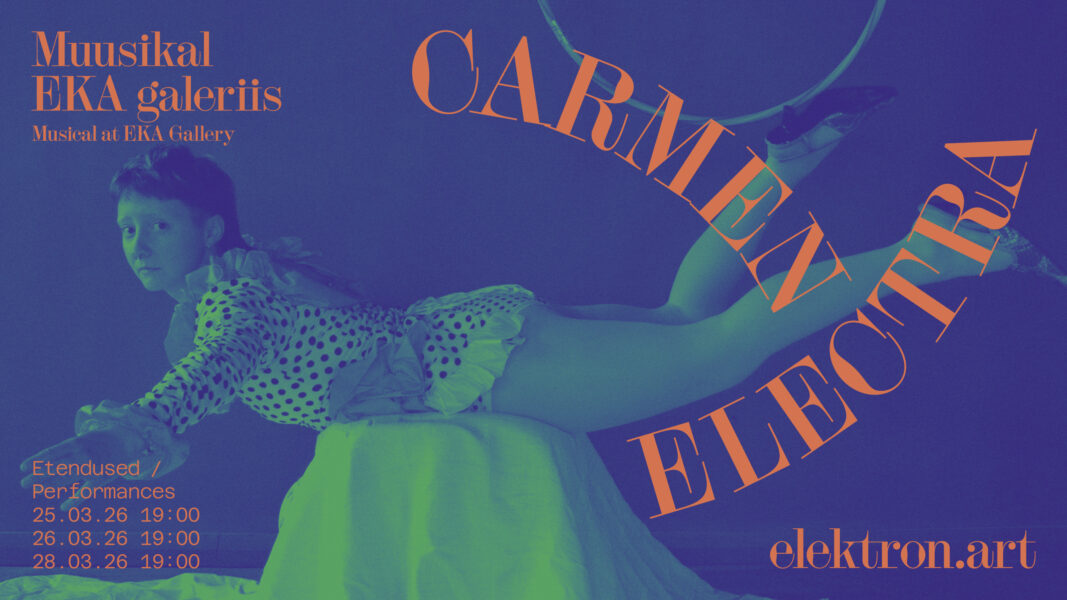
“Carmen Electra” – like a bolt from the blue!
The band ants1 will perform their musical “Carmen Electra” at EKA Gallery three more times in March! The act combines contemporary dance, colorful costumes, disturbing music, and scandalous statements into its magical world. The libretto was collaboratively written by members of ants1, with the lead role performed by the eternally young and immortal Anumai Raska.
“Carmen Electra explores themes that feel both familiar and melancholic to a generation coming of age in a time when Europe is once again at war. It is a time when leaders of great nations won’t acknowledge climate change, when carrots cost more in Estonian grocery stores than in Belgium – even though the average income here is three times lower,” says a rabbit who wished to remain anonymous, commenting on the background of the production. “What will become of us like this?”
The band ants1 is a collective that emerged from the Estonian Academy of Arts, whose members work in various fields of contemporary art. When they come together, the collective is called ants1, whose music connects contemporary social problems with the painful yet fun language of punk music.
The musical “Carmen Electra” is not recommended for children under 12.
Performers: Ekke Janisk, Ats Kruusing, Andreas Kübar, Eke Ao Nettan, Anumai Raska, Henri Särekanno, Mattias Veller
Costumes by: Lisette Sivard
Light design by: Leon Allik
Sound design by: Roman Belov
Graphic design: Jaan Evart
Co-producer: elektron.art
Supported by: Estonian Cultural Endowment, City of Tallinn
Performances will take place on March 25, 26 and 28 at the EKA Gallery (Põhja pst 7, Tallinn). The performance is in Estonian with English subtitles. Entrance through the EKA lobby (from Põhja puiestee).
Tickets are available at Fienta:
More info: https://elektron.art/projects/carmen
Kaie Olmre: kaie@elektron.art +372 5241778
“Carmen Electra” – like a bolt from the blue!
The band ants1 will perform their musical “Carmen Electra” at EKA Gallery three more times in March! The act combines contemporary dance, colorful costumes, disturbing music, and scandalous statements into its magical world. The libretto was collaboratively written by members of ants1, with the lead role performed by the eternally young and immortal Anumai Raska.
“Carmen Electra explores themes that feel both familiar and melancholic to a generation coming of age in a time when Europe is once again at war. It is a time when leaders of great nations won’t acknowledge climate change, when carrots cost more in Estonian grocery stores than in Belgium – even though the average income here is three times lower,” says a rabbit who wished to remain anonymous, commenting on the background of the production. “What will become of us like this?”
The band ants1 is a collective that emerged from the Estonian Academy of Arts, whose members work in various fields of contemporary art. When they come together, the collective is called ants1, whose music connects contemporary social problems with the painful yet fun language of punk music.
The musical “Carmen Electra” is not recommended for children under 12.
Performers: Ekke Janisk, Ats Kruusing, Andreas Kübar, Eke Ao Nettan, Anumai Raska, Henri Särekanno, Mattias Veller
Costumes by: Lisette Sivard
Light design by: Leon Allik
Sound design by: Roman Belov
Graphic design: Jaan Evart
Co-producer: elektron.art
Supported by: Estonian Cultural Endowment, City of Tallinn
Performances will take place on March 25, 26 and 28 at the EKA Gallery (Põhja pst 7, Tallinn). The performance is in Estonian with English subtitles. Entrance through the EKA lobby (from Põhja puiestee).
Tickets are available at Fienta:
More info: https://elektron.art/projects/carmen
Kaie Olmre: kaie@elektron.art +372 5241778
31.03.2026
Book presentation and discussion: Jurriaan Benschop’s Why Paintings Work
Come to the book launch and panel discussion on March 31 at 6 PM!
Jurriaan Benschop’s Why Paintings Work was published in Estonian at the end of 2025 – now Kristi Kongi and Kaido Ole will discuss the book and painting, with the conversation moderated by Anu Allas. Everyone is welcome to listen and take part in the discussion.
In the book, Benschop navigates the multifaceted landscape of contemporary painting. By presenting the work of numerous contemporary painters, including Kaido Ole and Kristi Kongi, he seeks to answer the question of why a painting has an impact at all. In what way is it meaningful and convincing? He examines the visible aspects of painting, such as subject matter and use of color, and relates them to the invisible factors of art – the artist’s motivations, worldview, and background. The book touches on many themes that emerge when viewing contemporary painting: nature, the body, materiality, touch, identity, memory, and spirituality.
The book is published by the Estonian Academy of Arts, translated by Katrin Laiapea, edited by Neeme Lopp, and designed by Maria Muuk.
We will gather for the presentation and discussion in the new event corner of the EKA Library. We kindly ask you to sign up, so we know how many will be attending: https://forms.gle/h6aXonQvRpFiEHHW9
Time: March 31 at 6 PM
Place: EKA Library
The discussion will be held in Estonian, with no translation available.
Book presentation and discussion: Jurriaan Benschop’s Why Paintings Work
Tuesday 31 March, 2026
PaintingCome to the book launch and panel discussion on March 31 at 6 PM!
Jurriaan Benschop’s Why Paintings Work was published in Estonian at the end of 2025 – now Kristi Kongi and Kaido Ole will discuss the book and painting, with the conversation moderated by Anu Allas. Everyone is welcome to listen and take part in the discussion.
In the book, Benschop navigates the multifaceted landscape of contemporary painting. By presenting the work of numerous contemporary painters, including Kaido Ole and Kristi Kongi, he seeks to answer the question of why a painting has an impact at all. In what way is it meaningful and convincing? He examines the visible aspects of painting, such as subject matter and use of color, and relates them to the invisible factors of art – the artist’s motivations, worldview, and background. The book touches on many themes that emerge when viewing contemporary painting: nature, the body, materiality, touch, identity, memory, and spirituality.
The book is published by the Estonian Academy of Arts, translated by Katrin Laiapea, edited by Neeme Lopp, and designed by Maria Muuk.
We will gather for the presentation and discussion in the new event corner of the EKA Library. We kindly ask you to sign up, so we know how many will be attending: https://forms.gle/h6aXonQvRpFiEHHW9
Time: March 31 at 6 PM
Place: EKA Library
The discussion will be held in Estonian, with no translation available.
02.04.2026
EKA Doctoral School Conference
EKA Doktoral School Conference will take place on 2nd April 2026
Please register by 29th March.
Conference will be held in English.
PROGRAMME
08.40 Registration
09.00 Welcome by Prof. Linda Kaljundi (EKA Vice Rector for Research, Head of Doctoral School)
09.10 Opening Lecture
Moderator Prof. Linda Kaljundi
Dr. Anna Carolina Jensen “In-Between Chaos and Control”(EKA, postdoctoral researcher)
Panel 1: Art History & Visual Culture
Moderator Prof. Andres Kurg
10.10 Rahul Sharma “Border Chronotopes and Third-Positionality: Peripheral In-Between Identities on the Eastern Borderlands in de Montesquiou’s Olga and Olga (2017) and Eksperiment Katja (2020)” (supervisors Dr. Mari Laanemets, Prof. Linda Kaljundi).
10.45 Mie Mortensen “A Philosophy of Sponges: The Influence of Ernst Haeckel on Ivan Leonidov” (supervisor Prof. Andres Kurg).
11.20 Coffee break
11.40 Anneli Porri “How to Explain Pictures… to Ourselves?
Mediating the Artwork and Supporting Meaning-Making in Art History Education” (supervisor Prof. Linda Kaljundi).
12.15 Marten Esko “The Contemporary as Method: Use, Abuse, and Critical Afterlife” (supervisor Prof. Virve Sarapik).
12.50 Rahel Aerin Eslas “The Aesthetics of Nature in Denis Diderot’s Philosophy and Art Criticism” (supervisors Prof. Krista Kodres, Prof. Frédéric Ogée).
13.25 Lunch
Panel 2: Art & Design
Moderator Dr. Jaana Päeva
14.00 Kadri Liis Rääk “The Artist’s Body as a Sensory Threshold” (supervisor Dr. Liina Unt).
14.35 Taavi Varm “The Video Game Creation Process as a Practice of Care for Creative Sustainability and Psychological Well-being” (supervisors Dr. Varvara Guljajeva, Dr. Helen Uusberg).
15.10 Eva Liisa Kubinyi “Wondering Pathways Toward Community-Based Service Designing from Rõuge” (supervisor Associate Prof. Josina Vink).
15.45 Aman Asif “Beyond the Visible Spectrum: Algal Entanglements” (supervisor Prof. Kärt Ojavee).
16.20 Coffee break
Panel 3: Architecture & Urban Planning
Moderator Dr. Eik Hermann
16.40 Alvin Järving “The Value-Space of Extending Building Lifespans: Locating Architectural Practice in a Conflicted Field” (supervisor Dr. Siim Tuksam).
17.15 Jaak-Adam Looveer “Urban Planning in the Comfort Zone: The Case of Tallinn” (supervisors Dr. Siim Tuksam, Dr. Priit-Kalev Parts).
17.50 Roundtable: Dr. Eik Hermann, Prof. Andres Kurg, Prof. Linda Kaljundi, Dr. Jaana Päeva
Contact:
Aljona Gineiko aljona.gineiko@artun.ee
Ragne Soosalu ragne.soosalu@artun.ee
EKA Doktoral School Conference will take place on 2nd April 2026
Please register by 29th March.
Conference will be held in English.
PROGRAMME
08.40 Registration
09.00 Welcome by Prof. Linda Kaljundi (EKA Vice Rector for Research, Head of Doctoral School)
09.10 Opening Lecture
Moderator Prof. Linda Kaljundi
Dr. Anna Carolina Jensen “In-Between Chaos and Control”(EKA, postdoctoral researcher)
Panel 1: Art History & Visual Culture
Moderator Prof. Andres Kurg
10.10 Rahul Sharma “Border Chronotopes and Third-Positionality: Peripheral In-Between Identities on the Eastern Borderlands in de Montesquiou’s Olga and Olga (2017) and Eksperiment Katja (2020)” (supervisors Dr. Mari Laanemets, Prof. Linda Kaljundi).
10.45 Mie Mortensen “A Philosophy of Sponges: The Influence of Ernst Haeckel on Ivan Leonidov” (supervisor Prof. Andres Kurg).
11.20 Coffee break
11.40 Anneli Porri “How to Explain Pictures… to Ourselves?
Mediating the Artwork and Supporting Meaning-Making in Art History Education” (supervisor Prof. Linda Kaljundi).
12.15 Marten Esko “The Contemporary as Method: Use, Abuse, and Critical Afterlife” (supervisor Prof. Virve Sarapik).
12.50 Rahel Aerin Eslas “The Aesthetics of Nature in Denis Diderot’s Philosophy and Art Criticism” (supervisors Prof. Krista Kodres, Prof. Frédéric Ogée).
13.25 Lunch
Panel 2: Art & Design
Moderator Dr. Jaana Päeva
14.00 Kadri Liis Rääk “The Artist’s Body as a Sensory Threshold” (supervisor Dr. Liina Unt).
14.35 Taavi Varm “The Video Game Creation Process as a Practice of Care for Creative Sustainability and Psychological Well-being” (supervisors Dr. Varvara Guljajeva, Dr. Helen Uusberg).
15.10 Eva Liisa Kubinyi “Wondering Pathways Toward Community-Based Service Designing from Rõuge” (supervisor Associate Prof. Josina Vink).
15.45 Aman Asif “Beyond the Visible Spectrum: Algal Entanglements” (supervisor Prof. Kärt Ojavee).
16.20 Coffee break
Panel 3: Architecture & Urban Planning
Moderator Dr. Eik Hermann
16.40 Alvin Järving “The Value-Space of Extending Building Lifespans: Locating Architectural Practice in a Conflicted Field” (supervisor Dr. Siim Tuksam).
17.15 Jaak-Adam Looveer “Urban Planning in the Comfort Zone: The Case of Tallinn” (supervisors Dr. Siim Tuksam, Dr. Priit-Kalev Parts).
17.50 Roundtable: Dr. Eik Hermann, Prof. Andres Kurg, Prof. Linda Kaljundi, Dr. Jaana Päeva
Contact:
Aljona Gineiko aljona.gineiko@artun.ee
Ragne Soosalu ragne.soosalu@artun.ee
13.05.2026
Seminar: How to write a more inclusive, transnational and polyphonic history of the visual arts on a European scale today?

The EKA Institute of Art History and Visual Culture is part of the Visual Arts in Europe: An Open History (EVA) project that brings together more than 150 art and heritage historians representing the 46 member countries of the Council of Europe. The project is led by an Editorial Board, composed of six European specialists, and supported by the International Association of Research Institutes in the History of Art (RIHA). Its scientific and operational coordination is provided by the Institut national d’histoire de l’art (INHA) in Paris.
Launched in 2019, this scientific and editorial project results in the publication of a digital platform, documenting the history of the visual arts on the European continent, from prehistory to the present day. This platform will be structured around a collection of 475 objects and images, selected in consultation with all of its institutional partners. It is developed within the framework of an international dialogue, remaining attentive to the plurality and richness of scholarly traditions, accessible to all audiences, and providing an account of current research in the discipline of art history.
This seminar will examine the principles that inspired the launch of this project, the methodology used both for the selection of objects and the attribution of associated texts, as well as the challenges encountered during the development of the digital platform. The presentation of the project and platform prototype will be followed by an open discussion with colleagues from the EKA Institute of Art History and Visual Culture, host of this seminar and Estonian project partner. With INHA director Anne-Solène Rolland and project coordinator Margot Sanitas present, the seminar will be an opportunity for all the Estonian representatives to share their reflections on the selection of objects and how the project contributes to reshaping our common history of European visual culture.
Seminar: How to write a more inclusive, transnational and polyphonic history of the visual arts on a European scale today?
Wednesday 13 May, 2026
Institute of Art History and Visual CultureThe EKA Institute of Art History and Visual Culture is part of the Visual Arts in Europe: An Open History (EVA) project that brings together more than 150 art and heritage historians representing the 46 member countries of the Council of Europe. The project is led by an Editorial Board, composed of six European specialists, and supported by the International Association of Research Institutes in the History of Art (RIHA). Its scientific and operational coordination is provided by the Institut national d’histoire de l’art (INHA) in Paris.
Launched in 2019, this scientific and editorial project results in the publication of a digital platform, documenting the history of the visual arts on the European continent, from prehistory to the present day. This platform will be structured around a collection of 475 objects and images, selected in consultation with all of its institutional partners. It is developed within the framework of an international dialogue, remaining attentive to the plurality and richness of scholarly traditions, accessible to all audiences, and providing an account of current research in the discipline of art history.
This seminar will examine the principles that inspired the launch of this project, the methodology used both for the selection of objects and the attribution of associated texts, as well as the challenges encountered during the development of the digital platform. The presentation of the project and platform prototype will be followed by an open discussion with colleagues from the EKA Institute of Art History and Visual Culture, host of this seminar and Estonian project partner. With INHA director Anne-Solène Rolland and project coordinator Margot Sanitas present, the seminar will be an opportunity for all the Estonian representatives to share their reflections on the selection of objects and how the project contributes to reshaping our common history of European visual culture.
Subscribe to EKA Calendar in order to see EKA events in your Google Calendar, Microsoft Outlook, or other iCal compatible calendar service.