
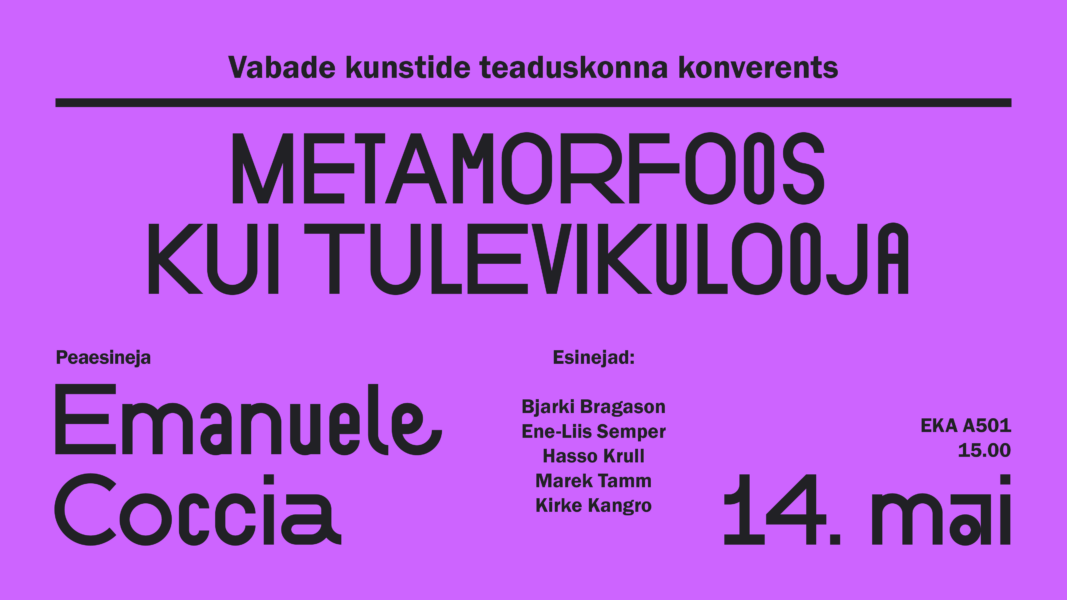
On May 14, 2026, the Estonian Academy of Arts will host an open conference titled “Metamorphosis as a Creator of the Future” in room A501, featuring internationally acknowledged Italian philosopher Emanuele Coccia as the keynote speaker.
The conference will be held in English.
The conference will focus on the philosophy of Emanuele Coccia, with metamorphosis as the key term. Life is an incessant series of metamorphoses that happen everywhere, and the first natural technology is the cocoon, where preparation for transformation takes place. The keynote speaker at the conference will be Emanuele Coccia. The floor will also be given to artists and thinkers who, through their work, have explored change and its impact on the world around us.
Programme:
15.00 Opening words and introduction
I session: Contemporary Art and Language as a Form of Transformations
Bjarki Bragason (artist, educator, Iceland University of the Arts):
The Garden That Was: Memory, Ecology and Transformation
Ene-Liis Semper (artist, stage director, educator, Estonian Academy of Arts)
Large-Scale Performances as the Agents of Change in Society
Hasso Krull (poet, essayist, philosopher, Tallinn University)
A Metamorphic Event: Hommages à Artur Alliksaar and Emanuele Coccia
16.00 Coffee break
16.15 II session: Philosophy of Metamorphosis
Marek Tamm (cultural historian, theorist, Tallinn University)
Philosophy as Metamorphosis: Emanuele Coccia
Emanuele Coccia (philosopher, Italy/France, EHESS)
Metamorphosis as the Creator of Future
17.30 -18.30 final panel: Metamorphosis as the Creator of Future
Coccia, Bragason, Semper, Krull, Tamm – moderated by Kirke Kangro
Emanuele Coccia is Associate Professor at the École des Hautes Études en Sciences Sociales (EHESS) in Paris. He has been a visiting professor and researcher at numerous international institutions, including universities in Tokyo, Buenos Aires, Düsseldorf, Columbia University, Harvard, Penn University and New York University. His work bridges philosophy, ecology, contemporary art, architecture, and visual theory, proposing a renewed understanding of life, form, and habitation on a planetary scale.
He is the author of several books translated into many languages, including The Life of Plants (Polity, 2018; Gallimard, 2016), Metamorphoses (Polity, 2021; Rivages, 2020), and Philosophy of the Home (Penguin, 2024; Rivages, 2024) and A Treatise on Modern Love (Flammarion and Einaudi 2026) . Together with photographer Viviane Sassen, he published Modern Alchemy (JBE Books, 2022), a book on photographic theory and image-thinking; with Paolo Roversi, Lettres sur la lumière (Gallimard, 2024), a philosophical epistolary on light as a principle of visibility and creation; and with Alessandro Michele, creative director of Valentino, The Life of Forms. Philosophy of Re-enchantment (HarperCollins, 2024). His forthcoming book, New Natures. Planetary Museums (Park Books, 2026), co-authored with author and curator Béatrice Grenier and architect Jeanne Gang, examines the emergence of planetary museums as living ecologies at the intersection of nature, architecture, and culture.
In 2019 and 2021, he contributed to Nous les Arbres, presented at the Fondation Cartier pour l’art contemporain in Paris and the Power Station of Art in Shanghai, where he is also a member of the Academic Committee. Together with Olivier Saillard, he curated The Many Lives of a Garment (ITS Arcademy, Trieste 2024) and Borderless (ITS Arcademy, Trieste, 2025), two exhibitions reflecting on the philosophical and social metamorphoses of fashion.
With Yuko Hasegawa, he co-curated Dancing with All at the 21st Century Museum of Contemporary Art in Kanazawa, centered on ecology, coexistence, and the poetics of movement. He is a member of the Scientific Committee of the Power Station of Art of Shanghai. In 2024, Coccia was awarded the Mondriaan Prize for his theoretical and curatorial work bridging philosophy, art, and architecture.
Bjarki Bragason (b. 1983) studied at the Iceland University of the Arts, Universität der Künste Berlin and CalArts in Los Angeles. He is Associate Professor and Dean of the Fine Art Department at the Iceland University of the Arts and has taught at institutions internationally since 2014. His work has been represented in numerous solo- and group exhibitions internationally, and is in the collection of museums and private collections.
Hasso Krull (b. 1964) is an Estonian poet, translator and philosopher who has published nineteen books of poetry and eleven collections of essays that include literary criticism as well as writings concerning art, cinema and society. During 1990–2017 he was teaching cultural theory at the Estonian Institute of Humanities (special courses on continental philosophy, psychoanalysis, creation myths and oral tradition). From 2019 he has been teaching creative writing in the Estonian Academy of Arts. His latest books are The Eternal Recurrence (2025) and Twilight Remembrance (2025). He currently works as a researcher at Tallinn University.
Ene-Liis Semper (b. 1969) is an Estonian video, performance, and theatre director, and professor in the Department of Scenography at the Estonian Academy of Arts. In 2004, she co-founded Teater NO99 with Tiit Ojasoo, where she worked as artistic director and stage director until the theatre closed in 2018. Semper has created numerous set and costume designs for both drama and opera productions, and is known for her visually powerful and grandiose style. Her solo exhibitions have been held at prestigious museums, including the Kumu Art Museum (2011) and the Estonian Museum of Contemporary Art (EKKM) (2024). Her most recent major production projects include the concert-performance “Where Are You?” (2026), “The Master and Margarita” (2024, Riga Dailes Theater), “Macbeth” (2023, Estonian Drama Theatre/ERSO/Estonian Concert), “Now We Can Talk About It” (2023, Theater Expedition), and many more.
Marek Tamm is professor of cultural history in Tallinn University and head of the Institute of History, Archaeology and Art History. His primary research fields are cultural history of medieval Europe, theory and methodology of history, and cultural memory studies. He has recently published Breakthroughs in Cultural Psychology (ed. with Jaan Valsiner; Tallinn University Press, 2024), The Fabric of Historical Time (co-authored with Zoltán Boldizsár Simon; Cambridge University Press, 2023), and The Companion to Juri Lotman: A Semiotic Theory of Culture (ed. with Peeter Torop; Bloomsbury, 2022).
Event on Facebook