
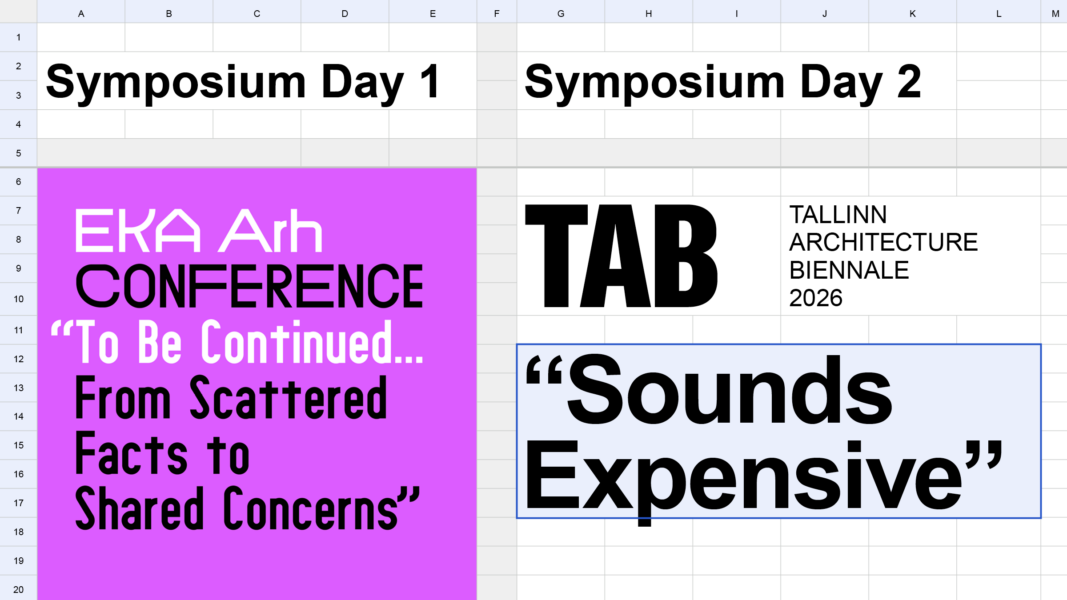
EKA Arh Conference 2026 “To Be Continued….From Scattered Facts to Shared Concerns“
10 September 2026
EKA Arh Conference 2026 takes place as Day 1 of the two-day Tallinn Architecture Biennial TAB Symposium.
Tickets for the EKA Architecture Conference and the entire TAB Symposium can be purchased on Fienta.
The 2026 EKA Arh Conference focuses on one of the central questions facing architecture and urban development today: how do we move forward when starting from scratch is no longer a viable option? While knowledge about climate transition, resource limits, and the built environment is abundant, translating that knowledge into collective action remains a challenge. Rather than asking only what comes next, the conference asks what can and should continue.
Across urban, building, and material scales, international speakers and researchers explore adaptation, reuse, and transformation in the built environment. The programme brings together perspectives from architecture, planning, construction, and research to discuss how existing places, buildings, and resources can support meaningful change, and how scattered knowledge can become shared concerns capable of shaping long-term action.
Participants can earn 10 Estonian Architects Union continuing professional development (CPD) credits for attending the conference.
Programme
09:30–09:45
Opening Words
09:45–10:30
Transformation Keynote
Aleksi Neuvonen (Demos Helsinki, Finland)
From Fragmentation to New Norm(ative)
Climate action in cities is pulled in different directions by varied priorities, worldviews, data sources, and levels of ambition. Shared, time-bound climate and carbon neutrality goals have helped, giving everyone a common target. But a goal alone isn’t enough. Every city’s material culture (buildings, infrastructures, technologies) shapes not just how it behaves today, but what future it can imagine. Because different cities inherit different material cultures, often shaped by past technology and finance decisions, they move towards the future at different speeds. The challenge is building a shared direction that still recognizes these differences.
10:30–10:45 — Coffee Break
Parallel Session I
10:45–12:15
Spatial and Architectural Transformation
Location: Main Hall
Chair: Kaja Pae
This session explores processes of spatial transformation across urban and architectural scales, examining how cities, landscapes, and built environments adapt to changing social, ecological, and cultural conditions. Contributions address themes such as urban restructuring, adaptive reuse, spatial continuity, and the relationship between territorial systems, public space, and architectural intervention.
Ivana Angelova
Farms and Buried Rivers as Connective Infrastructure in Nerima, Tokyo
Ss. Cyril and Methodius University
Elina Liiva
Architectural Practice and Institutional Systems in Transition
Estonian Academy of Arts
Jaak-Adam Looveer
How Tallinn (Briefly) Became a Cycling City
Estonian Academy of Arts
Helmi Marie Langsepp
Energy as Site: Place-Responsive Renewable Energy Infrastructure in Baltic Sea Edge Conditions
Tallinn University of Technology
Gizem Bakioğlu Apaydın
Futures Foreclosed: Scenario Thinking and Urban Design in Post-Disaster Antakya
Istanbul Technical University
Soenke Zehle and Dan Dubowitz
Sounding Archipelagic Imaginaries: Holding Relations of Sense and Care across Stranded Sites
K8 Institut für strategische Ästhetik, HBKsaar / Manchester School of Architecture
In parallel
Prefabrication, Retrofit, and Adaptive Reuse
Location: Monumental Studio
Chair: Siim Tuksam
This session examines prefabricated and industrialized approaches to the transformation of existing buildings and urban fabric. Contributions explore themes such as adaptive reuse, modular retrofit systems, circular renovation strategies, and the extension of building lifecycles, addressing how contemporary construction methods can support more sustainable and resource-conscious forms of spatial transformation.
Chieh-Hsuan Jasmy Chen
Multi-Resolution Fabrication: A Notation-to-Fabrication Framework for Volumetric Point Printing
University of Innsbruck
Andriy Golovchenko
Designing for Continuity: Environmental and Production-Informed Development of the 3Cycle Modular Timber System for Crisis Response and Long-Term Reconstruction
Estonian Academy of Arts
Kaiko Kivi
Topological Modelling for Design–Fabrication Continuity: A Case Study in CLT Panel Systems
Estonian Academy of Arts
Alvin Järving
Building Longevity as a Heterogeneous Design Question: Mapping Preservation and Transformation Across Scales
Estonian Academy of Arts
Katrin Stöhr
The Seasonal Plan: Spatial Gradients and Seasonal Patterns of Inhabitation
University of Innsbruck
Anni Martin
The Bar We Set: Making Architectural Critique Actionable in Mass-Housing Renovation
Estonian Ministry of Climate
12:15–13:15
Lunch
13:15–14:00
Adaptation Keynote
Hiroto Kobayashi (Keio University, Tokyo, Japan)
Do-It-Together-Anyway: Design-Build Action toward Participatory Architecture
The Veneer House Project, developed by Hiroto Kobayashi and the Kobayashi Laboratory at Keio University, is an affordable, participatory architecture system using CNC-fabricated plywood panels. Inspired by traditional Japanese joinery, its interlocking components can be assembled and disassembled without specialized tools, nails, or heavy hardware. Originally conceived after the 2011 Great East Japan Earthquake, the project enables communities, students, architects, and volunteers to build flexible and resilient shelters and community spaces together. Adaptable to local climates and cultures, Veneer House projects have been realized in Japan and internationally, exploring new possibilities for self-build, disaster recovery, and community empowerment.
14:00–14:15 — Coffee Break
Parallel Session II
14:15–15:45
Material Systems and Circular Construction
Location: EKA Main Hall
Chair: Sille Pihlak
This session focuses on material systems, construction processes, and circular approaches to the built environment. Contributions examine themes such as material reuse, prefabrication, tectonics, fabrication methods, and resource-aware design strategies, addressing how construction systems can support more adaptive and sustainable spatial practices.
Xiao Wang
Abductive Reasoning for Bio-digital Computational Design: Generating Relations Across Fragmented Nonhuman Domains
University of Innsbruck
Samantha Ratanarat
Building with Byproducts: Circular Construction and Land Use in the Plantation Landscapes of Southern Thailand
MIT
Kateřina Klímová
Pop-up Learning Landscape: Towards a Modern Educational Environment Through Furnishing Rather Than Construction
Academy of Arts, Architecture and Design in Prague
Eva Toom
Building an Unfinished Transition: Negotiating Bioconstruction, Local Practices and Habitability in a Rural Off-Grid House in Southern Chile
Ecotectura
Muchen Yan
Rubbles: Material Features as Design Data
University of Innsbruck
In parallel
Participatory Planning and Urban Transformation
Location: EKA Monumental studio
Chair: Panu Lehtovuori
This session explores participatory approaches to urban transformation through digital mapping, GIS-based spatial analysis, and collaborative planning tools. Contributions address themes such as tactical urban interventions, community engagement, and urban greening strategies, examining how localized actions and participatory processes can inform broader spatial and policy frameworks and vice versa.
Juulia Aliide Salulaid
Between Rules and Practice: Emergent Practices in Urban Planning Systems
Tallinn University of Technology
Kimmo Lylykangas
Climate Jeopardy: Representational Mismatch in Urban Greenhouse Gas Inventories
Tallinn University of Technology
Milda Kuraitytė and Gediminas Viliūnas
From Visual Graph Analysis to Eye-Tracking Stimuli: A Methodological Framework for Three Urban Genotypes
Vilnius Academy of Arts
Antti Heinonen
Immersive Co-Design as Posthumanist Pedagogy: A Studio Study of Collaborative XR Sketching
LAB University of Applied Sciences
Chiara Chioni
From UTOPIA to Practice: Technology-Mediated Participation for Climate-Responsive Public Spaces
Aalto University
Hawke Gihm
Between Compliance and Character: Architectural Diversity Under Carbon Limits
Tallinn University of Technology
15:45–16:00
Coffee Break
16:00–16:45
Panel Discussion
16:45–17:00
Closing Words
EKA Arh Conference 2026 forms the first half of the two-day Tallinn Architecture Biennale (TAB) Symposium. We thank our partners and supporters: the Estonian Centre for Architecture, TAB, the City of Tallinn, the Cultural Endowment of Estonia, the Estonian Research Council, and the Estonian Doctoral School. The project “University Cooperation in Promoting Doctoral Studies” (2021-2027.4.04.24-0003) is co-funded by the European Union.