
Calendar
Ongoing
21.05.2026 — 11.10.2026 Exhibition “Kristi Kongi: Chromatic Drift” Thursday 21 May, 2026 — Sunday 11 October, 2026 Faculty of Fine Arts

Opening on Thursday, 21 May at 6 pm in the Great Hall of the Kumu Art Museum
(Weizenbergi 34 / Valge 1, Tallinn).
Chromatic Drift creates a cohesive perceptual and spatial experience centred on colour, a defining element in the oeuvre of the Estonian painter Kristi Kongi. Works created specifically for this exhibition over the past couple of years, together with the surrounding installation-based environment, evoke both chromatic richness and a poetic mode of being in unmapped territory.
At the opening, the launch of the book accompanying the exhibition will also take place.
The opening will take place in Kumu’s courtyard, weather permitting.
Opening programme on Saturday, 23 May:
Exhibition tours with curator Ann Mirjam Vaikla and artist Kristi Kongi: 12 noon (in English) and 2 pm (in Estonian)
Artist talk with Kristi Kongi at 3:30 pm
The exhibition will remain open until 11 October 2026.
Curator: Ann Mirjam Vaikla
Exhibition design: Mari Hunt, Grete Daut (MARIHUNT architects)
Graphic design: Brit Pavelson
Exhibition installation manager: Tõnis Medri
Coordinator: Anastassia Langinen
11.07.2026 — 25.10.2026 Kaisa Maasik. The Lightness of Being Saturday 11 July, 2026 — Sunday 25 October, 2026 Faculty of Fine Arts
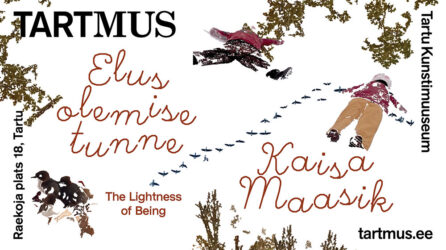
11.07.2026–25.10.2026
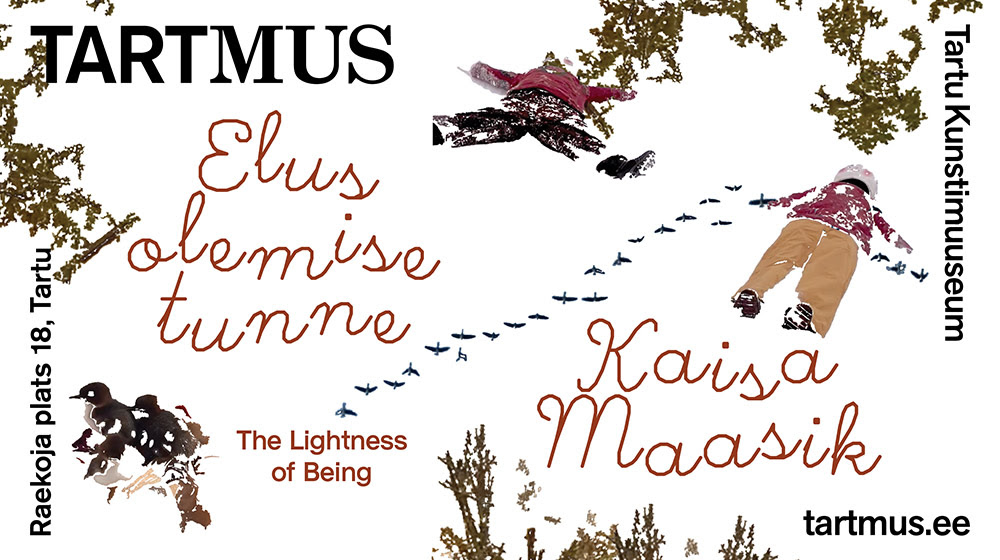
From 11 July, Tartu Art Museum’s project space will present Kaisa Maasik’s solo exhibition The Lightness of Being as part of the Young Tartu exhibition series.
Kaisa Maasik’s solo exhibition The Lightness of Being focuses on ordinary yet beautiful moments that are easy to overlook. These may be a fleeting smile between two strangers, the first day after a long winter when you can finally swap your boots for sneakers, or the sound of rain tapping on a windowsill that briefly wakes you in the night before lulling you back to sleep. Maasik’s works are rooted in observation and attentiveness, bringing together collected moments and everyday observations shared by different people. Against the backdrop of rapid information flows and constant competition for our attention in digital environments, the exhibition invites visitors to slow down and notice what usually remains in the background – situations that could happen to any of us and that remind us that life is largely made up of such small, genuine moments.
The Young Tartu exhibition series was launched in 2017 with the aim of promoting and supporting the work of emerging artists connected to Tartu. Previous participants in the programme have included Sten Eltermaa, Keiu Maasik, Mirjam Hinn, Siiri Jüris, Nele Marie Tiidelepp, Tõnis Jürgens and Viktoria Berezina.
Kaisa Maasik’s exhibition will take place in the project space on the third floor of the Tartu Art Museum from 11 July to 25 October 2026.
Kaisa Maasik (b. 1994) is an artist and curator based in Tallinn. She graduated from the Contemporary Art Programme at the Estonian Academy of Arts (MA, 2021) and from the Photography Department (BA, 2017). In 2019, she furthered her studies at the Academy of Fine Arts of the University of the Arts Helsinki in the Praxis curatorial master’s programme. Collaboration plays an important role in Maasik’s practice; she works both collectively and independently on projects that often take the form of spatial artworks. She focuses on the feelings and experiences of people she encounters, seeking to convey their stories through objects and memories. Collecting is central to Maasik’s methodology, drawing primarily on everyday life. She was a member of the Umbrella Group (2016–2017) and has been involved in the organising teams of the project space Vent Space (2018–2019) and the Tallinn Photomonth Biennial (2017 and 2019). In 2020, Maasik was awarded the Wiiralt Scholarship. In spring 2021, she participated in the FAIR residency at FABRIKKEN in Copenhagen. Maasik has been a member of the Estonian Union of Photography Artists since 2021 and of the Estonian Artists’ Association since 2022.
Artist: Kaisa Maasik
Curator: Stella Mõttus
Graphic designer: Kersti Heile
Supporters: Estonian Cultural Endowment, Ledzep OÜ
Exhibition team: Indrek Grigor, Joanna Hoffmann, Rene Kriisa, Katariina Leets, Katrin Lõoke, Anti Saar, Peeter Talvistu
Video clip credits: Arvi Anderson, Jana Arendi, Katariina Aule, Andrus Avarand, Yvette Bathgate, Marleen Eino, Alexei Gordin, Yiheng Gu, Viktor Gurov, Liisa-Lota Jõeleht, Erik Jürmann, Pirke Kaljula, Piret Klea-Velleste, Karel Koplimets, Nele Kurvits, Epp Kuslap, Kadri Lind, Maria Luiga, Mariel Luuk, Heiki Maasik, Katariin Mudist, Stella Mõttus, Reigo Nahksepp, Urmet Piiling, Evelyn Raudsepp, Mari-Liis Rebane, Yiyang Sun, Maryliis Teinfeldt-Grins, Annika Toots, Tõnu Tunnel, Simona Tätte, Lotte Ugandi, Ruudu Ulas, Pille-Riin Valk, Eliisabet Valmas, Sten Vendik, Helen Västrik
01.09.2026 — 30.09.2026 Reimo Võsa-Tangsoo “Mind the Frog!” Tuesday 01 September, 2026 — Wednesday 30 September, 2026 Photography
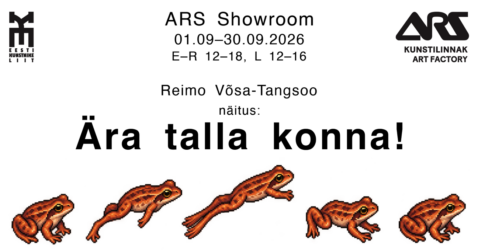
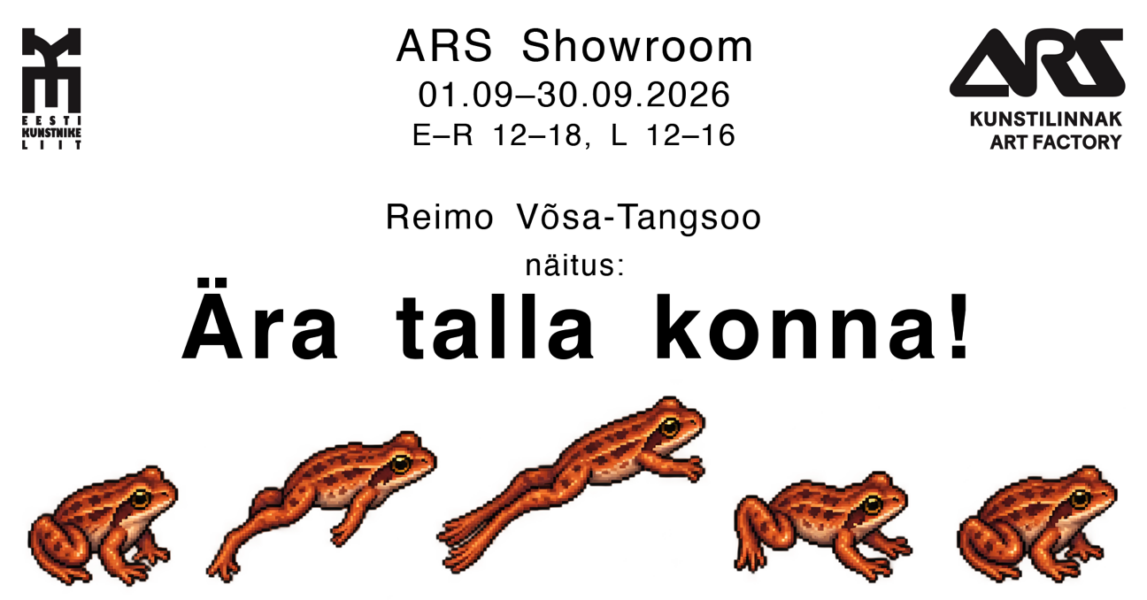
One of the starting points for the exhibition is Karel Čapek’s The Gardener’s Year. Čapek’s sharp and humorous observations on a (city) gardener’s desires, joys, disappointments and endless need to care for something immediately struck a chord.
Having spent an increasing amount of time at a summer cottage in recent years, I have also begun to develop my own, still rather vague understanding of rural life and the rhythms of nature. These rhythms can be calming and abundant, but at the same time ruthless and starkly indifferent.
Autumn evenings and nights in the countryside are dark, unless the moon is shining. If wearing a reflector in the city is recommended, in the countryside making yourself visible can be a necessity.
A beautiful summer is pleasant and abundant, but already in August the creatures that have kept their distance from the house begin pushing their way back in through cracks and openings. All it takes is a single day away for birds to devour all the berries ripening on the bushes, or for the last apples fallen beneath the trees to disappear overnight.
It is uncomfortably sobering to realise how fragile life is, and how much care is required to maintain this small part of our surroundings that we try to “domesticate” or cultivate. Even if one somehow manages to avoid disease, fungi and frost, a vole suddenly moving into the garden can be enough to throw the entire order of things into question.
In the countryside, humans are not necessarily the masters. Everyone is competing for food, light and space. If humans imagine they have an advantage in this struggle, it is only for as long as they remain vigilant and keep things “in order”. In the end, everything is food for someone or something.
Of course, one can take an arrogant position – scatter poison left and right, put up deterrents, or concrete over every available patch of ground. But at least I don’t want the countryside to become too orderly and controlled. That would take away one of the reasons for being there in the first place.
The ant, the wasp and the snail all have their place. So does the frog.
With thanks to: Estonian Artists’ Association, ARS Art Factory, EKA Foto, EVA Lab, Katrin Koit, Lipuvabrik OÜ, Taavi Varm, my wife, and my mother.
Open Mon-Fri 12-18, Sat 12-16
Finissage: 28 September, 18:00
* This plea has stayed with me from a period I once spent in Kütiorg, which significantly reshaped my understanding of living alongside nature and of nature conservation as an alternative worldview – one in which slogans and radicalism do not take centre stage, but rather common sense and an understanding of what is and is not possible.
01.09.2026 — 01.10.2026 “Plastic Archive”, curator Marite Kuus-Hill Tuesday 01 September, 2026 — Thursday 01 October, 2026 Library
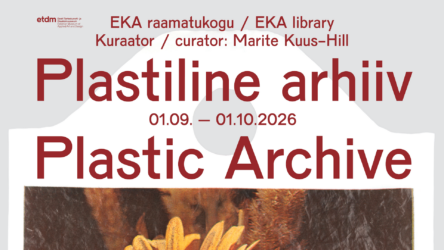
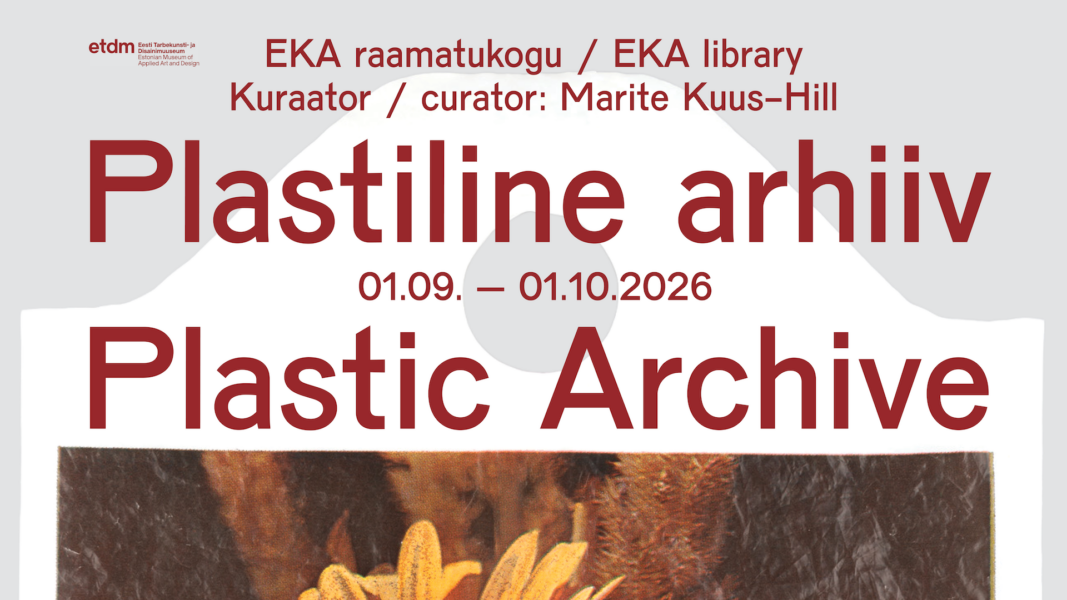
Plastic bags are nowaday’s symbols of disposability, an object we associate with overconsumption and wastefulness. The plastic bag’s association with Western consumerism is precisely what made it an object of value during the Soviet period in Estonia. Behind the iron curtain, anything linked to the West was desirable because it signified modernity and freedom. The plastic bag thus became a currency, an accessory, a collectible and now, it’s a documentation of a bygone era.
The bags in this exhibition are originally from private collections and most of them are now in the collection of the Estonian Museum of Applied Arts and Design. They are examples of Estonian product design and applied graphic art, yet their designs also illustrate the daily culture of Soviet life in Estonia. The value that was attached to these bags was a reflection of its time which is remembered for its scarcity and repression. Our shift in perspective towards plastic bags reflects the shift in the world around us, both in everyday realities as well as political ideology. Plastic is known for its plasticity, its ability to shapeshift and morph. The reputation of plastic bags is plastic – it has changed from revolutionary wonder-material and object of desire to useless, disposable trash, associated with deteriorating over-production. In a way, every archive is plastic, because the way we see the objects is ever changing.
The texts of the exhibition are based on the supporting materials of the exhibition “Kile kotti! / Plastic into Bag!” which was shown at the Estonian National Museum and Estonian Museum of Applied Art and Design in 2004 and 2005, especially the interviews conducted by Kristi Kaljumägi and the exhibition text written by Pille-Triin Männik.
Thank you to Helen Adamson, Kristi Kaljumägi, Marvi Meriniit, Anu Järs, Chloé Gourvennec, Eva Mahhov, Marit Hololei and Katri Kuus. Research for this project has been supported by the Estonian Cultural Endowment.
Graphic design by Chloé Gourvennec.
03.09.2026 — 04.10.2026 Nordic and Baltic comics exhibition “Mythbústers” 03.09.–04.10.2026 Thursday 03 September, 2026 — Sunday 04 October, 2026
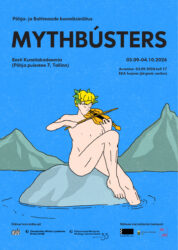
Nordic and Baltic comics exhibition “Mythbústers”
In the lobby of the Estonian Academy of Arts 03.09.–04.10.2026
Open Mon–Sun 8–23, admission free
Opening: Thu 3.09.26 at 5 pm in the lobby of the Estonian Academy of Arts
Artist talk with Emmi Valve, Joonas Sildre and David Schilter: Thu 3.09.26 at 5.30 pm
Emmi Valve’s workshop: Fri 4.09. at 2–4 pm
When thinking about the Nordic and Baltic countries, the first associations that come to mind might be trolls and Vikings, the midnight sun and the polar night, saunas and winter swimming, hygge and fika, Nokia and IKEA. Perhaps you have also heard of these countries’ excellent school systems and strong social welfare models? But what is behind these myths? 16 comic artists from all over the Nordic and Baltic countries created works that reflect their own unique perspectives on life in the region.
The Baltic comic magazine “š!”, issue 57 “Mythbústers” which includes all these works and is distributed worldwide, was published in connection to the exhibition.
As part of the exhibition, a comic drawing workshop for students will be held on Friday, September 4, at 2–4 pm, led by Emmi Valve. Participation is free, but places are limited. The workshop will be held in English and all students are welcome to participate. Register here.
Participating artists: Akvile Magicdusté (LT), Cecilia Vårhed (SE), Clara Jetsmark (DK), Disa Wallander (SE), Elín Elísabet (IS), Emmi Valve (FI), Ida Neverdahl (NO), Joonas Sildre (EE), Jurijs Tatarkins (LV), Laura Ķeniņš (CA), Liisa Kruusmägi (EE), Mari Ahokoivu (FI), Ona Kvašytė (LT), Søren Glosimodt Mosdal (DK), Tim Ng Tvedt (NO), Tommi Musturi (FI)
Curator: David Schilter (LV)
The exhibition is organised by Kuš! in cooperation with the Nordic Council of Ministers’ offices in Latvia and Estonia.
The exhibition was supported by the Cultural Endowment of Latvia, the Nordic Council of Ministers’ offices in Latvia and Estonia, the Danish Cultural Institute and the Embassy of Sweden in Riga.
04.09.2026 — 30.09.2026 Cristopher Siniväli “the sacred feeling of…” Friday 04 September, 2026 — Wednesday 30 September, 2026 Ceramics
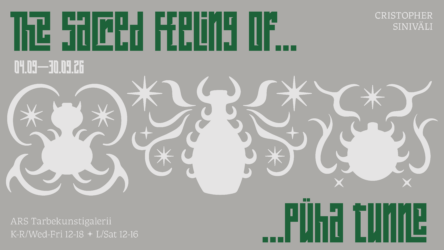
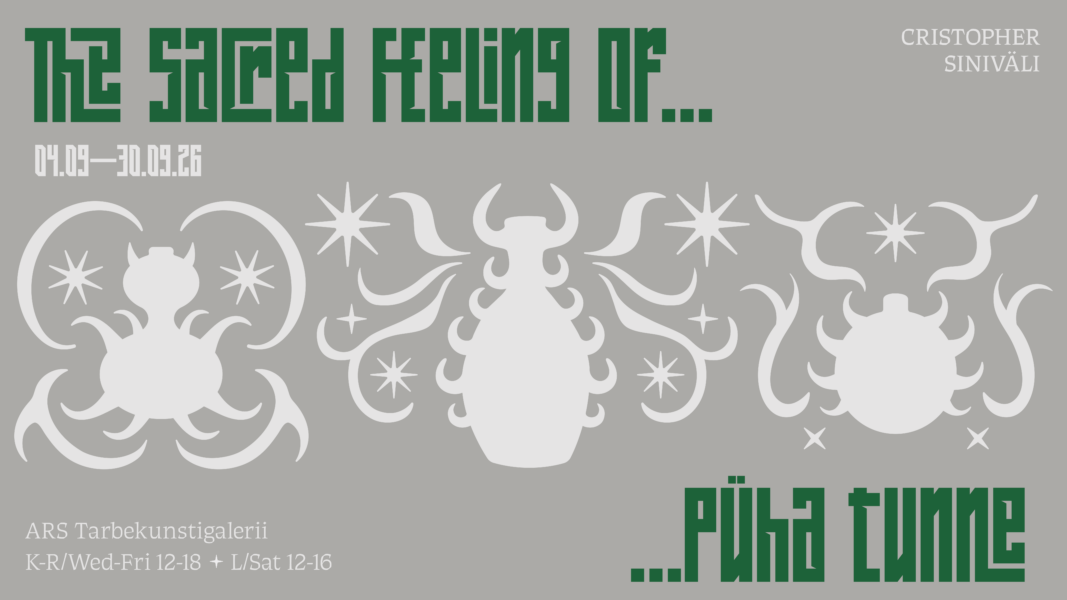
Sacredness usually sounds like something definite – a belief, symbol, or place set apart from the rest of the world. This exhibition, however, begins from a more fragile place: the feeling that something suddenly becomes meaningful, charged, untouchable, even when it is ordinary or impossible to describe in words.
The sense of intensity experienced in the exhibition presents sacredness not as a fixed definition, but rather as a field that circulates around objects. The protruding elements of the works evoke both protective armour and an energy field. Each form appears to hold or guard something—a memory, a body, a habit, a fantasy—yet their actual function remains open.
The exhibition invites visitors to reflect on, and remind themselves of, what feels sacred to them. Not in a grand or formal sense, but in the small ways certain objects, routines, and stories remain attached to us. Can something sacred exist only in reality, or does it exist solely in our imagination?
* Many of the ceramic works were created during an almost year-long ceramics internship in Berlin – a period that has shaped their forms and surfaces. In the exhibition, they are brought together in a new, altar-like constellation that makes room for both real and imagined sacred things.
Cristopher Siniväli (b. 1999) is a ceramic artist who received a Master’s degree in Design and Crafts from the Estonian Academy of Arts in 2025. His artistic practice centres on creating non-functional ceramic compositions, drawing deeply on nature and personal emotions for inspiration. In recent years, he has also explored the relationship between the human body and ceramics, considering how form and presence affect both the viewer’s experience and the experience of wearing an object. His work creates connections between ceramics, fashion, and sculpture.
Thank you: ARS Ceramics Center, Estonian Artists’ Association, Vivarec, Bildhauerwerkstatt, Karksi, Fazer
04.09.2026 — 04.10.2026 Loora Kaubi and Erik Hõim “Cobbled Together, Stumbling” Friday 04 September, 2026 — Sunday 04 October, 2026 Contemporary Art
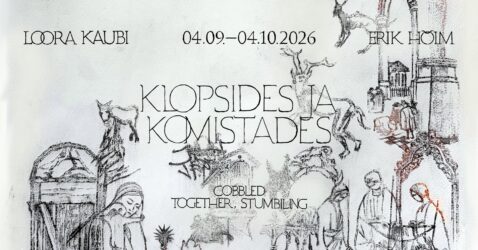
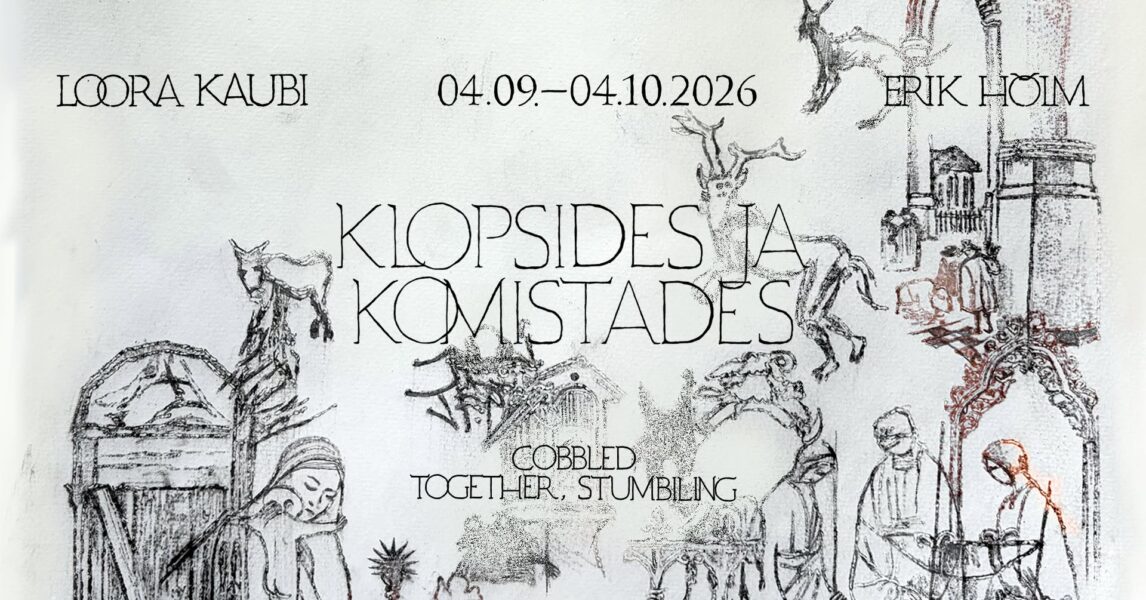
Loora Kaubi’s and Erik Hõim’s joint exhibition “Cobbled together, stumbling” is open till October 4th in the Monumental Gallery of the Tartu Art House.
The exhibition is inspired by memories of various places and stories. These stories speak to age-old needs: how to be with people when they can no longer be with us, and how to say the words that have come too late.
We believe in that which we hope for. We believe that our memory will always shine with the same brightness. We believe that we will forever hold a place in this rapidly changing, aching world. Faith is a small and stubborn thing. It is a load which we bear. This faith can become a chapel-shaped house, not built in memory of a single person, but as a tribute to all those who have ever been longed for.
It is hard to say why mortal humans build houses for those who are no longer here, shelters in which one can continue to believe in the possibility of good, quiet worlds, filled with small gestures for humanity, cobbled together bit by bit from whatever happens to be at hand, without trying to adorn that which we still do not know, or force any meaning onto anything. But still, small stones, lines, pieces from familiar places say: someone was here. They did exist. And maybe in the end that is the meaning of faith: we hope that something stays.
Loora Kaubi (b. 1998) is an artist working in Tallinn. Her work explores themes of sleep, personal and collective memory and fatigue. Kaubi holds an MA in fine arts from the LUCA School Of Arts, a BA degree from the painting department of the Estonian Academy of Arts, has completed a portion of her studies in the Vienna Academy of Arts and did an internship in Mexico City.
Erik Hõim (b. 2001) has a bachelor’s degree in photography from the Estonian Academy of Arts and has furthered his studies in photography in Prague, at FAMU. He has received the Estonian Youth Contemporary Art Association’s weekly award, the audience award of the Summer Exhibition and has participated in exhibitions in Tallinn, Võru, Urbino and Prague. He is part of the fictional artist Uru Valter and a member of the Estonian Youth Contemporary Art Association.
Graphic design: Diandra Rebase
Thanks: Hanna Samoson, the Contemporary Art Museum of Estonia, António Tainha, Mette Mari Kaljas and Deviis OÜ
The exhibition is being supported by the Cultural Endowment of Estonia.
05.09.2026 — 31.10.2026 Ceramists’ Union Annual Exhibition “Silent Resonance” Saturday 05 September, 2026 — Saturday 31 October, 2026 Ceramics
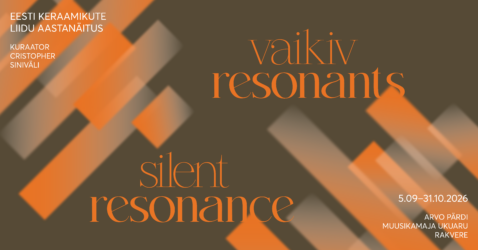
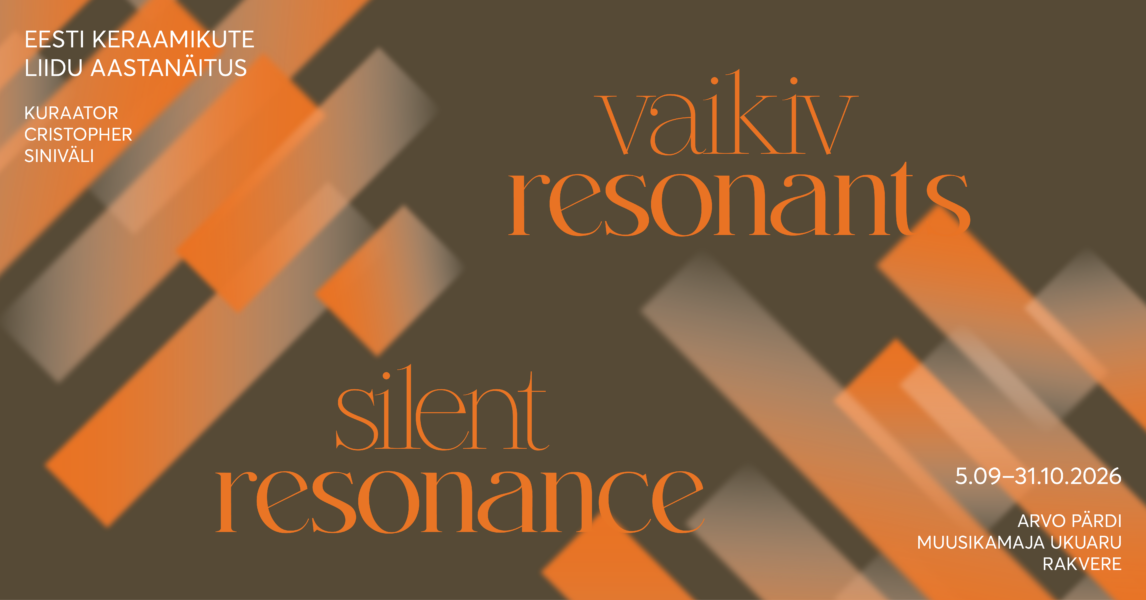
“silent resonance” is an exhibition in which ceramics and sound meet not through direct “musicality,” but through behaviour: how ceramic form, mass, surface, and emptiness affect the space we perceive. A work may function like an acoustic organism – one piece absorbing sound through matte, porous surfaces and soft edges; another reflecting it through glossy glaze, tense arches, and hard surfaces; a third dispersing it through rhythmic reliefs and fragmented geometry.
Air is an essential quality of the works: the invisible volume held inside the ceramic is like a lung or chamber, giving the object internal tension and presence. Openings, necks, edges, lids, and mouths create the impression that an object could resonate – even if it does not actually make a sound. The focus therefore shifts from sound as content – melody, recording, performance – to sound as a quality: resonance, silence, reverberation, and dampening.
Silence becomes the exhibition’s supporting material. “Silence” as a formal decision – an omitted detail, a break in a pattern – and “listening” as a way of looking. The viewer does not need to listen with their ears; it is enough for the work to make them perceive the space differently: more slowly, more closely, and more attentively.
“silent resonance” is not a conventional ceramics exhibition where visitors are expected to keep their distance from seemingly fragile works. On the contrary, visitors can physically engage with many of the pieces: approach them, view them from different angles, and discover details that only become visible up close. Several works can even be gently touched, moved, and used to produce sound. This interactivity is not a “game,” but a way of listening to the space and the work through the body: how the direction of openings, the depth of inner voids, the roughness of surfaces, or glazed areas become perceptible only through closer engagement.
A quiet resonance emerges when looking becomes a form of attention akin to listening.
Organizer: Estonian Ceramists’ Association
Curator: Cristopher Siniväli
Supporters: Cultural Endowment of Estonia, Bellus Furniture OÜ, Nudist Participating artists: Mari Ait, Ingrid Allik, Kaja Altvee, Merike Hallik, Kadi Hektor, Elize Hiiop, Eve Hint, Jarõna Ilo, Sergei Isupov, Kadri Jäätma, Tiina Kaljuste, Karin Kalman, Üllo Karro, Kersti Karu, Lauri Kilusk, Milvi Korela, Jaana Kormashov, Külli Kõiv, Kristel Kärdi, Triinu Maide-Safin, Margit Mald, Maia Noorväli, Ann Nurga, Aigi Orav, Clelia Piirsoo, Urmas Puhkan, Rave Puhm, Kadri Pärnamets, Anne Pärtna, Rita Randma, Ene Raud-Mägi, Sander Raudsepp, Aino Saan, Maarika Saarelaht, Kärt Seppel, Marget Tafel-Vahtra, Katri Taklaja, Ene Tapfer, Annika Teder, Margit Terasmees, Helena Tuudelepp, Triin Türnpuu, Mart Vaarpuu, Helle Videvik
06.09.2026 — 10.01.2027 From Sketch to Printed Fabric Sunday 06 September, 2026 — Sunday 10 January, 2027 Textile Design
A joint exhibition by the EKA Textile Department and Kreenholm textile artists on the process of printed-fabric making
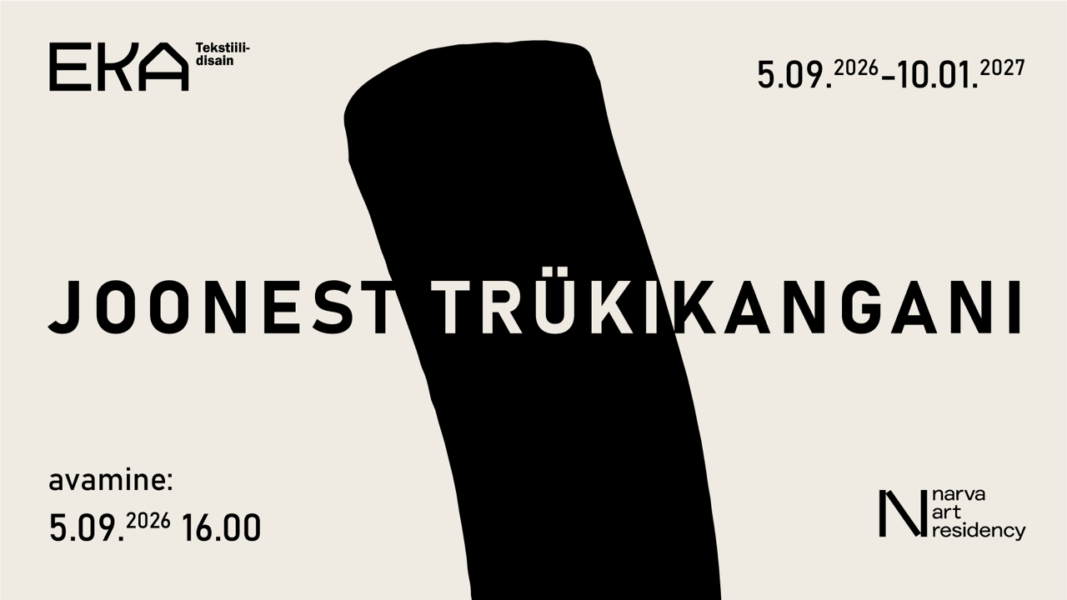
Opening at Narva Art Residency on September 5th 16:00, From Sketch to Printed Fabric brings together archival materials by Kreenholm textile artists and contemporary printed fabrics by students of the Estonian Academy of Arts.
The exhibition looks at the process behind printed textiles: how a repeat is constructed, how a sketch develops into a printable fabric, and how colour separation and registration shape the final result.
The exhibition presents works and archival materials by Kreenholm textile artists from 1960–2000, including sketches, repeats, colour studies, print proofs and fabrics. Alongside them are large-scale digital prints by EKA Textile Department students, designed in relation to Kreenholm’s historical repeat dimensions of 640 and 914 mm and bringing contemporary themes and perspectives into the exhibition.
An installative printing table with technical samples introduces the screen-printing process from idea to printed fabric. Visitors can also experiment with creating their own patterns and immediately see how they work in repetition.
Opening: 5 September 2026
Exhibition: 6 September 2026–10 January 2027
Location: Narva Art Residency (NART)
Curator: Alyona Movko-Mägi
Exhibition design: Eva Reiska
Works and archival materials by Kreenholm textile artists, 1960–2000
Estonian Academy of Arts, Department of Textile Design
Artists: Rosena Marju Melvin, Annabel Mustasaar, Ethel Noortoots, Karin Sarv, Hannah Parman, Katriin Tammoja, Getlin Tammoja, Eliisa Leppik, Marta Velda Loos, Freia Mugra, Lisandra Murumets, Helena-Mai Posti
Tutors: Krista Leesi and Piret Valk
Supporters and partners: Estonian Academy of Arts, EKA Textile Design, Cultural Endowment of Estonia / Eesti Kultuurkapital, Narva Art Residency (NART)
11.09.2026 — 11.10.2026 “STUDIO” at EKA Gallery 12.09.–11.10.2026 Friday 11 September, 2026 — Sunday 11 October, 2026 Architecture and Urban Design
“STUDIO: EKA Architecture and Urban Planning Graduation Projects 2004–2026”
EKA Gallery 12.09.–11.10.2026
Open Tue–Sat 12–6 pm Sun 12–4 pm
Opening: Friday, September 11 at 6 pm
Architecture is one of the disciplines through which societies imagine alternatives to present conditions. In Estonia too, architecture students have for decades asked in their graduation projects what other lives could be possible for us. Characteristically for the discipline, answers have been sought through imaginative representations – drawings, models and texts.
The graduation project, a creative genre in which realisation is not expected, has allowed students to wander and stake out a place of their own in this strange territory between hard reality and pure imagination, starting from existing conditions, yet able to play out possibilities more freely, sometimes well beyond the bounds of realism.
From 2004 to 2026, EKA’s Department of Architecture and Urban Planning has supervised this work in the studio format. “STUDIO” situates this format within the broader history of architectural education and practice-based research, while looking back at the rich archive of graduation projects that have accumulated over these years. What have successive cohorts considered worthy of attention, investigation and change? What architectural responses have they imagined? And what role has the studio played in shaping such inquiry?
Curators: Eik Hermann, Andres Ojari, Toomas Tammis (Department of Architecture and Urban Planning, EKA)
Exhibition design: Andres Ojari, Toomas Tammis
Design of light boxes: Raul Kalvo (InPhysica Technology)
Graphic design: Stuudio Stuudio
Technical support: Ats Kruusing, Eugenio Marini, Éric-Olivier Thériault-Raymond
Thanks: all the supervisors and students of the EKA department of Architecture and Urban Planning 2004–2026, Sander Haugas, Oliver Kanniste, Mikk-Mait Kivi, Jevgeni Krassi, Priit Kõiv, Tiina Tammet, Avo Tragel
The exhibition is supported by the Cultural Endowment of Estonia, Estonian Academy of Arts, Tallinn City and Sadolin Estonia.
Opening drinks from mirai™ and Põhjala Brewery.
11.09.2026 — 24.10.2026 Banasińska, Kaubi, Januševičiūtė “Familiar Stranger” Friday 11 September, 2026 — Saturday 24 October, 2026 Faculty of Fine Arts
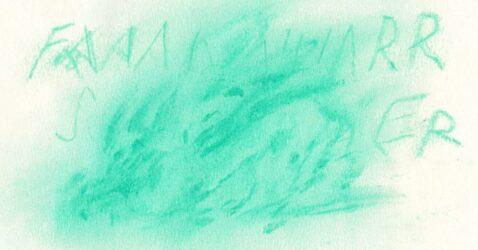
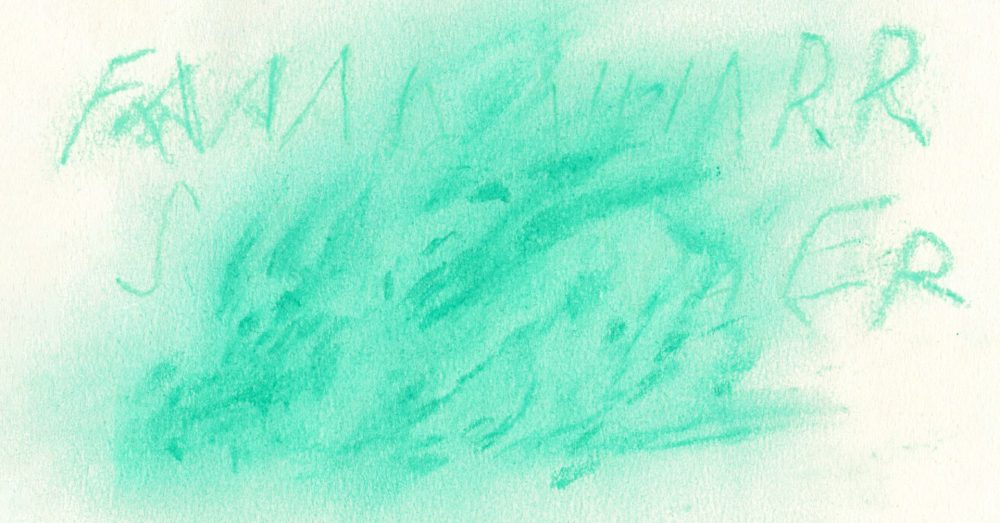
On Friday, 11 September, at 6pm, Editorial (Latako 3, Vilnius) will open the exhibition Familiar Stranger, curated by Milda Januševičiūtė. The exhibition is part of the Vilnius Gallery Weekend programme.
Familiar Stranger brings together works by Zuza Banasińska, Loora Kaubi, Sarah Neumann and Milda Januševičiūtė, to look at memory as an unstable process through which personal and collective identities are continually reconstructed. The exhibition lingers between family histories, inherited images, bodily memory and digital archives, asking what happens when the past reaches out through fragments: a story repeated by relatives, an image whose details no longer agree, a gesture inherited without explanation, or a file stored somewhere in the clouds. Memory here is less an archive of what happened, and more an ongoing negotiation between what is remembered, forgotten, altered and passed on.
The exhibition is interested in the shift between embodied and externalised memory. What was once held in stories, objects and bodies increasingly also exists on corporate servers, accessible through passwords, subscriptions and infrastructures that we rarely see. Forgetting may be a basic condition of being human; data storage has made it into a service.
Rather than treating memory as reliable evidence, Familiar Stranger considers how remembering is shaped by repetition, omission, technology, and the moment from which it looks back. The familiar can return slightly changed; someone else’s memory can quietly enter our own; an inherited story can feel simultaneously intimate and strangely foreign. The exhibition does not propose the recovery of an original, intact past. Instead, it asks how to live with what remains, what has already been rewritten, and what we choose, or allow other systems, to remember for us.
The exhibition can be seen at Editorial (Latako 3, Vilnius) until 24 October.
Familiar Stranger
Artists: Zuza Banasińska, Milda Januševičiūtė, Loora Kaubi, Sarah Neumann
Curator: Milda Januševičiūtė
Architect: Ona Juciūtė
Designer: Monika Janulevičiūtė
Language Editor: Joseph Everatt
The exhibition is funded by the Lithuanian Council for Culture
The exhibition will be accompanied by a programme of events: follow us for updates at www.editorial.lt.
22.09.2026 — 14.11.2026 LLRRLLRR Exhibition “Loose Knots” in Prague Tuesday 22 September, 2026 — Saturday 14 November, 2026 Architecture and Urban Design
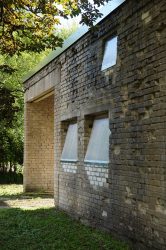
On Tuesday, 22 September, an exhibition titled Loose Knots by the Estonian architecture practice LLRRLLRR opens at the architecture gallery VI PER in Prague.
Laura Linsi and Roland Reemaa (LLRRLLRR) present three projects that draw inspiration from traditional practices of reuse and adaptation, the robustness characteristic of the Baltic landscape, and collectively emerging pedagogies. The exhibition explores alternative paths to the norms established within the architectural profession. Through their projects, LLRRLLRR seek to question prevailing tastes, funding models, and established practices of architectural competitions and commissioning processes, which have become central to shaping architectural practice.
In addition to the duo’s projects, the exhibition presents the works produced during Paraply, an architecture summer workshop that Laura and Roland led in Copenhagen. The exhibition features works by Estonian textile artist Johanna Ulfsak and English-Belgian artist Chris Evans, with whom the architects collaborate closely on numerous projects.
Laura Linsi and Roland Reemaa teach diploma studios at the Estonian Academy of Arts and at Central Saint Martins, University of the Arts London. Roland is a visiting professor at the Estonian Academy of Arts, while Laura is editor-in-chief of the Estonian architecture magazine MAJA. Both practise as architects and work across the expanded field of spatial practice.
The exhibition is supported by the Cultural Endowment of Estonia and the Embassy of Estonia in Prague.
Web:
https://www.vipergallery.org/en/exhibition/llrrllrr-loose-knots
https://llrrllrr.com
Instagram:
@llrrllrr_studio
@vipergallery
Future
01.10.2026 Seminar: How does EKA’s circular design research and development work come into practice? Thursday 01 October, 2026 Faculty of Design
You are invited to listen to how The Circular Design and Materials Research Group (DiMa) got its start, what we are working on today, what projects are currently underway and what the future holds.
Let’s see what impact DiMa’s research and development work has created over the years, both in Estonia and internationally. We will also take a closer look at the journey of the UPMADE platform, which grew out of DiMa’s activities, and its first major steps in the international market.
Margaret Aus, senior researcher at DiMa, and Triin Siimer, project manager, and Jeanine Ballone, founder of World Collective and UPMADE’s business model advisor, will talk about the work and experiences of the research group.
The event will be held in English.
Schedule:
15:00 Welcome
15:05 DiMa – who are we, what have we done so far and where are we going?
15.30 Introduction to the UPMADE platform and plans
16.00 Discussion and questions
16.30 Closing
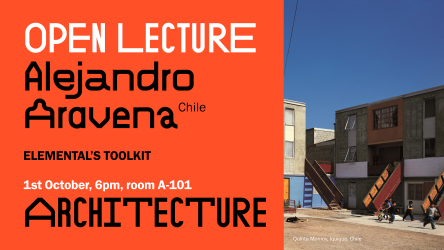
01.10.2026 Open Architecture Lecture: Aljeandro Aravena Thursday 01 October, 2026 Architecture and Urban Design
This autumn’s Open Architecture Lecture Series is curated by Mira Samonig, a doctoral student at the EKA Faculty of Architecture and one of the curators of the 2026 Tallinn Architecture Biennale, under the overarching title Standby.
This autumn open lecture series brings together practitioners and scholars attentive to public agency and to the way standardised spaces of power and capital can be pixelated. Standby considers how space and architecture are never fully revolutionary in themselves, just as they are neither merely static backdrops. The series looks at spaces in which social, political and material capacities are maintained in suspended readiness and not exhausted by programmed function; invited lecturers speak to what these practices are and what they might become across architecture, urbanism, design and theory.
World-renowned architect Alejandro Aravena will open this autumn’s lecture series on 1 October at 6 pm in the EKA Auditorium with his lecture “Elemental’s Toolkit”.
Alejandro Aravena is a Chilean architect, co-founder and partner of the Santiago-based studio Elemental. In 2016, he was awarded the Pritzker Architecture Prize and appointed Director of the Venice Biennale the same year, previously he taught at Harvard Graduate School of Design. His architectural work is particularly defined by socially engaged and incremental housing approaches that address economic inequality in urban spaces. Elemental is internationally recognised for their design of structurally complete “half a good houses” as a strategy that enables low-cost housing to be built on more expensive land closer to economic opportunity. Drawing from a wide portfolio of completed projects, Aravena will introduce his architectural practice and emphasise architecture as an enabling framework for collective agency.
The lecture is free of charge and will be held in English.
Previous Open Architecture Lectures are available to watch at www.avatudloengud.ee.
The lecture is a collaboration between the EKA Faculty of Architecture and TAB 2026, kindly supported by the Embassy of Chile to Finland and Estonia. The lecture series is supported by the Estonian Cultural Endowment.
01.10.2026 — 03.10.2026 Conference “Giving Voice to Museum Collections: Finno-Ugric and Sámi Heritage Today” Thursday 01 October, 2026 — Saturday 03 October, 2026 Institute of Art History and Visual Culture
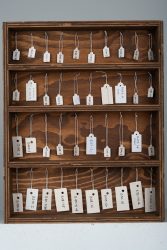
The collections of Finno-Ugric and Sámi heritage in Estonian museums are shaped by long and sometimes contested histories. They preserve not only material objects, but also forgotten narratives: Indigenous knowledge, relationships and voices that have largely remained undocumented or marginalised.
This conference seeks to examine the histories of these collections, and, most importantly, to explore their future: how they can be activated in new and empowering ways to uncover hidden stories, amplify marginalised voices, and generate new knowledge.
We aim to create a space for discussion on rethinking collections and their futures. Particular attention will be paid to the authors, donors, and collecting practices behind the objects, as well as on consciously engaging with institutional and cultural amnesia.
How can the collections be used as a starting point for exploring new possibilities and horizons? How can we develop new ways of knowledge creation, grounded in context-sensitive and collaborative thinking, and enabling more inclusive and non-hierarchical engagement with Finno-Ugric and Indigenous themes?
A central focus of the conference is a comparative approach to decolonisation, addressing its meanings and practices across different contexts, including Sámi, Estonian and broader Eurasian frameworks, as well as in relation to specific Finno-Ugric collections. By bringing these perspectives into dialogue with global decolonial theory and practice, we seek to highlight regional particularities and to explore how this region can contribute to expanding and diversifying understandings of colonial histories and decolonial thought.
Special attention is given to the creators of the works held in museum collections and to artistic research as a practice for exploring how interdisciplinary approaches can help spotlight marginalised voices and open up new ways of engaging with and interpreting collections.
The three-day conference is organised into thematic sections, in which scholars and artists from different fields address the historical and contemporary meanings of collections, and creating and communicating future-oriented knowledge.
The conference is being jointly organised by the Estonian Academy of Arts, the Art Museum of Estonia and the Estonian National Museum.
1 October
Venue: Kumu Art Museum (Weizenbergi 34 / Valge 1, Tallinn)
18:00 Opening of the exhibition Expedition: Finno-Ugrians and the Power of Images in the atrium of the Kumu Art Museum
2 October
Venue: Estonian Academy of Arts (Põhja pst 7, Tallinn), A-101 auditorium
10:00–10:15 Opening remarks
Panel I
10:15–11:45 Collaborating with Collections
Svetlana Karm (Estonian National Museum) and Piret Koosa (Estonian National Museum). Materialising Kinship? Ambivalences in Finno-Ugric Collecting Laur Vallikivi (University of Tartu). Gods, Idols, and Museum Objects: The Lives of khekheq in the Nenets Tundra
Bart Pushaw (University of Tennessee at Chattanooga). From Reactive to Reciprocal: Indigenous Belongings and the Past-Present-Future
Discussant and moderator: Linda Kaljundi (Estonian Academy of Arts)
Panel II
12:00–13:00 Ethnographic Film
Stephan Dudeck (University of Tartu, University of Lapland, Vilnius University, Foundation for Siberian Cultures) and Liivo Niglas (University of Tartu). Collaborative Practices in the Lennart Meri Film Project The Sons of Torum
Alo Paistik (Film-maker and researcher, Goethe-Universität Frankfurt). Archival Isthmus, Notes on Returning Images
Discussant and moderator: Terje Toomistu (University of Tartu, Tallinn University)
13:00–14:00 Lunch Break
Panel III
14:00–14:45 Oil Landscapes: Extraction, Labour and Indigenous Struggle
Katherine Zubovich (University of Buffalo). Late Soviet Petroscapes: Estonian Materials and Builders in the Oil Town of Kogalym
Discussant and moderator: Andres Kurg (Estonian Academy of Arts)
14:45–15:00 Coffee break
15:00–15:30 Anders Kreuger (Kunsthalle Kohta, Helsinki) Is there a future for ethno-futurism?
Panel Discussion 15:30–17:00: Practices of Change: Art – Research – Activism
Marika Alver (Artist group SLED)
Jaanika Vider (Tallinn University)
Eero Ehanti (National Museum of Finland)
Discussant and moderator: Anders Kreuger (Kunsthalle Kohta, Helsinki)
3 October
Venue: Estonian National Museum (Muuseumi tee 2, Tartu), Moora auditorium
15:45–16:45 Panel discussion: What is an artist doing in collections? Practices, prospects and problems
Artists, film-makers and researchers:
Karl Joonas Alamaa
Jaanus Samma
Alo Paistik
Discussant and moderator: Eva Toulouze (University of Tartu)
01.10.2026 — 28.11.2026 Group Exhibition “The Motorway is Clearly Audible Even with the Curtains Drawn” Thursday 01 October, 2026 — Saturday 28 November, 2026 Faculty of Fine Arts
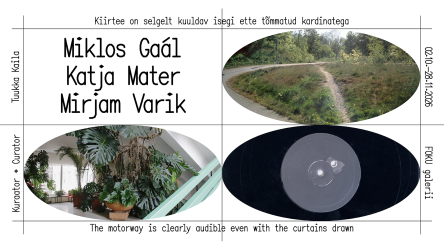
On Thursday, 1 October, at 6:00 PM, the international group exhibition The Motorway is Clearly Audible Even with the Curtains Drawn will open at the FOKU Gallery, featuring artists Miklos Gaál (FI/NL), Katja Mater (BE/NL), and Mirjam Varik (EE). The curator of the exhibition is Tuukka Kaila (FI/EE).
The exhibition proposes an understanding of space as actively produced by those who experience it. Both intentionally and unconsciously, space is shaped through individual acts as well as shared patterns of behaviour. Rather than an empty container or passive stage, space is regarded here as an ever-changing social construct, a negotiation between its physical characteristics and their subjective interpretation.
The title of the show The motorway is clearly audible even with the curtains drawn quotes an Airbnb user review. On the platform, users share their experiences of the listed spaces with the purpose of helping others imagine what it’s like to spend time in them.
The exhibition will remain open at the FOKU Gallery until 28 November 2026.
FOKU Gallery is a gallery-showroom focused on contemporary lens-based art. FOKU Gallery is run by the Estonian Union of Photography Artists (FOKU).
Supporters:
Cultural Endowment of Estonia
Alfred Kordelin foundation
Partner:
Rüki galerii
Opening drinks by:
Mikkeller
02.10.2026 DiMa at Tallinn Design Week: How Can We Make the Textile Industry More Sustainable? Friday 02 October, 2026 Ringdisain


On 2 October from 13.00–15.00, the Disainiöö programme at Põhjala Factory will host “Sustainable Textile Counselor: A New Learning Opportunity in the Textile Sector”, introducing a new international educational initiative focused on supporting sustainable transformation in the textile sector.
The textile industry faces an urgent need for new knowledge, skills and approaches to make production and consumption more sustainable. The Sustainable Textile Counselor (STC) project offers a practical learning pathway for professionals who want to support companies and organisations in developing more sustainable textile practices.
The event will introduce the STC project and its independent learning opportunities, while also exploring what it means to work as a sustainable textile counselor. The event will also celebrate the completion of Estonia’s first STC pilot programme, with diplomas presented to the newly trained counselors.
The programme will conclude with a hands-on workshop led by the new sustainable textile counselors. Participants will have the opportunity to explore practical approaches, knowledge and methods developed during the pilot programme.
The event is free and open to everyone interested in sustainable textiles.
Põhjala Factory
2 October
13.00–15.00
More information: https://www.sustainabletextilecounselor.com/
The event is organised by DiMa, EKA’s Circular Design and Materials Research Group.
04.10.2026 — 11.10.2026 Kristen Punger “At the End of the Storm, There’s a Golden Sky” @ KESKPUUR Sunday 04 October, 2026 — Sunday 11 October, 2026 Faculty of Fine Arts
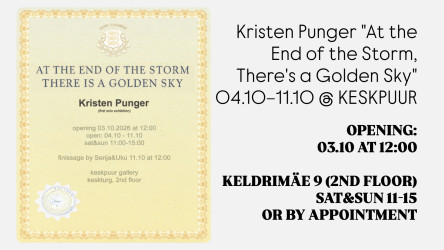
The opening of Kristen Punger’s first solo exhibition will take place on October 3 at 12:00. Drinks for the opening will be provided by Põhjala.
Keskpuur Gallery, Keldrimäe 9(2nd floor)
Sat&Sun 11-15 or by appointment: senja.keskpuur@gmail.com
*opening hours might differ*
Throughout my high school years, I have accumulated an entire cabinet full of scraps of paper: drawings, reminders, homework, and other paper materials containing personal information. Now, as I begin a new chapter of my life by entering university, I feel the need to make space at home and let go of the past.
In order to make space, leave the past behind, and start with a fresh piece of paper figuratively, I decided to get rid of old pieces of papers literally. Yet they still hold significance – they carry memories, traces of my artistic development, and recollections of my difficult years of high school. That is precisely why simply throwing them away felt wrong. This exhibition tries to give a proper farewell to those papers and with them to my high-school years, helping me to finally let go.
After the exhibition, all the papers will be burned, freeing the space for the future.
…
Kristen Punger (2007) is a young independent artist based in Tallinn, working with installation and spatial practices. In 2026, he graduated from Tallinn Art Gymnasium and began studying blacksmithing at the Estonian Academy of Arts.
Kristen’s practice explores the relationship between personal experience, memory, and physical space, often transforming unwanted materials and environments into immersive and interactive installations. His work is influenced by an interest in political activism, an earlier involvement with street art, and possibilities of how personal and collective stories can occupy space.
He also works as an assistant at Keskpuur Gallery and is independently developing his own gallery space, „Pink”, which will open soon.
…
The exhibition’s finissage will take place on 11 October, curated by Senja Savtšenko & Uku Õunapuu, with space design by Anastasija.
The day will begin at 12:00 with a DJ set by uju (Uku Õunapuu), who will also be making waffles for visitors — so come early!
From 13:00–13:30, the Italian trio CANETAMBURO (Elia Dell’Orco, Eugenio Cecchini, and Gabriele Teti) will present a live electroacoustic set.
Following the performance, the programme will continue with ambient music and conversations until around 16:00.
The finissage will mark the closing of Kristen’s exhibition and the opening transition towards the next exhibition by Beate & Jegor, on view from 17 October to 15 November.
The event also marks the beginning of a new chapter for the space. We look forward to introducing our new team and sharing more about our vision and programme with you. More information coming soon!
05.10.2026 Open Lecture: “The importance of Dynamic Evolving Architecture” by Dr. James Ritson Monday 05 October, 2026 Cultural Heritage and Conservation
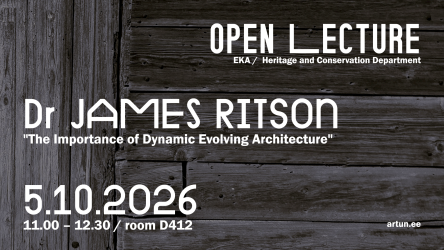
Open lecture “The importance of Dynamic Evolving Architecture” by architectural heritage specialist Dr. James Ritson will be held in the Department of Heritage Protection and Conservation as part of the EU-Repair project on October 5 at 11:00-12:30 in room D-412.
Introduction to the content of the lecture:
Our sustainable future requires us to adapt to new paradigms of a low-carbon circular society. Existing buildings have often been seen as a barrier in creating a sustainable future built environment. However, viewed through the lens of circularity, existing and historic buildings become part of the solution rather than a barrier to our sustainable, low-carbon circular future.
Lecturer: James Ritson BA (Hons) PGDip MA PhD FRGS, Associate Professor, Senior Academic for Sustainability, University of the Built Environment
James is an architecturally trained building conservator specializing in sustainability and the recording of the historic built environment. He is currently an Associate Professor in sustainability of the Existing Built Environment at the University of the Built Environment. Previously, he was a senior lecturer in the sustainability of the existing built environment at Kingston University, teaching on the Building Surveying, architecture and historic building conservation courses. James is currently a member of the ICOMOS International Scientific Committee on Energy and Sustainability (ICOMOS ISCES) and the ICOMOS UN Sustainable Development Goals Working Group. He was made a fellow of the Royal Geographical Society in 2010 for work on the sustainability of the built environment. He has published widely on sustainability, health and conservation issues. James is also an expert reviewer for Routledge and the Journal of Architectural Conservation.
The lecture will be held in English and will be recorded for the e-course of the EU-Repair project.
The aim of the EU-REPAIR project is to promote sustainable renovation of buildings in Estonia, Germany, Lithuania, North Macedonia and Serbia.
06.10.2026 — 24.10.2026 Mirjam Varik and Juulia Aleksandra Mikson “Luht /(Flood) Meadow” Tuesday 06 October, 2026 — Saturday 24 October, 2026 Graphic Art
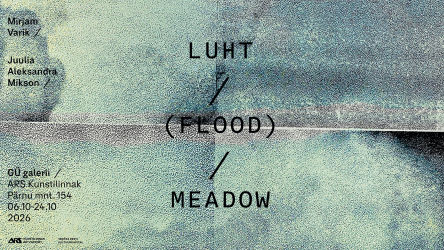
Mirjam Varik’s and Juulia Aleksandra Mikson’s exhibition focuses on a landscape familiar to both artists: Matsalu. Together, they observe the quiet movement of nature, which may, at first glance, appear to be a state of stillness. A flower grows in the garden bed, junipers spread along the edge of the meadow, a cloud lingers in the sky, and visible movement has come to a halt as the stillness of summer takes hold.
Both Varik and Mikson work with the medium of screen printing. They depict nature as a marker of time and space, weaving the local heritage of the Matsalu region through generations. The environment from which we have come and into which we disappear is only like this for a moment, until a ray of sunlight flashes from beyond the clouds and the Earth is once again different. The relief-like images, both in clay and on paper, refer to forms characteristic of Matsalu: clayey soil and the wind-exposed landscape, where views of the clouds are in constant flux. On the one hand, the surroundings are in perpetual transformation; on the other, they may seem uneventful to the human observer. In such a place, adaptation begins only when the viewer merges with the environment and learns to sense its natural rhythm.
ABOUT THE ARTISTS:
Mirjam Varik (1990) studied photography at the Tartu Art College (2014) and as an exchange student at the University of Arts Linz. She graduated from the Estonian Academy of Arts with a degree in Graphic Design (2021), followed by a Master’s degree in Contemporary Art (2024). Since 2023, she has worked with screen-printing in the Department of Printmaking.
In her artistic practice, Varik articulates seemingly insignificant moments that have a lasting impact on the formation of a person. Through photography, video and installation, she explores childhood experiences and identity in a narrative manner, focusing on memories, places and phenomena.
Juulia Aleksandra Mikson (1998) studied Textile Design at the Estonian Academy of Arts (2022). She has also furthered her studies in fashion and styling in Cyprus and at a plant-dyeing laboratory in Italy. She completed her Master’s degree in Craft Studies at the Estonian Academy of Arts (2025). Since 2022, she has worked as a screen-printing studio technician in the Department of Textile Design.
Juulia Aleksandra Mikson is a textile artist who explores the boundaries between materials. Her working process stems from the properties of the material, allowing the material itself to become a guide that shapes the dynamics of creation. In her liminal practice, she has combined textiles with clay as well as metal with textiles, discovering new layers in the relationships between materials. For Mikson, themes concerning the relationships between humans, the Earth and nature are of particular importance.
Graphic design: Martin Pedanik
With thanks to: EKA Department of Textile Design, EKA Department of Printmaking, Craftrag, Martin Mikson
Supported by: Cultural Endowment of Estonia, Põhjala Brewery
08.10.2026 — 09.10.2026 5th Conference of Baltic Art Historians: Art History in Uncertain Times Thursday 08 October, 2026 — Friday 09 October, 2026 Institute of Art History and Visual Culture
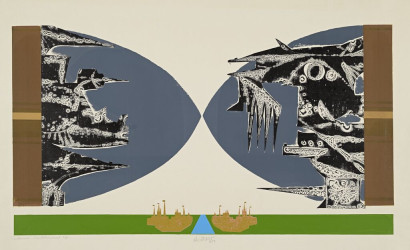
Conference of The Estonian Society of Art Historians and Curators
8–9 October, 2026
Estonian Academy of Arts, Põhja pst 7, Tallinn
Room A101
The conference aims to explore the voice of art history in relation to both contemporary and historical cultural, social, and political processes. We encourage participants to reflect on the role of art history as a discipline, as well as on the responsibilities of art historians and curators as individuals engaged in public discourse. What is the value of their expertise? How does it relate to power structures and public debate? What roles do traditional and emerging art historical methodologies play in addressing current issues? In what ways are scholarly and curatorial practices shaped by, or actively engaged with, broader social movements and political ideologies?
The conference continues the series of Baltic art historians’ conferences, including Geographies of Art History in the Baltic Region (Tallinn, 2009), (Un)blocked Memory: Writing Art History in the Baltic Countries (Kaunas, 2011), Representing Art History in the Baltic Countries: Experiences and Prospects (Riga, 2016), and Baltic Art Histories: Roles, References, Relations (Vilnius, 2024).
The conference is organized by the Estonian Association of Art Historians and Curators. The main organizer of the conference is Anu Allas, the committee includes Emili Kelle, Hanna Õunapuu, Merike Kurisoo, and Liisa Kaljula.
Programme
Thursday, 8 October
10.30 Gathering and opening words (Liisa Kaljula, Anu Allas)
11.00–12.30 I Panel: Art and Power
Chair Gregor Taul
Baiba Vanaga (Latvian National Museum of Art)
Wilhelm Neumann and the Riga City Art Museum during World War I
Jovita Jankauskienė (Independent researcher, Kaunas)
The Heteronomisation of the Art Field in Authoritarian Lithuania: Cultural Policy, Censorship, and Regimes of Recognition
Giedrė Jankevičiūtė (Lithuanian Institute for Culture Research)
Lithuanian Art under the Sign of Hakenkreuz
12.30–13.30 Lunch
13.30–15.00 II Panel: Continuous Past
Chair Margaret Tali
Ieva Astahovska (Latvian Centre for Contemporary Art)
Decoloniality, Monuments, and Erasing or Understanding the Past
Anu Allas (Estonian Academy of Arts)
Revisiting “Thinking Pictures”: Bildstreit on the Background of War
Ramutė Rachlevičiūtė (Vilnius Academy of Arts)
What Form did Lithuanian Surrealism Take, and How does it Manifest Itself Today?
15.00–15.30 Coffee break
15.30–17.00 III Panel: Activating Archives
Chair Ingrid Ruudi
Kai Stahl (University of Turku)
Additional Insights into the History of Estonian Art: The Three Mei Sisters and their Oeuvre
Laine Kristberga (University of Latvia)
Writing the History of What Was Not Supposed to Exist: Performance Art, Canon Formation, and Historiographic Silence in Soviet Latvia
Andra Silapētere (Latvian Centre for Contemporary Art)
Safety Zones and Shifting Timelines
18.00 Open Lecture
Chair Anu Allas
Curating Socialism. Sven Spieker (University of California) in conversation with Anders Härm (Estonian Academy of Arts / Kumu Art Museum)
Friday, 9 October
11.00–12.30 IV Panel: Negotiating Knowledge
Chair Epp Lankots
Andres Kurg (Estonian Academy of Arts)
Architectural Historian in Uncertain Times: Jean-Louis Cohen and Cold War Asymmetries
Virve Sarapik (Estonian Academy of Art)
Negotiating the Canon: Soviet Encyclopedias and the Production of Art Historical Knowledge
Krista Kodres (Estonian Academy of Arts)
(Art) History and “Postmodernism”: Epistemological Uncertainty in the Uncertain 1990s
12.30–13.30 Lunch
13.30–15.00 V Panel: Creative Interventions
Chair Magdaleena Maasik
Linara Dovydaitytė (Vytautas Magnus University)
Emotional Heritage: Affective Encounters with a Dissonant Past in a Museum
Linda Kaljundi (Estonian Academy of Arts)
How to Reframe Monuments – and/or the Practices of Art History and Curating?
Agnė Narušytė (Lithuanian Culture Research Institute)
Artists and Art Historians at War: The Case of Three Films by Darius Žiūra from Ukraine
15.00–15.30 Coffee break
15.30–17.00 Roundtable on Art History Writing in the Baltics
Chair Liisa Kaljula
Kristiāna Ābele (Art Academy of Latvia), Krista Kodres (Estonian Academy of Arts), Giedrė Jankevičiūtė (Lithuanian Institute for Culture Research)
12.01.2027 Urban Studies MSc programme online info session 2027 Tuesday 12 January, 2027 Urban Studies
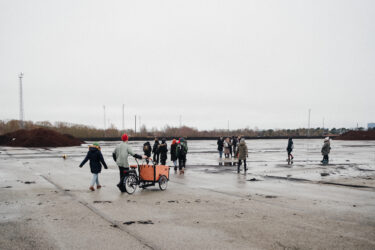
EKA Urban Studies MSc programme invites prospective master’s students to join the programme’s online info session on Tuesday, January 12, 2027 at 17:00 EET (local Estonian time).
This online info session will be a good opportunity to hear more about the curriculum, and to meet and ask questions directly from people behind the Urban Studies programme. The info session will be hosted online over Zoom.
If you would like to attend, please register online through the form below. A link to attend will be e-mailed shortly before the event begins.
REGISTER HERE
More information about Urban Studies MSc programme:
- https://www.artun.ee/urban-studies
- https://www.facebook.com/urbantallinn
- https://www.instagram.com/ekaurbanstudies
Next admissions period starts on the 1st of February 2026 and application deadline is 2nd of March 2026 at 3pm EET (local Estonian time).
Subscribe to EKA Calendar in order to see EKA events in your Google Calendar, Microsoft Outlook, or other iCal compatible calendar service.