
PhD Students
DAMIANO CERRONE (4th year, extern)
Urban meta-morphology: new principles of urban structure
Supervisors PhD Mart Kalm, PhD Panu Lehtovuori
The PhD is about developing a new method to map and reveal the invisible image of the city using social media data and activity patterns. It is believed that spatial accessibility is the main attractor of social interactions (activities) and economic transaction (businesses) but in my case studies I present how the shape of the city is no longer related to activity patterns and use of certain space. This means that the practice of planning has to be updated and upgraded with this new understanding of urban phenomenology. Through the work of SPIN Unit I have used this new methodology (urban-metamorphology) to influence the planning and education practice in the US, Europe and Russia.
JOHAN TALI (4th year, on academic leave)
Animating future scenarios for public space
Supervisors PhD Andres Kurg, PhD Maroš Krivy
Public space has become a widespread agenda for architects. The „space between the architecture“ has become subject to political correctness. Yet the notion of public space goes far beyond generous gestures in the built environments. In a global market economy, the public extends to geopolitics in planetary scale, yet very few spatial factors have been subject to environmental thinking as a public domain. With policies like the Paris Agreement, the first steps have been made in understanding the potential of a global public space, yet spatial practitioners stand far from being at the core of these debates, while their tools of projecting scenarios can potentially be the most effective in animating future developments.
MATTIAS MALK (4th year, extern)
Disruptive Infrastructural Renewal: The Case of Rail Baltica
PhD Maroš Krivy
The spatial order of the world is urban and its history is one of circulation. Therefore, researching mobility infrastructure can offer particularly valuable insights for urban studies, revealing geometries of power. My thesis delves into the particular controversies around planning and delivering Rail Baltica, analysing the economic and political context of the particular time and location. Considering capital and circulation as the defining agents of urbanisation, my research investigates the motivation of various stakeholders against the global challenges as well as local impacts of large scale infrastructural renewal by combining a topological mapping of the planning process with qualitative case studies.
info@mattiasmalk.com
KARIN BACHMANN (4th year, on academic leave)
Curated Biodiversity as a Mitigator of Global Urban Change: Orienting Value Systems with Landscape Architecture Solutions
Supervisor PhD Urve Sinijärv
Doktoritöö ülesanne on mõtestada maastikuarhitektuuri distsipliinina positsioonis, kus vastavate võtetega on sel võimalik toimida leevendavate meetmete kogumina. Globaalmuutuste põhjused on lokaalsed ehk et saanud alguse kohalikul tasandil tehtud otsustest ja tegevustest. Nende muutustega tegelemine peab samuti algama kohalikest otsustest. Kuigi muutused on olemuselt reaalteaduslikud, siis lahendused neile peituvad järjest enam humanitaarteadustes ehk tuleb tegeleda inimeste suhtumiste ja veendumustega. Globaalmuutuste põhjuseks ei ole halvad kavatsused, vaid üldsuse tahtlik teadmatus. Sellest on saanud majandusressurss, mille pinnalt saab teha majandusest juhitud otsuseid, hoolimata olulistest väärtussüsteemidest.
Globaalprobleemidele lahenduste otsimine lokaalsel tasandil ei lahenda loomulikult globaalprobleeme endid (kliima, õhusaaste), kuid tervendab süsteemi osi (elurikkus, vee- ja pinnaseveesaaste) ning kui kõik tegelevad oma lokaalprobleemidega kohalikult, terveneb süsteem tervikuna.
Milline väärtussüsteem takistab meil siduda linna loodusega üheks tervikuks, lõikamata teda sealt välja? Millises väärtusruumis me liigume, millised on peamised draiverid ja motivaatorid moraalsete otsuste tegemiseks elukeskkonna osas? Mitteantropotsentriliste väärtusotsuste tegemiseks tuleb väärtusruum lahti mõtestada, kollektiivset väärtussüsteemi analüüsida ja põhjendada, leida alternatiivid pragmatismist ja majanduskasvust juhitud väärtusotsustele, et leida tasakaal ratsionaalse suhtumise ja keskkonnateadlikkuse vahel, võttes arvesse kõiki heaks inimeluks vajalikke aspekte. Kuna keskkonna olukord on juba nii halb, tuleb esikohale seada mitte indiviidi heaolu, vaid inimeste kui liigi, mis tähendab hoopis teistsuguseid otsuseid igal tasandil. Inimene kui liik sõltub looduse hüvedest, ilma ta hukkub. Seega tuleb bioloogilisest vaatepunktist käsitlemist leidvale probleemile töötada välja sotsiaalsed lahendused, mille kaudu mõjutada inimeste väärtussüsteeme. Nende pealt tekivad väärtushinnangud, mis on omakorda aluseks moraalsete ja eetiliste otsuste langetamisel, väärtushierarhia tekkel.
MARTIN MELIORANSKI (4th year, on academic leave)
Architecture by Textual and Diagrammatic Abstraction – Forms of Sequencing Practice
Supervisor PhD Jüri Soolep
The PhD thesis is structured as a combinatorial integration of text- and practice-led investigations, where initial spatial ideas and principles will be brought to the foreground in the wider cultural context of architecture and the sciences of other disciplines. I am conducting this research as a somewhat diachronically arranged process, where the defining criteria are not so much tied to exact spatial and time-based constraints, but the ways of building up an architectural idea and its development through time. Within that I am treating recursion in generative systems – a simple replacement and rewriting cascade – as one of the base-modes to achieve this and critically assess, in an architecture practice aimed at building buildings, theory and experimental projects.
martin.melioranski@artun.ee
SEAN THOMAS TYLER (4th year, on academic leave)
Landscape Architecture, Stewardship and the Swan Coastal Plain
Supervisor PhD Maroš Krivy
Landscape architecture’s declaration of ‘stewardship’ within national and international institutions becomes the starting point for my research. This exploration will address a genealogy of ‘stewardship’ more broadly, and then to trace the discipline’s understanding of and application of the concept across the Swan Coastal Plain of Western Australia. Where I will unpack the ‘how, why and for whom’ it is being performed.
If the ‘nature’ or environment that is strived to be stewarded is understood as a social construction set within its own particular human history, can ‘stewardship’ be reconceptualised to help formulate grounds for a more progressive landscape architecture practice?
ELINA LIIVA (4th year)
Patterns of compensation
Supervisor PhD Renee Puusepp
HELENA MÄNNA (4th year, on academic leave)
The doctoral thesis examines the value of housing: its economic, social and environmental function. In the Estonian context, housing policy is self-sustaining and largely in the hands of private owners. There is no high-quality social housing infrastructure and a tradition of shared livingspaces. As a result, there are few plans or strategies prepared to address time-critical issues such as housing affordability or environmental issues.
In my doctoral thesis, I ask who should be the one fighting these struggles? Resident, owner, cooperative, community or state? What is the responsibility of the community and what brings people together for a common goal? I look at this problem in the contrasting situation of Estonia: the capital city, where the number of inhabitants has grown by an average of 5,000 people per year during the last ten years, and small towns that are getting smaller every year.
Supervisor PhD Renee Puusepp
PACO-ERNEST ULMAN (4th year)
Virtual space: Architecture and digitality
Supervisor PhD Jüri Soolep
Most of our spatial experiences tend to be non-physical. Triggered by visual cues, we are able to place ourselves in different spatial situations by using our past experiences and cultural knowledge. And if spatial experiences do not require our physical presence, what does that entail in regards of architecture in all expanding digital space? Do architects have any say in digital environments, or is it destined to belong in the field of user interface or narrative design?
At the moment there is little discussion about possibilities and experiences in digital environments among architects. Digital solutions are commonplace in the profession, but these are mostly used as tools for fabricating and streamlining planning work with an end-goal in creating physical spaces. But if our digital presence is becoming more important in coming decades, what can architecture contribute?
KAIKO KIVI (4th year, on academic leave)
Digital scaling of modular housing platform
Supervisor PhD Renee Puusepp
CARL-DAG LIGE (3rd year)
The Role of Aesthetics in the Design Philosophy of Structural Engineers of the Modern(ist) Era: August Komendant and Ove Arup
Supervisor PhD Andres Kurg
August Komendant (1906–1992) and Sir Ove Arup (1895–1988) were structural engineers whose collaboration with Louis Kahn, Moshe Safdie, Eero Saarinen, Berthold Lubetkin, Jørn Utzon, and other talented architects resulted in several twentieth-century architectural masterpieces. Both Komendant’s and Arup’s professional career spanned more than half a century from the interwar period to the 1980s and coincided with an era characterised by modernisation, urbanisation, and the rapid development of technology.
The thesis investigates Komendant’s and Arup’s design philosophy and how it was reflected in their projects and buildings. As structural designers they both emphasised the importance of artistic imagination, trust-based teamwork, and high-quality construction. Their professional beliefs were firmly based on scientific knowledge but complemented with a refined sense of aesthetics.
JAAK-ADAM LOOVEER (3rd year)
The city without rush hour
Doctoral thesis are exploring city as a complex system of various networks. The peak loads are troubling every network and are making them highly inefficient. In addition in the cities when planning according or respecting the peak loads the city environment and public space is being transformed gradually into less livable City and will not meet energy and climate adaptation needs. The main goal of the thesis is to expose those malfunctions and also those cities or networks where good examples of dealing with peak loads exist. The thesis, if successful, would make a statement that streets should not be designed according to car traffic peak loads and lack of accessibility or energy resources is not something to be afraid and it could in some cases transform cities towards better, climate friendly and more efficient cities.
Supervisors PhD Siim Tuksam and Priit-Kalev Parts
ALVIN JÄRVING (3rd year)
Long view perspective in architecture – extending design life from 50 to 500 years
The research topic of the doctoral thesis is focused on the implementation of long-term service life in architecture. The aim of the research is to think about architecture through change, disturbance, uncertainty in programmatic and structural organization and to cultivate adaptability and resilience in architecture, which would allow architecture to reorganize and recover from change without changing its state.
Supervisor PhD Siim Tuksam
KARINA VABSON (3rd year)
Urbanizing degrowth: ethnic minorities and urban nature in Tallinn
Supervisor PhD Maroš Krivy
ANNA-LIISA UNT (3rd year, extern)
MIRA SAMONIG (2nd year)
Co-opted ideals–complicit spaces: a critical analysis and theoretical exploration of right-wing urbanism
Supervisor PhD Maroš Krivy
This dissertation investigates the interaction between right-wing populism and the field of urbanism. Against the backdrop of today’s resurgence of the political right, it identifies a notable trend whereby contemporary right-wing movements leverage urban environments to advance their agendas. The research is based on the hypothesis that the notion of ‘the public’ has been co-opted by right-wing politics, aided by neoliberal processes of normalisation and mainstreaming. This has opened a gateway for right-wing political sentiments to permeate spatial disciplines, which in turn manifest homogeneous, restrictive visions of the world in built form–thus, implying the complicity of urbanism in this process.
The dissertation introduces the theory of right-wing urbanism, illustrating how urbanism becomes an ideological shortcut to cement right-wing populist agendas into ever new-presents. Ultimately, the research highlights the urgency of examining spatial disciplines as a conduit for ideological narratives.
KATRIN KOOV (2nd year)
ANDRIY GOLOVCHENKO (2nd year)
Advancing Timber Construction for Ukraine’s Recovery: Developing Open-Source Building Systems
Supervisor Renee Puusepp
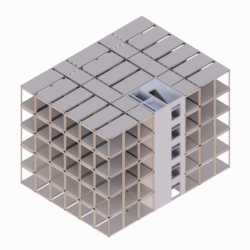
The research aims to advance open-source industrial systems for mass-customizable wooden buildings as part of Ukraine’s reconstruction efforts. While the country faces the most extensive destruction in Europe since World War II, developing timber construction will be crucial to reduce the potential carbon footprint from new facilities. Focusing on priority typologies for community needs, the project will not only contribute to academia, but also offer practical solutions for rebuilding war-affected regions. Furthermore, it seeks to develop digital tools that enhance design, decision-making, and construction processes, with the potential to realize prototypical building(s) in cooperation with local authorities.
MARIJA KATRINA DAMBE (2nd year)
Building Together: Redefining the Architect’s Role in Built Commons through Community Engagement, Collective Ownership, and Governance
Supervisor Gregor Taul
YOKO ALENDER (2nd year, academic leave)
Is terraced housing, with its densification and modular trajectories, a solution for sustainability in the built environment that also contributes to people-oriented design and well-being? Defining the spatial qualities of the town-house typology that boomed during the first industrial revolution in the UK the research tries to establish it as a source of social sustainability. If the town-house typology is favourable for creating well-being in a densely populated urban environment, which changes in planning legislation do we need to make it an option for North-European countries such as Estonia which may be hosting millions of climate refugees in the decades to come.
Supervisors Matti Kuittinen, Veronika Valk-Siska
JOHAN KIRSIMÄE (1st year)
Informal urban practices within the politics of spatial agency
Supervisors Andres Ojari and Panu Lehtovouri
ZANE VĒJA (1st year)
Latvian female architects of the 20th century
Supervisor PhD Ingrid Ruudi