
5-Year Curriculum
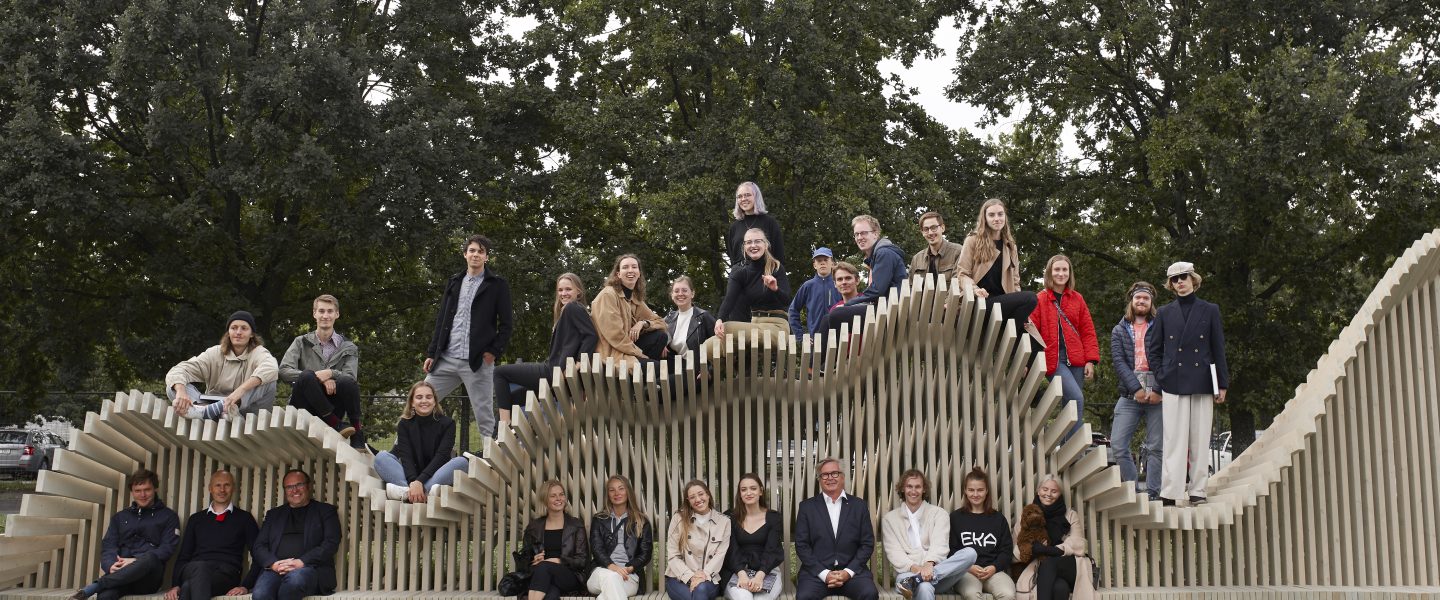
Opening of the Shelter 2020 "Paradise", 31.08.2020. Photo Laura Rohtlaan
The architectural studies comprise an integrated five-year curriculum. In the Architecture and Urban Design curriculum, it is possible to acquire in-depth knowledge and specialise in the fields of restoration, landscape architecture, or planning.
Architectural studies at EKA are studio-based in form and interdisciplinary in content. Most of the work is done in a studio, which is essentially an environment similar to an architectural office, where your sketches create an actual project. The most important subject of the curriculum is architectural and urban design, which deals with processes taking place in society. Each semester, a building of different sizes and the surrounding urban space or plan is created according to a theme. In addition to the professional studio, the architecture student participates in general and specialised theory and engineering subjects and painting, drawing and specialised experimental studios (see our professors). The last so-called vertical studios are cross-course and related to the laboratories of the Faculty of Architecture (3D Laboratory, VR Laboratory, PAKK) and the research work carried out in them, which explores the fringes of spatial creation. All EKA laboratories and workshops allow students to realise their ideas and designs.
The Faculty of Architecture organizes the traditional “Open Lecture Series” in which EKA is visited by the world’s top architects and internationally renowned professors. In addition to giving lectures, guest speakers always give feedback on students’ professional projects in critical seminars. Within the Erasmus program, EKA has student exchange agreements with many architecture schools around the world, and thanks to the initiative of students, the list is constantly updated. Our students have easy access to the best universities in the world for exchange studies.
The study of architecture and urban design ends with completing a master’s thesis, which is dedicated to the entire fifth year of study. The Master’s student has a choice between five studios related to building design or adaptation, existing environment and materials, urban planning, landscape or digital tools in architecture. The master’s thesis is a professional project with visual material, models, and text that describes the master’s thesis process and its theoretical and practical background.
A student who completes the curriculum receives a Master of Architecture (MSc) degree.
What are the career prospects?
A graduate of the EKA Architecture and Urban Design curriculum can work in private practice as a designer of buildings and planning projects, both as a member of a larger design team and as a leader. It is also possible to find an application in cities and municipalities as a visionary and planner directing local spatial development, to continue studies at the doctoral level, to work in research institutions developing various digital and material processes or offering applied research, for example, dealing with large-scale national plans or particular production companies.
The graduates of the curriculum of Architecture and Urban Design of EKA can work in the private sector as a designer of buildings and planning projects as a manager or a member of a larger project team, similarly as a public official or ideologist channelling the spatial development on the local government level, and also at universities or research centres developing various digital and material processes and providing applied research studies to a broad section of the society starting from large-scale planning to particular problems related to production.
EKA is the only university in Estonia where the Curriculum for Architecture and Urban Design belongs to the Qualification Directive no. 2005/36/EC in Annex V Of the European Parliament and the Council of the European Union (see more details), and the five-year training provided here is in accordance with the framework requirements for architectural studies offered by the Government of the Republic Regulation (see more details).
It provides the graduate of EKA with a degree in Architecture and Urban Design and a diploma architect level 7 professional qualification (see more details), which allows you to work as an architect anywhere in the European Union.
SUBJECTS
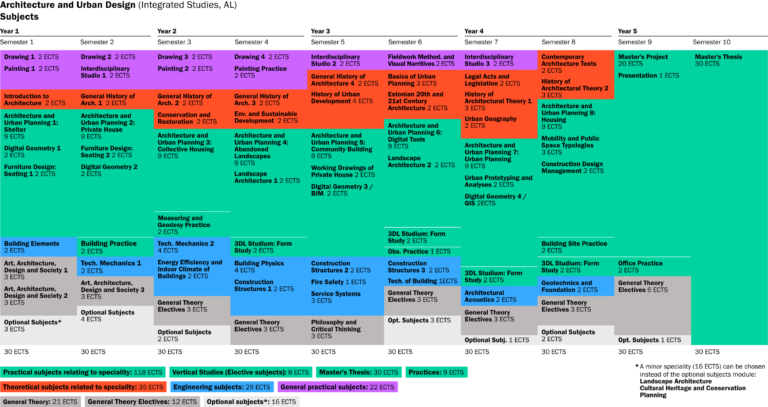
The curriculum has five blocks: specialised subjects (theoretical and practical subjects), general subjects (theoretical and practical subjects), engineering-technical subjects, internships and free subjects with a choice of minor subjects.
You can see more precisely which subjects are studied in architecture and urban design from the curriculum (please choose the most recent version).
In the initial phase of the study, knowledge and skills are imparted in the general parts of engineering and humanities, as well as visual thinking and self-expression. As the curriculum develops, it moves forward with more specific and applied subjects in all subject groups. The structure of special projects moves through the curriculum from more straightforward and smaller-scale tasks towards more complex, more diverse subjects and larger-scale projects. Methodologically, this means shifting the focus of the basic structure of professional projects from spatial planning in the initial phase of the study to research-based planning in the final phase, which results in a closely intertwined symbiosis of research and spatial planning in the master’s thesis.
The curriculum shows in more detail which subjects are studied in the field of architecture and urban design.
PRAXES
In addition to daily study, students undergo various practices during the study period
Construction praxis at the end of the 1st year aims to develop a comprehensive understanding of realising an architectural idea from design to completion, helping students grasp the architect’s roles and responsibilities in the construction process. It also broadens knowledge and practical skills related to design, construction planning, management and execution, safety engineering, teamwork, and role allocation.
Geodesy and measurement practice before the 2-nd year provides practical skills in measuring and documenting buildings, general knowledge, and an understanding of heritage architecture and landscape. It also offers a broad overview of village structures, the placement of farm buildings within the landscape, and construction principles. The aim is to develop skills in object reconnaissance, ranging, abscissa preparation, height determination, and horizontal surveying, as well as to understand various technologies and techniques.
The aim of the construction site practice is to experience the process of construction, the problems associated with it, the layout of the construction site, and the hierarchical networks functioning there. Besides familiarising oneself with the construction site as a workplace, it is also important to observe the construction management process.
The aim of the observational practice before the 4-th year is to a) observe, experience, see, and understand how a complex modern city functions geographically, institutionally, and in daily life; b) see and understand how the use of (public) spaces varies throughout the daily cycle, grasp the impact of space, and observe how activities influence space; c) observe the logistical and institutional systems and experience their changes across different eras and in (public) spacesious purposes; d) foster a connection with history that remains a distant intellectual knowledge by learning beyond books. created for var
Office practice introduces the structure of an architectural office, including its internal organisation, the various stages of preparing an architectural project, and the management of an architectural practice. This experience also involves working with other partners, such as engineering firms and construction companies. involves collab
MASTER'S STUDIOS
In master’s theses, it is possible to choose between five different studios today, each with its own focus: architectural design studio, urban planning studio, landscape architecture studio, digital tools studio, and space and material circulation studio.
CURRICULUM COMMITTEE
Architecture and Urban Design Curriculum Committee:
Curriculum Leader
Andres Ojari, professor
Faculty members of the curriculum
Sille Pihlak, dean, associate professor
Toomas Tammis, professor
Lecturers outside the curriculum
Siiri Vallner, architect, urban planner
Koit Ojaliiv, guest lecturer, architect, urban planner
Curriculum student representatives
Arabella Aabrams AL22
Representatives of employers or target and stakeholder groups
Andro Mänd, architect, president of the Association of Estonian Architects
Andres Sevtsuk, architect, urban planner; Associate Professor, MIT
Tõnis Arjus, architect, Miltton, sustainable living environment expert, late Tartu city architect