
Academic Affairs OfficeAccessory DesignAnimationArchitecture and Urban DesignArt EducationCenter for Flat TechnologiesCeramicsContemporary ArtCultural Heritage and ConservationDepartmentsDesign and Technology FuturesDoctoral SchoolDrawingFacilities and WorkshopsFaculty of ArchitectureFaculty of Art and CultureFaculty of DesignFaculty of Fine ArtsFashion DesignFinancial DepartmentGalleryGlass ArtGraphic ArtGraphic DesignInstallation and SculptureInstitute of Art History and Visual CultureInternational OfficeIT OfficeJewellery and BlacksmithingLandscape ArchitectureLibraryLinnaehitus @enMaking SpaceNew MediaOffice of the RectorateOpen AcademyPaintingPerforming ArtsPhotographyProduct DesignRectorateResearch and Development OfficeScenographySupport UnitsTextile DesignUncategorizedUrban PlanningUrban Studies
Pre-reviewing of Tõnis Jürgens’ exhibition “Dreaming of Babylon”
06.06.2022
Pre-reviewing of Tõnis Jürgens’ exhibition “Dreaming of Babylon”
Doctoral School
On the 6th of June at 10.00, the pre-reviewing of Art & Design doctoral student Tõnis Jürgens’ exhibition “Dreaming of Babylon” will take place via Zoom. Link HERE
“Dreaming of Babylon” is the first solo exhibition related to Jürgens’ artistic research doctoral thesis. The thesis is supervised by dr Rolf Hughes (KU Leuven, Belgium). The pre-reviewers of the exhibition are dr Eva Näripea and Taavi Talve.
The virtual exhibition was open during 28.02.–10.04.2022 at the post-gallery.online platform, and is archived here: https://www.post-gallery.online/archive/dreamingofbabylon/index.
“Dreaming of Babylon” is a nostalgic-satirical vision of the future whose central motifs are distraction and the materiality of data.
The film and online exhibition form one possible imagination of a post-human time, where the drive for better life, novelty and technological solipsism has led to the total melding of conscience into code, and digital ruins, around which the earthy nature keeps on perpetuating.
The title refers to a novel by American prose writer Richard Brautigan. In a parody of 1940s noir fiction, Brautigan’s protagonist is a private detective and hapless dreamer who, while trying to solve a case, incessantly becomes entangled in his own daydreams. As a response to the explicitly rapid and brief chapters of Brautigan’s novel, this film instead adheres to the lingering style of slow cinema, whilst tipping its hat to the romantic medium of 16mm film.
film crew
executive producer: Fidelia Regina Randmäe
1st assistant camera: Erki Kase
2nd assistant camera: Aadu Lambot
post-gallery.online
programmer: Kelli Gedvil
management: Kristen Rästas
thanks
Joosep Ehasalu, Toomas Jürgens, Raul Keller, Kristo Kiis, Kalju Karl Kivi, Piibe Kolka, Paul Kuimet, Kulla Laas, Ian Simon Märjama, Allan Proos, Rene Tamm, Erko Valdmets
supported by
Balti Filmi- ja Meediakool, Eesti Kultuurkapital, Eesti Rahvuskultuuri Fond, Jõelähtme vald, Kino Sõprus, Kuusalu vald, Paekivitoodete Tehas OÜ, Rae vald, Rahvusarhiiv, Silikaat AS, Tallinna Strateegiakeskus, Telia Eesti AS
Posted by Irene Hütsi — Permalink
Pre-reviewing of Tõnis Jürgens’ exhibition “Dreaming of Babylon”
Monday 06 June, 2022
Doctoral School
On the 6th of June at 10.00, the pre-reviewing of Art & Design doctoral student Tõnis Jürgens’ exhibition “Dreaming of Babylon” will take place via Zoom. Link HERE
“Dreaming of Babylon” is the first solo exhibition related to Jürgens’ artistic research doctoral thesis. The thesis is supervised by dr Rolf Hughes (KU Leuven, Belgium). The pre-reviewers of the exhibition are dr Eva Näripea and Taavi Talve.
The virtual exhibition was open during 28.02.–10.04.2022 at the post-gallery.online platform, and is archived here: https://www.post-gallery.online/archive/dreamingofbabylon/index.
“Dreaming of Babylon” is a nostalgic-satirical vision of the future whose central motifs are distraction and the materiality of data.
The film and online exhibition form one possible imagination of a post-human time, where the drive for better life, novelty and technological solipsism has led to the total melding of conscience into code, and digital ruins, around which the earthy nature keeps on perpetuating.
The title refers to a novel by American prose writer Richard Brautigan. In a parody of 1940s noir fiction, Brautigan’s protagonist is a private detective and hapless dreamer who, while trying to solve a case, incessantly becomes entangled in his own daydreams. As a response to the explicitly rapid and brief chapters of Brautigan’s novel, this film instead adheres to the lingering style of slow cinema, whilst tipping its hat to the romantic medium of 16mm film.
film crew
executive producer: Fidelia Regina Randmäe
1st assistant camera: Erki Kase
2nd assistant camera: Aadu Lambot
post-gallery.online
programmer: Kelli Gedvil
management: Kristen Rästas
thanks
Joosep Ehasalu, Toomas Jürgens, Raul Keller, Kristo Kiis, Kalju Karl Kivi, Piibe Kolka, Paul Kuimet, Kulla Laas, Ian Simon Märjama, Allan Proos, Rene Tamm, Erko Valdmets
supported by
Balti Filmi- ja Meediakool, Eesti Kultuurkapital, Eesti Rahvuskultuuri Fond, Jõelähtme vald, Kino Sõprus, Kuusalu vald, Paekivitoodete Tehas OÜ, Rae vald, Rahvusarhiiv, Silikaat AS, Tallinna Strateegiakeskus, Telia Eesti AS
Posted by Irene Hütsi — Permalink
27.05.2022 — 09.06.2022
ASTE: EKA Graphic Design BA Graduation Show
Graphic Design
Graduating Bachelor’s students of the Department of Graphic Design kindly welcome you to the opening of their exhibition ASTE (“A Step” in English) at the Estonian Academy of Arts, room C-304 on Friday, May 27 at 18:00.
There is a variety of projects at the exhibition, which display the ideas and interests of the young designers. There are publications, installations, visual experiments, video works, and virtual environments with which visitors can get familiar.
The graduation show takes place in the students’ usual working space, a studio, which is commonly a place run by a buzzing and chaotic atmosphere. A new surface arises at the exhibition from stacked desks – the site-specific intervention brings the works and visitors to the next level.
Prior to the exhibition, the graduating class will present their graduation projects on 26 May starting at 10:00 at EKA in room A-501. Presentations will be in English.
Graduation projects will be assessed by a jury:
Ott Kagovere, Associate Professor at the Department of Graphic Design (Tallinn, Estonia);
Sandra Kosorotova, artist and designer (Tallinn, Estonia);
Sandra Nuut, Lecturer at the Department of Graphic Design (Tallinn, Estonia);
Agnes Ratas, graphic designer (Tallinn, Estonia);
Nerijus Rimkus, graphic designer (Vilnius, Lithuania & Amsterdam, The Netherlands).
Graduating designers:
Kristi Jaago, Rainer Kasekivi, Kertu Kibal, Martin Kipper, Jekaterina Kožemjatšenko, Uku Art Mikkin, Nora Pelsš, Urmet Piiling, Villem Sarapuu, Polina Zahharenkova, Ingel-Kristen Veevo.
Supervisors of the BA graduation projects:
Else Lagerspetz, Maria Muuk, Laura Pappa, Indrek Sirkel
Supervisor of the BA graduation show project:
Kaisa Maasik
Supported by
AS Merko Ehitus, Mistra-Autex AS, Peenjoogivabrik Nudist, Põhjala Pruulikoda, Valmiermuiža Pruulikoda
The exhibition is on view daily from 12:00 to 18:00 until June 9, 2022.
The visual identity of the exhibition is designed by Polina Zahharenkova.
Posted by Andres Lõo — Permalink
ASTE: EKA Graphic Design BA Graduation Show
Friday 27 May, 2022 — Thursday 09 June, 2022
Graphic Design
Graduating Bachelor’s students of the Department of Graphic Design kindly welcome you to the opening of their exhibition ASTE (“A Step” in English) at the Estonian Academy of Arts, room C-304 on Friday, May 27 at 18:00.
There is a variety of projects at the exhibition, which display the ideas and interests of the young designers. There are publications, installations, visual experiments, video works, and virtual environments with which visitors can get familiar.
The graduation show takes place in the students’ usual working space, a studio, which is commonly a place run by a buzzing and chaotic atmosphere. A new surface arises at the exhibition from stacked desks – the site-specific intervention brings the works and visitors to the next level.
Prior to the exhibition, the graduating class will present their graduation projects on 26 May starting at 10:00 at EKA in room A-501. Presentations will be in English.
Graduation projects will be assessed by a jury:
Ott Kagovere, Associate Professor at the Department of Graphic Design (Tallinn, Estonia);
Sandra Kosorotova, artist and designer (Tallinn, Estonia);
Sandra Nuut, Lecturer at the Department of Graphic Design (Tallinn, Estonia);
Agnes Ratas, graphic designer (Tallinn, Estonia);
Nerijus Rimkus, graphic designer (Vilnius, Lithuania & Amsterdam, The Netherlands).
Graduating designers:
Kristi Jaago, Rainer Kasekivi, Kertu Kibal, Martin Kipper, Jekaterina Kožemjatšenko, Uku Art Mikkin, Nora Pelsš, Urmet Piiling, Villem Sarapuu, Polina Zahharenkova, Ingel-Kristen Veevo.
Supervisors of the BA graduation projects:
Else Lagerspetz, Maria Muuk, Laura Pappa, Indrek Sirkel
Supervisor of the BA graduation show project:
Kaisa Maasik
Supported by
AS Merko Ehitus, Mistra-Autex AS, Peenjoogivabrik Nudist, Põhjala Pruulikoda, Valmiermuiža Pruulikoda
The exhibition is on view daily from 12:00 to 18:00 until June 9, 2022.
The visual identity of the exhibition is designed by Polina Zahharenkova.
Posted by Andres Lõo — Permalink
26.05.2022
EXTENSION: an intervention to the space in Skoone Bastioni
Contemporary Art
Artists: Brit Kikas, Jakub Tulinger, Nora Schmelter, Viktor Kudriashov
Curator: Katarina Nyyssönen
Graphic Design: Oliver Long
On Thursday, May 26 at 6 pm EKA students invite you to join with a critical run, we take over and question the existence of a man-made mound of soil and look at what such a natural buffer zone in the middle of the city symbolizes. A critical run is an art format created by Thierry Geoffroy/Colonel and will be used to open a discussion, to reflect and debate during the run. We will end the run to enter an exhibition platform where traces already exist and can be actualized. To what extent of interaction do we see this platform still as a part of nature? This exhibit brings into interest human connections between nature and artificial.
“People’s natural need to spend time in nature has not disappeared: instead of being amused, they like to chill…” – Juhan Hint, Sirp 2019
EXTENSION
Skoone bastion
Do you think differently when you run?
Is reconstruction constant?
Human shelter, a form of forgotten space?
Can we give structure to nature?
Do you leave traces?
Will traces become permanent?
Or permanent become nature?
Are we creating our own models of nature by leaving traces?
Do we perceive an intervention as artificial?
Or is it becoming part of the existing ecosystem?
With losing its functionality?
Artificial nature, a created image excluding reality?
A long forgotten green space in the middle of the city, shows the mankinds attitude towards the environment and what surrounds us. Even the protection that the underground tunnels have provided in the past has been forgotten, despite the current state of the world.
Start: Critical Run, 26.05.2022 at 18:00 (Meeting point in front of EKA)
End: Skoone bastioni, Rannamäe tee, Entrance to the tunnels
Supported by: Estonian Academy of Arts, Sveta Bar
Additional information:
Katarina Nyyssönen
katarina.nyyssonen@artun.ee
+372 53021657
Posted by Andres Lõo — Permalink
EXTENSION: an intervention to the space in Skoone Bastioni
Thursday 26 May, 2022
Contemporary Art
Artists: Brit Kikas, Jakub Tulinger, Nora Schmelter, Viktor Kudriashov
Curator: Katarina Nyyssönen
Graphic Design: Oliver Long
On Thursday, May 26 at 6 pm EKA students invite you to join with a critical run, we take over and question the existence of a man-made mound of soil and look at what such a natural buffer zone in the middle of the city symbolizes. A critical run is an art format created by Thierry Geoffroy/Colonel and will be used to open a discussion, to reflect and debate during the run. We will end the run to enter an exhibition platform where traces already exist and can be actualized. To what extent of interaction do we see this platform still as a part of nature? This exhibit brings into interest human connections between nature and artificial.
“People’s natural need to spend time in nature has not disappeared: instead of being amused, they like to chill…” – Juhan Hint, Sirp 2019
EXTENSION
Skoone bastion
Do you think differently when you run?
Is reconstruction constant?
Human shelter, a form of forgotten space?
Can we give structure to nature?
Do you leave traces?
Will traces become permanent?
Or permanent become nature?
Are we creating our own models of nature by leaving traces?
Do we perceive an intervention as artificial?
Or is it becoming part of the existing ecosystem?
With losing its functionality?
Artificial nature, a created image excluding reality?
A long forgotten green space in the middle of the city, shows the mankinds attitude towards the environment and what surrounds us. Even the protection that the underground tunnels have provided in the past has been forgotten, despite the current state of the world.
Start: Critical Run, 26.05.2022 at 18:00 (Meeting point in front of EKA)
End: Skoone bastioni, Rannamäe tee, Entrance to the tunnels
Supported by: Estonian Academy of Arts, Sveta Bar
Additional information:
Katarina Nyyssönen
katarina.nyyssonen@artun.ee
+372 53021657
Posted by Andres Lõo — Permalink
06.06.2022 — 07.06.2022
Portfolio Cafe 2022
Faculty of Fine Arts
June 6-7 at EKA Library
Portfolio Café is structured around one on one meetings that take place between local and international fine arts field professionals and EKA BA and MA level students. Each meeting takes place about 45 minutes. During Portfolio Café sessions students introduce themselves and their work and experts share their observations, provide recommendations, ask questions etc. After the first scheduled conversation student moves on to the next selected expert they have signed up for.
All Portfolio Café meetings are in English.
Registration: Portfolio Café invites all fine art students from the BA and MA level to participate. The spots are limited and participants will be chosen according to the provided portfolios.
To apply, please fill out this registration form before June 3 and upload your portfolio.
EXPERTS
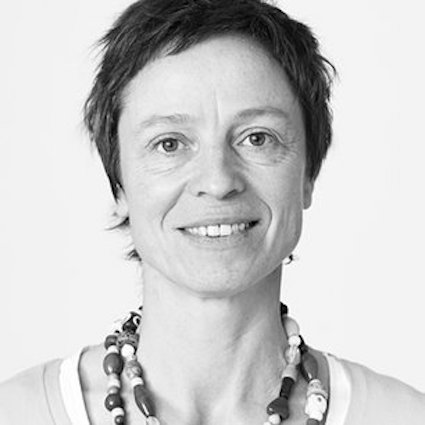
Ulla Marquardt is a German artist and educator whose work revolves around people’s aspirations and determination to leave behind often dire working and living conditions and come a little closer to their hopes and dreams. In her photographic series and her mostly site-specific video installations, the different parts play together to form a complex visual experience that enables a dialogue – both within the different parts of the installation and between the artwork and the viewer. The second aspect in her works is the exploration of the phenomena of beauty and transience in nature.
www.ulla-marquardt.com
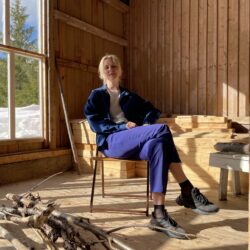
Lilian Hiob (b. 1991) is a curator, gallerist and art agent. She is a manager at Temnikova & Kasela gallery, also a founder of an independent gallery located in her basement, Hoib gallery. Together with Siim Preiman she is hosting a monthly radio show Vitamin K at IDA radio, dedicated to contemporary art.
Anna Zača (b. 1984) – curator, programmer and project manager in the field of animated and short film. Anna studied Art History and Theory in Latvia and Animation in Estonia. She has been the creative director of 2ANNAS ISFF and one of the founders of Riga International Film Festival, in 2015 she founded SHORT RIGA a section dedicated to short and artist film within Riga International Film Festival. Since 2016 Anna has been the Head of the Latvian Animation Association and since 2018 she is one of the Board Members at the European Animation Awards.
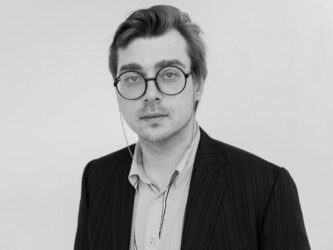
Audrius Pocius (b. 1991) is a curator and a philosopher currently based in Vilnius. In his curatorial practices he is mainly focused on conceptual and performative aspects of art and their potency for social and cultural critique. Audrius has been a curator and educator at CAC Vilnius up until he co-founded Swallow space for contemporary art together with his co-conspirators. He is also lecturing on various topics related to philosophy, aesthetics and contemporary culture at Vilnius University, Vilnius Academy of Art and Lithuanian Academy of Music and Theatre.
www.swallow.lt
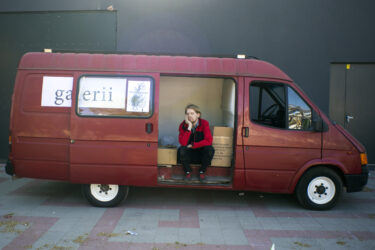
Siim Preiman (b. 1992) works as a curator at Tallinn Art Hall and runs a mobile art platform gallery gallery. He is characterised by a strong awareness of the environment and a desire for a more equal society. Preiman’s curatorial projects sprout from the personal and, with the help of co-creators, grow into collective platforms that address various generational pain points. The exhibitions he has convened have addressed among other issues the expanded sense of self, changing Eastern Europeanism, the ethics of art-making and the national landscape. More recently, he has been reflecting on hospitality, gender, violence and living as a whole.
Major projects include the group exhibition “Mändfulness” at Tallinn City Gallery (2021), the temporary project space March 1 in Tallinn Old Town (2021), the group exhibition “The Art of Being Good” at Tallinn Art Hall (2019) and the durability project/mobile platform gallery gallery (2016 – …).
www.galeriigalerii.ee
Portfolio Café is supported by the European Regional Development Fund EKA LOOVKÄRG (2014-2020.4.01.20-0288).
Posted by Maarja Pabut — Permalink
Portfolio Cafe 2022
Monday 06 June, 2022 — Tuesday 07 June, 2022
Faculty of Fine Arts
June 6-7 at EKA Library
Portfolio Café is structured around one on one meetings that take place between local and international fine arts field professionals and EKA BA and MA level students. Each meeting takes place about 45 minutes. During Portfolio Café sessions students introduce themselves and their work and experts share their observations, provide recommendations, ask questions etc. After the first scheduled conversation student moves on to the next selected expert they have signed up for.
All Portfolio Café meetings are in English.
Registration: Portfolio Café invites all fine art students from the BA and MA level to participate. The spots are limited and participants will be chosen according to the provided portfolios.
To apply, please fill out this registration form before June 3 and upload your portfolio.
EXPERTS
Ulla Marquardt is a German artist and educator whose work revolves around people’s aspirations and determination to leave behind often dire working and living conditions and come a little closer to their hopes and dreams. In her photographic series and her mostly site-specific video installations, the different parts play together to form a complex visual experience that enables a dialogue – both within the different parts of the installation and between the artwork and the viewer. The second aspect in her works is the exploration of the phenomena of beauty and transience in nature.
www.ulla-marquardt.com
Lilian Hiob (b. 1991) is a curator, gallerist and art agent. She is a manager at Temnikova & Kasela gallery, also a founder of an independent gallery located in her basement, Hoib gallery. Together with Siim Preiman she is hosting a monthly radio show Vitamin K at IDA radio, dedicated to contemporary art.
Anna Zača (b. 1984) – curator, programmer and project manager in the field of animated and short film. Anna studied Art History and Theory in Latvia and Animation in Estonia. She has been the creative director of 2ANNAS ISFF and one of the founders of Riga International Film Festival, in 2015 she founded SHORT RIGA a section dedicated to short and artist film within Riga International Film Festival. Since 2016 Anna has been the Head of the Latvian Animation Association and since 2018 she is one of the Board Members at the European Animation Awards.
Audrius Pocius (b. 1991) is a curator and a philosopher currently based in Vilnius. In his curatorial practices he is mainly focused on conceptual and performative aspects of art and their potency for social and cultural critique. Audrius has been a curator and educator at CAC Vilnius up until he co-founded Swallow space for contemporary art together with his co-conspirators. He is also lecturing on various topics related to philosophy, aesthetics and contemporary culture at Vilnius University, Vilnius Academy of Art and Lithuanian Academy of Music and Theatre.
www.swallow.lt
Siim Preiman (b. 1992) works as a curator at Tallinn Art Hall and runs a mobile art platform gallery gallery. He is characterised by a strong awareness of the environment and a desire for a more equal society. Preiman’s curatorial projects sprout from the personal and, with the help of co-creators, grow into collective platforms that address various generational pain points. The exhibitions he has convened have addressed among other issues the expanded sense of self, changing Eastern Europeanism, the ethics of art-making and the national landscape. More recently, he has been reflecting on hospitality, gender, violence and living as a whole.
Major projects include the group exhibition “Mändfulness” at Tallinn City Gallery (2021), the temporary project space March 1 in Tallinn Old Town (2021), the group exhibition “The Art of Being Good” at Tallinn Art Hall (2019) and the durability project/mobile platform gallery gallery (2016 – …).
www.galeriigalerii.ee
Portfolio Café is supported by the European Regional Development Fund EKA LOOVKÄRG (2014-2020.4.01.20-0288).
Posted by Maarja Pabut — Permalink
21.06.2022
EKA Graduation Ceremonies 2022
This year’s Graduation Ceremonies will be held on June 21th in the EKA gallery and main hall (room A101, Põhja puiestee 7, Tallinn).
11am – graduates of Faculties of Design and Art Culture
3pm – graduates of Faculties of Architecture and Fine Art
NB! Dear graduate, please come to the EKA gallery 15 minutes earlier, so we can lead you to your place. Guests can sit in the hall or watch the ceremonies in the lobby on the screens or online on EKA TV.
Posted by Maarja Pabut — Permalink
EKA Graduation Ceremonies 2022
Tuesday 21 June, 2022
This year’s Graduation Ceremonies will be held on June 21th in the EKA gallery and main hall (room A101, Põhja puiestee 7, Tallinn).
11am – graduates of Faculties of Design and Art Culture
3pm – graduates of Faculties of Architecture and Fine Art
NB! Dear graduate, please come to the EKA gallery 15 minutes earlier, so we can lead you to your place. Guests can sit in the hall or watch the ceremonies in the lobby on the screens or online on EKA TV.
Posted by Maarja Pabut — Permalink
27.05.2022 — 09.06.2022
EKA Grad Show ’22
Gallery
TASE’22
Estonian Academy of Arts Grad Show
28.05–09.06, open daily 12–6 pm
Opening: 27.05, 4pm @EKA
Exhibition locations:
EKA, Põhja pst 7
Vent Space, Vabaduse väljak 6-8
ARS Art Factory, Pärnu mnt 154
Rotermanni kvartal, Rotermanni 7
TASE is the annual graduation show of the Estonian Academy of Arts. It presents the final projects of Fine Arts, Architecture, Design, and Art and Culture faculties’ master’s students, along with the final artworks by Fine Arts and Design faculties’ bachelor’s students. The opening of the main exhibition and TASE’22 webpage tase.artun.ee takes place on May 27th at 4 pm at EKA!
Most of the works are exhibited at EKA on all five floors and including EKA Gallery and Billboard Gallery. Additionally, you can visit the exhibition at ARS Art Factory (Project Space, Showroom and room 112), Vent Space, Rotermanni 7, Lai 31, Kanuti Gildi Hall Cellar, Kadriorg Art Museum, Poordi 3 and Loewenschede tower on Kooli str 7. See more info on the programme.
tase.artun.ee opens simultaneously with the main exhibition on May 27th!
In addition to the works at the main exhibition, written theses by PhD and Art and Culture graduates and grad works from the rest of the BA graduates will be presented on tase.artun.ee. Last year’s TASE page can be found at tase20.artun.ee and tase21.artun.ee.
Young Artist Award and Young Applied Artist Award
The Young Artist Award and Young Applied Artist Award winners at the master’s and bachelor’s levels will be announced at the opening of TASE main exhibition. The prizes are each 1500€.
Young Artist Award winner at the master’s level will be chosen from Contemporary Art graduation works and at the bachelor’s level from the Graphic Art, Installation and Sculpture Painting, and Photography graduation works. The master’s prize includes a solo exhibition at the Hobusepea or Draakon gallery in 2023. This year’s jury members are art professionals Elin Kard, Marko Mäetamm, Aleksander Zahharov, Karolin Poska (only MA), Sigrid Viir and Maarin Ektermann.
Young Applied Artist Award winners will be selected from the Design and Crafts graduation works. The master level prize includes a solo exhibition at the HOP Gallery. The jury members are Maria Valdma, Ketli Tiitsar, Gregor Taul, Keiu Krikmann and Tiina Sarapu.
PROGRAMME
Exhibition opening ceremony
27.05 at 16.00, EKA lobby
Theses defences
30.05–15.06, www.artun.ee/kaitsmised
TASE FILM
04.06 at 17.00, A101
Scenography bachelors’ works exhibition “Kujundliku Mõtte Labor”
Estookin, Kristel Zimmer, Anita Kremm, Linda Mai Kari, Liisamari Viik, supervisor Ene-Liis Semper
28.05–07.06, open every day at 12.00–18.00, opening on 27.05 at 18.00
Lai 31, II floor
Graphic Design master’s graduation works “Silence After Early Hours”
Mucho Mustachio (Alejandro Bellón Ample), Louise Borinski, Daddy Breezy (Aleksandrs Breže), Energy Star (Paula Buškevica), Reese (Björn Giesecke), Tropaasi (Otso Peräsaari), Foxy (Diandra Rebase), miss S (Katarina Sarap)
04–11.06 at 13.00–19.00
Opening 03.06 at 18.00, finissage 11.06 at 21.00
Kanuti Guild Hall Cellar, Pühavaimu 5
www.silenceafterearlyhours.eka-gd-ma.ee
“Piiritu”, curator Nele Ambos
Cultural Heritage and Conservation master’s graduation work
Lilly Walther
23.02–29.05, Wed, Fri-Sun at 11.00–18.00, Thu at 11.00–20.00
Tartu Art Museum, Raekoja plats 18, Tartu
“ars viva 2022 – tajuvälja agendid”, curator Maria Helen Känd
Curator studies master’s graduation work
Tamina Amadyar, Laura Põld, Lewis Hammond, Jānis Dzirnieks, Anastasia Sosunova, Mooni Perry
09.04–07.09, Wed-Sun at 12.00–18.00
Kai kunstikeskus, Peetri 12
“Visible Storage Gallery for the Sculpture Collection”, curator Maria Väinsar
Department of Cultural Heritage and Conservation, master’s thesis
18.05.2022–31.12.2024
Tue, Thu-Sun at 10.00–18.00, Wed at 10.00–20.00
Kadriorg Art Museum, Weizenbergi 37, 10127 Tallinn
Olev Kuma “Transmission”
Painting bachelor’s graduation work
28.05–09.06, every day at 11.00–19.00
Poordi 3
Caroline Pajusaar “Inferno”
Bachelor’s thesis in Graphics
27.05–10.06, Mon-Fri at 11.00–18.00
Loewenschede tower, Kooli 7 (entrance from the park, last floor)
SATELLITE PROGRAMME
Open Academy exhibition “Maalikunsti A, B, C… ja Z lõputööde näitus”
Kaia Hommik, Ivo Kuldmäe, Anne-Mari Rannamäe, Jana Koel, Gerli Pesor, Andri Lõhek, Mari-Helen Vili, Kristine-Kristi Kasak, Ülle Soitu, Astrid Mägi, Mari Annuka, Raili Moldov
20.05–28.05, Wed-Fri at 12.00–18.00, Sat at 12.00–16.00, opening 19.05 at 18.00
Artdepoo gallery, Jahu 12-213
Jewellery and Blacksmithing II year student exhibition “NIHE”
Anna-Maria Vaino, Ardo Teesalu, Bianca Triinu Toots, Hugo Toss, Margus Elizarov, Villu Mustkivi, Visa Eino Eduard Nurmi, Ellen Axberg, Camilla Prey
20.05–02.06 at 12.00–20.00, opening 19.05 at 18.00
Uus 4
Photoart Academy exhibition “Ruumis”
Marcus Kallavus, Marta Khrshanovskaya, Silvi Kiin, Elias Kuulmann, Kristi Leps, Margus Metsaäär, Jaanus Muruõis, Nelli Pello, Kärt Petser, Annika Vihmann
Open 24/7, opening 07.06 at 18.00,
Telliskivi 64
Head organiser: Pire Sova
Assistant: Dana Lorên Vares
Exhibition design: Brigit Arop, Katarina Ild, Anabel Ainso
Communication: Solveig Jahnke, Andres Lõo, Maarja Pabut
Graphic design: Birgita Siim, Agnes Isabelle Veevo, Aaro Veiderpass
Web coordinator: Kert Väljak
TASE FILM and opening event: Johanna Kuzmenko, Ligia Fernandes
Supported by Eesti Kultuurkapital, Kasevetekohin, Mistra, AkzoNobel, BigBerry
Posted by Maarja Pabut — Permalink
EKA Grad Show ’22
Friday 27 May, 2022 — Thursday 09 June, 2022
Gallery
TASE’22
Estonian Academy of Arts Grad Show
28.05–09.06, open daily 12–6 pm
Opening: 27.05, 4pm @EKA
Exhibition locations:
EKA, Põhja pst 7
Vent Space, Vabaduse väljak 6-8
ARS Art Factory, Pärnu mnt 154
Rotermanni kvartal, Rotermanni 7
TASE is the annual graduation show of the Estonian Academy of Arts. It presents the final projects of Fine Arts, Architecture, Design, and Art and Culture faculties’ master’s students, along with the final artworks by Fine Arts and Design faculties’ bachelor’s students. The opening of the main exhibition and TASE’22 webpage tase.artun.ee takes place on May 27th at 4 pm at EKA!
Most of the works are exhibited at EKA on all five floors and including EKA Gallery and Billboard Gallery. Additionally, you can visit the exhibition at ARS Art Factory (Project Space, Showroom and room 112), Vent Space, Rotermanni 7, Lai 31, Kanuti Gildi Hall Cellar, Kadriorg Art Museum, Poordi 3 and Loewenschede tower on Kooli str 7. See more info on the programme.
tase.artun.ee opens simultaneously with the main exhibition on May 27th!
In addition to the works at the main exhibition, written theses by PhD and Art and Culture graduates and grad works from the rest of the BA graduates will be presented on tase.artun.ee. Last year’s TASE page can be found at tase20.artun.ee and tase21.artun.ee.
Young Artist Award and Young Applied Artist Award
The Young Artist Award and Young Applied Artist Award winners at the master’s and bachelor’s levels will be announced at the opening of TASE main exhibition. The prizes are each 1500€.
Young Artist Award winner at the master’s level will be chosen from Contemporary Art graduation works and at the bachelor’s level from the Graphic Art, Installation and Sculpture Painting, and Photography graduation works. The master’s prize includes a solo exhibition at the Hobusepea or Draakon gallery in 2023. This year’s jury members are art professionals Elin Kard, Marko Mäetamm, Aleksander Zahharov, Karolin Poska (only MA), Sigrid Viir and Maarin Ektermann.
Young Applied Artist Award winners will be selected from the Design and Crafts graduation works. The master level prize includes a solo exhibition at the HOP Gallery. The jury members are Maria Valdma, Ketli Tiitsar, Gregor Taul, Keiu Krikmann and Tiina Sarapu.
PROGRAMME
Exhibition opening ceremony
27.05 at 16.00, EKA lobby
Theses defences
30.05–15.06, www.artun.ee/kaitsmised
TASE FILM
04.06 at 17.00, A101
Scenography bachelors’ works exhibition “Kujundliku Mõtte Labor”
Estookin, Kristel Zimmer, Anita Kremm, Linda Mai Kari, Liisamari Viik, supervisor Ene-Liis Semper
28.05–07.06, open every day at 12.00–18.00, opening on 27.05 at 18.00
Lai 31, II floor
Graphic Design master’s graduation works “Silence After Early Hours”
Mucho Mustachio (Alejandro Bellón Ample), Louise Borinski, Daddy Breezy (Aleksandrs Breže), Energy Star (Paula Buškevica), Reese (Björn Giesecke), Tropaasi (Otso Peräsaari), Foxy (Diandra Rebase), miss S (Katarina Sarap)
04–11.06 at 13.00–19.00
Opening 03.06 at 18.00, finissage 11.06 at 21.00
Kanuti Guild Hall Cellar, Pühavaimu 5
www.silenceafterearlyhours.eka-gd-ma.ee
“Piiritu”, curator Nele Ambos
Cultural Heritage and Conservation master’s graduation work
Lilly Walther
23.02–29.05, Wed, Fri-Sun at 11.00–18.00, Thu at 11.00–20.00
Tartu Art Museum, Raekoja plats 18, Tartu
“ars viva 2022 – tajuvälja agendid”, curator Maria Helen Känd
Curator studies master’s graduation work
Tamina Amadyar, Laura Põld, Lewis Hammond, Jānis Dzirnieks, Anastasia Sosunova, Mooni Perry
09.04–07.09, Wed-Sun at 12.00–18.00
Kai kunstikeskus, Peetri 12
“Visible Storage Gallery for the Sculpture Collection”, curator Maria Väinsar
Department of Cultural Heritage and Conservation, master’s thesis
18.05.2022–31.12.2024
Tue, Thu-Sun at 10.00–18.00, Wed at 10.00–20.00
Kadriorg Art Museum, Weizenbergi 37, 10127 Tallinn
Olev Kuma “Transmission”
Painting bachelor’s graduation work
28.05–09.06, every day at 11.00–19.00
Poordi 3
Caroline Pajusaar “Inferno”
Bachelor’s thesis in Graphics
27.05–10.06, Mon-Fri at 11.00–18.00
Loewenschede tower, Kooli 7 (entrance from the park, last floor)
SATELLITE PROGRAMME
Open Academy exhibition “Maalikunsti A, B, C… ja Z lõputööde näitus”
Kaia Hommik, Ivo Kuldmäe, Anne-Mari Rannamäe, Jana Koel, Gerli Pesor, Andri Lõhek, Mari-Helen Vili, Kristine-Kristi Kasak, Ülle Soitu, Astrid Mägi, Mari Annuka, Raili Moldov
20.05–28.05, Wed-Fri at 12.00–18.00, Sat at 12.00–16.00, opening 19.05 at 18.00
Artdepoo gallery, Jahu 12-213
Jewellery and Blacksmithing II year student exhibition “NIHE”
Anna-Maria Vaino, Ardo Teesalu, Bianca Triinu Toots, Hugo Toss, Margus Elizarov, Villu Mustkivi, Visa Eino Eduard Nurmi, Ellen Axberg, Camilla Prey
20.05–02.06 at 12.00–20.00, opening 19.05 at 18.00
Uus 4
Photoart Academy exhibition “Ruumis”
Marcus Kallavus, Marta Khrshanovskaya, Silvi Kiin, Elias Kuulmann, Kristi Leps, Margus Metsaäär, Jaanus Muruõis, Nelli Pello, Kärt Petser, Annika Vihmann
Open 24/7, opening 07.06 at 18.00,
Telliskivi 64
Head organiser: Pire Sova
Assistant: Dana Lorên Vares
Exhibition design: Brigit Arop, Katarina Ild, Anabel Ainso
Communication: Solveig Jahnke, Andres Lõo, Maarja Pabut
Graphic design: Birgita Siim, Agnes Isabelle Veevo, Aaro Veiderpass
Web coordinator: Kert Väljak
TASE FILM and opening event: Johanna Kuzmenko, Ligia Fernandes
Supported by Eesti Kultuurkapital, Kasevetekohin, Mistra, AkzoNobel, BigBerry
Posted by Maarja Pabut — Permalink
09.06.2022 — 12.06.2022
Exhibition “REKrulli: Reconstructing spatial culture”
Architecture and Urban Design
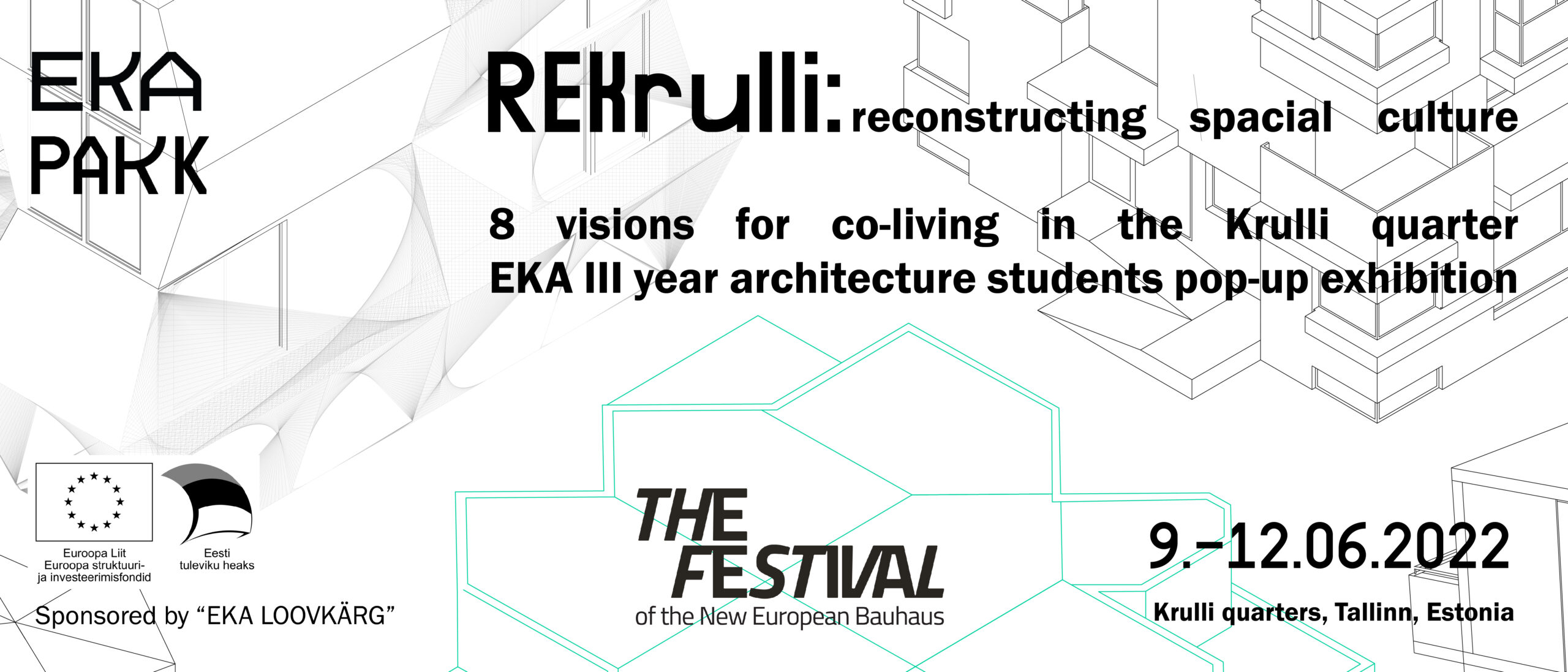
On Thursday, June 9, at 6 pm, we will open an exhibition of works by architecture students of the Estonian Academy of Arts in the Krull Quarter. In the evening, the first introduction of the Timber Architecture Research Center PAKK will take place.
The pop-up exhibition “REKrulli: reconstructing spacial culture” is an official side event of the New European Bauhaus Festival and it will remain open until June 12.
The REKrulli studio’s objective was to develop flexible architecture from sustainable materials, based on digital design and fabrication. We were looking at possible ways of living together beyond the usual apartment association home ownership model, while developing contemporary building structures that can produce adaptable and efficient solutions for the creation of high quality spaces with a positive environmental impact.
REKrulli superstudio supports the ongoing research project “sLender” at EKA PAKK which examines what type of apartment building does Tallinn need today and how to solve a new apartment building using the best knowledge of the Estonian wooden house industry and architects.
SCHEDULE OF THE OPENING EVENT:
15.00 Presentations of the five best works of the Estonian Pavilion of the Venice Architecture Biennale *
17.30 Opening of the installation “Steampunk” *
Exhibition:
18.00 Introduction of the EKA Wooden Architecture Competence Center PAKK, researchers and guests speak.
18.30 Students of the Faculty of Architecture of EKA will present the visions of apartment buildings and the results of the REKrull superstudio.
THE EXHIBITION IS OPEN:
Thursday, June 9, 6 p.m. – Opening night
Friday, June 10, 10 a.m. to 6 p.m.
Saturday, June 11, from 10 a.m. to 6 p.m.
Sunday, June 12, 10 a.m. to 4 p.m.
Students:
Triinu Amboja, Mariia Babur, Grete Daut, Simon Eiland, Roosmarii Kukk, Helin Kuldkepp, Patrick Liik, Kristina Lillepea, Maria Helena Luiga, Mattias Ots, Mariia Paslova, Yelyzaveta Perel, Yelyzaveta Peresada, Daria Polonska, Anna Pushkarska, Mikael Ristmets, Martin Sepp, Sander Sinnep, Kaari Maria Tirmaste, Cristin Marii Titma, Aneth Traumann, Mariia Ufimtseva, Liispet Viira, Laura Liis Vilbiks, Dalia Viškelyt
Tutors:
Architectural planning: Siim Tuksam, Sille Pihlak
Structural analysis and energy design: Adam Orlinski (Bollinger+Grohmann)
Anthropological analysis: Mattias Malk
Landscape architecture: Karin Bachmann
* The opening of the exhibition will be preceded at 3 pm by the public presentations of the five best works of the Estonian Pavilion for the Venice Architecture Biennale and the opening of the installation “Steampunk” in the Krull Quarter. The event is organized by the Estonian Center of Architecture.
Posted by Anna Tommingas — Permalink
Exhibition “REKrulli: Reconstructing spatial culture”
Thursday 09 June, 2022 — Sunday 12 June, 2022
Architecture and Urban Design
On Thursday, June 9, at 6 pm, we will open an exhibition of works by architecture students of the Estonian Academy of Arts in the Krull Quarter. In the evening, the first introduction of the Timber Architecture Research Center PAKK will take place.
The pop-up exhibition “REKrulli: reconstructing spacial culture” is an official side event of the New European Bauhaus Festival and it will remain open until June 12.
The REKrulli studio’s objective was to develop flexible architecture from sustainable materials, based on digital design and fabrication. We were looking at possible ways of living together beyond the usual apartment association home ownership model, while developing contemporary building structures that can produce adaptable and efficient solutions for the creation of high quality spaces with a positive environmental impact.
REKrulli superstudio supports the ongoing research project “sLender” at EKA PAKK which examines what type of apartment building does Tallinn need today and how to solve a new apartment building using the best knowledge of the Estonian wooden house industry and architects.
SCHEDULE OF THE OPENING EVENT:
15.00 Presentations of the five best works of the Estonian Pavilion of the Venice Architecture Biennale *
17.30 Opening of the installation “Steampunk” *
Exhibition:
18.00 Introduction of the EKA Wooden Architecture Competence Center PAKK, researchers and guests speak.
18.30 Students of the Faculty of Architecture of EKA will present the visions of apartment buildings and the results of the REKrull superstudio.
THE EXHIBITION IS OPEN:
Thursday, June 9, 6 p.m. – Opening night
Friday, June 10, 10 a.m. to 6 p.m.
Saturday, June 11, from 10 a.m. to 6 p.m.
Sunday, June 12, 10 a.m. to 4 p.m.
Students:
Triinu Amboja, Mariia Babur, Grete Daut, Simon Eiland, Roosmarii Kukk, Helin Kuldkepp, Patrick Liik, Kristina Lillepea, Maria Helena Luiga, Mattias Ots, Mariia Paslova, Yelyzaveta Perel, Yelyzaveta Peresada, Daria Polonska, Anna Pushkarska, Mikael Ristmets, Martin Sepp, Sander Sinnep, Kaari Maria Tirmaste, Cristin Marii Titma, Aneth Traumann, Mariia Ufimtseva, Liispet Viira, Laura Liis Vilbiks, Dalia Viškelyt
Tutors:
Architectural planning: Siim Tuksam, Sille Pihlak
Structural analysis and energy design: Adam Orlinski (Bollinger+Grohmann)
Anthropological analysis: Mattias Malk
Landscape architecture: Karin Bachmann
* The opening of the exhibition will be preceded at 3 pm by the public presentations of the five best works of the Estonian Pavilion for the Venice Architecture Biennale and the opening of the installation “Steampunk” in the Krull Quarter. The event is organized by the Estonian Center of Architecture.
Posted by Anna Tommingas — Permalink
16.05.2022
Will/Воля: EKA Ukraine Student Exhibition
Photography
Today, 16 May at 4 pm, EKA Ukrainian students will open their pop-up exhibition Will in the foyer.
The portraits were created in the course led by Tanja Muravskaja and will remain on view for 4 days.
Posted by Andres Lõo — Permalink
Will/Воля: EKA Ukraine Student Exhibition
Monday 16 May, 2022
Photography
Today, 16 May at 4 pm, EKA Ukrainian students will open their pop-up exhibition Will in the foyer.
The portraits were created in the course led by Tanja Muravskaja and will remain on view for 4 days.
Posted by Andres Lõo — Permalink
19.05.2022
“Preservation: Architecture, Nature and Politics” studio final presentations in Pärnu
Urban Studies
Preservation has achieved cultural significance as a lens through which various urban experts have come
to imagine what a socially and environmentally sound future might look like. As an approach, preservation has been applied to disparate phenomena ranging from historic neighbourhoods and natural environments to democracy and identity. This studio unfolded the formative concepts and historic moments that define contemporary understandings of preservation and applied these discussions to various typologies of architecture, urban fabric and the natural environment taking Pärnu and the wider region as a case study. In particular, the studio focused on the ways in which ideas, labour and design have intersected in the past to identify alternatives to the mainstream forms of preservation.
The studio culminates with a presentation of group projects that explore a variety of approaches to layers of heritage and questions of preservation in Pärnu and Sindi. Pärnu, the fourth largest city in Estonia, is struggling with the seemingly conflicting and contradictory notions of growth, shrinkage, preservation and destruction. Sindi, as a smaller town in the region, faces similar, but also additional challenges connected to its significant industrial heritage. Efforts to imagine and construct a vision for a city are also tied up with the tactile practices of preservation; set within specific administrative and management frameworks of maintenance, care, and neglect.
Despite intentions, prescriptive visions by the city and developers can serve to exacerbate inequalities through the various infrastructures, supply chains, policies and environmental conditions that extend well beyond the rigid borders of a city.
Can the concept of preservation open a discussion around a vision for Pärnu (and its hinterlands)
beginning not with growth and progress, but rather with repair, maintenance or even deterioration?
Student projects explore who gets to decide what is valuable, organise the preservation of things, and who then carries out the work. Negotiations about what should be preserved and what “good preservation” entails, are always contingent and contextual.
Projects:
-
- Decompressed Transition: Paula Veidenbauma, Nora Soo and Jannik Kastrup
- Tides of a Summer City: Khadeeja Farrukh, Anna Dzebliuk and Christian Hörner
- Fabricated Heritage – Interweaving the Past and Future of Sindi’s Kalevivabrik: Luca Riese Ritter, Paulina Schroeder and Augustas Lapinskas
- Tea, Coffee or Hot Water?: What to Make of the Boiler Room: Kush Badhwar, Nabeel Imtiaz and Paul Simon
 Decompressed Transition
Paula Veidenbauma, Nora Soo and Jannik Kastrup

Pärnu is caught between diverging time regimes. In its role as a major spa and resort town, the city aims at slowing down the rhythm of life of the urban workforce. In parallel, the developments surrounding Rail Baltica will likely greatly compress this rhythm within Pärnu. The project examines frameworks of the relationship between those phenomena. It deals with instances of built and immaterial heritage and acts of preserving, especially the latter through shifting political systems. The float, emerging as the central piece of the project, can be interpreted as a gradient operating between Rail Baltica (a linear and high-velocity infrastructure), Pärnu’s leisure facilities and the open sea. It might function as a means of transportation while also exploring the possibility of non-arrival.
Visitors will be engaging with the project via a video installation, a float building workshop and a presentation. Float building instructions will be summarised in a booklet.
 Tides of a Summer City
Khadeeja Farrukh, Anna Dzebliuk and Christian Hörner
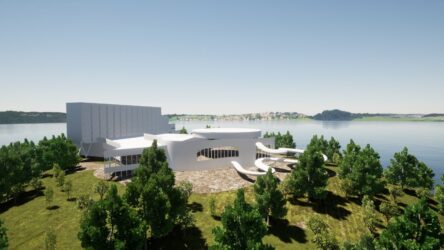
The project explores possible resilient futures in Pärnu as a resort city. Showing how the “Summer City” developed historically, the video installation extrapolates empirical insights through Pärnu’s present-day reality into a future of constant flood emergency. The installation mobilizes futuristic renderings of possible resilient futures after a catastrophic flooding event to juxtapose and question the concepts of heritage, seasonality and resilience. We touch upon the inter-urban dependencies between Pärnu and Tallinn, manifesting historically, materially and spatially at the seaside of Estonia’s summer capital, securing the cities influx of holidaymakers during summer, but also causing issues of urban disenfranchisement of its residents, exploitation of its workers and destruction of coastal habitats of non-human residents. Looking into the future, it will no longer be possible to brush over the threat of flooding and the prospect of permanent crisis. The project “Tides of a Summer City” asks hypothetical questions, working towards a framework for understanding future challenges by following the changing historical tides of a summer city.
Fabricated Heritage – Interweaving the Past and Future of Sindi’s Kalevivabrik
Luca Riese Ritter, Paulina Schroeder and Augustas Lapinskas
The project explores the significance of Sindi´s industrial heritage. In recent decades, globalisation, deindustrialization, economic restructuring and industrial relocation have produced new landscapes within many European cities and towns – the post-industrial landscape. Deprived of their raison d’être, they are often regarded as spatially, socially, and semiotically empty places. In order to overcome this apparent ‘void’, the transformation of these post-industrial remnants into new uses is now an essential part of urban development practice.
Turning to industrial landscapes as potential carriers of cultural heritage ostensibly provides a framework for the continued management of these sites. Industrial heritage then becomes the bearer of local identity and creates uniqueness out of the former mundane.
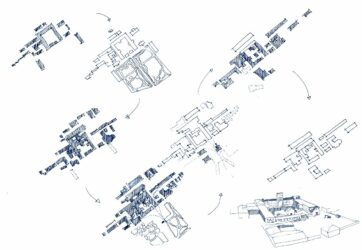
The town of Sindi, a place essentially born from the settlement of a textile factory in the early 19th century, is in the process of discussing the reintegration of the material remains of industrial production into the town’s fabric which, since the closure of Kalevivabrik, the textile factory, has outgrown its original purpose. In this process of readjusting the relationship between factory-gone-ruin and the reorientation of the city, our project seeks to understand the potentials and conflicts that arise from industrial heritage, while taking a critical perspective at the practices of heritage preservation and its political implications. How and by whom is the town’s history preserved and remembered? Can there be a value of the material remains in the process of their decay? What is the role of heritage as a legal imperative? What role can the factory building play in the future of Sindi?
 Tea, Coffee or Hot Water?: What to Make of the Boiler Room
Kush Badhwar, Nabeel Imtiaz and Paul Simon
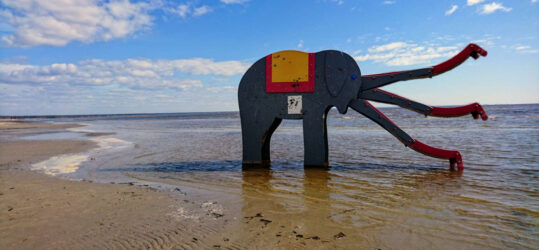
Drawing on the interest in the role of the educational institution Academia Non-Grata, elephants and other far-out references, the project explores junctions between the plan, the script and performance; preservation, the boiler room in the wider fabric of Pärnu; and the pitfalls and possibilities of experimental approaches to planning.
Plans for places chart a set of intentions that seek to influence the future of a place. Could the duration in which a plan is enacted be considered a performance?
Conversely, the script may be considered the plan for a performance. But despite the presence of a script, in performance, there can be room to manoeuvre in and around what is on the page, to improvise, to confront uncertainty and the yet to be known, to discover and learn from the process. Could such an approach also be applied to planning a city?
What might be discovered about prospective futures, preservation and other possibilities in Pärnu through the act of performance? Can performance and planning ever effectively speak to one another?
The possibilities of these questions are explored through three intertwined narratives of the boiler room, also the site of performance/presentation of the work: one in which the boiler room remains, structurally, as it is today; another in which the boiler room retains its shell but is appropriated over time; and, lastly in which the boiler room is razed and the site changes in purpose. Speculative fiction and alternative history take us through the boiler room and into the possible futures of the boiler room and the city of Pärnu.
Posted by Kaija-Luisa Kurik — Permalink
“Preservation: Architecture, Nature and Politics” studio final presentations in Pärnu
Thursday 19 May, 2022
Urban Studies
Preservation has achieved cultural significance as a lens through which various urban experts have come
to imagine what a socially and environmentally sound future might look like. As an approach, preservation has been applied to disparate phenomena ranging from historic neighbourhoods and natural environments to democracy and identity. This studio unfolded the formative concepts and historic moments that define contemporary understandings of preservation and applied these discussions to various typologies of architecture, urban fabric and the natural environment taking Pärnu and the wider region as a case study. In particular, the studio focused on the ways in which ideas, labour and design have intersected in the past to identify alternatives to the mainstream forms of preservation.
The studio culminates with a presentation of group projects that explore a variety of approaches to layers of heritage and questions of preservation in Pärnu and Sindi. Pärnu, the fourth largest city in Estonia, is struggling with the seemingly conflicting and contradictory notions of growth, shrinkage, preservation and destruction. Sindi, as a smaller town in the region, faces similar, but also additional challenges connected to its significant industrial heritage. Efforts to imagine and construct a vision for a city are also tied up with the tactile practices of preservation; set within specific administrative and management frameworks of maintenance, care, and neglect.
Despite intentions, prescriptive visions by the city and developers can serve to exacerbate inequalities through the various infrastructures, supply chains, policies and environmental conditions that extend well beyond the rigid borders of a city.
Can the concept of preservation open a discussion around a vision for Pärnu (and its hinterlands)
beginning not with growth and progress, but rather with repair, maintenance or even deterioration?
Student projects explore who gets to decide what is valuable, organise the preservation of things, and who then carries out the work. Negotiations about what should be preserved and what “good preservation” entails, are always contingent and contextual.
Projects:
-
- Decompressed Transition: Paula Veidenbauma, Nora Soo and Jannik Kastrup
- Tides of a Summer City: Khadeeja Farrukh, Anna Dzebliuk and Christian Hörner
- Fabricated Heritage – Interweaving the Past and Future of Sindi’s Kalevivabrik: Luca Riese Ritter, Paulina Schroeder and Augustas Lapinskas
- Tea, Coffee or Hot Water?: What to Make of the Boiler Room: Kush Badhwar, Nabeel Imtiaz and Paul Simon
Decompressed Transition
Paula Veidenbauma, Nora Soo and Jannik Kastrup
Pärnu is caught between diverging time regimes. In its role as a major spa and resort town, the city aims at slowing down the rhythm of life of the urban workforce. In parallel, the developments surrounding Rail Baltica will likely greatly compress this rhythm within Pärnu. The project examines frameworks of the relationship between those phenomena. It deals with instances of built and immaterial heritage and acts of preserving, especially the latter through shifting political systems. The float, emerging as the central piece of the project, can be interpreted as a gradient operating between Rail Baltica (a linear and high-velocity infrastructure), Pärnu’s leisure facilities and the open sea. It might function as a means of transportation while also exploring the possibility of non-arrival.
Visitors will be engaging with the project via a video installation, a float building workshop and a presentation. Float building instructions will be summarised in a booklet.
Tides of a Summer City
Khadeeja Farrukh, Anna Dzebliuk and Christian Hörner
The project explores possible resilient futures in Pärnu as a resort city. Showing how the “Summer City” developed historically, the video installation extrapolates empirical insights through Pärnu’s present-day reality into a future of constant flood emergency. The installation mobilizes futuristic renderings of possible resilient futures after a catastrophic flooding event to juxtapose and question the concepts of heritage, seasonality and resilience. We touch upon the inter-urban dependencies between Pärnu and Tallinn, manifesting historically, materially and spatially at the seaside of Estonia’s summer capital, securing the cities influx of holidaymakers during summer, but also causing issues of urban disenfranchisement of its residents, exploitation of its workers and destruction of coastal habitats of non-human residents. Looking into the future, it will no longer be possible to brush over the threat of flooding and the prospect of permanent crisis. The project “Tides of a Summer City” asks hypothetical questions, working towards a framework for understanding future challenges by following the changing historical tides of a summer city.
Fabricated Heritage – Interweaving the Past and Future of Sindi’s Kalevivabrik
Luca Riese Ritter, Paulina Schroeder and Augustas Lapinskas
The project explores the significance of Sindi´s industrial heritage. In recent decades, globalisation, deindustrialization, economic restructuring and industrial relocation have produced new landscapes within many European cities and towns – the post-industrial landscape. Deprived of their raison d’être, they are often regarded as spatially, socially, and semiotically empty places. In order to overcome this apparent ‘void’, the transformation of these post-industrial remnants into new uses is now an essential part of urban development practice.
Turning to industrial landscapes as potential carriers of cultural heritage ostensibly provides a framework for the continued management of these sites. Industrial heritage then becomes the bearer of local identity and creates uniqueness out of the former mundane.
The town of Sindi, a place essentially born from the settlement of a textile factory in the early 19th century, is in the process of discussing the reintegration of the material remains of industrial production into the town’s fabric which, since the closure of Kalevivabrik, the textile factory, has outgrown its original purpose. In this process of readjusting the relationship between factory-gone-ruin and the reorientation of the city, our project seeks to understand the potentials and conflicts that arise from industrial heritage, while taking a critical perspective at the practices of heritage preservation and its political implications. How and by whom is the town’s history preserved and remembered? Can there be a value of the material remains in the process of their decay? What is the role of heritage as a legal imperative? What role can the factory building play in the future of Sindi?
Tea, Coffee or Hot Water?: What to Make of the Boiler Room
Kush Badhwar, Nabeel Imtiaz and Paul Simon
Drawing on the interest in the role of the educational institution Academia Non-Grata, elephants and other far-out references, the project explores junctions between the plan, the script and performance; preservation, the boiler room in the wider fabric of Pärnu; and the pitfalls and possibilities of experimental approaches to planning.
Plans for places chart a set of intentions that seek to influence the future of a place. Could the duration in which a plan is enacted be considered a performance?
Conversely, the script may be considered the plan for a performance. But despite the presence of a script, in performance, there can be room to manoeuvre in and around what is on the page, to improvise, to confront uncertainty and the yet to be known, to discover and learn from the process. Could such an approach also be applied to planning a city?
What might be discovered about prospective futures, preservation and other possibilities in Pärnu through the act of performance? Can performance and planning ever effectively speak to one another?
The possibilities of these questions are explored through three intertwined narratives of the boiler room, also the site of performance/presentation of the work: one in which the boiler room remains, structurally, as it is today; another in which the boiler room retains its shell but is appropriated over time; and, lastly in which the boiler room is razed and the site changes in purpose. Speculative fiction and alternative history take us through the boiler room and into the possible futures of the boiler room and the city of Pärnu.
Posted by Kaija-Luisa Kurik — Permalink
19.05.2022 — 02.06.2022
SHIFT: Jewellery and Blacksmithing joint exhibition
Jewellery and Blacksmithing
On May 19, a joint exhibition “SHIFT” of the second-year jewelery and blacksmithing students of the Estonian Academy of Arts will be opened in the Old Town of Tallinn, Uus tn 4, where various states of change will be discussed.
There is a constant hidden movement within the apparent stability of the material world. Although stability and change seem at first sight to be opposites, change is the only constant element in our lives. However, we cannot escape the effects of the slightest change – regardless of its essence, we will inevitably have a shift between reality and the assumptions made on the basis of our experience, knowledge and feelings.
As the temporal forms solidify through exploratory and repetitive practice, the viewer will remain a testimony to the limits of our age.
As spatial phenomena change around through emerging and diverse practices, the viewer is left with only a tribute to the inaccuracies of our existence. “artybollocks generator”
Participants in the exhibition: Anna-Maria Vaino, Ardo Teesalu, Bianca Triinu Toots, Ellen Axberg, Hugo Toss, Margus Elizarov, Camilla Prey, Villu Mustkivi, Visa Eino Eduard Nurmi
The works have been supervised by: Nils Hint, Eve Margus
The exhibition is part of the EKA’s TASE ’22 satellite program and will be open daily from 12.00–20.00, until June 2.
The exhibition is supported by: Estonian Academy of Arts, Kaili Baked Goods, Fabric Jungle, Kräftwärk, Valmiermuiža, Barrel
Posted by Andres Lõo — Permalink
SHIFT: Jewellery and Blacksmithing joint exhibition
Thursday 19 May, 2022 — Thursday 02 June, 2022
Jewellery and Blacksmithing
On May 19, a joint exhibition “SHIFT” of the second-year jewelery and blacksmithing students of the Estonian Academy of Arts will be opened in the Old Town of Tallinn, Uus tn 4, where various states of change will be discussed.
There is a constant hidden movement within the apparent stability of the material world. Although stability and change seem at first sight to be opposites, change is the only constant element in our lives. However, we cannot escape the effects of the slightest change – regardless of its essence, we will inevitably have a shift between reality and the assumptions made on the basis of our experience, knowledge and feelings.
As the temporal forms solidify through exploratory and repetitive practice, the viewer will remain a testimony to the limits of our age.
As spatial phenomena change around through emerging and diverse practices, the viewer is left with only a tribute to the inaccuracies of our existence. “artybollocks generator”
Participants in the exhibition: Anna-Maria Vaino, Ardo Teesalu, Bianca Triinu Toots, Ellen Axberg, Hugo Toss, Margus Elizarov, Camilla Prey, Villu Mustkivi, Visa Eino Eduard Nurmi
The works have been supervised by: Nils Hint, Eve Margus
The exhibition is part of the EKA’s TASE ’22 satellite program and will be open daily from 12.00–20.00, until June 2.
The exhibition is supported by: Estonian Academy of Arts, Kaili Baked Goods, Fabric Jungle, Kräftwärk, Valmiermuiža, Barrel
Posted by Andres Lõo — Permalink