KVI open lectures 2026 autumn
Baltic Perspectives, curator Anu Allas

This autumn semester, the Institute of Art History and Visual Culture is hosting a series of open lectures on selected topics in the art history of the Baltic countries. The lectures are connected to the MA course Baltic Perspective: Insights into 20th Century Art History and to the conference of Baltic art historians, Art History in Uncertain Times, which will take place on 8–9 October at EKA (A101). The lectures will be held in English.

Programme:

  • Thursday, 24.09 at 18.00 (A403), Baiba Vanaga (Latvian National Museum of Art) “From Amateurs to Professionals: Women Artists in Latvia in the 19th Century and Early 20th Century”
  • Thursday, 8.10 at  18.00 (A101), Sven Spieker (University of California) in conversation with Anders Härm (Estonian Academy of Arts / Kumu Art Museum) “Curating Socialism”
  • Thursday, 19.11 at 18.00 (A403), (Art Academy of Latvia)
    “Artists’ Archives, Interpretation and Canonization. The Case of the Latvian Artists’ Group Nebijušu Sajūtu Restaurēšanas Darbnīca (Workshop for the Restoration of Unfelt Feelings,
    1982–1989)”
  • Thursday, 3.12 at 18.00 (A403), Lolita Jablonskienė (National Gallery of Art, Vilnius) “Unbound Places and Times: on Eglė Budvytytė, Marija Gimbutas, and Others”

Academic year of 2024/25, the open lecture series of the Institute of Art History and Visual Culture at the Estonian Academy of Arts focuses on decolonial practitioners and practices. The series departs from a new wave of decolonisation in Eastern Europe and Central Asia, strongly influenced by Russia’s full-scale war in Ukraine.

The lecturers include prominent researchers and curators who are invited to share their perspectives on the theory and practice of decolonisation in different fields and parts of the world. The series aims to create new comparisons between different decolonising contexts and to contribute to a dialogue between Eastern Europe and Central Asia and other regions.

We want to contribute to the decolonisation processes in Eastern Europe by helping the region to position and vocalise itself in relation to other and often older decolonisation traditions, and at the same time also emphasise the importance of solidarity.

Decolonisation challenges and dismantles grand dominant discourses about history, culture and art. Equally in need of a decolonising perspective are museum and exhibition practices, whose choices have also depended on the colonisers’ view of what is valuable in art and why it is valuable.

The series was curated by prof. Linda Kaljund

In addition to students and faculty from the Estonian Academy of Arts, other universities and schools, we therefore invite art, museum and cultural professionals – and anyone else interested – to join us.

The lectures are held in English, free of charge and open to everyone interested.

Programme in 2024/2025:


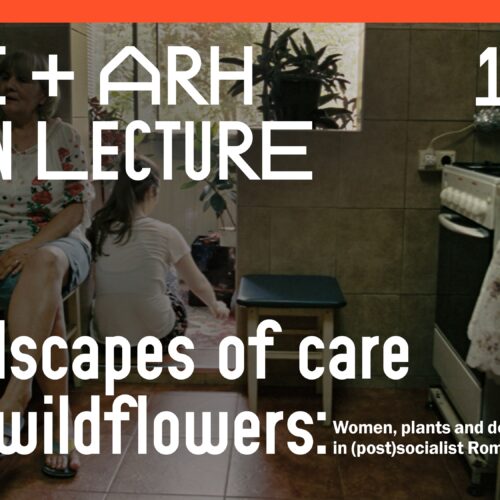
The 2025/26 season of public lectures examined architecture from the perspective of the ethics of care. How does architecture care for people’s physical, social and emotional needs, both today and from a historical perspective? While traditionally everything related to care has been considered issues of the private realm, in reality the question of who, how and to what extent is considered worthy of care and attention is one of the central agreements of a social organization. Architecture plays a very important role in this, both as a creator of specific spatial conditions and as a conditioner of unspoken attitudes and a formative force for social subjects. The starting point for many of the speakers in this lecture series is intersectional feminism – the desire to empower users who, due to their gender, sexuality, nationality, social background, age, or physical or mental characteristics, have not received full attention and support in standard architectural and planning practices. Topics covered will range from feminist urban criticism to the role of architects in the context of wars and refugee crises, from considering disabilities and neurodivergence in design practice to the spatial experience of queer and trans people.

Programme 2025/2026:

Help and search