
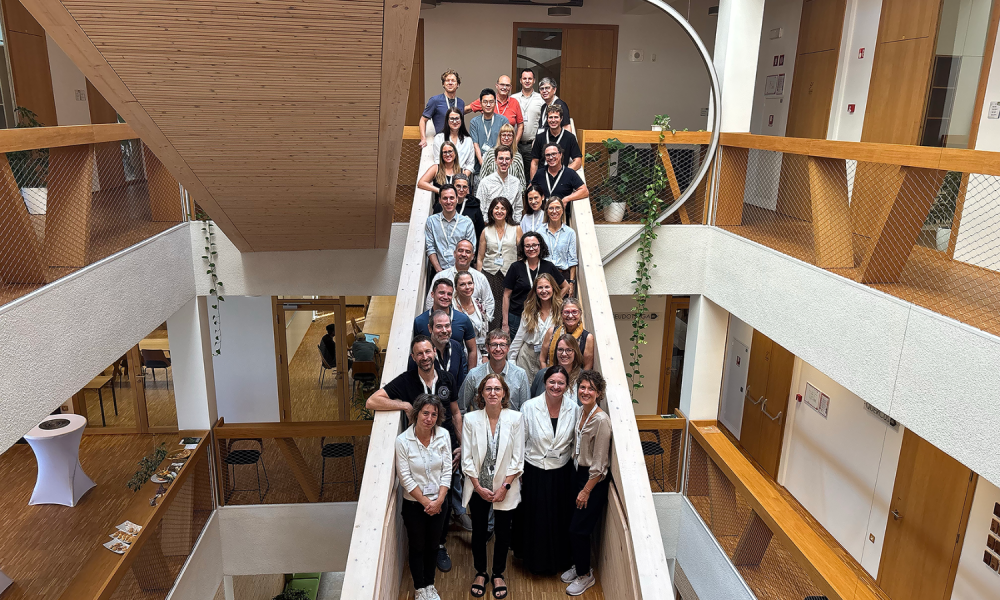
In September, the four-year international project WISE – From Widening to Urban Sustainability Innovation and Excellence was launched, bringing together universities and partners from the Transform4Europe (T4EU) alliance to advance research collaboration in the field of urban sustainability. The Estonian Academy of Arts (EKA) participates in the project through its Research and Development Office and the PAKK Research Centre.
WISE is a four-year project funded under the European Union’s Horizon Europe WIDERA programme, running from 1 September 2026 to 31 August 2030. The project’s kick-off meeting took place on 14 September at InnoRenew CoE and the University of Primorska in Izola, Slovenia.
The project focuses on urban sustainability. WISE brings together 16 organisations across Europe: 11 higher education institutions and five partners representing industry, the public sector and civil society. The project is coordinated by the University of Primorska in Slovenia.
WISE has three main objectives: to strengthen scientific excellence and knowledge valorisation; to increase the international competitiveness of European universities in the field of urban sustainability; and to develop the skills and career opportunities of researchers and research support staff.
EKA contributes to both research and the development of research support systems
For EKA, WISE provides an opportunity to develop both substantive research collaboration and the services and practices that support research. The PAKK Research Centre brings EKA’s expertise in architecture and design to the project, focusing on the development of new structural solutions within urban sustainability research. Particular attention is given to metal-free and adhesive-free timber joints, which PAKK will prototype and test in terms of both structural strength and acoustics. The solutions will also be developed and tested at building scale, linking research with hands-on construction and allowing them to be evaluated as complete systems. One of the starting points for this work is the Mustermaja building system currently under development at PAKK. International collaboration will also create new connections with universities, companies, cities and other organisations, as well as opportunities for future research and development projects.
From the perspective of the Research and Development Office, WISE will help strengthen EKA’s capacity in research and project management. The project includes training and international mobility opportunities for both researchers and research support staff. It will also address open science, FAIR data management, Open Access publishing and engagement with wider society.
An important objective is for WISE to generate new international collaborative projects. Successful models and practices developed and tested through the project are intended to continue beyond its conclusion as part of the longer-term activities of the Transform4Europe alliance.
How should research be assessed in art, design and architecture?
For EKA, one of the central strands of WISE concerns the development of research assessment practices. The project draws, among other frameworks, on the principles of CoARA (Coalition for Advancing Research Assessment), which aim to reduce excessive reliance on simple quantitative indicators – such as publication and citation counts or journal impact metrics – and place greater emphasis on qualitative assessment of researchers’ actual contributions.
For EKA, this is a particularly important question in the fields of art, design and architecture: how can research contributions be assessed in a way that recognises not only academic publications but also practice-based research, design and creative outputs, societal impact, open science, collaboration and knowledge valorisation?
As part of WISE, partner universities will analyse their current research assessment practices and experiment with new approaches. These may include the use of narrative CVs, broader recognition of researchers’ different outputs and contributions, and reducing the role of journal-based metrics in research assessment and career advancement.
Three research projects on urban sustainability
At the heart of WISE’s scientific collaboration are three research strands related to urban sustainability. They range from innovative building materials and urban sustainability monitoring to methodologies for transferring policies and good practices across regions and countries.
The broader ambition of WISE is to build a well-connected network of research and higher education institutions in which scientific excellence goes hand in hand with knowledge valorisation, international collaboration, open science, and the professional development of researchers and research support staff.
WISE at EKA
The project lead at EKA is Pille Epner, while the day-to-day coordination of the project is managed by Kristi Mets-Alunurm. Renee Puusepp and Anna Tommingas are responsible for PAKK’s scientific and substantive contribution to the project.
In addition to the Estonian Academy of Arts, the WISE consortium includes the University of Primorska, Universidade Católica Portuguesa, the University of Silesia in Katowice, Vytautas Magnus University, Sofia University St. Kliment Ohridski, Mariupol State University, Saarland University, the University of Alicante, the University of Trieste and Jean Monnet University, as well as five non-academic partners from Slovenia, Germany, Lithuania and Belgium.