
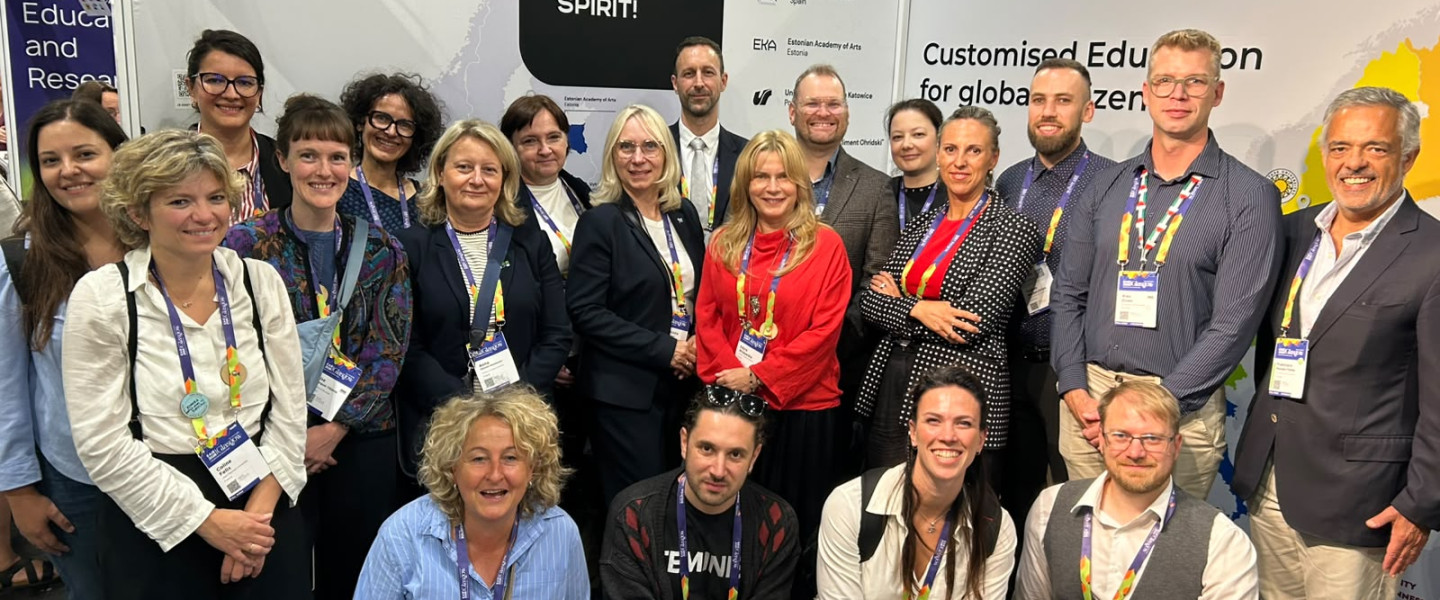
The Transform4Europe (T4EU) European University Alliance focused on strengthening international partnerships and advancing the transformation of European higher education at the European Association for International Education (EAIE) annual conference in Glasgow. Held from 8–11 September, the 36th EAIE conference brought together more than 7,000 higher education professionals. T4EU participated in the conference for the fourth time, presenting its ongoing cooperation in education, research, innovation, and regional development.
“EAIE 2026 marks an important milestone for T4EU. We are no longer talking only about the potential of European University Alliances; we are demonstrating the impact of cooperation that is already taking place,” said T4EU Secretary General and Saarland University Professor Dominik Brodowski.
T4EU collaborates with universities and partners in countries including Australia, Brazil, Georgia, India, Kenya, Mozambique, and the United States. In Glasgow, the Alliance explored new opportunities for cooperation while strengthening existing partnerships. Particular attention is being given to Europe’s neighbouring regions and the Mediterranean, as well as Central and Southeast Asia.
Reflecting on this year’s conference theme, “The Rhythm of Revolution,” T4EU representatives discussed how higher education can become more flexible and international. Key topics included interdisciplinary learning, short-term mobility, cooperation across universities, and adapting curricula more quickly to society’s changing needs.
T4EU is also developing a model of “knowledge entrepreneurship” aimed at connecting the knowledge and expertise of students and staff with solutions to real-world societal challenges. To support this goal, the Alliance offers initiatives including summer schools, student competitions, T4EU Weeks, stakeholder challenges, and professional development programmes.
Transform4Europe brings together 11 European universities, including the Estonian Academy of Arts. The Alliance aims to contribute to a European higher education environment in which universities cooperate more closely, teaching and research are increasingly international, and students and staff have greater opportunities for mobility and collaboration.
