
Enhancing personal designs in an inspiring and supportive environment.
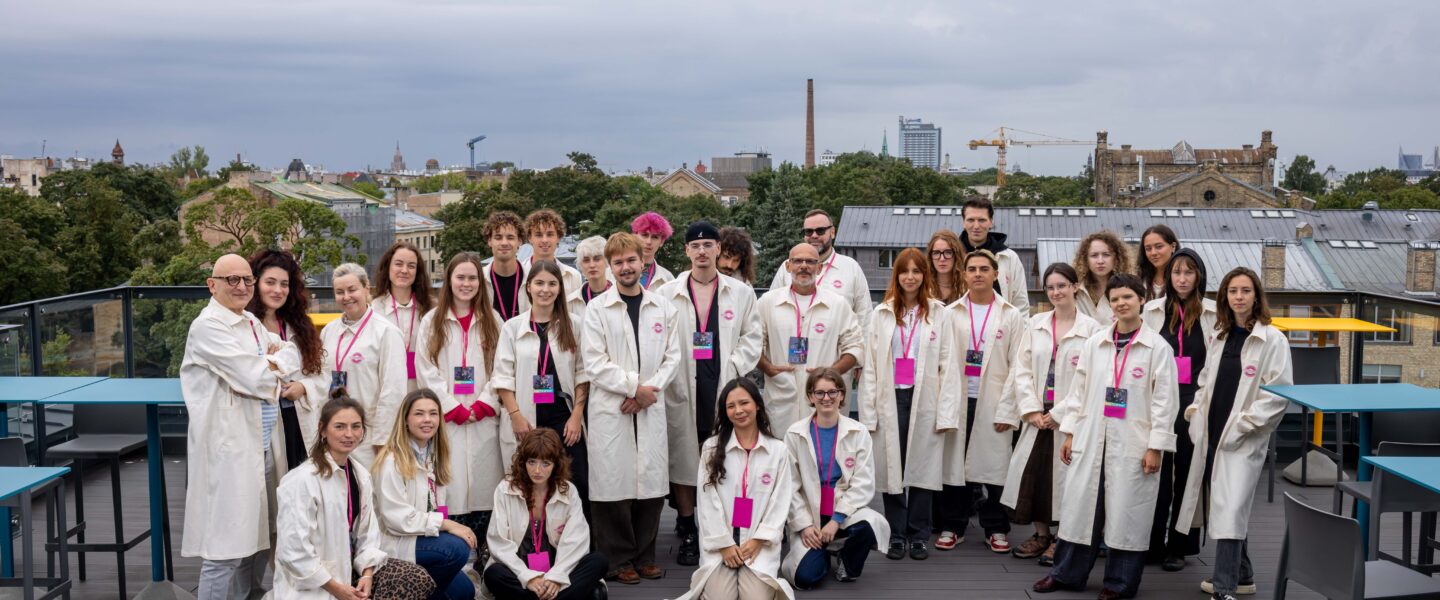
From August 31 to September 12, the Riga Makerspace of the Latvian Academy of Arts will host the FashionTEX international residency, bringing together young fashion designers from 11 European fashion schools. Second-year textile design students Ethel Noortoots and Katriin Tammoja represent the Estonian Academy of Arts.
During the two-week intensive residency, 24 international students will develop new ideas in digital and physical fashion design under the guidance of a variety of experts, exploring modern digital manufacturing technologies and innovative materials. Also, the residency will be a unique opportunity for all students to develop their interpersonal skills, encouraging collaboration, idea exchange, and challenge troubleshooting; while interacting, communicating, and building relationships with peers and mentors from different countries and cultures.
Program participants will learn and practically use CLO3D digital modeling software, as well as 3D printing, laser cutting, digital knitting and other digital prototyping technologies. Students will create not only physical prototypes of their designs, but also their digital twins, thus combining traditional skills with digital modeling, visualization and manufacturing capabilities. This approach also reflects broader changes in the fashion industry, where digital prototypes, virtual fitting, 3D design and artificial intelligence tools are increasingly becoming an important part of the design and realisation processes.
The works created in Riga and the results of the creative workshop will be presented at the FashionTEX Festival, which will take place on September 30 and October 1 at the LEDunit virtual production studio, also in Riga. The two-day festival will be a platform where physical fashion will meet the digital environment and the latest technologies. Viewers will have the opportunity to get acquainted with the outfits created by young designers, digital fashion solutions and virtual images, as well as participate in conversations, presentations and other program activities that will focus on the future of the fashion industry.
The FashionTEX Festival will focus mainly on the relation between Digitalisation & Sustainability in Fashion, and will raise questions about how digitalization is changing the fashion design process, how the virtual environment expands creative possibilities and how technologies can help create a more sustainable fashion industry. In addition to the fashion show and exhibition, the festival program will also focus on knowledge exchange and discussions about the development of digital fashion, education and new opportunities in the creative industries.
“The FashionTEX project implemented by the Latvian Academy of Fine Arts along with other 10 European fashion institutions shows how the fashion design process itself is changing – from the creation of a physical garment to its digital version and virtual experience. Using CLO3D, 3D printing, laser cutting, virtual production and other technologies, students experiment with new ways to create and present fashion. Digital technologies are becoming an important part of the fashion design process, expanding the possibilities in the development, visualization and presentation of garments,” emphasizes Jānis Gailītis, Head of the Development and Communication Department of the Latvian Academy of Fine Arts.
FashionTEX is an international three-year project co-funded by the European Union’s Creative Europe Programme, which aims to develop digital fashion education and promote the integration of future- and sustainability-oriented skills into the study programmes of European fashion universities, bringing together a total of roughly 50 students from Portugal, Italy, Croatia, Ukraine, Czech Republic, Germany, Netherlands, Poland, Estonia, Latvia and Lithuania
Makerspace Equipment
During the two-week FashionTex Riga Makerspace recidency, students have access to a wide range of digital design and prototyping technologies. The facilities allow them to move freely between virtual fashion, textiles, 3D printing, digital fabrication and traditional materials – and to turn digital concepts into physical prototypes.
CLO3D
CLO3D forms the digital foundation of the project, enabling garments to be designed and developed in a virtual environment. During the workshop, students expand their existing skills and refine the designs they have already created. A deeper focus on materials, texturing and lighting allows them to produce high-quality animations and visual presentations. Combined with a professional photo setup, students will be able to create immersive presentations of their designs.
Motion Capture
Motion capture connects virtual fashion with real human movement. Instead of relying on predefined animations, students can transfer complex and natural movements to digital avatars and explore how their garments behave in motion. AI-driven tools for generating and processing 3D animations have made these technologies increasingly accessible, while even relatively simple hardware can now produce impressive results.
3D Printing
3D printing opens up an entirely different approach to fashion production. It can be used to create accessories, shoes, bracelets and bags, but also larger garment structures. The makerspace’s large-format and multi-material 3D printers allow the production of objects up to 80 cm in size, and the experimentation with combinations of printed structures, conventional fabrics and other materials. This allows students to explore the space between textile, product and fashion design.
Laser Cutting & Milling
One of the particular advantages of working in a makerspace is the opportunity to cross the traditional boundaries of fashion and textile design and enter fields such as metalworking or woodworking. CNC milling and laser cutting machines are accessible even to students without extensive previous experience and can process a broad range of materials – from acrylic and wood to aluminum and steel. Vacuum forming and bending equipment further expands the possibilities for creating three-dimensional forms and experimental structures.
Kniterate, Digital Embroidery & Semi-Automatic Weaving
Digital manufacturing has long been part of the textile industry, particularly in knitting and embroidery. At the Riga Makerspace, students have access to digital machines for double-bed knitting, twelve-colour embroidery, and digital semi-automatic weaving. They can develop complex Jacquard patterns, experiment with digitally controlled textile structures and even produce totally knitted garments. Together with the other technologies in the workshop, these machines connect established textile techniques with contemporary digital design and fabrication.