
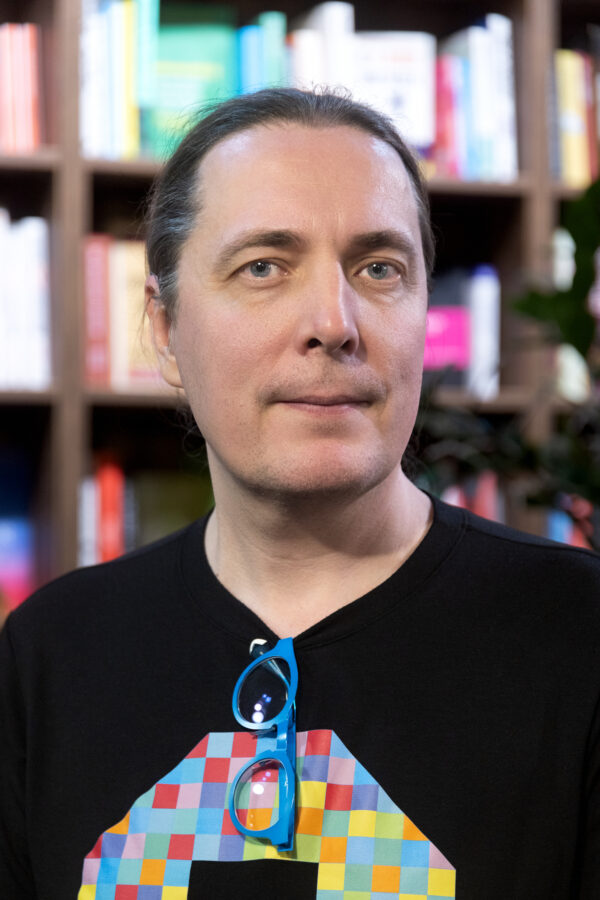
Taaniel Raudsepp will take on the role of Dean of the Faculty of Fine Arts of the Estonian Academy of Arts from the 2026/2027 academic year.
Raudsepp has previously worked in the field of cybersecurity as a risk manager, creative director, artist, director of the Tallinn Art Hall, Deputy Chancellor of the Ministry of Culture, and most recently as the leader of the Paide Opinion Festival. Raudsepp will take over the position of Dean from Kirke Kangro, who has led the Faculty of Fine Arts of the Estonian Academy of Arts since 2016.
Where do you see the Faculty of Fine Arts developing?
I come from the outside and I don’t yet have a picture of what is happening inside the faculty – what are the concerns or joys of the lecturers, students, and everyone else.
From the outside, I see Estonian art developing. It flows quite nicely from one source – the Faculty of Fine Arts of the Estonian Academy of Arts. I think we are doing rather well with creative thought and art: there are both interesting newcomers and experienced artists who accurately catch the pulse of the times. Being in the international spotlight is a fairly natural part of being an artist today, and there are quite a few who move there with enviable self-evidence.
As an EKA member, I would like this connection between the latest creative thought and the EKA Faculty of Fine Arts to be even clearer to the public, and the importance of art to be more generally perceived.
What would you definitely like to do during your first year as dean?
During this year, I want to see and hear as much as possible about how our daily work actually goes. I think that my first year should, above all, be a year of cooperation and building understanding. Perhaps I want to have good cooperation with my colleagues and a common understanding of what we really need to achieve by the end of this year.
In other words, we would have had a number of meaningful conversations, set goals together to move towards, and taken the first steps towards them. If we compare the time ahead to, for example, an expedition, then this year would be mainly preparation. However, sufficient preparation, a clear understanding of the goal, and a team working in good synergy are, as we know, important prerequisites for success.
What is the freedom that the fine arts bring to EKA?
Fine arts are the freedom to create worlds. It is the freedom to understand oneself and this world through creation. In other words: art does not describe the world, but helps us imagine what it could be like. This freedom is fundamental to me, and I think that in a sense all other human freedom starts from it.
I believe that Rancière is right when he claims that aesthetics and politics determine what we can imagine or talk about at all. Also Lotman, when he says that art creates new/different models of the world, i.e. models, not describes it.
In this sense of fundamentality, the fine arts are also the particle accelerator of (visual) culture. Here, the elementary particles of creation are minted, taken apart, bounced around, discovered new ones, reflected on the world and put back together. Perhaps we are dealing with something very fundamental and at the same time something that requires an extraordinary amount of practical skills. In the accelerator, the absolute peak of engineering sciences meets the last word in theory.
You can add one of your own questions and answer it.
I borrow the question from Taavi Varmi, who asked me on behalf of the doctoral student-junior researchers at a meeting with the faculty: “If you were an animal, what animal would you be?”
I answered: a raven. But in fact, depending on the situation, I am sometimes more like a crow and sometimes more like a jackdaw. I am a crow with a somewhat fluid identity – Corvus cornix corax monedula.
Or at least I would like to be – they are smart animals that can operate in a changing environment alone, in a group, in pairs or as a large cooperative tribe; when necessary, to poke eyes and ears, and when necessary, to be present with their attention unnoticed.