
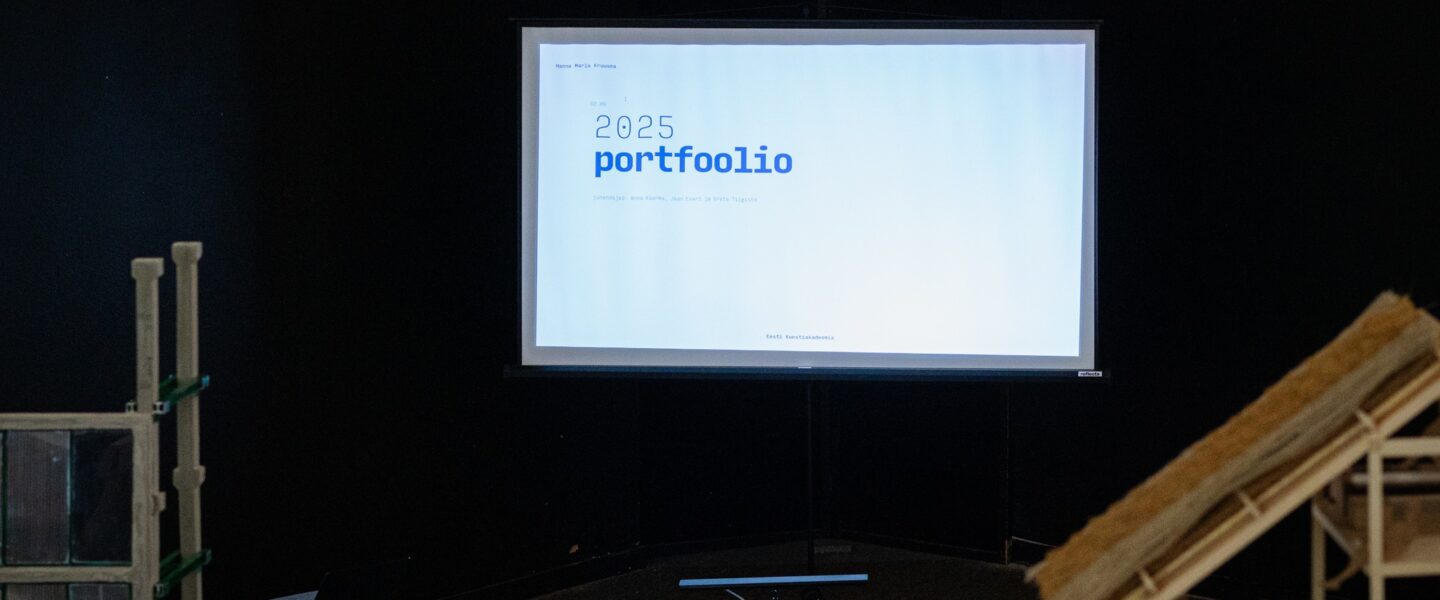
Thesis defence. Photo: Evert Palmets
The public defenses of the Bachelor’s thesis/portfolio of Interior Architecture 2025 took place on June 2 and 3 in the auditorium of the House of Designers (Rävala 8).
Within the framework of the thesis, the development of topics arising from individual creative interest takes place in parallel with the compilation of the portfolio. An exhibition was put together from the developed projects.
Supervised by Anna Kaarma (portfolio), Ville Lausmäe (project development), Veiko Liis (project development). The theses were evaluated by a committee consisting of Maria Helena Luiga (chairman of the committee), Peeter Klaas, Mari Põld, Gregor Taul and Merilin Tee. The secretary of the committee was Marie-Katharine Maksim.
***
Susann Vahe
Interiors of Estonian summer houses 1960-1990
Portfolio
The aim of my bachelor’s thesis was to analyze the interior architecture of Estonian summer houses and compile related information, driven by a desire to contribute to the preservation of cultural heritage. As a result of the thesis, I created a website that presents the collected material and makes it easily accessible to a wider audience. Currently, there is no comprehensive or educational platform dedicated specifically to the interior design of Estonian summer houses—therefore, the website fills an important gap and serves as a starting point for broader exploration of the topic.
Supervisors: Veiko Liis, Anna Kaarma, Grete Tiigiste and Jaan Evart.
*
Simona Porta
Simona Porta’s BA thesis consists of a portfolio and a development project that reflects on the creation of casual contacts in public space.
The project is inspired by anonymous communication. For example, online or in a closet, where people share their thoughts and feelings without hiding behind a face or name. The real world brings bodies, customs and expectations into our communication, which often create invisible boundaries. The principle of the project was to understand the role a physical barrier plays in a dialogue between two people and how a person perceives the presence of their body and voice when there is no visual contact. The dialogue was completed as a prototype of an anonymous communication space. It is a life-sized exploratory model, the purpose of which was to test a new typology of small forms in urban space. I tried to create an experimental form through which I could study the conditions for contact in public space.
Supervisors Ville Lausmäe, Anna Kaarma, Grete Tiigiste and Jaan Evart.
*
Kairi Mändla
Portfolio
Kairi Mändla’s BA diploma project consists of a portfolio and a development project that asks for a spatial core.
Supervisors Ville Lausmäe, Anna Kaarma, Grete Tiigiste and Jaan Evart.
*
Villem Reimann
Portfolio
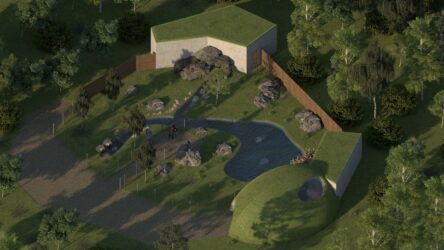
Villem Reimann’s BA diploma project consists of a portfolio and a development project, within the framework of which a design solution was prepared for a joint enclosure for the European mink and Eurasian beaver at Tallinn Zoo.
The planned shared enclosure for the European mink and Eurasian beaver at the Tallinn Zoo aims to create a nature-inspired and educational environment for both the animals and visitors.
The shared habitat supports the animals’ well-being and offers visitors an immersive experience, allowing them to feel like part of the environment—not just as observers, but as engaged participants.
Supervisors Ville Lausmäe, Anna Kaarma, Grete Tiigiste and Jaan Evart.
*

Nelelis Tasa
Portfolio
Nelelis Tasa’s BA diploma project consists of a portfolio and a development project that explores the reuse of textile waste in interior architecture.
As part of the project “KIUD”, I focused on post-consumer blended fiber textile waste that has reached the end of its life cycle and for which recycling options in Estonia are currently limited. The aim was to develop solutions for processing this type of material and to enable its reuse in interior design. A key focus was on making the most of the entire material — from the fabric itself to the labels and buttons attached to it.
The collected textiles were sorted by color to enhance their potential for reuse and to increase their compatibility with various interior environments — regardless of fiber composition. The resulting material samples in different colors demonstrate just a few of the many possible applications, leaving interior architects with the freedom to experiment further with the material.
Supervisors Veiko Liis, Anna Kaarma, Grete Tiigiste and Jaan Evart.
*
Hanna Maria Kruusma
Portfolio
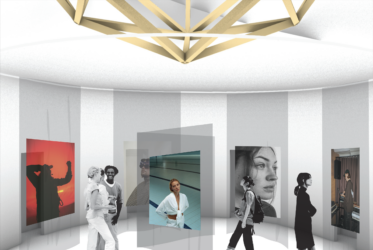
Hanna Maria Kruusma BA diploma project consists of a portfolio and a development project, the focus of which is the spatial concept for photographer Mari Makarov’s solo exhibition at Viimsi Artium.
As part of the development project, I focused on creating a spatial solution for the contemporary art gallery at Viimsi Artium for photographer Mari Makarov’s solo exhibition. The exhibition is rooted in analog photography – Mari’s preferred medium, which values temporality, interruptions, and physical presence. These qualities became the starting point for the entire spatial concept.
The final design is based on the logic of a film strip: the installation unfolds through the space as a three-dimensional sequence that the visitor can partially unroll themselves. In this way, viewing becomes a bodily experience, and the space enters into dialogue with the works, together forming a meaningful whole.
Supervisors Veiko Liis, Anna Kaarma, Grete Tiigiste and Jaan Evart.
*
Caitlyn Kesa
Portfolio
Project
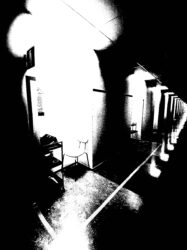
Caitlyn Kesa’s BA diploma project consists of a portfolio and a theoretical development project focusing on the meaning of windows in (interior) architecture.
My development project focuses on the window as a threshold between interior and exterior space. Traditionally, the window is primarily treated as a façade element — with this project, I aim to highlight the window’s potential as a structural and meaningful component of the interior, something an interior architect can consciously shape and direct. My goal was to explore how a window influences spatial and bodily experience — how it guides the gaze, establishes relationships within the space, divides zones, and creates atmosphere. I approached the window not simply as an opening for light, but as a psychologically active and bodily engaged surface.
Supervisors Ville Lausmäe, Anna Kaarma, Grete Tiigiste and Jaan Evart.
*
Arnold Zagurski
Portfolio
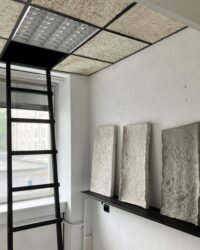
Arnold Zagurski’s BA diploma project consists of a portfolio and a development project “Text in Stone”, which focuses on material research on paper waste.
“Text in Stone” is an experimental material whose main component is glossy scrap paper – something that is produced and used in large quantities, but has limited prospects for reuse. To improve its properties, additives such as slaked lime and dry cement are used. Preliminary measurements suggest that, in addition to regulating air humidity, the material may also purify air from toxins, such as formaldehyde and volatile organic compounds. Although I am presenting a few possible ways the material could be used at TASE, my goal is not to introduce a specific product, but to raise a question: what if waste could have a new life and a positive effect on indoor climate? This work is an invitation to experiment, to doubt, and to rethink how we value materials we usually consider useless.
Supervisors Ville Lausmäe, Anna Kaarma, Grete Tiigiste and Jaan Evart.
*
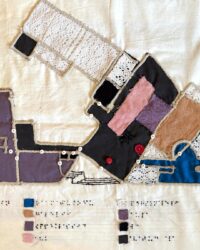
Christine Rõõm
Portfolio
Cristine Rõõm’s BA diploma project consists of a portfolio and a development project, centered on a tactile spatial plan for the visually impaired.
For my thesis, I created a tactile map of the first floor of EKA, designed for people with visual impairments. I’ve always been fascinated by the sensory world of craft – the feeling of materials under my fingers: cords, fabrics, embroidery, buttons… a world you can experience through touch.
At the same time, I feel that our indoor spaces rarely “speak” to those who cannot see. Too often, people with visual impairments are made to feel invisible – unwelcome in spaces, unseen by society.
My goal wasn’t to design a “perfect” map, but to highlight how much more we could do to make our environments accessible. A handmade map is warm, personal, and human – it invites touch, connection, and belonging.
Supervisors Veiko Liis, Anna Kaarma, Grete Tiigiste and Jaan Evart.
*
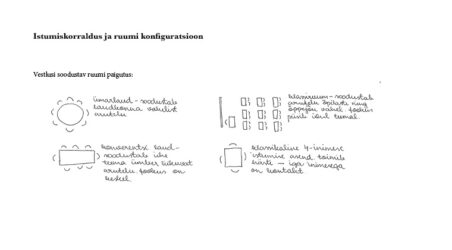
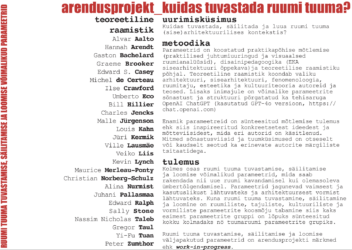
Space, Culture, and Communication: The Cultural Influence on Space Usage and the Formation of Conversations
As part of my development project, I focused on exploring the concept of conversational space as a cultural and social phenomenon, and translating that exploration into a spatial installation for the TASE exhibition. The starting point for the project was my personal experience living in a multicultural environment, which revealed how differently people from various cultures perceive and use space—especially in situations involving communication. These observations sparked my curiosity about the role of space in shaping dialogue.
The process began with mapping the spatial aspects of intercultural communication. I focused on four key factors—seating arrangement, lighting, sound, and personal distance—and examined how their interaction either supports or hinders the flow of conversation. The analysis was grounded in interviews, spatial experiments, and atmospheric studies.
The final spatial outcome for the TASE exhibition is presented in three conceptual variations, one of which was realized as an installation. Each version investigates how light quality, ambient sound, and seating configuration influence the perception of space and the dynamics of interaction. The installation does not seek to offer a definitive answer but rather invites the visitor to become aware of how space quietly shapes our conversations. Here, space is not a neutral backdrop—it is an active participant in the creation of social meaning.
Supervisors Veiko Liis, Anna Kaarma, Grete Tiigiste and Jaan Evart.
*
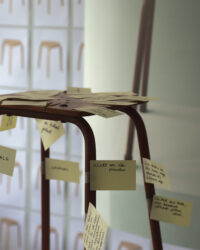
Katariina Ild
Portfolio
Katarina Ild’s diploma thesis consists of a portfolio and a development project, where the search for memory and meaningful space is under observation.
In an empty place — a new development, another suburb, or somewhere else — a person should seek to understand the relationship between themselves and the space they inhabit. To find their character reflected in it. This understanding can emerge through a dialogue with an object that bears traces of life — something that tells a story. Perhaps their own, of a loved one, or someone else’s entirely. In this way, a person leaves behind their own imprint on the space, weaving in memories. Connecting user and space. Without fear of aging, preserving relationships and emotions. Each interpretation is unique, as each person becomes someone who adds to the story — and continues to shape it.
Supervisors Ville Lausmäe, Anna Kaarma, Grete Tiigiste and Jaan Evart.
*

Anni Kärmik
Portfolio
A step into the water
In contemporary design, fully naturally derived materials are rarely used, despite the abundance of valuable resources in our surroundings. The Baltic Sea provides an exceptionally favorable environment for the growth of red seaweed, the base for agar, from which I have developed a series of bioplastic materials. These algae-based materials possess leather-like qualities: they are flexible, water-resistant and biodegradable. This material can be molded and reused by reheating it into its liquid form.
Algae are among the few completely renewable natural resources. As such, the production of this material is inherently sustainable, enabling the creation of a distinctive design language that honors and elevates local nature.
All it takes is a step into the water.
Supervisors Veiko Liis, Anna Kaarma, Grete Tiigiste and Jaan Evart.