
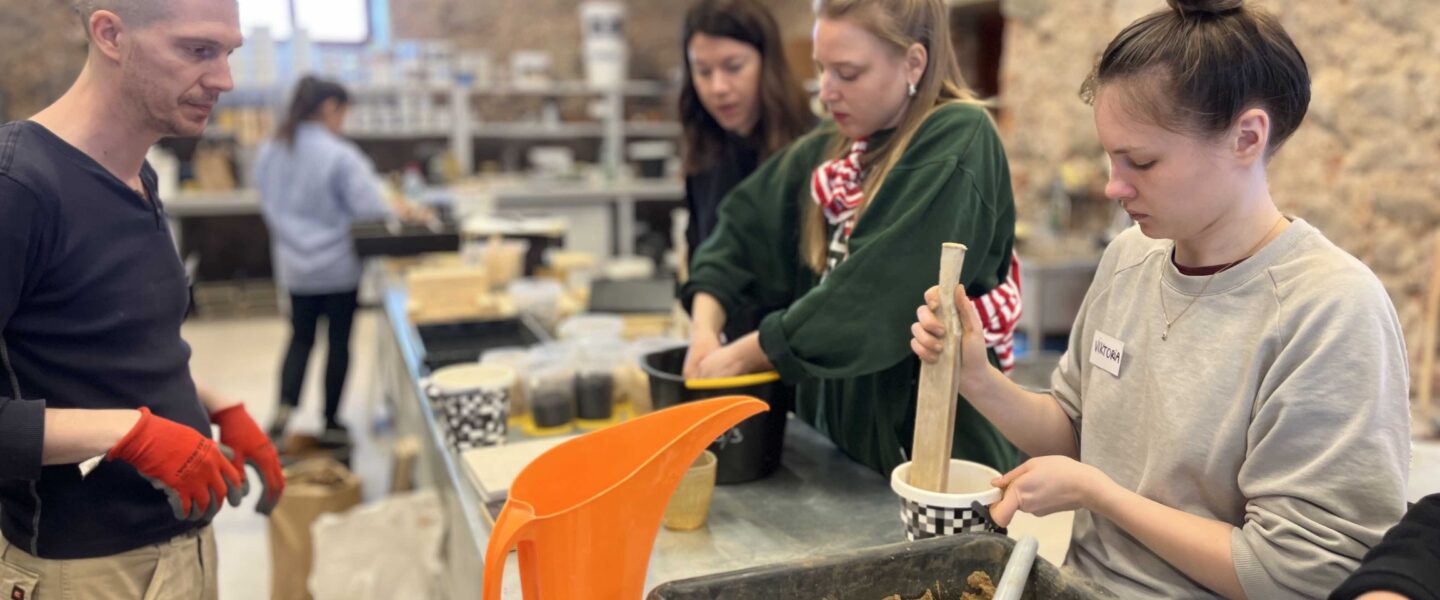
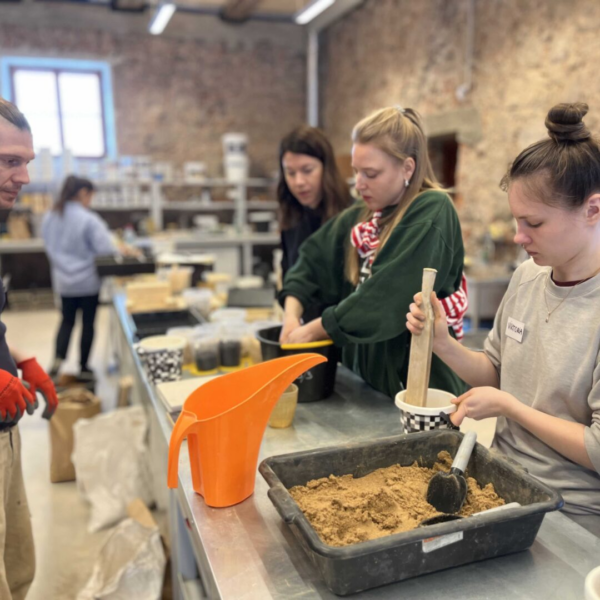
Estonian Architecture supervisor Mikk Luht and interior architecture students Anni Truu, Mari Uibo and Viktoria Ugur at work. Photo: Piret-Liis Carson.
This spring, the first-year specialist studio of the EKA Master’s degree in Interior Architecture will focus on ecological building materials.
Under the guidance of supervisors Roland Reemaa and Hannah Segerkrantz, (interior) architecture in the Anthropocene era will be examined and students will learn firsthand about the materials used in construction every day, the origins of these materials, and the environments from which they are sourced, processed, and used. As a counterweight to extractivism (a term used to describe the large-scale extraction of raw materials and natural materials in order to export them or capitalize them in other ways after minimal processing), the course will seek to find local alternatives and discuss the applicability of these options in architectural and design practice.
The semester-long course will take place in four phases, with each block structured as a separate workshop, focusing on the material, object, context, and spatial levels, respectively.
During the first workshop, students visited 5–8 until March with instructors at the ecological construction competence center Eestimaaehitus located in the Mooste Manor complex. Eestimaaehitus advises and connects organizations, companies and individuals operating in the field of ecological construction and is an umbrella organization for its members in local and international projects. Eestimaaehitus offers a broad-based training service, promotes traditional and modern solutions in the field of energy-efficient construction and natural building materials, initiates international cooperation and cooperation between research institutions and companies. In 2020, Eestimaaehitus opened an ecological construction training, product development and competence center in the renovated stable-carriage shed of Mooste Manor.
On the first day, the students were told about the organization’s activities, the building renovation and the preparatory processes preceding it. During a thorough tour of the building, various construction and finishing solutions used and ongoing research and development work were introduced.
The second day was dedicated to learning about materials. Clay, lime and natural fibres – materials that humanity has used for construction and finishing for over 10,000 years, and Estonian Construction has mainly focused on the use of these materials. Load-bearing structures, insulation materials, blocks, mortars, plasters, putties and paints – students got a practical overview through exciting experiments and hands-on activities of the possibilities offered by clay, lime and natural fibres in the traditional and modern world of construction and finishing.
The main theme of the third day was “Clay as an architect’s tool”. Clay is an excellent modelling material with which to create three-dimensional models and works of art. Clay can be reused indefinitely and, in addition, working with it is a very therapeutic activity. Contact with the material, material awareness and manual activity are important factors in developing creativity and planning.
Students had the opportunity to prepare their own modelling mixtures and create models using other natural materials. The same clay material was reused in several different tasks, transforming it according to its purpose – from raw material to model, from model to wickerwork filling mixture, and from filling mixture to raw brick. In addition, a lecture was held on the topic of “Modern ecological construction and finishing”. In order to inspire students to use it more themselves and to recommend user-friendly and environmentally friendly solutions to their clients, a small overview was given of how natural building materials are used today and in the future, in Estonia and elsewhere.
On the fourth day, the students were tasked with designing and making a sofa table and a flower pedestal for the lobby of the Estonian Construction building, using the tamped clay soil or tamped clay technology. The students’ joint work resulted in a table on wheels, with a round plywood base, and a cylindrical leg made of tamped clay, to which a round plywood top is added as the mixture dries. There is a 20 cm diameter hole in the middle of the top, from which the tamped clay reaches the level of the table top. In addition, the students made a cylindrical, partially recessed, flower pedestal made of tamped clay.
As a side activity to the lectures, discussions and practical tasks, the students also created their first dorodangos during the days spent in Mooste. Dorodango is an art and meditation form originating from Japanese culture, in which a ball is formed from clay soil, which is then finished as desired to give it a texture or polished to a high gloss, using finely ground clay powders.
The initial feedback from the participants was very emotional and positive, and the Estonian Academy of Arts and Estonian Architecture are also interested in long-term cooperation to prepare new generations of more environmentally conscious (interior) architects.
The students were supervised by members and trainers of Estonian Architecture:
Mikk Luht (Founder and Board Member of Estonian Architecture), Malvo Tominga (Wanawiisi Architecture OÜ) and Sven Aluste (Academy of Nature Architecture). The participants were master’s students Simon Baguette, Piret-Liis Carson, Päär-Joonap Keedus, Ann-Katriin Kelder, Krete Tarkmees, Anni Truu, Laura Maria Tõru, Viktoria Ugur, Mari Uibo and Eliisabet Valmas-Romanov.
The course is supported by the Cultural Endowment of Estonia.
We would like to thank the Linakoja guesthouse at Mooste Manor and Kristeli, the cook at Mooste Primary School.
Piret-Liis Carson’s photos from the workshop on Facebook.