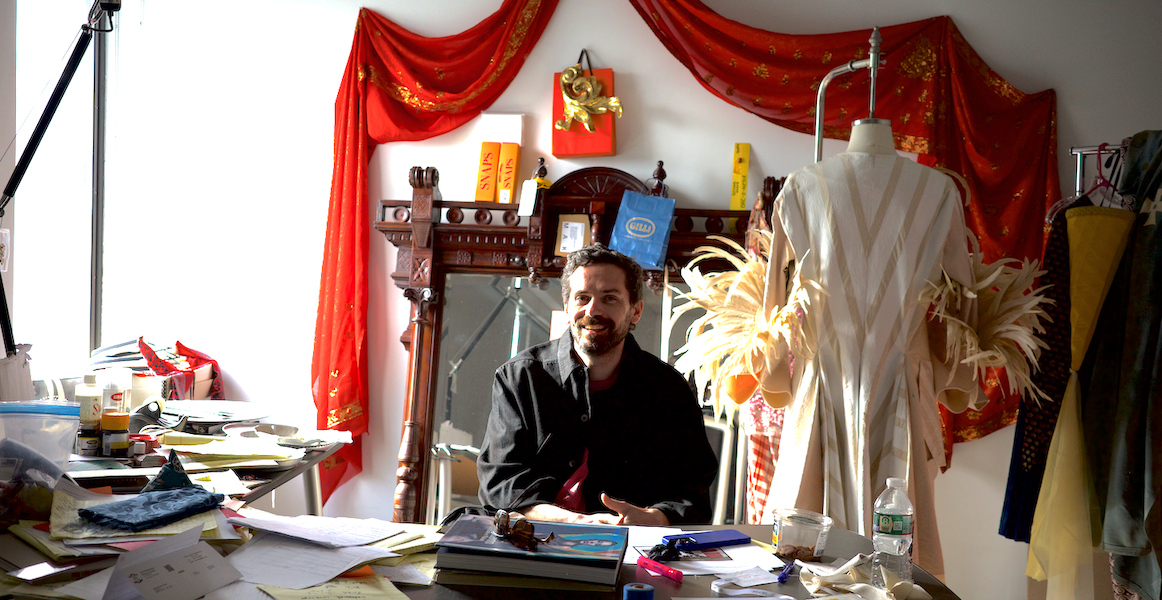
Gwen Van Den Eijnde. Foto: Kelian Luisk
In May 2025, the Department of Accessories and Bookbinding visited design schools in Detroit, New York, and Rhode Island. Kelian Luisk spoke with Gwen van den Eijnde, Head of the Fashion Design Department at the Rhode Island School of Design (RISD), about making through meaning and fashion design in todays word. The interview was published in Sirp and can be read here: https://www.sirp.ee/inimlikkus-roivadisainis/. Below is the English version.
Beyond trends: preparing designers for creative longevity
An interview with an associate professor and the head of the Apparel Design, Gwen Van Den Eijnde.
Inside the Structure of RISD’s Apparel Design Program
The Apparel Design program at RISD is a three-year Bachelor of Fine Arts degree, beginning in a student’s sophomore year. Before entering the department, all students complete a rigorous Foundation Year and Studio Studies — a year designed to build a strong base in drawing, sculpture, spatial composition, and material exploration. This multidisciplinary training serves as a crucial springboard for their development as apparel designers.
Once in the major, the curriculum is carefully sequenced to balance technical mastery with conceptual exploration. Sophomore year emphasizes foundational skills like garment construction, pattern cutting, and working with denim — alongside identity-focused courses that encourage self-reflection and creative experimentation. As juniors, students explore knitwear and tailoring, with the option to study abroad (mostly at institutions like Central Saint Martins or London College of Fashion) to pursue specialized coursework. The senior year is centered around the creation of a final collection, supported by classes in fabrication, concept development, and professional portfolio building.
Electives within the department — such as shirt-making, fashion theory, or even courses on spacesuits and accessory design — are open to students from across disciplines, reinforcing RISD’s commitment to cross-pollination and creative flexibility.
While the program is structured, faculty are actively working to evolve the curriculum into a more individualized, flexible system. The goal: to give students greater agency in shaping their education, and to support original, interdisciplinary, and deeply personal design work.
What are some of the core competencies, skills that you aim for students to develop by the time they graduate?
Well, one of the core competencies is the ability to fabricate an entire collection by hand, because it’s true that everything you see on the runway is made by the students.
They’re not really allowed to outsource the work, so we want them to create everything with their own hands or using the tools available to them here at RISD, to the highest possible standard. It’s a very high level of making. But it’s not just about making — it’s also about imagining and conceptualizing a collection. You need a vision to create a strong collection. You need to have an aesthetic point of view, and that’s something we also prepare our students for.
They need to be prepared to be makers, meaning they must have a certain set of skills. They need to be able to cut and construct garments, sew by hand or machine, understand the basics of pattern cutting, and know how to work with various materials — and actually a wide range of them, whether it’s wool, leather, denim, or silk — and shape those materials into form. But it’s also important to note that this isn’t just an artisanal dressmaking school. It’s a program where, when you talk to the designers individually, they can speak about their inspiration and references. You can have meaningful conversations about why their work matters to them and why they want to pursue it further.
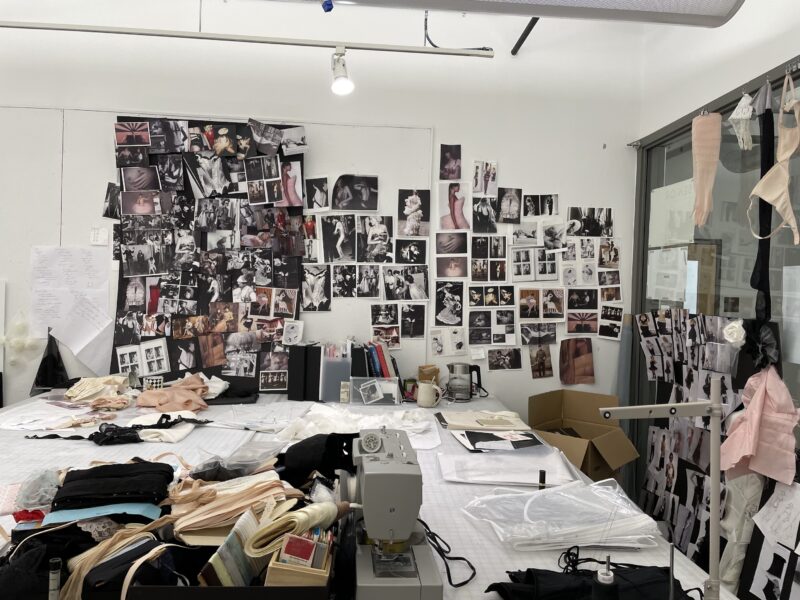
In apparel, we do everything we can to ensure that there’s enough research in each student’s process, because I personally feel that the topic of inspiration in fashion schools is sometimes treated a bit superficially. In that sense, I believe our designers are better trained — conceptually trained — and maybe more like artists. I think that skill will carry them further. At some point in a critique, it doesn’t matter if the hem of the skirt is too short or too long. What matters is that students invent an entire world, a world of imagination in which their collection lives. I know it sounds a bit abstract, but once they identify their topic or theme, they can then develop a cohesive design process within that. Some do it better than others, but I believe it’s a very important aspect of design. It’s the imagination that the pieces convey.
Do we give them some kind of reference list, like “you should read this” or “look at that”? Or is it more about their own sources? And are there things we discourage, like Pinterest? Yes, for sure. That’s also something we address. For example, we have a very good fashion history class and a fashion theory class.
We also have an excellent course about the use of animals in fashion, which covers materials that come from animals — wool, silk, feathers, all sorts of leather and skins. It’s really eye-opening for students, because it teaches them to consider materials not just as items on a shelf, but in terms of their provenance — historically and ethically. It’s a wonderful class that helps students think about materials differently, and that’s, of course, ten times better than browsing Pinterest or choosing fabric samples online.
And yes, we’re all working with a generation of students who are on their phones all the time, but I believe it’s important to keep the hand, the body, and tactility at the center of the process. That’s a personal belief, but I feel strongly about it. I’m not interested in living in a purely virtual world. Some faculty, of course, are embracing new digital tools — like CLO3D, augmented reality, and other sophisticated machines — which are useful for design rendering, prototyping, and ensuring material efficiency in production. I understand that. But nothing replaces the experience of draping real fabric on the body and the quality of touch.
It’s like writing a text by hand. That’s not a new idea. There are many scientific studies showing how it engages the mind and body, developing intelligence and memory. So I’m not anti-technology at all, but I take it with a pinch of salt. I think we can see in students’ chosen topics that sometimes they lean toward dark or dystopian themes.
Of course, we’ve all gone through COVID, and the world isn’t in the happiest state, so I ask: what happens if you suddenly don’t have access to all that sophisticated equipment because there’s no electricity? You still need to be able to make — for example, to carve an amazing pair of shoes with your hands. Again, I’m not saying students should be educated in survival mode, but I do believe in giving them options. And I really think there’s a level of humanity that we must not lose to machines.
How do you balance conceptual development with technical skills in coursework?
It’s actually not easy to balance, because the problem is that, for example, here we have different faculty members teaching different courses. Some faculty focus on technique and making, while others teach more about research and the inspiration process. But we also need to find moments when faculty co-teach—when they come together, review the students’ work, and offer constructive, uplifting feedback.
This can sometimes be tricky, because while co-teaching is interesting, it’s not always perfectly aligned. It also happens that some faculty can be a bit stubborn, as they each have very different definitions of apparel design, fashion, textiles, and costume. For example, I have faculty who lean toward a more Ralph Lauren approach—a traditional fashion collection—while others are more experimental and prefer something closer to a Comme des Garçons aesthetic.
Of course, these differing ideas about what a garment could or should be can lead to conflicts. Sometimes students find themselves caught in the middle of these opposing viewpoints, and they struggle to decide what inspires them most—especially when they’re still quite young.
This is a BFA program, not an MFA. I think the students do a good job; they’re not simply trying to please the faculty. In the end, they seek guidance, but they also manage to carve out their own expressive space and say, “I’m interested in this, and this is what I want to do,” and so on. It’s not easy, but I think it works.
Obviously, we’ve had some really good outcomes, but it does require a lot of coordination among faculty. You need instructors who are open to this kind of collaborative dialogue. Otherwise… I’ve seen—not so much here in Apparel Design at RISD, but in other fashion programs—teachers who tend to expect students to produce work that mirrors their own. Take, for example, the class run by Vivienne Westwood in Vienna. Essentially, what resulted was Vivienne Westwood’s work recreated by the students.
Of course, it’s inevitable that we influence students with our own aesthetics, even through the references we bring to the table. Personally, I’m very interested in historical dress and costume, so I naturally share certain things with the students. But I’m not interested in seeing them produce work that looks like my own. That, to me, is not exciting.
What I find more compelling is designing a kind of space where something can grow—where students can truly take ownership of their visions. That echoes what I’ve said before. Of course, you can guide them, but you have to let go of control over what the end result will look like. That’s when it gets really interesting—more surprising for both the student and the faculty.
I don’t necessarily believe in fashion sketches, because for me, they tend to lock everything into a final image too early. But if you follow a truly experimental and thoughtful fabrication process, then what you make in week one might look completely different by week twelve—and that’s a really exciting creative journey. It’s not interesting to draw a sketch in week one and spend twelve weeks fabricating exactly that.
Along the way, so many magical things might happen. If you develop things properly, it’s not just about creating one piece. You might discover a process that’s much richer—one that can produce a whole collection. Or you might find a whole design DNA, a personal identity, through which you can fabricate numerous models, not just a single look.
I’m still learning how to ask the right questions so that the students can guide the process themselves. It’s really challenging.
But that’s what makes our jobs interesting. It’s much more engaging, because I see it as a form of collaboration with the students. Instead of trying to control the outcome, it’s more about establishing the rules of the game. You set the parameters, because students need some structure. Sometimes that means providing a framework in terms of time.
For example, we have 12 weeks in the semester, and it needs to focus on research, process, and presentation. But within that structured framework, students are free to do what they want. They’ll receive individual feedback, assignments, and guidance, of course. But I can’t predict whether a student will present a coat, a dress, a hat, a corset, or something entirely different — because they need to bring in something they’re genuinely excited about.
I really believe you can’t force someone. There’s that expression: you can lead a horse to water, but you can’t make it drink. Not that I see students as horses, but a student needs to find their own fuel. And this is one of those key moments where we ask, “Tell me what you’re interested in.” Especially when it comes to an artistic process, it’s about empowering them to own their individual journey.
Right now, they’re in school, but they’re here precisely to do this kind of fundamental research — so that when they graduate, they have a better understanding of who they are as creative individuals, and they can continue to grow.
It’s not just about mastering technical skills. It’s also about investing in your intellectual curiosity, and I think that’s incredibly important. It’s even more crucial in fashion, because I don’t want to live in a world where, during an interview, a fashion designer has nothing to say. That’s the most boring kind of conversation. A designer should be able to captivate their audience and speak about a wide range of topics.
That’s actually something Vivienne Westwood said: have a foundation and know where your deep interests lie. Of course, I know Vivienne Westwood was a provocative and, in some ways, outrageous figure — but some of her statements remain deeply relevant today.
How has the curriculum evolved recently in response to changes in the fashion industry or student needs? You did say that you want to work on changing.
Yes. I would say there are two answers to this question. First, we made internal adjustments in a very practical way. We noticed that some things just didn’t work for students, so we rearranged the sequence of classes to better support the creation of a stronger body of work. That was successful, and it’s something you can really only do through experience. It’s hard to plan everything theoretically without seeing what works and what doesn’t.
Over the years, we’ve run several classes and made adjustments along the way. We removed certain assignments and combined others — for example, pairing two classes to better balance concepts and making. We also advise students who want to go abroad to do so in the spring of junior year, since they need to be on campus for their full senior year to work on their collection and portfolio. It’s important to make full use of the campus resources and workshops.
That’s also why we encourage seniors to stay during winter session — to take advantage of the studio space and finalize their collections. The goal is for students to graduate with a strong body of work and an outstanding portfolio. These are pragmatic curriculum adjustments, made in response to students’ needs and pacing — not necessarily to changes in the fashion industry.
Secondly, regarding the fashion industry. Honestly, maybe we don’t care about it as much. I know that sounds provocative, but RISD is an art and design school, not a traditional fashion school. I believe students need to be educated in artistic processes, and fashion is one way to express that. It’s also a craft and a culturally significant medium, and students need to understand and appreciate that.
Once they have that foundation, we can talk about industry standards. But I’m not convinced that current industry norms should dictate our curriculum. Trends change — especially with ideas like sustainability. In 10 or 20 years, those concepts might look very different. We’re preparing people for the long term, and we hope they’ll look back on their education as a meaningful foundation. That was certainly my experience. My education wasn’t perfect, but it shaped my understanding of the world.
I was never trained to follow a standard model for fitting into the industry. I think that approach risks turning students into something formulaic. And that’s not what an artist is. Not that artists must be rebellious — but they do need a unique perspective. And from there, you can explore different production methods, whether industrial or more handcrafted. These reflect different ecosystems, different ways of making.
I’ll admit, I don’t have answers to some big questions — like the future of fashion. I really don’t know. Sometimes you attend symposiums where people expect a definitive answer, and I just think, “I hope it’s a bright, creative, exciting future.” But that begins with deeply inspired people making beautiful things. I’ve said it before: the most sustainable things are beautiful things. The world is full of products, but we all want to be emotionally moved—by a garment or object that transforms our daily experience. That feeling of being uplifted by what you wear—that’s powerful.
So, should we adjust the curriculum based on industry needs? I’m not sure. It’s important to be in dialogue with the industry, understand their challenges and goals — but as academics, we also need to protect what we believe is essential. It’s a different mindset. For me, it’s about culture and storytelling. I don’t want that to disappear.
Of course, students want concrete skills to enter the workforce — I completely understand. But the ability to speak about one’s work, and to recognize its emotional and cultural power, is also a critical skill. I hope we’re helping shape individuals who can transform reality through clothes.
Fashion has changed a lot. There was a provocative piece by Lidewij Edelkoort in 2014 that said, “Fashion is dead, now it’s only clothes.” And maybe she’s right. The idea of fashion as a shared aesthetic is fading — now it’s more about individual styling. But I’m fascinated by the Wiener Werkstätte — a collective of artists and designers in early 20th-century Vienna who worked across media, including fashion, interiors, and textiles. They had strong individual voices, yet still forged a unified aesthetic.
I wonder if something like that could return — a collective movement where people work together to create a shared vision. That would be powerful. Today, there’s so much focus on individualism, but imagine 12 people collaborating on a new artistic wave — like a modern Art Nouveau. That could be extraordinary.
Tell about one project, a student work, that has impressed you or had given you a lasting impression?
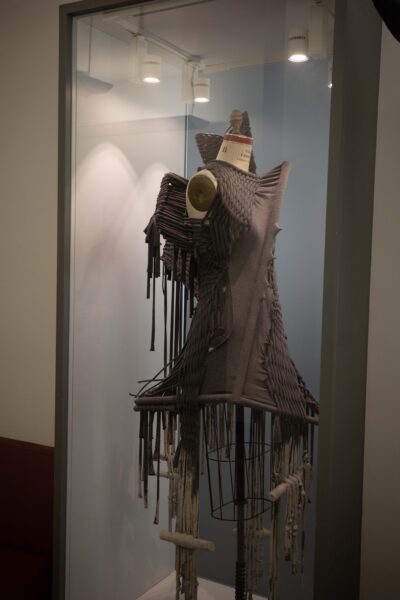
I could tell you about the dress, made by Mariam Devadze. It was constructed with sticks wrapped in jersey — an incredible garment that sits somewhere between sculpture and architecture. It almost makes the wearer look like a brutalist building. It’s absolutely wild.
I’m thrilled to see that kind of work coming out of the apparel department. Of course, some might look at it and think, What is this? How is it functional?—and it’s not. The model probably couldn’t even sit down. But it’s clearly a sculpture. As a vision, it’s incredibly strong. And I think it’s better to start with a strong vision. From there, you can dial it back—collaborate with a team and ask, How can we translate this into a more wearable piece? Maybe there’s a T-shirt version of it, something that keeps the spirit but adapts to the body.
Although the students’ styles differ, I do hope that this kind of work can spark something — a movement, maybe. Okay, perhaps that’s an exaggeration, but it ties back to what I was saying earlier. Some people might dismiss these pieces as grotesque or ask, Who would wear this? And I get that. Personally, I’ve often been criticized for my interest in costume — because people think costume is a cheap version of fashion, something rushed or unserious. But there’s such thing as theatrical fashion. And whether you call it costume or fashion, you can still choose to work in theater, film, dance — or stay within the fashion world. These things are wearable — it just depends on the context. Maybe not for an office job, but for a special event? Absolutely. And you’d be surprised. Some people really do wear these things every day.
A friend of mine, a curator at the Openluchtmuseum, whose mother still dresses every day in traditional Dutch clothing—starched aprons, caps, the whole thing. It’s incredible. She rides a bike, drives a car, farms, milks cows, goes to church—all in that attire. In many ways, it’s a preservation of craft. They’ve passed down knowledge over generations and know how to make extraordinary things. Many of them never went to RISD or EKA. I was honestly in shock during my last visit — just staring at the craftsmanship, thinking: This is incredible.
______________________________________________________________________________
Mariam Devadze
(Instagram https://www.instagram.com/mari.devadze/)
How do you usually approach the research process?
I think my research partly stems from my experience as a displaced person. I’m from Georgia and currently an international student. A lot of my inspiration comes from post-Soviet buildings and the search for familiarity in unfamiliar places.
In my research, I often explore what subconsciously makes me feel comfortable. I’m especially drawn to abandoned places and liminal spaces, and how architecture and urban environments affect the body.
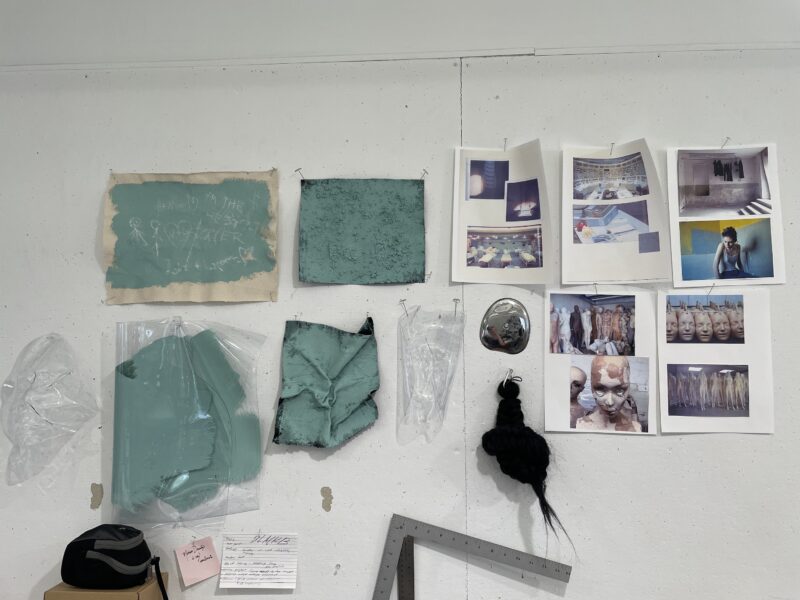
Usually, our research starts with library work — finding books and topics we’re interested in. This semester, I began looking at abandoned shelters in different countries and noticed they were all painted a faded turquoise blue. That color immediately reminded me of home, as many post-Soviet interiors were once painted that vivid turquoise, now worn and faded. I’m trying to bring that sense of familiarity into the body through my work.
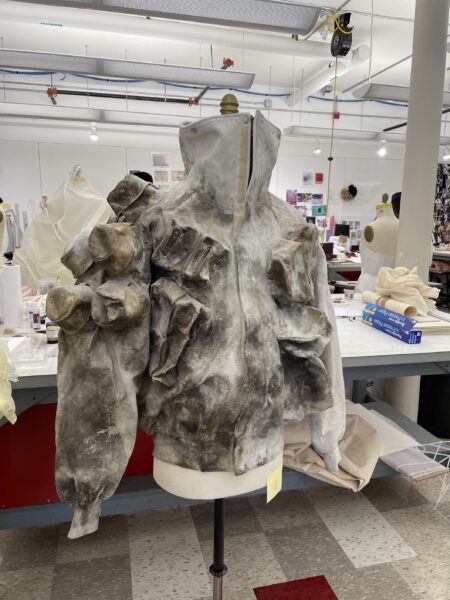
I like using unconventional materials — paint on fabric, wire, cement. Lately, I’ve been working with chalk paint mixed with perlite to give fabric a textured, architectural feel. When you touch it, it feels like a wall. I’m fascinated by how people use chalk to leave messages — by wearing those writings, the body becomes part of the architecture. It feels intimate, like you’re carrying people’s thoughts. There’s something archival and abandoned about it.
I’m also experimenting with the idea of leaving a garment outside with an invitation to write on it with chalk — anonymously collecting messages. I made some of the writings myself, but for others, there’s a mystery — where did these words come from?
While researching abandoned places, I noticed many contained mannequins. That led me to imagine a dystopian world where everything is abandoned except for these inanimate figures. Mannequins are eerily human but soulless, and in that imagined world, the only way people coexist peacefully is by being stripped of thoughts and individuality. Seeing them together feels uncanny — they’re equal, identical, and entirely empty.
What are your thoughts or feelings about the industry?
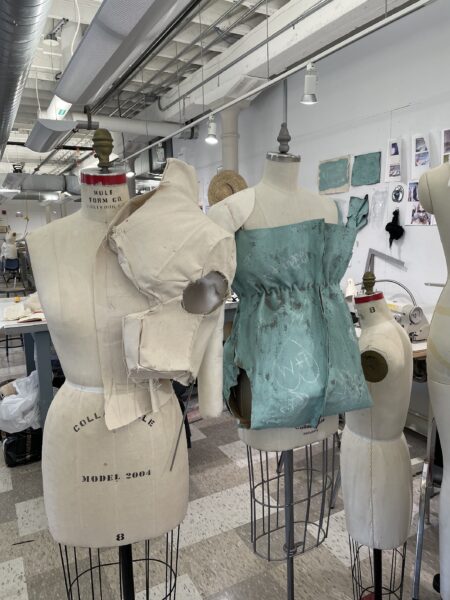
I feel that here in RISD, we’re really lucky. We have our own desks, sewing machines, and space to leave our work. That kind of setup encourages us to create big, sculptural pieces — sometimes even character-like. We’re not really making things you’d wear out on the street, but it’s interesting to ask: what if someone did? It creates this uncanny moment — a strange, otherworldly figure in a mundane city.
My own work isn’t exactly ready-to-wear, but having the freedom to build large, detailed pieces allows us to later scale them down if we want to move toward something more wearable. Or we can land somewhere in between, creating garments meant only for the runway.
That’s what I did for a recent competition — I used last semester’s research and sculptural dresses, applied the same construction techniques, and adapted them to the body in a more wearable way. Like: how can I turn this jersey weaving into a dress? How can I apply these ideas to something functional, while keeping the original concept and message?
Personally, I find sculptural work more fun. But wearable pieces are exciting too — especially because I can actually wear them out. It’s a different kind of satisfaction.
As for the industry, I’m still figuring it out. I definitely want to work for someone at first, just to get a sense of what I like. Eventually, I’d love the creative freedom to make large-scale pieces or even costumes for contemporary dance. I’m not too picky yet — I haven’t experienced much of the industry. But I think a role that gives me creative space, or a balance where I work for someone but still have time for personal projects, would be ideal. For now, I’m just going with the flow.
______________________________________________________________________________
RISD Apparel: https://www.risd.edu/academics/apparel-design
2025 Graduate Show
The visit was supported by Erasmus+ and Cultural Endowment of Estonia