
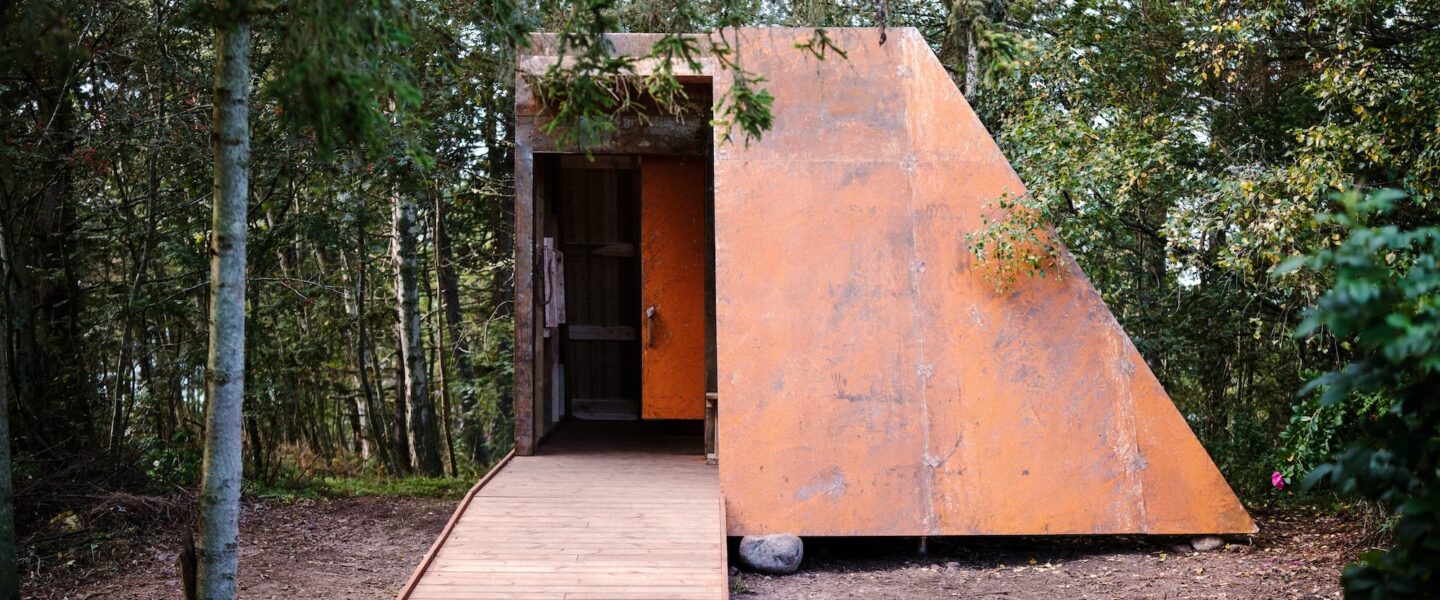
The Estonian Academy of Arts Interior Architecture students built the outdoor toilet “Julla” at the camping area of the State Forest Management Centre (RMK) at the tip of the Juminda peninsula, which takes into account the virtues of modern sustainability, visitor comfort and flexibility of materials.
For years, the traditional spring semester project task for first-year students of the EKA Department of Interior Architecture has been a small building, which ends with a construction internship in the summer. In 2025, the cooperation partner was RMK, which manages the public hiking trails and camping areas of state forests and the need to renew the existing infrastructure. The project was helped by the PAKK Wood Architecture Competence Centre operating at the Faculty of Architecture of the EKA.
While in previous times forest objects, observation towers, shelters and saunas were created, this year’s small form function became an outdoor toilet at the request of RMK. The initial development of the project’s conceptual solutions took place as individual work by the students, and in a later phase, working groups were formed from similar ideas. Four projects were completed in the group work, from which the winning work “Julla” was selected. The authors of the winning work are interior architecture students Lisell Oja, Ketlin Kõiv and Aleksandra Saar.
“Julla” is a functional small building intended for public use, the aim of which is to increase the comfort of visiting the camping area, to offer a hygiene solution that is accessible to visitors with mobility restrictions and that is compatible with the environment. “Julla”’s sustainable design, use of recycled wood material and construction take into account the characteristics of the environment and maintainability, while also offering a bold architectural form. The design of the building emphasized visual quality and fit into the unique landscape of the Juminda Peninsula.
“I had two things in mind. While RMK’s hiking trails and sites generally have uniform signposts, benches and shelters, a single, metal and angular-looking barbecue stove looks strange next to everything else. I hear people often tend to tamper with objects at RKM hiking sites. That’s why my personal initial task was to create a cute but dangerous-looking companion for that stove, which would give the impression that it’s not worth trying your hand at,” says student Lisell Oja.
“Some of the wood used for the project came from Norway, from a century-old barn. In this project, the material was adapted to be suitable for construction in the Building Structures Testing Laboratory of TalTech, and various components were manufactured to strengthen and stiffen the frame,” notes senior lecturer Eero Tuhkanen, from the building structures research group at the School of Civil Engineering and Architecture.
“RMK is pleased that the cooperation with the Estonian Academy of Sciences, which has lasted for many years, has continued. As usual, the toilets in our visitor infrastructure are fully functional. It is very pleasing that the Juminda camping area now combines functionality with modern design. The cooperation with the supervisors and students went well and was flexible. The students coped with the difficult initial task, which also had to take into account the nature conservation restrictions arising from the Lahemaa National Park. The final assessment of the ease of use and maintenance of “Julla” will be given by the visitors and the nature ranger maintaining the toilet,” commented Timo Kangur, Head of the RMK visitor area.
The completion of the project was supported by the research project “PUUSTER” TEM-TA80, co-funded by the European Commission and the Estonian Research Council, which deals with the development of methods for valorizing underused wood and wood materials in construction.
The small building was completed in the summer of 2025 during the course of the subject “Construction Practice” and was opened on September 6.
The students were supervised by lecturers Ardo Hiiuväin, Eeros Lees, Päär-Joonap Keedus, Avo Tragel and Oliver Kanniste.
The small building was built by students Kertu Aljas, Diana Alliksaar, Sander Etverk, Lotta Mii Hasa, Julius Heinlo, Kaur-Markus Jenas, Krisette Juur, Henri Kats, Ketlin Kõiv, Lisell Oja, Kaur Rõõmussaar, Aleksandra Saar, Triin Virve and Janet Kljuzin.
The building process was supported by Circular Technology lecturer of the Tartu University Viljandi Culture Academy, Peep Tobreluts.
The completion and opening of the small building was supported by RMK, PAKK, TalTech, Essve Estonia AS, Raitwood, Green Pro OÜ, Carrotscrew and Rõngu Pagar.