
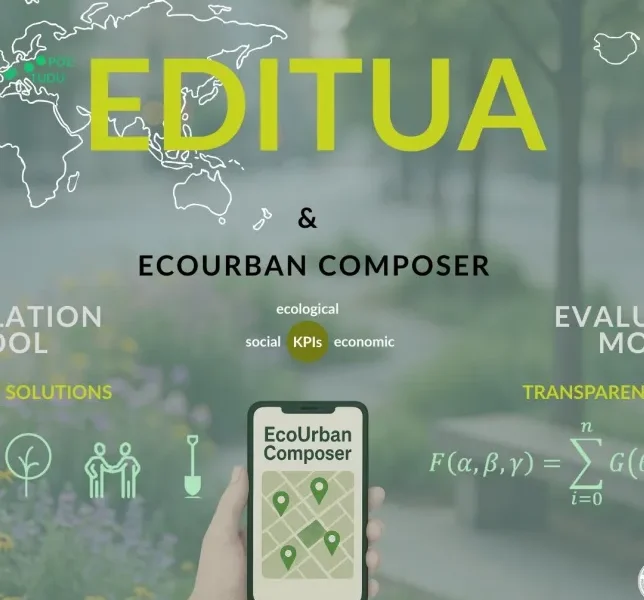
The EDITUA project aims to create a new tool, EcoUrban Composer, for mapping urban spaces, taking into account green thinking and integrating technology. The project helps to create added value for urban actors by raising social awareness and civic engagement and responsibility for a sustainable lifestyle. The tool helps to socially engage underused public spaces and create green spaces.
Challenges:
The EDITUA project is based on an analysis of the impacts of existing commercial certification programs. In practice, these schemes concentrate power in the hands of large developers and corporations, leaving ordinary citizens on the sidelines and not allowing them to direct the green transition of their neighborhoods. Certification programs are often exclusive, opaque, exploitative, expensive and top-down — and therefore prone to greenwashing.
The EDITUA project aims to pave the way for the green transition by providing practical solutions and open tools that give every resident the opportunity to contribute to the creation of a livable urban space. By sharing information, skills and decision-making power with local communities, EDITUA seeks fairer, more sustainable and community-based pathways to healthier and more resilient urban neighbourhoods.
Through collaborative workshops, the project develops local skills, supports a caring attitude towards the living environment and creates models for fair and low-carbon change in urban space.
Proposed solutions:
The project responds to the challenge with several concrete solutions. In the theoretical work, a comprehensive EDITUA model is created – a general framework for data-driven decision-making. The model takes into account clear criteria and all stakeholders.
Second, a digital tool – EcoUrban Composer – is gradually created and developed, which combines simulation and evaluation engines through a user-friendly graphical user interface.
The consortium partners will use these tools to conduct pilot projects in several cities to test the applicability of the tool and its simulation and evaluation capabilities. Lessons learned through comparative studies are synthesized and compiled into the EDITUA Handbook, which contains good practices and policy recommendations.
The Handbook translates the lessons learned from the pilot projects into practical guidelines, templates and metrics to support the replication, scaling-up and community-based urban renewal in different contexts.
Expected outcome:
The EDITUA project will deliver a practical tool that operates at three interrelated levels — technological, procedural and social — to promote community-based green space planning.
The main outcomes are the digital tool EcoUrbanComposer and a working action protocol, which together enable inclusive, playful design, data-driven decision-making and transparent evaluation.
Pilot projects will be implemented in Poznań (Poland), Tallinn (Estonia) and Volos/Larisa (Greece), where measurable results are expected: increased participation of local residents, better maintenance of underused public spaces, increased biodiversity in cities and reduced carbon and resource use.
The project will publish a comparative handbook with descriptions of experiences, policy recommendations and toolkits to support the dissemination and replication of solutions.
Residents, municipalities and urban planners will all benefit. Local capacity will be strengthened, and management-ready metrics will be provided to guide fair, resilient and affordable urban renewal on a larger scale.
Long-term impacts are seen as strengthened inter-city networks, new roles in the community and knowledge that will help shape policy and funding decisions.
Project duration: 1.1.2025-31.12.2027
Project partners are: Poznan University of Technology, Estonian Academy of Arts and University of Thessaly, Dortmund University of Technology and University of Ljubljana
The project is co-financed by the European Union
DUT – Driving Urban Transitions
Ministry of Climate