
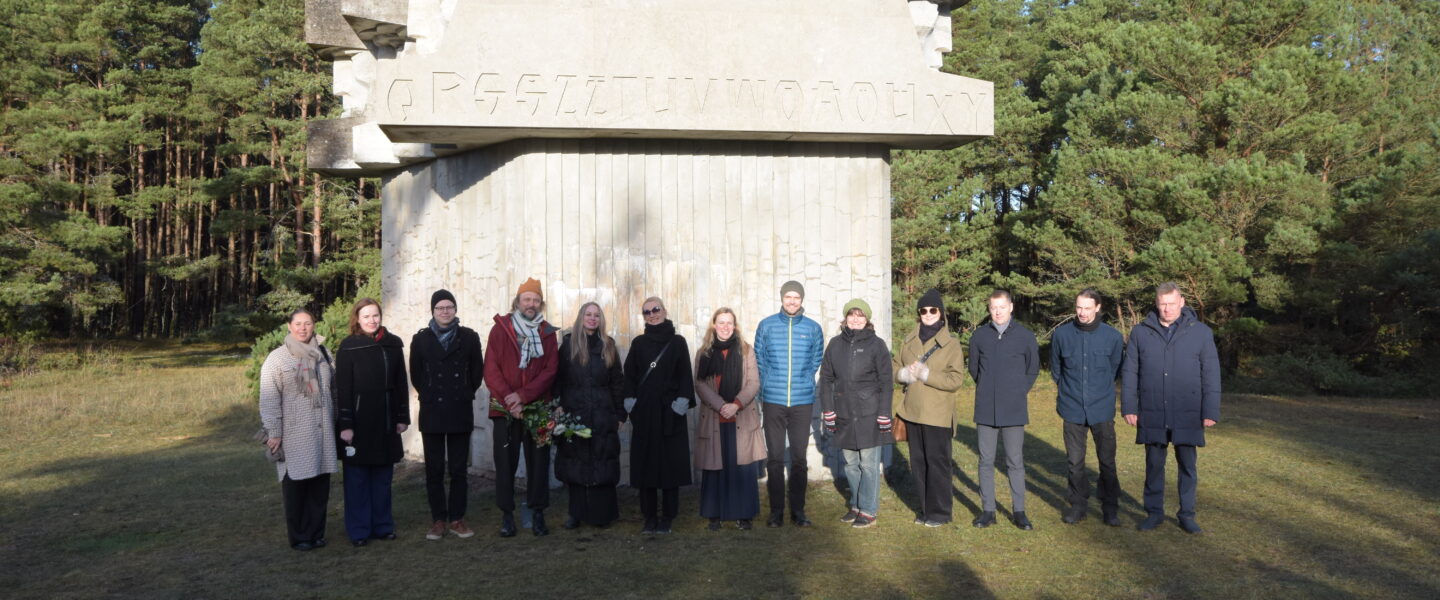
The recontextualisation of the Tehumardi memorial in Saaremaa was unveiled on 14 November. It is the first Soviet-era monument in Estonia to be reframed in this way. Developed through a combination of artistic and research-led approaches and with the active involvement of the local community, the outcome is unique even in an international context.
The Tehumardi monument (designed by Riho Kuld, Matti Varik and Allan Murdmaa, and unveiled in 1967) has been given new meaning. Last summer, the remains of soldiers were reburied and the gravestones that had formed part of the memorial grounds were removed. Together with the newly opened artistic intervention, the remaining element of the memorial — the column monument — has received a contemporary reinterpretation. As part of this reframing, an outdoor exhibition has been installed, presenting the history of both the battle and the monument, along with the ways in which their meanings have changed over time.
The artistic intervention Words by Neeme Külm, which won the design competition, replaced the Soviet-era inscription on the memorial with an alphabet carved into a slab of Saaremaa dolomite. By breaking down the monument’s propagandistic message to its basic components, the intervention leaves space for the aesthetics of the era, inviting viewers to notice the monument’s original sculptural and architectural form.
“Monuments are illustrative interleaves in the book history — visual rehearsals for telling someone’s truth. The ability to speak of what has been, while remaining honest with oneself, is worth the effort. This proposal is an attempt to seek the half-tones and understanding between contrasts, without unnecessary words,” said Neeme Külm.
The comprehensive solution became possible by bringing together knowledge and skills from different fields — the project involved artists, historians and conservators, and equally important were the technical skills of the local craftsmen who carried out the work, as well as the municipality’s role in conveying the local vision and negotiating with the community. The recontextualised memorial highlights the multilayered nature of local history and heritage, creating an opportunity to discuss Estonia’s complex with both residents and visitors. The solution, noteworthy even in a European and global context, has already attracted international attention.
“The reinterpretation of the Tehumardi monument was a complex process that required careful consideration of heritage-protection and artistic values, as well as its ideological charge. Neeme Külm’s intervention Words demonstrates how an artistic approach can help to neutralise difficult heritage while still respecting cultural heritage,” said Jüri-Martin Lepp, Adviser on Art Heritage at the National Heritage Board.
The reinterpretation of the memorial was carried out through the collaboration of the Estonian Academy of Arts and Tallinn University’s project How to Reframe Monuments, Saaremaa Municipality and the National Heritage Board. The project was supported by the Estonian Ministry of Culture.