
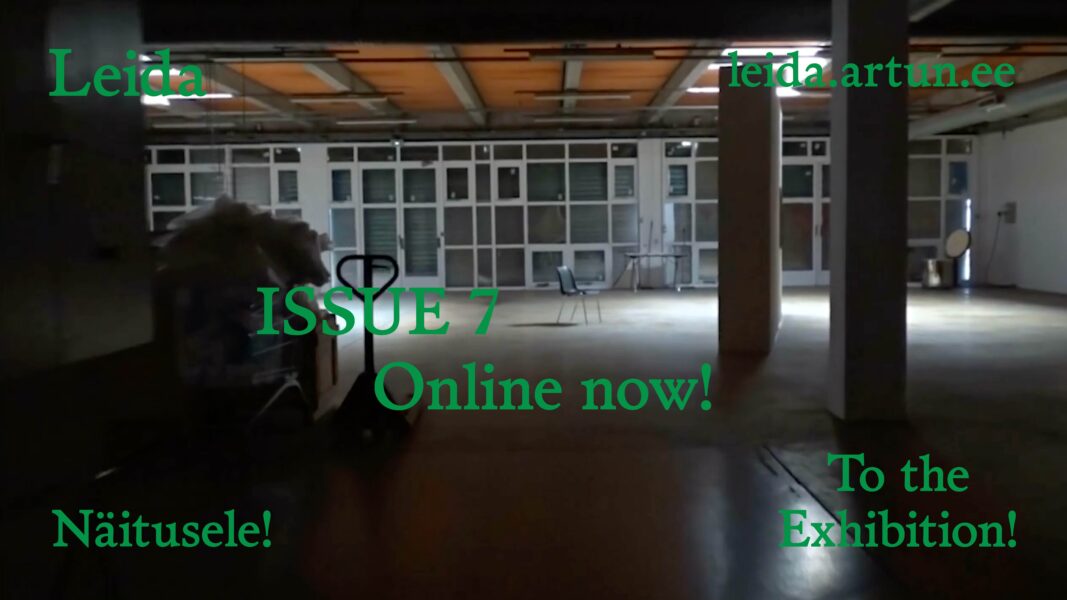
On November 28, the new issue of the design journal Leida, titled To the Exhibition!, was published. Drawing on the history of design exhibitions, examining the influence of institutions on exhibition practices, and introducing varied curatorial approaches, the issue offers an overview of both historical and contemporary examples while outlining new directions for design curation. The issue invites to reflect on the role design has played in exhibition-making and on the curatorial practices design requires today.
“In recent decades, the field of design exhibitions and curation has seen rapid development with a wide range of exhibitions, published catalogues and media coverage. At the same time, discussions around design curation as a professional practice are meagre,” writes the guest editor of Leida Sandra Nuut in the preface. “Several texts in Leida’s current issue highlight the role of institutions in knowledge production, as well as the movement from object-based exhibitions to programmatic and participatory curatorial work that centres around responsibility towards both communities and the environment. New tendencies in Western European design museums emphasise the importance of dialogue and an active engagement with the citizens. In Estonia, however, design curation is more focused on programme-based involvement, bringing to light thus far undiscovered materials and writing design history.”
The 7th issue of Leida opens with a conversation between Sandra Nuut and the curators Karin Paulus, Karin Vicente and Kai Lobjakas, who have long been actively involved in the field of design and art exhibitions in Estonia. Along with outlining the evolution of design exhibitions, curatorial practices and institutional history, the discussion also emphasises the importance of mapping the local design history and calling attention to contemporary design practices. Prague-based Lilia Gutiérrez explores the shifting role of design museums and calls upon us to react to environmental and social changes, drawing from terms used in the natural sciences, such as taxonomy. The Basel-based curator and critic Vera Sacchetti shares with Sandra Nuut her curatorial journey characterised mainly by participatory and programme-based formats. She summons curators and museums to stop making exhibitions and instead engage in conversations with the audience. Similar to Sacchetti’s views, three curators with a background in the Design Academy Eindhoven have stepped away from traditional curation. Tiiu Meiner’s interview with Nadine Botha and Delany Boutkan reveals how education has influenced their professional journeys and shaped their understanding of curation in its extended sense, including developing educational programmes, creating contexts for dialogue etc.
In her essay, Sunny Lei, a master’s student in the graphic design department at the Estonian Academy of Arts, analyses exhibition paratexts (labels, wall texts) and looks into the ways they may influence the interpretation of the work or shape the political or cultural dimension of the exhibition. Marite Kuus-Hill, a master’s student in craft studies at the Estonian Academy of Arts, writes about a course in the framework of which the textile students visited the exhibition “Between Borders, Between Materials” (curated by Karin Paulus and Ingrid Allik) at ETDM. This inspired them to later make experimental connections between text and textile, while looking for new artistic and intellectual perspectives. The issue also features two case studies of design exhibitions. Grete Tiigiste, curator of the Estonian Museum of Architecture, writes with the design historian Ivar Sakk and designers Aimur Takk and Andree Paat about the typeface Tallinna Infošrift and the designs related to the Tallinn sailing regatta, which was part of the 1980 Moscow Olympics. The exhibition “Sailing Forward. How the 1980 Olympic Regatta Shaped Tallinn” at the Museum of Architecture (curated by Grete Tiigiste, Ivar Sakk, Karin Paulus) presented a suitable context for examining and revitalising the typeface.
The curator Annelies Thoelen introduces the exhibition “Colour. Seeing Beyond Pigment” at Z33, House for Contemporary Art, Design and Architecture in Hasselt, Belgium, where her aim was to focus on creating a relationship between the object, environment and the audience, even though physical engagement with the material seemed complicated at first. The graphic designer Paula Buškevica created a visual essay for the issue based on the unfinished anthology of design exhibitions compiled by the guest editor. Its aim is to map and visualise the development of design exhibitions held in Tallinn.
Leida’s graphic designers are Haron Barashed and Fernanda Saval. The cover image for To the Exhibition! is by Chloé Gourvennec.
Leida is an online journal published twice a year. Leida is initiated by the Faculty of Design of EKA, the journal is supported by the Architecture Endowment of the Cultural Endowment of Estonia, the Research Fund of EKA and the Faculty of Design of EKA.