
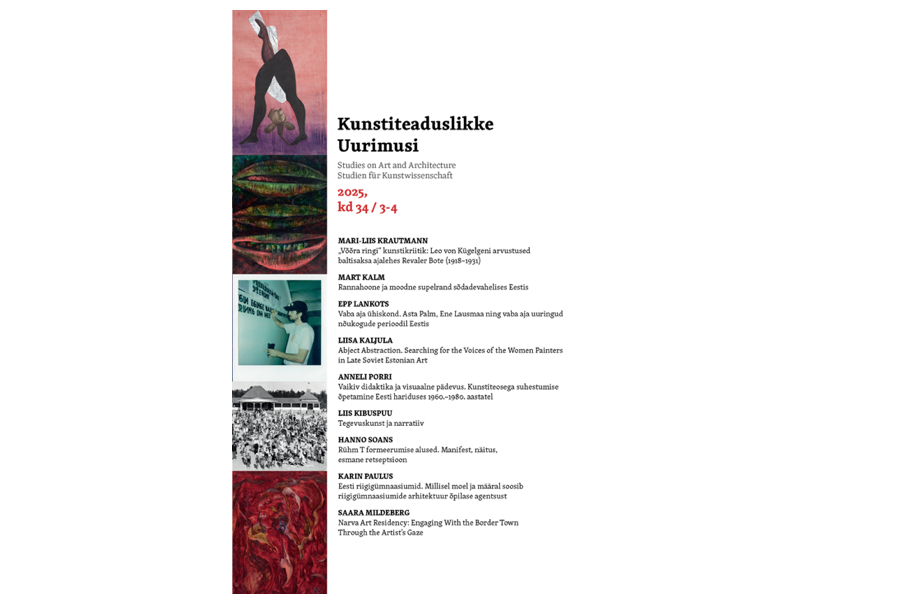
The autumn issue (3–4/2025) of the Studies in Art and Acrhitecture (Kunstiteaduslikke Uurimusi) has been published, bringing together nine highly diverse articles selected through a public call. The issue opens with Mari-Liis Krautmanni’s analysis of the writings of the Baltic German art critic Leo von Kügelgen from the 1920s–1930s. Kügelgen’s art criticism reflects the Baltic German community’s simultaneous desire to be part of the local cultural field while also preserving its distinct identity; at the same time, the texts connect to developments and attitudes within the broader German cultural sphere of the period.
Mart Kalm describes the emergence of modern beach culture and the democratization of leisure, which unfolded through the construction of seaside buildings across Estonia. Epp Lankots continues the examination of the concept and meaning of leisure in the Soviet context, highlighting the research of architect Asta Palm and geographer Ene Lausmaa in spatial planning related to leisure, as well as their contribution to the emergence of new spatial disciplines. Lankots also asks whether Palm and Lausmaa may have been guided in their research by personal spatial experience as mothers and women in Soviet society.
Liisa Kaljula examines late-Soviet women artists such as Valve Janov, Silvia Jõgever, and Kristiina Kaasik through the concept of abject abstractionism. Although the artists belonging to the Tartu circle and the ANK’64 group were not familiar with Kristeva’s notion of the abject or with Western feminist theory, Kaljula argues that this approach makes it possible to foreground their distinctive contributions alongside their more widely recognized male peers.
Anneli Porri’s article on art education in the 1960s–1980s asks how engagement with visual art was taught at the time and what values were transmitted through this teaching. Liis Kibuspuu’s article on performance art in the 1980s raises the question of how to study art that we have not seen. In addition to photographic and video documentation, the researcher must rely on narratives—so how might narrative analysis assist in this regard?
Hanno Soans continues with themes of performance art, showing—through the formation of Group T, its early manifestos, and the reception of its first exhibition—how the creation of a programmatic cultural rupture was a deliberate aim of the group from the very beginning. Karin Paulus examines state gymnasiums built in the last decade: whether, and in what ways and extent, the architecture of new school buildings fosters students’ ability to act independently. Saara Mildeberg concludes the selection with a discussion of the Narva Art Residency and the ways in which the artists working there have engaged with the physical and conceptual realities of the border city.
The translation section features Alfred Archer’s article on the affective power of monuments and affective injustice. This issue’s archival find is the correspondence between Friedrich Ludwig von Maydell and Wilhelm Stier discovered in the Architecture Museum of the Technical University of Berlin. The letters provide a far more thorough picture of Maydell’s work and its context than previously available and open numerous new avenues for research. Tiina-Mall Kreem writes about the letters and the seminar dedicated to them.
The journal also includes reviews of a new anthology on manor culture (The Phenomenon of the Manor in Baltic Cultural History. Perspectives Across Research Fields, reviewed by Elis Pärn), a monograph examining actions that blur the boundaries between protest and art (Art as Demonstration, reviewed by Anu Allas), and more.
The journal launch will take place on Wednesday, December 10, at the Estonian Academy of Arts during the conference of the Estonian Society of Art Historians and Curators, “The Politics and Poetics of Exhibitions.”
The journal will soon be available at R-Kiosks, the EKA Library, museum shops, Stockmann, and Prisma stores.