
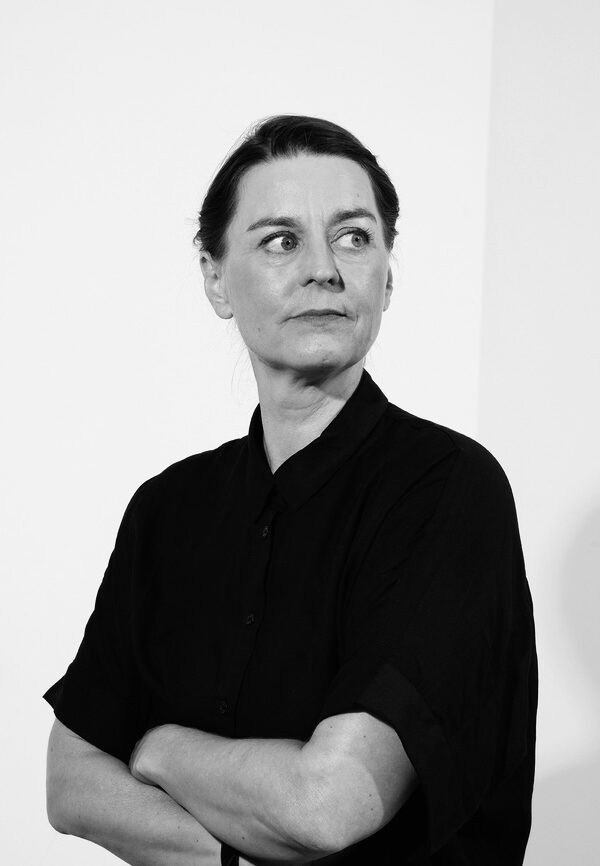
DA Anna Jensen is a curator, researcher, artist, and critic whose practice is grounded in site-specific, embodied, and collective approaches, and she is usually based in Helsinki. Her work revisits notions of curating, canon, and politics, with a particular sensitivity to places and practices that exist in-between—between histories, communities, and ideological frameworks.
At EKA, Jensen will be carrying out her postdoctoral research project City Is the Thing Bodies and Time Move Through: Concrete Structures of In-Betweenness, an artistic research inquiry situated in the border city of Narva.
Working through practice-led projects, Jensen explores how urban spaces, architectures, and leisure environments carry historical layers and lingering ideologies, shaping everyday life in ways that are both intimate and uncanny. In her work, Narva appears not only as a lived city but also as a spectral figure—simultaneously ordinary and extraordinary, suspended between past and future—through which broader questions of collective memory, social imagination, and in-betweenness can be examined.
Jensen is also the co-founder of Porin kulttuurisäätö, an artist-curator collective that has been organising a nomadic Pori Biennial since 2014. Together with Eliisa Suvanto they run a project called Space Invaders, a series of interdisciplinary exhibitions that creatively utilize empty or underused spaces. Jensen also forms the duo How to Life with Andrea Coyotzi Borja, where they use artistic research methods to explore the uncanniness of everyday life.
To add to all this, Jensen will also be our keynote speaker at the EKA Doctoral School Conference taking place already on April 2nd!
***
We asked Anna Jensen to talk a bit more about her postdoctoral research project at EKA, and what she might be speaking about at the EKA Doctoral Conference.
You describe Narva as a city that bodies and time move through — at once lived, haunted, and imagined. What first drew you to Narva, and how has the city begun to reveal itself through its architectures, atmospheres, and everyday encounters?
I spent three months in Narva in NART last spring and then revisited during summer, and was immediately struck by the unique atmosphere of the city. Its architecture and design have a similar sense of unhomely homeliness that I recognize from the Finnish suburb where I grew up and, on the other hand, from the postindustrial city with its former cotton mills where I studied. The place seemed to embody that sense of unheimlich, a concept that has always been central to my art and research, and one that is near and dear to me. At the same time, the city feels like a fertile starting point for exploring many overlapping theoretical questions from knowledge and experience to resistance and nostalgia in a site-specific way.
As you begin your postdoctoral period at EKA, what are you hoping to find here — in terms of conversations, conditions, or forms of working — that feel necessary for your research to unfold?
Already during my residency, I was impressed by how much interesting stuff is happening in Estonia and EKA, and the EKA graduate exhibition also made a strong impression on me. I’m super excited about the Doctoral School Conference programme and looking forward to new encounters, diverse research presentations, and varied perspectives and ideas: everything that fuels curiosity and stimulates new ideas! In the long term, I hope for lasting cooperation and opportunities for collaborative thinking, and I also hope for opportunities to reflect together on what artistic research is and what is meant by its methods, as this is a question that continues to puzzle me.
Can you give any hints as to what you will be talking about at the Doctoral School Conference in April?
I will present my doctoral research and my current postdoctoral research through the central concept of in-betweenness: what it is like to work in between different positions, languages, theory, and practice, and how the work often happens in between chaos and control, but also how chaos and control are also political and social issues and linked to structures and power. Related to this, I will probably also be talking about ghosts and zombies too. The mentioned artistic research and questions related to its methods will surely be one of the themes. My work is often collaborative, which brings a lot of joy, but also raises various issues related to ethics, hierarchies, authorship and responsibility, and these themes are likely present in my talk as well.
Thank you!
***
Don’t forget to check out the EKA Doctoral School Conference programme and register to take part!
Questions: Triin Männik