
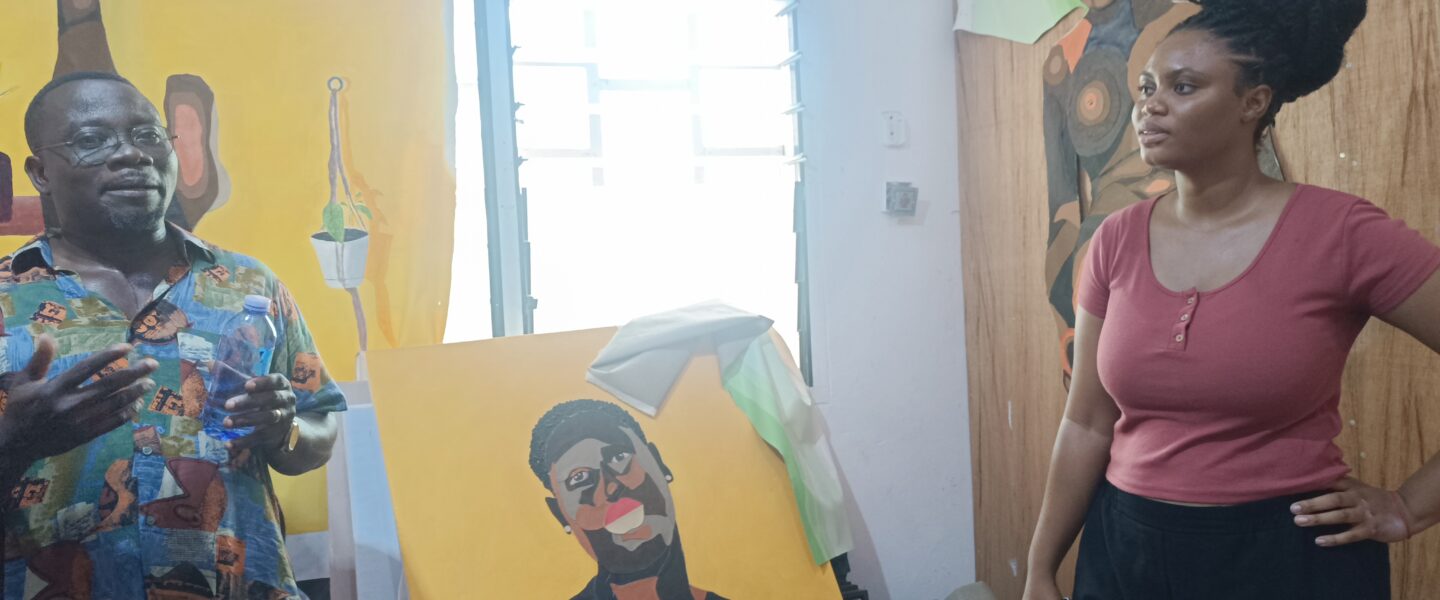
Kwaku Kissiedu in Accra at a young artist, KNUST alumni Millicent Dede Ako-Nai, studio
The Estonian Academy of Arts continues its strategic international cooperation, with Ghana emerging as one of its most important partners in Africa. For EKA, the Kwame Nkrumah University of Science and Technology (KNUST) in Ghana is an ideal partner: its art scene is dynamic, increasingly visible internationally, and grounded in strong community-based and local initiative.
From 23 to 27 March, EKA will host the five-day practical workshop Introduction to Akan Adinkra Printing Techniques, led by Ghanaian artist and lecturer Kwaku Boafo Kissiedu (Castro). Supported by the Erasmus+ programme, the workshop introduces students to the rich visual and philosophical heritage of Akan culture.
The workshop explores the history, meanings, and contemporary applications of Adinkra symbols, while also teaching traditional techniques such as dye preparation, stamp creation, and textile printing. The learning process is enriched by Ghanaian music, movement, and storytelling traditions, creating a layered and culturally charged learning environment.
The collaboration with Kwame Nkrumah University of Science and Technology in Kumasi has already lasted for several years and includes joint workshops, visiting lecturers, and student exchange. KNUST students Dennis Addo (academic year 2023/24) and Kimathi Agbanu (academic year 2025/26) have studied at EKA’s Faculty of Fine Arts, and their studies in Estonia have played an important role in strengthening the ties between the two universities. EKA has also hosted visiting lecturers from KNUST, including Kwaku Kissiedu, Adjo Kisser, and Edwin Bodjawah.
A key part of this collaboration has also been the recurring workshop Colour & Light, which has been held at KNUST on four occasions already — in 2020, 2023, 2024, and 2025. Bringing together light, colour, and movement through design and artistic practice, the workshop develops students’ interdisciplinary skills.
For EKA, it is important to offer Ghanaian students opportunities to study in Estonia through the Erasmus+ programme while at the same time giving Estonian students direct experience of the artistic context of Ghana. This reciprocal exchange supports the development of creative communities as well as more balanced and meaningful international collaboration.
Looking ahead, EKA plans to initiate new cooperation projects involving EKA, partners from Ghana, and the University of Bergen. Such multi-partner models create new opportunities for the exchange of knowledge and practices and strengthen international networks in art and design education.
To a large extent, it is also thanks to the international impact of artist Ibrahim Mahama that Ghana’s art scene has risen to the centre of broader international attention. Through his work as both an artist and institution builder, Mahama has helped make visible the strength of Ghanaian contemporary art, locally rooted knowledge-based creative practice, and new possibilities for collaboration in the wider African context.