
Exhibitions
09.04.2026 — 10.05.2026
Gerda Hansen and Rebecca Norman “On the Verge of Completion”
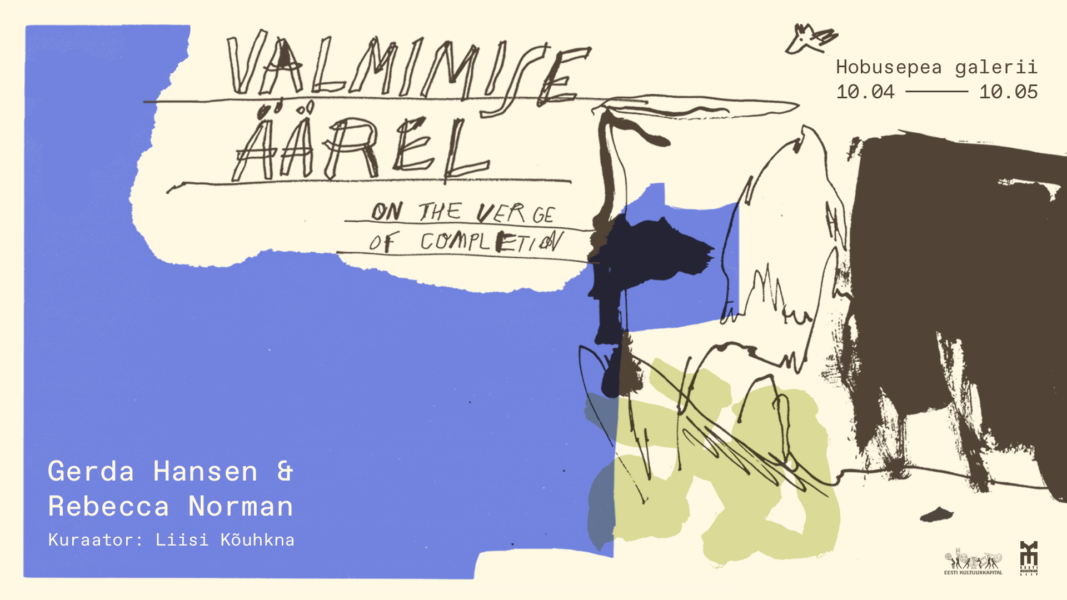
On Thursday, 9 April at 6:00 PM, a duo exhibition On the Verge of Completion by contemporary artists Gerda Hansen and Rebecca Norman will be opened at the Hobusepea Gallery.
The end is actually an unspeakably bleak place where no clear way forward presents itself and nothing no longer seems to lie ahead. The duo exhibition by Gerda Hansen and Rebecca Norman invites the viewer to experience art not only as something definitive, but as a way of becoming. The exhibition reveals the stages of artistic practice that usually remain hidden, offering a chance to step into the moment where a work is born and where meanings have not yet settled.
The exhibition examines the boundaries between completion and incompletion, approaching finality not as a destination, but as a state in which the forward movement is temporarily suspended. The creative process, often shaped by uncertainty, experimentation and internal tension, is usually resolved when the artist decides to declare a work complete. In this exhibition however, the viewer comes into contact with the process rather than the finalised work. The presented works do not conceal their unfinished state. Instead, they emphasise its value. On these canvases, thoughts remain dispersed, forms and tones are still taking shape, and meanings remain open. It is a moment where possibilities remain unended and the potential of the work is still unfolding.
Perhaps completing a work is a merely provisional decision, a pause within an ongoing process? The artist appears here as a practitioner of continuous choices and interruptions, guided by an intuitive and often sensitive self-reflection. Imperfection, repetition and error are not deviations, but integral to the organic nature of making. As Gilles Deleuze suggests, artworks are not defined by what they appear to be at a given moment, but by what they might become. The exhibition offers an insight into the concealed layers of artistic production, presenting the artwork as something that unfolds over time.
In Hansen’s works, layered structures strive toward presence and transparency. Repeating forms and interruptions create a rhythm that does not lead to a solution but instead exposes different stages of the creative process. She is interested in the moment when a work of art dissolves and comes into being at the same time. In Norman’s practice, the notion of completion is examined through its various permutations including the use of unstable colour pigments. For her, the apparent incompleteness of a work is not a deficiency, and the abundance of potential is realised through the material itself. The tension between continuation and completion becomes a deliberately sustained condition, in which the work does not close, but remains in an active and meaningful state of breathing.
Artists
Gerda Hansen (b. 1994) is a contemporary Estonian-based artist whose practice explores the intersections of painting and digital image-making. She holds a BA in painting (2022) and an MA in contemporary art (2025) from the Estonian Academy of Arts. In the current exhibition, Hansen brings together manual processes with AI-based generative systems. Her works emerge through a visual dialogue with the machine in which images remain intentionally ambiguous and leave the attribution of meaning to the viewer. Hansen has exhibited both in Estonia and internationally and is the recipient of the 2023 Adamson-Eric Young Artist Scholarship.
Rebecca Norman (b. 2001) graduated in painting from the Estonian Academy of Arts (2025), while also supplementing her studies at the Academy of Fine Arts in Prague (2024). Her practice addresses the convergence and misalignment between the author and the material and the resulting dissonant outcomes. Her works often engage with seemingly insignificant moments that call for new forms of categorisation through sustained attention. She is drawn to utilitarian objects that have irreversibly lost their function and various forms of apparent nonsense that mimic purposefulness. Norman has participated in several group exhibitions and received the Endover Prize for her 2025 graduation work Loaded Vacuity.
Curator
Liisi Kõuhkna is a curator and project manager who graduated with a master’s degree in health sciences from the Tallinn University and has also an MA from curatorial studies and a BA in jewellery and blacksmithing from the Estonian Academy of Arts. She has curated contemporary art exhibitions in various galleries in Estonia and abroad. Since March of this year, she works as the gallery assistant for the Estonian Artists’ Association.
Exhibition information
Location: Hobusepea Gallery, Hobusepea 2, Tallinn
Opening: 9.04.2026 from 18:00
Open for visitors: 10.04–10.05.2026,Wed, Fri–Sun 12–18, Thu 12–19
Curator: Liisi Kõuhkna
Graphic design: Helena Pass
Photo documentation: Kail Timusk
Special thanks to: Estonian Artists’ Association, Cultural Endowment of Estonia, Hans-Otto Ojaste, Mari Volens, Märt Vaidla, Paul Aadam Mikson, Jaana Kormašov, family members of the artists, Põhjala Pruulikoda, Nudist Drinks
Gerda Hansen and Rebecca Norman “On the Verge of Completion”
Thursday 09 April, 2026 — Sunday 10 May, 2026
On Thursday, 9 April at 6:00 PM, a duo exhibition On the Verge of Completion by contemporary artists Gerda Hansen and Rebecca Norman will be opened at the Hobusepea Gallery.
The end is actually an unspeakably bleak place where no clear way forward presents itself and nothing no longer seems to lie ahead. The duo exhibition by Gerda Hansen and Rebecca Norman invites the viewer to experience art not only as something definitive, but as a way of becoming. The exhibition reveals the stages of artistic practice that usually remain hidden, offering a chance to step into the moment where a work is born and where meanings have not yet settled.
The exhibition examines the boundaries between completion and incompletion, approaching finality not as a destination, but as a state in which the forward movement is temporarily suspended. The creative process, often shaped by uncertainty, experimentation and internal tension, is usually resolved when the artist decides to declare a work complete. In this exhibition however, the viewer comes into contact with the process rather than the finalised work. The presented works do not conceal their unfinished state. Instead, they emphasise its value. On these canvases, thoughts remain dispersed, forms and tones are still taking shape, and meanings remain open. It is a moment where possibilities remain unended and the potential of the work is still unfolding.
Perhaps completing a work is a merely provisional decision, a pause within an ongoing process? The artist appears here as a practitioner of continuous choices and interruptions, guided by an intuitive and often sensitive self-reflection. Imperfection, repetition and error are not deviations, but integral to the organic nature of making. As Gilles Deleuze suggests, artworks are not defined by what they appear to be at a given moment, but by what they might become. The exhibition offers an insight into the concealed layers of artistic production, presenting the artwork as something that unfolds over time.
In Hansen’s works, layered structures strive toward presence and transparency. Repeating forms and interruptions create a rhythm that does not lead to a solution but instead exposes different stages of the creative process. She is interested in the moment when a work of art dissolves and comes into being at the same time. In Norman’s practice, the notion of completion is examined through its various permutations including the use of unstable colour pigments. For her, the apparent incompleteness of a work is not a deficiency, and the abundance of potential is realised through the material itself. The tension between continuation and completion becomes a deliberately sustained condition, in which the work does not close, but remains in an active and meaningful state of breathing.
Artists
Gerda Hansen (b. 1994) is a contemporary Estonian-based artist whose practice explores the intersections of painting and digital image-making. She holds a BA in painting (2022) and an MA in contemporary art (2025) from the Estonian Academy of Arts. In the current exhibition, Hansen brings together manual processes with AI-based generative systems. Her works emerge through a visual dialogue with the machine in which images remain intentionally ambiguous and leave the attribution of meaning to the viewer. Hansen has exhibited both in Estonia and internationally and is the recipient of the 2023 Adamson-Eric Young Artist Scholarship.
Rebecca Norman (b. 2001) graduated in painting from the Estonian Academy of Arts (2025), while also supplementing her studies at the Academy of Fine Arts in Prague (2024). Her practice addresses the convergence and misalignment between the author and the material and the resulting dissonant outcomes. Her works often engage with seemingly insignificant moments that call for new forms of categorisation through sustained attention. She is drawn to utilitarian objects that have irreversibly lost their function and various forms of apparent nonsense that mimic purposefulness. Norman has participated in several group exhibitions and received the Endover Prize for her 2025 graduation work Loaded Vacuity.
Curator
Liisi Kõuhkna is a curator and project manager who graduated with a master’s degree in health sciences from the Tallinn University and has also an MA from curatorial studies and a BA in jewellery and blacksmithing from the Estonian Academy of Arts. She has curated contemporary art exhibitions in various galleries in Estonia and abroad. Since March of this year, she works as the gallery assistant for the Estonian Artists’ Association.
Exhibition information
Location: Hobusepea Gallery, Hobusepea 2, Tallinn
Opening: 9.04.2026 from 18:00
Open for visitors: 10.04–10.05.2026,Wed, Fri–Sun 12–18, Thu 12–19
Curator: Liisi Kõuhkna
Graphic design: Helena Pass
Photo documentation: Kail Timusk
Special thanks to: Estonian Artists’ Association, Cultural Endowment of Estonia, Hans-Otto Ojaste, Mari Volens, Märt Vaidla, Paul Aadam Mikson, Jaana Kormašov, family members of the artists, Põhjala Pruulikoda, Nudist Drinks
03.04.2026 — 13.04.2026
Film Screening: “Riga, My Love” by Kara Popicon
“I leave
With tears in my throat
To where
The roads are wrapped in mist
Riga, my love remains behind.”
— Vennaskond
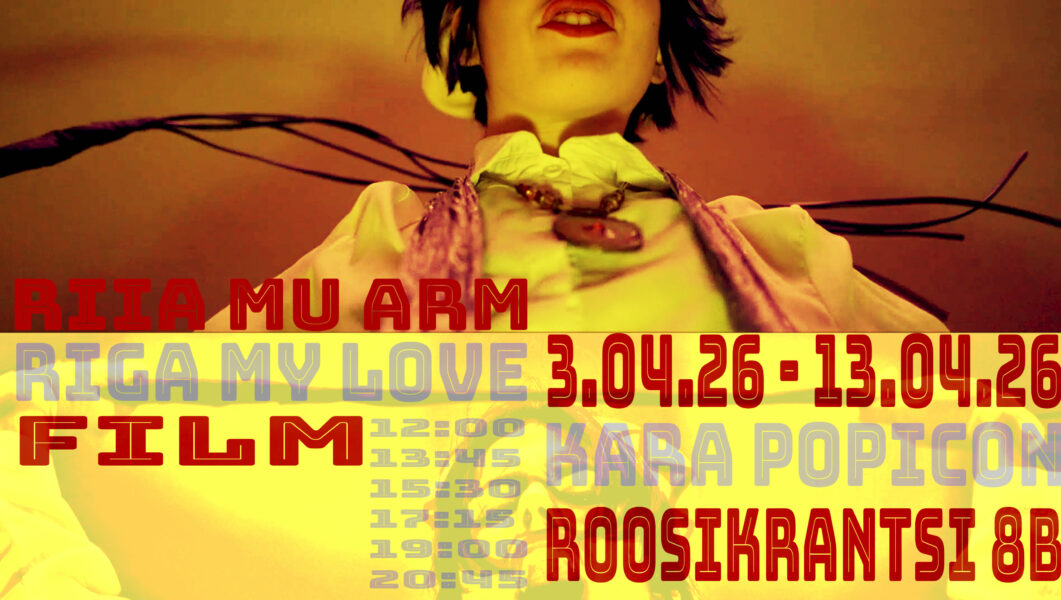
Join us on Friday, April 3 at 19:00 for the premiere of Karolina Peterson’s graduation film at Roosikrantsi 8b Gallery.
The film will be screened daily from April 3–13 at: 12:00 · 13:45 · 15:30 · 17:15 · 19:00 · 20:45.
Karolina Peterson (aka Kara Popicon) is a Latvian artist from an Estonian-Russian background who spent the past five years studying in Tallinn. Returning to Riga after a long time away, she found herself feeling like a stranger in her own home.
Her solo exhibition “Riga, My Love” explores this sense of distance through film – capturing the city both as it lives in memory and as it exists today.
The work is also shaped by her participation in a series of protests in Riga advocating for women’s and migrants’ rights, where she created a new artistic action each time. These experiences brought a political dimension into her practice.
This new video piece traces the evolution of that politicization, interwoven with personal reflections on loss, identity, and the emotional disconnection from home.
Supervisor: Anita Kremm
Film duration: 96 minutes
Language: English
Exhibition is supported by the Faculty of Fine Arts, Estonian Academy of Arts.
Film Screening: “Riga, My Love” by Kara Popicon
Friday 03 April, 2026 — Monday 13 April, 2026
“I leave
With tears in my throat
To where
The roads are wrapped in mist
Riga, my love remains behind.”
— Vennaskond
Join us on Friday, April 3 at 19:00 for the premiere of Karolina Peterson’s graduation film at Roosikrantsi 8b Gallery.
The film will be screened daily from April 3–13 at: 12:00 · 13:45 · 15:30 · 17:15 · 19:00 · 20:45.
Karolina Peterson (aka Kara Popicon) is a Latvian artist from an Estonian-Russian background who spent the past five years studying in Tallinn. Returning to Riga after a long time away, she found herself feeling like a stranger in her own home.
Her solo exhibition “Riga, My Love” explores this sense of distance through film – capturing the city both as it lives in memory and as it exists today.
The work is also shaped by her participation in a series of protests in Riga advocating for women’s and migrants’ rights, where she created a new artistic action each time. These experiences brought a political dimension into her practice.
This new video piece traces the evolution of that politicization, interwoven with personal reflections on loss, identity, and the emotional disconnection from home.
Supervisor: Anita Kremm
Film duration: 96 minutes
Language: English
Exhibition is supported by the Faculty of Fine Arts, Estonian Academy of Arts.
27.03.2026 — 05.04.2026
Hayden Daughtry’s “Prairie Dog Town” in Uus Rada Gallery
“A prairie dog town refers to the vast underground networks of tunnels and chambers constructed by prairie dogs across the grasslands. At the surface, these colonies appear as little more than a dispersed field of cone-shaped mounds. Beneath this modest topography, however, lies an extensive and highly organized architecture: a labyrinth of tunnels connecting nesting chambers, waste disposals, listening bays, nurseries, and bolt holes, before branching into distinct wards and family burrows.
Prairie Dog Town takes this subterranean architecture as both structure and allegory. The exhibition turns toward other underground networks—such as those operating within the logic of cartoons—where the burrow becomes a conceptual passage. Moving below the visible surface, tunnels open onto chambers of a more devious nature: spaces where logics conceal themselves, circulate, and multiply.” – H.D.
“Prairie Dog Town” is Hayden Daughtry’s inaugural show in Estonia. Originally from South Carolina, entering the European art scene through the Rietveld Academie in Amsterdam, Hayden lets the uncanny constructs of the outside seep into the gallery, places where it might not otherwise allow. Sometimes a playful veneer might be a scratchcard with an inverse prize. His work takes shape to its surroundings.
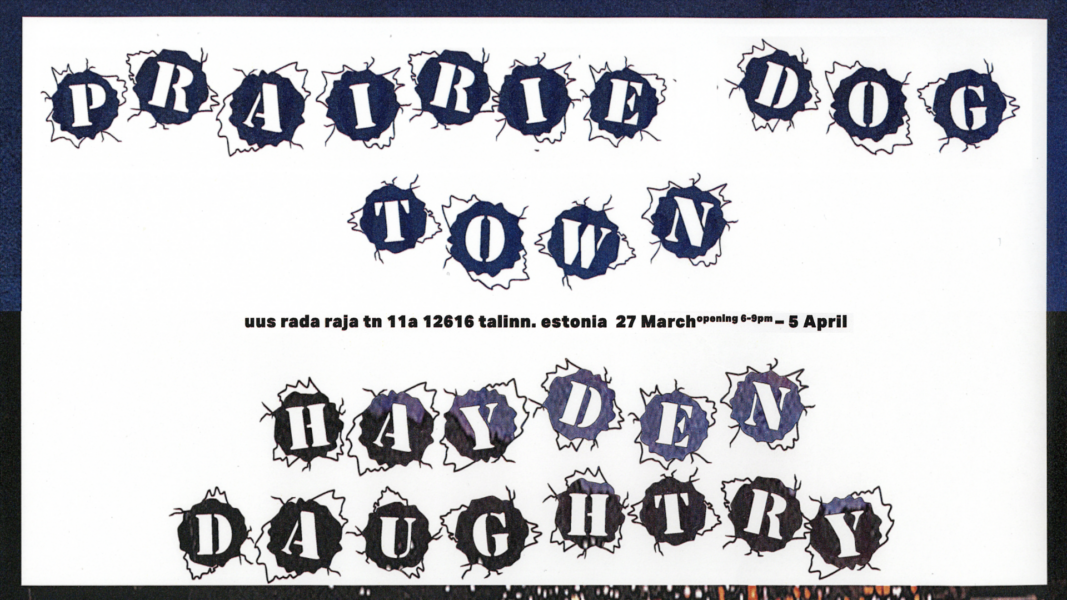
Opening March 27th at 18:00, then to be visited 28.03 – 05.04
M-T By appointment
F-S 14:00 – 18:00
Hayden Daughtry’s “Prairie Dog Town” in Uus Rada Gallery
Friday 27 March, 2026 — Sunday 05 April, 2026
“A prairie dog town refers to the vast underground networks of tunnels and chambers constructed by prairie dogs across the grasslands. At the surface, these colonies appear as little more than a dispersed field of cone-shaped mounds. Beneath this modest topography, however, lies an extensive and highly organized architecture: a labyrinth of tunnels connecting nesting chambers, waste disposals, listening bays, nurseries, and bolt holes, before branching into distinct wards and family burrows.
Prairie Dog Town takes this subterranean architecture as both structure and allegory. The exhibition turns toward other underground networks—such as those operating within the logic of cartoons—where the burrow becomes a conceptual passage. Moving below the visible surface, tunnels open onto chambers of a more devious nature: spaces where logics conceal themselves, circulate, and multiply.” – H.D.
“Prairie Dog Town” is Hayden Daughtry’s inaugural show in Estonia. Originally from South Carolina, entering the European art scene through the Rietveld Academie in Amsterdam, Hayden lets the uncanny constructs of the outside seep into the gallery, places where it might not otherwise allow. Sometimes a playful veneer might be a scratchcard with an inverse prize. His work takes shape to its surroundings.
Opening March 27th at 18:00, then to be visited 28.03 – 05.04
M-T By appointment
F-S 14:00 – 18:00
02.04.2026 — 26.04.2026
Asmus Soodla “Tool Room, Gallery” at EKA Gallery 4.–26.04.2026
Asmus Soodla
“Tool Room, Gallery”
EKA Gallery 4.–26.04.2026
Open Tue–Sat 12–6 pm Sun 12–4 pm, free entry (NB! EKA Gallery is closed on Good Friday, April 3 and Easter Sunday, April 5!)
Opening: Thursday, April 2 at 6 pm
Guided tours: Fri, April 10 at 1 pm (est) / Sun, April 12 at 2.30 pm (est) / Sun, April 12 at 3.30 pm (eng)
Asmus Soodla’s exhibition “Tool Room, Gallery” focuses on the art gallery as an ecosystem, where value-based distinction between the result and the process doesn’t exist. The conceptual starting point of the project is the internal conditions and work processes of the gallery as an institution, as well as its spatial logic. The exhibition focuses on activities that are usually hidden from the visitor’s gaze, but which play a decisive role in how the artwork and the viewer meet.
The project includes a spatial intervention that occupies the entire gallery, highlighting the spaces of EKA Gallery and its contents. The conceptual framework also includes the group exhibition “Field Notes from Immediate Proximity”, the curation of which Soodla entrusted to artist Riin Maide. This role-playing gesture treats the form of collaboration as a separate artwork.
Asmus Soodla (b. 2003) is a Tallinn-based artist and art technician. Soodla’s practice is conceptual and spatially sensitive, often employing sculpture, text, and photography. His work is primarily inspired by the existing environment and objects, unraveling their operational logic and history. Through his installative interventions, invisible systems and traces of human thought are brought into focus. Soodla earned a Bachelor’s degree in Installation and Sculpture (2025) from the Estonian Academy of Arts and completed a preparatory course in architecture and interior design (2022) at the EKA Open Academy. Additionally, he has furthered his studies at artist Simon Starling’s studio in Copenhagen.
Technical support: Mattias Veller
Graphic design: Sunny Lei
The exhibition is supported by the Cultural Endowment of Estonia, Tallinn City and Sadolin Estonia.
Opening drinks from mirai™ and Põhjala Brewery.
Asmus Soodla “Tool Room, Gallery” at EKA Gallery 4.–26.04.2026
Thursday 02 April, 2026 — Sunday 26 April, 2026
Asmus Soodla
“Tool Room, Gallery”
EKA Gallery 4.–26.04.2026
Open Tue–Sat 12–6 pm Sun 12–4 pm, free entry (NB! EKA Gallery is closed on Good Friday, April 3 and Easter Sunday, April 5!)
Opening: Thursday, April 2 at 6 pm
Guided tours: Fri, April 10 at 1 pm (est) / Sun, April 12 at 2.30 pm (est) / Sun, April 12 at 3.30 pm (eng)
Asmus Soodla’s exhibition “Tool Room, Gallery” focuses on the art gallery as an ecosystem, where value-based distinction between the result and the process doesn’t exist. The conceptual starting point of the project is the internal conditions and work processes of the gallery as an institution, as well as its spatial logic. The exhibition focuses on activities that are usually hidden from the visitor’s gaze, but which play a decisive role in how the artwork and the viewer meet.
The project includes a spatial intervention that occupies the entire gallery, highlighting the spaces of EKA Gallery and its contents. The conceptual framework also includes the group exhibition “Field Notes from Immediate Proximity”, the curation of which Soodla entrusted to artist Riin Maide. This role-playing gesture treats the form of collaboration as a separate artwork.
Asmus Soodla (b. 2003) is a Tallinn-based artist and art technician. Soodla’s practice is conceptual and spatially sensitive, often employing sculpture, text, and photography. His work is primarily inspired by the existing environment and objects, unraveling their operational logic and history. Through his installative interventions, invisible systems and traces of human thought are brought into focus. Soodla earned a Bachelor’s degree in Installation and Sculpture (2025) from the Estonian Academy of Arts and completed a preparatory course in architecture and interior design (2022) at the EKA Open Academy. Additionally, he has furthered his studies at artist Simon Starling’s studio in Copenhagen.
Technical support: Mattias Veller
Graphic design: Sunny Lei
The exhibition is supported by the Cultural Endowment of Estonia, Tallinn City and Sadolin Estonia.
Opening drinks from mirai™ and Põhjala Brewery.
02.04.2026 — 26.04.2026
“Field Notes from Immediate Proximity” at EKA Gallery 4.–26.04.2026
FIELD NOTES FROM IMMEDIATE PROXIMITY
EKA Gallery storage room 4.–26.04.2026
Open Tue–Sat 12–6 pm Sun 12–4 pm, free entry (NB! EKA Gallery is closed on Good Friday, April 3 and Easter Sunday, April 5!)
Opening: Thursday, April 2 at 6 pm
Guided tours: Fri, April 10 at 1 pm (est) / Sun, April 12 at 2.30 pm (est) / Sun, April 12 at 3.30 pm (eng)
The exhibition “Field Notes from Immediate Proximity” provides an insight into artists’ work and creative spaces. In addition to documenting the studios and homes of six creators, they also become windows into their inner world.
Postcards, tools, potted plants and piles of books that have been captured on the artist’s canvas or photograph, reveal moments from the artists’ everyday lives, from the spaces where the artist spends the most time doing their work – on the one hand, it is an opportunity to see inside the creative processes of contemporary artists, into their different practices, on the other hand, these works are simply interpretations of personal space, ways of seeing everyday life.
The narrow and cramped architecture of EKA Gallery’s storage space brings the viewer closer to the works and their details. Together with the unusual exhibition space, the works form a new spatial whole in which different visual languages and perspectives can meet and merge.
The exhibition was initiated within the conceptual framework of Asmus Soodla’s solo exhibition “Tool Room, Gallery”.
Riin Maide (b. 1997) is an artist and scenographer based in Tallinn, Estonia. Maides practice centers around the connection and comparison of two- and three-dimensional media and creation of staged environments. Maide Maide has obtained a MA degree in scenography (2025) and BA in Graphic Art in the department of graphic art at the Estonian Academy of Arts. In addition, she has studied at the Department of Alternative and Puppet Theater at DAMU in Prague and in the Performative Arts class of Academy of Fine Arts Vienna. She has received several scholarships and awards, including the Wiiralt scholarship in 2023 and Young Artist award of Estonian Academy of Arts in 2020.
Artists: Kristi Kongi, Joosep Kivimäe, Ann Pajuväli, Anu Vahtra and Lieven Lahaye, Mattias Veller
Curated by: Riin Maide
Technical support: Mattias Veller
Graphic design: Sunny Lei
The exhibition is supported by the Cultural Endowment of Estonia, Tallinn City and Sadolin Estonia.
Opening drinks from mirai™ and Põhjala Brewery.
“Field Notes from Immediate Proximity” at EKA Gallery 4.–26.04.2026
Thursday 02 April, 2026 — Sunday 26 April, 2026
FIELD NOTES FROM IMMEDIATE PROXIMITY
EKA Gallery storage room 4.–26.04.2026
Open Tue–Sat 12–6 pm Sun 12–4 pm, free entry (NB! EKA Gallery is closed on Good Friday, April 3 and Easter Sunday, April 5!)
Opening: Thursday, April 2 at 6 pm
Guided tours: Fri, April 10 at 1 pm (est) / Sun, April 12 at 2.30 pm (est) / Sun, April 12 at 3.30 pm (eng)
The exhibition “Field Notes from Immediate Proximity” provides an insight into artists’ work and creative spaces. In addition to documenting the studios and homes of six creators, they also become windows into their inner world.
Postcards, tools, potted plants and piles of books that have been captured on the artist’s canvas or photograph, reveal moments from the artists’ everyday lives, from the spaces where the artist spends the most time doing their work – on the one hand, it is an opportunity to see inside the creative processes of contemporary artists, into their different practices, on the other hand, these works are simply interpretations of personal space, ways of seeing everyday life.
The narrow and cramped architecture of EKA Gallery’s storage space brings the viewer closer to the works and their details. Together with the unusual exhibition space, the works form a new spatial whole in which different visual languages and perspectives can meet and merge.
The exhibition was initiated within the conceptual framework of Asmus Soodla’s solo exhibition “Tool Room, Gallery”.
Riin Maide (b. 1997) is an artist and scenographer based in Tallinn, Estonia. Maides practice centers around the connection and comparison of two- and three-dimensional media and creation of staged environments. Maide Maide has obtained a MA degree in scenography (2025) and BA in Graphic Art in the department of graphic art at the Estonian Academy of Arts. In addition, she has studied at the Department of Alternative and Puppet Theater at DAMU in Prague and in the Performative Arts class of Academy of Fine Arts Vienna. She has received several scholarships and awards, including the Wiiralt scholarship in 2023 and Young Artist award of Estonian Academy of Arts in 2020.
Artists: Kristi Kongi, Joosep Kivimäe, Ann Pajuväli, Anu Vahtra and Lieven Lahaye, Mattias Veller
Curated by: Riin Maide
Technical support: Mattias Veller
Graphic design: Sunny Lei
The exhibition is supported by the Cultural Endowment of Estonia, Tallinn City and Sadolin Estonia.
Opening drinks from mirai™ and Põhjala Brewery.
19.03.2026 — 22.03.2026
Last week guided tours part of “Image Is for Illustrative Purposes Only” at EKA Gallery
Guided tours taking place at EKA Gallery:
– on Thursday, March 19 at 5.30 pm, led by the curators Linda Kaljundi and Kirke Kangro and guest lecturers Victoria Donovan and Vlada Vazheyevskyy, in English
– on Friday, March 20 at 4.30 pm, led by the curators Linda Kaljundi and Kirke Kangro with artist Sigrid Viir, in Estonian
– on Sunday, March 22 at 4 pm, led by the curators Linda Kaljundi and Kirke Kangro with artist and exhibition designer Anna Škodenko, in Estonian
Appriximate duration of the tours is 30 minutes. Participation is free of charge.
The exhibition will remain open until March 22.
Read more about the exhibition here:
https://www.artun.ee/en/calendar/image-is-for-illustrative-purposes-only-at-eka-gallery/
Last week guided tours part of “Image Is for Illustrative Purposes Only” at EKA Gallery
Thursday 19 March, 2026 — Sunday 22 March, 2026
Guided tours taking place at EKA Gallery:
– on Thursday, March 19 at 5.30 pm, led by the curators Linda Kaljundi and Kirke Kangro and guest lecturers Victoria Donovan and Vlada Vazheyevskyy, in English
– on Friday, March 20 at 4.30 pm, led by the curators Linda Kaljundi and Kirke Kangro with artist Sigrid Viir, in Estonian
– on Sunday, March 22 at 4 pm, led by the curators Linda Kaljundi and Kirke Kangro with artist and exhibition designer Anna Škodenko, in Estonian
Appriximate duration of the tours is 30 minutes. Participation is free of charge.
The exhibition will remain open until March 22.
Read more about the exhibition here:
https://www.artun.ee/en/calendar/image-is-for-illustrative-purposes-only-at-eka-gallery/
06.03.2026 — 15.05.2026
EKA Print Exchange exhibition Looking Forward to Hearing From You
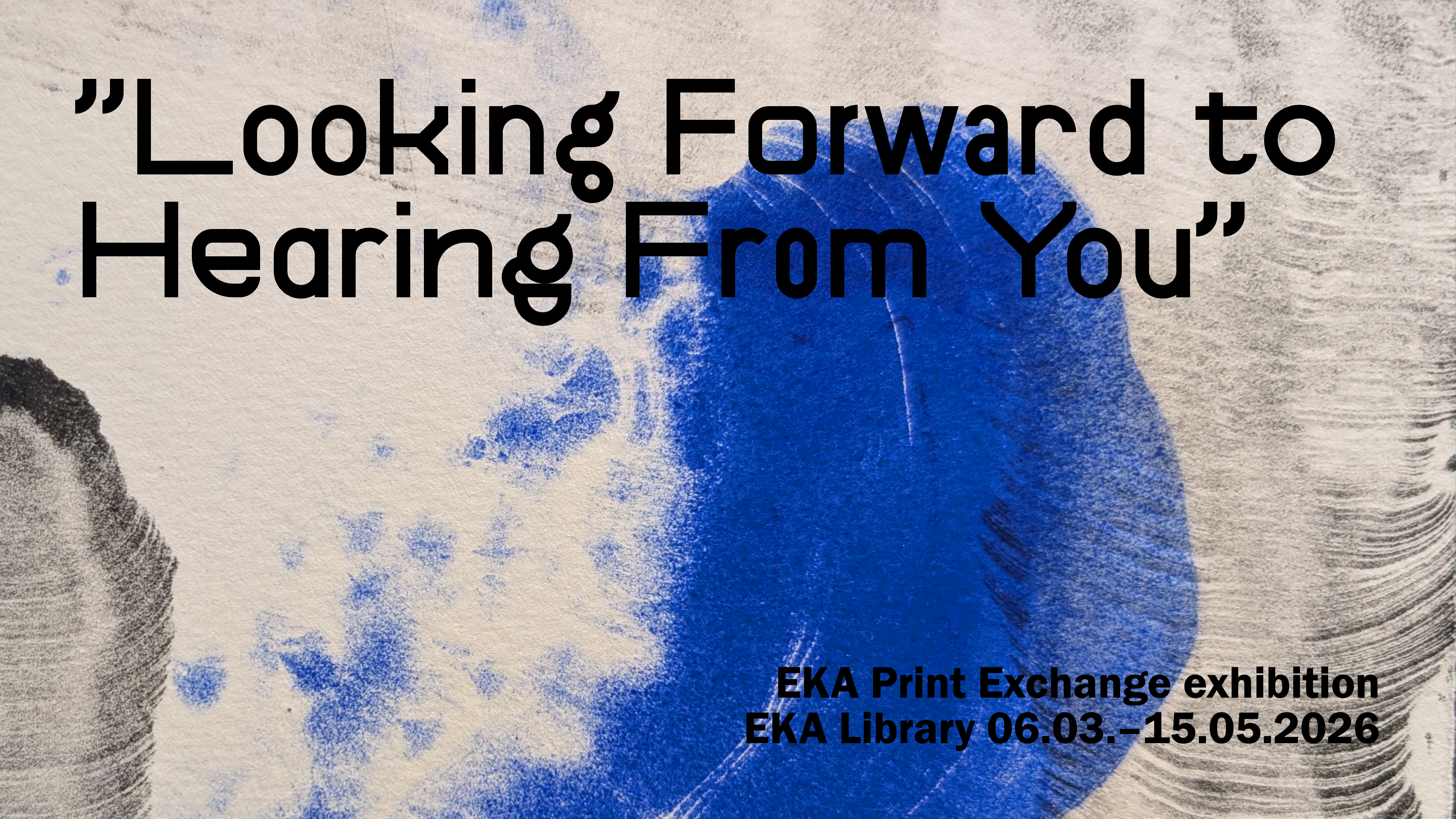
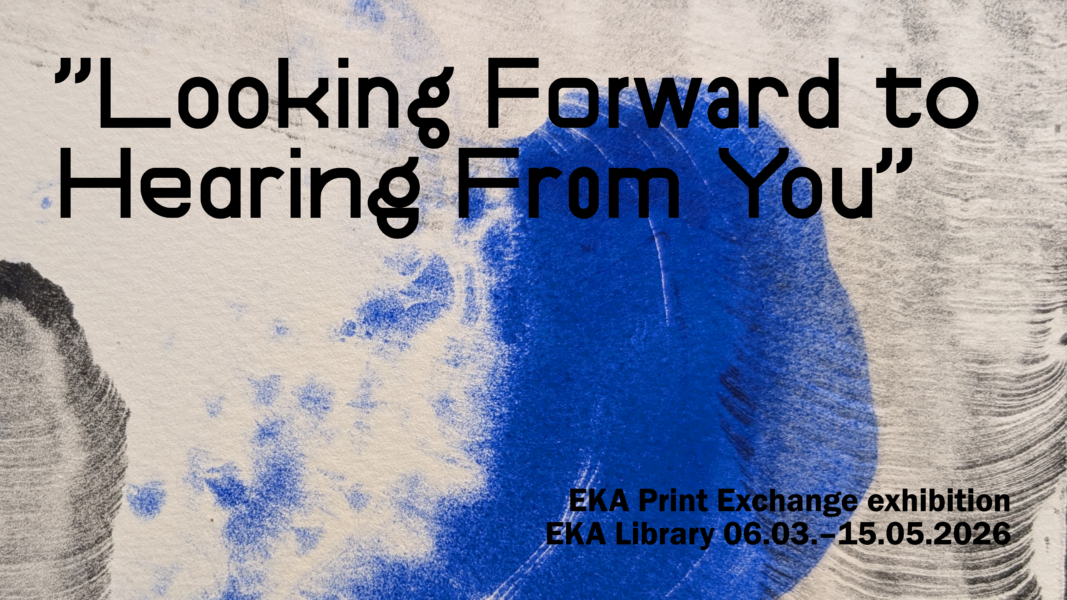
EKA library, 6.03.–15.05.2026
Dear friend,
It has been a long time since we last heard from you. Last time we spoke, you were working on some prints in the graphic arts workshop with a roller in your hand and ink on your fingers. How is it going? We would love to see some trials or progress pictures. At the moment we are also in the process of doing some tests. I have added a sample in the envelope. Check it out and tell us what you think!
Let’s keep in touch.
The exhibition shows works from the EKA Print Exchange project initiated by the department of Graphic Art at the Estonian Academy of Arts. Printmaking students from different universities were invited to take part and submit an original print edition. Each print was shipped to Tallinn, sorted and sent back to participants, so everyone received a random selection of ten prints.
The vision of this project was to create new connections between printmaking departments and students through collaboration and sharing physical works. So, we wrote to our penpals and were curious what students of other universities were up to. Depictions of current ideas, projects or any experiments were warmly welcomed as a response.
Four universities participated in the exchange: Estonian Academy of Arts (EKA),
Oslo National Academy of the Arts (KHiO), University of the West of England (UWE), The Eugeniusz Geppert Academy of Art and Design in Wrocław.
Exhibitions of the Print Exchange have taken place at the universities participating in the exchange, and the first presentation in Estonia took place in June-July 2025 at the TYPA Balcony Gallery in Tartu.
We would like to thank EKA graafika, TYPA, Anna Kodź, Aleksandra Janik and Angie Butler.
Organisers of the EKA Print Exchange: Alona Chuprina, Margarita Feofanova, Chantal Gerschuetz, Merit Himmelreich, Triin Mänd, Helena Pass, Marten Prei, Sandra Puusepp and our supervisor Charlotte Biszewski.
Exhibition design at the EKA library: Sandra Puusepp and Marten Prei.
EKA Print Exchange exhibition Looking Forward to Hearing From You
Friday 06 March, 2026 — Friday 15 May, 2026
EKA library, 6.03.–15.05.2026
Dear friend,
It has been a long time since we last heard from you. Last time we spoke, you were working on some prints in the graphic arts workshop with a roller in your hand and ink on your fingers. How is it going? We would love to see some trials or progress pictures. At the moment we are also in the process of doing some tests. I have added a sample in the envelope. Check it out and tell us what you think!
Let’s keep in touch.
The exhibition shows works from the EKA Print Exchange project initiated by the department of Graphic Art at the Estonian Academy of Arts. Printmaking students from different universities were invited to take part and submit an original print edition. Each print was shipped to Tallinn, sorted and sent back to participants, so everyone received a random selection of ten prints.
The vision of this project was to create new connections between printmaking departments and students through collaboration and sharing physical works. So, we wrote to our penpals and were curious what students of other universities were up to. Depictions of current ideas, projects or any experiments were warmly welcomed as a response.
Four universities participated in the exchange: Estonian Academy of Arts (EKA),
Oslo National Academy of the Arts (KHiO), University of the West of England (UWE), The Eugeniusz Geppert Academy of Art and Design in Wrocław.
Exhibitions of the Print Exchange have taken place at the universities participating in the exchange, and the first presentation in Estonia took place in June-July 2025 at the TYPA Balcony Gallery in Tartu.
We would like to thank EKA graafika, TYPA, Anna Kodź, Aleksandra Janik and Angie Butler.
Organisers of the EKA Print Exchange: Alona Chuprina, Margarita Feofanova, Chantal Gerschuetz, Merit Himmelreich, Triin Mänd, Helena Pass, Marten Prei, Sandra Puusepp and our supervisor Charlotte Biszewski.
Exhibition design at the EKA library: Sandra Puusepp and Marten Prei.
06.03.2026 — 15.05.2026
Estonian Academy of Arts Graphic Art Department Exhibition: “Artists’ Books”
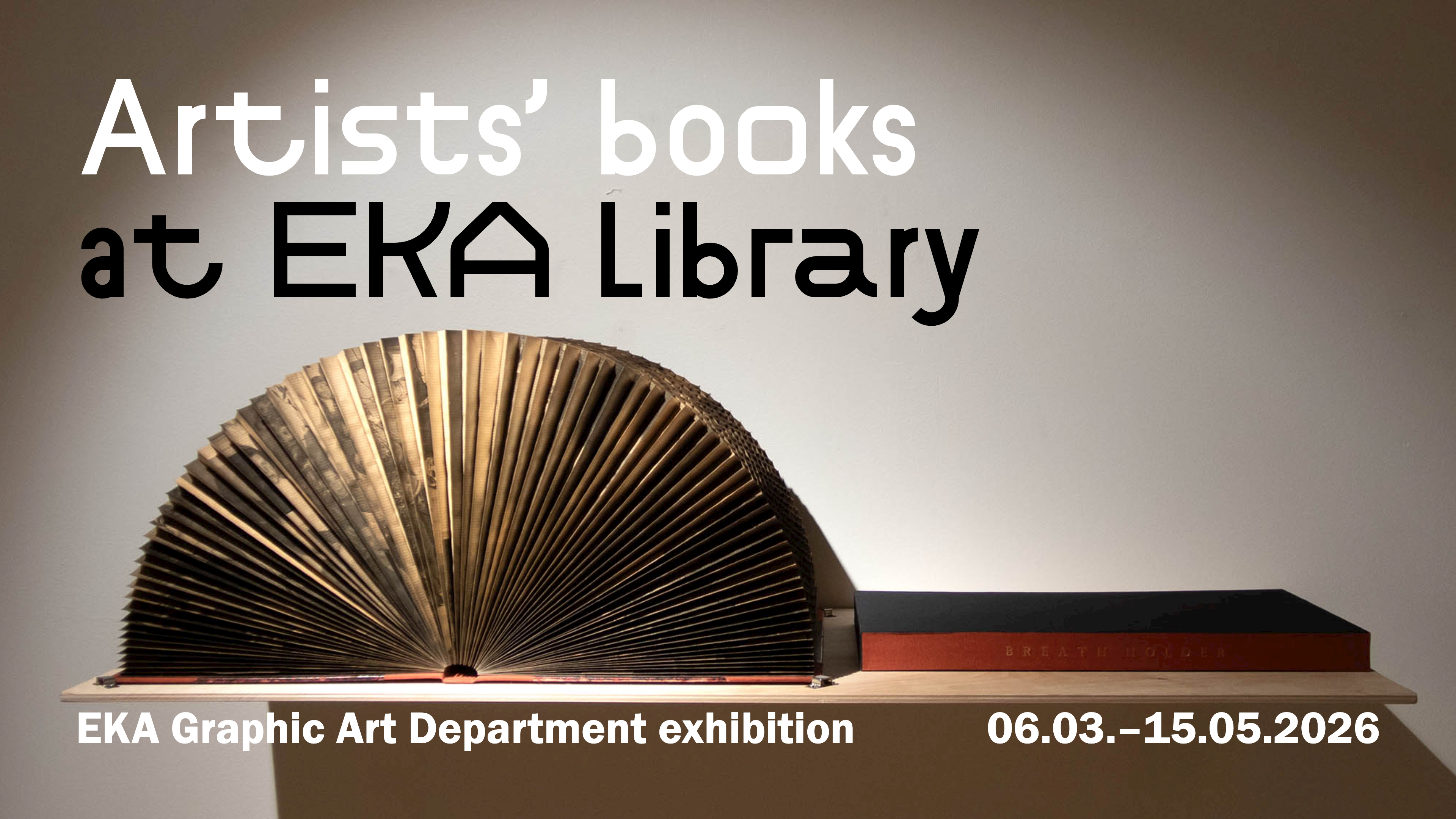
3rd-year Graphic Art students are showcasing the artists’ book as an independent medium of visual art and an original artwork. The authors draw from personal experiences and memories, exploring themes of physicality, history, and ethical boundaries:
- Aliisa Ahtiainen presents a grandfather’s life story in risography and a “breathing” book inspired by her grandmother’s experience in a tuberculosis sanatorium.
- Jacqueline-Desiree Rosenthal exhibits a piece made of tattooed pigskin rawhide, raising questions about morality and the parallels between animals and humans.
- Olga Dubrovskaja utilizes her background as an intensive care doctor to explore the experience of death through her own and her colleagues’ perspectives. In her second book titled “Delight”, she focuses on the moments of life.
- Adriana Jinmao Biosca Sánchez examines the volatility of memory through materiality and layers of printing.
- Robin August Vöörmann deals with gender identity, drawing parallels with changes in nature.
Supervisors: Eve Kask, Eve Kaaret (binding) and Viktor Gurov.
Exhibition dates: 6.03.–15.05.2025
Estonian Academy of Arts Graphic Art Department Exhibition: “Artists’ Books”
Friday 06 March, 2026 — Friday 15 May, 2026
3rd-year Graphic Art students are showcasing the artists’ book as an independent medium of visual art and an original artwork. The authors draw from personal experiences and memories, exploring themes of physicality, history, and ethical boundaries:
- Aliisa Ahtiainen presents a grandfather’s life story in risography and a “breathing” book inspired by her grandmother’s experience in a tuberculosis sanatorium.
- Jacqueline-Desiree Rosenthal exhibits a piece made of tattooed pigskin rawhide, raising questions about morality and the parallels between animals and humans.
- Olga Dubrovskaja utilizes her background as an intensive care doctor to explore the experience of death through her own and her colleagues’ perspectives. In her second book titled “Delight”, she focuses on the moments of life.
- Adriana Jinmao Biosca Sánchez examines the volatility of memory through materiality and layers of printing.
- Robin August Vöörmann deals with gender identity, drawing parallels with changes in nature.
Supervisors: Eve Kask, Eve Kaaret (binding) and Viktor Gurov.
Exhibition dates: 6.03.–15.05.2025
05.03.2026 — 12.04.2026
Jana Ribkina, Irmak Semiz “Soovikaev”
“To feel the pull of desire is to feel the presence of absence.”
-Anne Carson, “Eros The Bitterweet”
It was the gods’ punishment to separate the whole being into two, condemned to fit the chase of our ideal fullness into one lifetime — and pathetically, we turn back to gods to show us the ways we can be united again. Some say this love belongs only to gods themselves. Still, we defy that notion treacherously, and we face whatever form of divinity we believe in, to plea:
“I wish.”
To wish is to indulge in the lack. The lover does not only wish for the ephemeral sense of fulfillment, but eventually wishing itself serves to satisfy the lover’s hunger. The wish transforms into the sustenance and our appetite refuses to act as a form of weakness, but as devotion.
The exhibition “The Wishing Well” is simultaneously a practice ground and a receipt of reverence. Light a candle, throw a coin, count the petals and make your wish.
opening 05.03.2026 at 6PM
06.03. – 12.04.2026
open Wed-Sun 12.00-18.00
KETT gallery / Aparaaditehas, Kastani 42, Tartu
Irmak Semiz (b. 1997, Istanbul) is a multidisciplinary artist living in Tallinn, currently pursuing a master’s degree in contemporary art at the Estonian Academy of Arts. Working primarily through sculpture, installation, and animation, their practice focuses on expressing contradictory identities, decisions, and emotional states, processed through the lens of humor, connection, and myth-making.
Jana Ribkina (b. 1995, Riga) is a multidisciplinary artist living and working in Riga. Working primarily with ceramics, textiles, and illustration, she explores reflections from her daily life through a playful approach, while drawing inspiration from folklore and fantasy. Her work seeks to weave the personal and the mythical into one continuous thread.
Graphic design: Paul Graßler
The exhibition is supported by the City of Tartu and the Cultural Endowment of Estonia.
Jana Ribkina, Irmak Semiz “Soovikaev”
Thursday 05 March, 2026 — Sunday 12 April, 2026
“To feel the pull of desire is to feel the presence of absence.”
-Anne Carson, “Eros The Bitterweet”
It was the gods’ punishment to separate the whole being into two, condemned to fit the chase of our ideal fullness into one lifetime — and pathetically, we turn back to gods to show us the ways we can be united again. Some say this love belongs only to gods themselves. Still, we defy that notion treacherously, and we face whatever form of divinity we believe in, to plea:
“I wish.”
To wish is to indulge in the lack. The lover does not only wish for the ephemeral sense of fulfillment, but eventually wishing itself serves to satisfy the lover’s hunger. The wish transforms into the sustenance and our appetite refuses to act as a form of weakness, but as devotion.
The exhibition “The Wishing Well” is simultaneously a practice ground and a receipt of reverence. Light a candle, throw a coin, count the petals and make your wish.
opening 05.03.2026 at 6PM
06.03. – 12.04.2026
open Wed-Sun 12.00-18.00
KETT gallery / Aparaaditehas, Kastani 42, Tartu
Irmak Semiz (b. 1997, Istanbul) is a multidisciplinary artist living in Tallinn, currently pursuing a master’s degree in contemporary art at the Estonian Academy of Arts. Working primarily through sculpture, installation, and animation, their practice focuses on expressing contradictory identities, decisions, and emotional states, processed through the lens of humor, connection, and myth-making.
Jana Ribkina (b. 1995, Riga) is a multidisciplinary artist living and working in Riga. Working primarily with ceramics, textiles, and illustration, she explores reflections from her daily life through a playful approach, while drawing inspiration from folklore and fantasy. Her work seeks to weave the personal and the mythical into one continuous thread.
Graphic design: Paul Graßler
The exhibition is supported by the City of Tartu and the Cultural Endowment of Estonia.
04.03.2026 — 31.03.2026
Katariin Mudist “Temporary Solution”
5–31 March 2026
On Wednesday, 4 March at 18:00, Katariin Mudist’s exhibition “Temporary Solution”(Ajutine lahendus) will open at ARS Showcase Gallery.
“Temporary Solution” brings together doorholders collected from various institutions, mainly from Estonia’s cultural field. Doorholders are born out of necessity: something needs to be held open for a moment, something needs to be let through. Yet a temporary solution tends to become permanent without anyone noticing. In this way, an accidental form and material can become surprisingly universal.
The exhibition focuses on small moments of annoyance: when your bike tyre is flat again; when you forget your towel, but discover it at the gym; when you have to return the shirt you ordered; when the internet keeps buffering during a film; when someone explains something you already know; when, at the grocery store, the line you chose is the slowest, or when the doorholder is missing. This annoyance is a minor disturbance that, through repetition, begins to shape attention, movement, and one’s attitude toward space. A door has been kept open for years with the help of an apparently insignificant piece of material. But one day, arms full of things, that familiar wooden block is no longer there. There is a brief delay and mild irritation: something else is quickly found as a substitute, the door is held open again, and work continues. The moment passes and is very likely forgotten immediately.
Over the course of a year, the collected doorholders have held open different kinds of doors (main entrances, side doors, back doors, etc.) and operate according to different principles: as a wedge, as a threshold stopper, or as weight. What unites these objects is that they come from institutions where doors are not merely architectural elements but tools of access and work organisation. Doorholders are small, unofficial spatial interventions that make movement smoother and signal for whom a space “works. ” Removing them and gathering them into one room reveals a layer of temporary solutions on which institutional space quietly depends.
The door to the exhibition is always (temporarily) open.
Katariin Mudist is an interdisciplinary Estonian artist who believes that the most telling things are often those that usually remain behind the door. She is interested in small annoyances that arise, for example, when a door refuses to cooperate- whether it’s an automatic door that won’t open or a missing doorstop. Humour and irony run through her practice. She examines social norms and the practices and meanings of being an artist within the context of the cultural field and its institutions, using material and process-based approaches. She is currently studying in the Fine Arts Studio programme at the Estonian Academy of Arts, searching for common ground between visual and material-centred art. Mudist holds an MA in Contemporary Art (EKA, 2022) and a BA in Media and Advertising Design (Pallas University of Applied Sciences, 2018). She has received the Adamson-Eric Scholarship (2025) and the Young Sculptor Award (2025). In 2026, together with Keithy Kuuspu, she received the main prize of the Visual and Applied Arts Endowment for the exhibition “Unfortunately, You Were Not Selected This Time” (2025) and the performative Awards Gala (2025).
Exhibition team:
Exhibition design and production assistance: Alden Jõgisuu
Graphic design: Katariin Mudist
Supporters: Punch Club, Põhjala, Estonian Artists’ Association
Special thanks: Alan Voodla, Johanna Mudist, Eva Nava, Keithy Kuuspu, Maria Elise
Remme, Helena Pass, and all the institutions from which the collected doorholders originate.
Exhibition open:
5–31 March 2026
Mon–Fri 12–18, Sat 12–16
Katariin Mudist “Temporary Solution”
Wednesday 04 March, 2026 — Tuesday 31 March, 2026
5–31 March 2026
On Wednesday, 4 March at 18:00, Katariin Mudist’s exhibition “Temporary Solution”(Ajutine lahendus) will open at ARS Showcase Gallery.
“Temporary Solution” brings together doorholders collected from various institutions, mainly from Estonia’s cultural field. Doorholders are born out of necessity: something needs to be held open for a moment, something needs to be let through. Yet a temporary solution tends to become permanent without anyone noticing. In this way, an accidental form and material can become surprisingly universal.
The exhibition focuses on small moments of annoyance: when your bike tyre is flat again; when you forget your towel, but discover it at the gym; when you have to return the shirt you ordered; when the internet keeps buffering during a film; when someone explains something you already know; when, at the grocery store, the line you chose is the slowest, or when the doorholder is missing. This annoyance is a minor disturbance that, through repetition, begins to shape attention, movement, and one’s attitude toward space. A door has been kept open for years with the help of an apparently insignificant piece of material. But one day, arms full of things, that familiar wooden block is no longer there. There is a brief delay and mild irritation: something else is quickly found as a substitute, the door is held open again, and work continues. The moment passes and is very likely forgotten immediately.
Over the course of a year, the collected doorholders have held open different kinds of doors (main entrances, side doors, back doors, etc.) and operate according to different principles: as a wedge, as a threshold stopper, or as weight. What unites these objects is that they come from institutions where doors are not merely architectural elements but tools of access and work organisation. Doorholders are small, unofficial spatial interventions that make movement smoother and signal for whom a space “works. ” Removing them and gathering them into one room reveals a layer of temporary solutions on which institutional space quietly depends.
The door to the exhibition is always (temporarily) open.
Katariin Mudist is an interdisciplinary Estonian artist who believes that the most telling things are often those that usually remain behind the door. She is interested in small annoyances that arise, for example, when a door refuses to cooperate- whether it’s an automatic door that won’t open or a missing doorstop. Humour and irony run through her practice. She examines social norms and the practices and meanings of being an artist within the context of the cultural field and its institutions, using material and process-based approaches. She is currently studying in the Fine Arts Studio programme at the Estonian Academy of Arts, searching for common ground between visual and material-centred art. Mudist holds an MA in Contemporary Art (EKA, 2022) and a BA in Media and Advertising Design (Pallas University of Applied Sciences, 2018). She has received the Adamson-Eric Scholarship (2025) and the Young Sculptor Award (2025). In 2026, together with Keithy Kuuspu, she received the main prize of the Visual and Applied Arts Endowment for the exhibition “Unfortunately, You Were Not Selected This Time” (2025) and the performative Awards Gala (2025).
Exhibition team:
Exhibition design and production assistance: Alden Jõgisuu
Graphic design: Katariin Mudist
Supporters: Punch Club, Põhjala, Estonian Artists’ Association
Special thanks: Alan Voodla, Johanna Mudist, Eva Nava, Keithy Kuuspu, Maria Elise
Remme, Helena Pass, and all the institutions from which the collected doorholders originate.
Exhibition open:
5–31 March 2026
Mon–Fri 12–18, Sat 12–16