
Exhibitions
06.01.2026 — 31.01.2026
Model exhibition “H-school” in the lobby of EKA
Starting from the first week of January 2026, an exhibition of ideas for renewing standard school buildings will be on display in the lobby of the Estonian Academy of Arts.
The exhibition features works completed by 2nd and 3rd year architecture and urban design students in the 2025 autumn semester, illustrated by school models.
“The studio looked for ways to design an H-shaped Soviet-era standard school building into a modern school space. Five H-type school buildings were considered, located in locations with different population densities, environments, and spatial needs.
All solutions are diverse, but they also share similar features, which, when compared, can be used to establish more general architectural principles to modernize H-type school buildings.”
Supervisors of the “School Studio”: Kertu Johanna Jõeste, Tristan Krevald, Ra Martin Puhkan, Siim Tanel Tõnisson (studio TÄNA); Mart Kalm (theory, history)
Model exhibition “H-school” in the lobby of EKA
Tuesday 06 January, 2026 — Saturday 31 January, 2026
Starting from the first week of January 2026, an exhibition of ideas for renewing standard school buildings will be on display in the lobby of the Estonian Academy of Arts.
The exhibition features works completed by 2nd and 3rd year architecture and urban design students in the 2025 autumn semester, illustrated by school models.
“The studio looked for ways to design an H-shaped Soviet-era standard school building into a modern school space. Five H-type school buildings were considered, located in locations with different population densities, environments, and spatial needs.
All solutions are diverse, but they also share similar features, which, when compared, can be used to establish more general architectural principles to modernize H-type school buildings.”
Supervisors of the “School Studio”: Kertu Johanna Jõeste, Tristan Krevald, Ra Martin Puhkan, Siim Tanel Tõnisson (studio TÄNA); Mart Kalm (theory, history)
16.01.2026 — 05.04.2026
Mari Männa and Maria Erikson “Imprint of Vulnerability”
You are warmly invited to the opening of the exhibition Imprint of Vulnerability on Friday, 16 January at 6 pm at Tallinn City Gallery.
The joint exhibition by Mari Männa and Maria Erikson approaches material as an active participant. Fragility and delicacy operate here as working methods: form emerges through cracking, breaking, and acts of care. Drying, deformation, and the formation of imprints are not deviations or failures, but part of a process through which material remembers, transforms, and shapes its own rhythm. The exhibition is curated by Madli Ljutjuk.
“Imprint of Vulnerability approaches fertility beyond biological or gender-defined terms. Here, fertility is understood as an existential condition: the capacity to change, to be receptive, and to remain within uncertainty. The exhibition invites viewers to experience fragility and delicacy not as weakness, but as sources of vitality and renewal, fostering a sense of connection to a bodily, cyclical understanding of life,” explains curator Madli Ljutjuk.
Working together for the first time, the artists approach the same question from different angles. In Männa’s works, a logic of emergence unfolds: the world is born from disintegration and transitional states in which life has not yet settled into its final form. Erikson begins with the wound – the moment when a surface is opened and forced to remember. For both artists, form is not an end point but a temporary condition, something still in the process of becoming.
Through sculptural and printmaking processes, the exhibition reveals how form emerges where something is broken or unfinished. Cracking, drying, imprinting, and deformation do not signify rupture, but a generative dynamic. The exhibition speaks of two modes of becoming – emergence and the wound – as different manifestations of the same process.
The exhibition is set against a world in which fixed boundaries are dissolving. The human no longer stands at the centre, but exists as one participant among bodies and materials in an entangled network. In such a world, fertility becomes receptivity – the ability to remain open even when the outcome is uncertain. Imprint of Vulnerability invites us to slow down and notice how life emerges precisely through interruption.
The exhibition will remain open until 5 April 2026.
Mari Männa and Maria Erikson “Imprint of Vulnerability”
Friday 16 January, 2026 — Sunday 05 April, 2026
You are warmly invited to the opening of the exhibition Imprint of Vulnerability on Friday, 16 January at 6 pm at Tallinn City Gallery.
The joint exhibition by Mari Männa and Maria Erikson approaches material as an active participant. Fragility and delicacy operate here as working methods: form emerges through cracking, breaking, and acts of care. Drying, deformation, and the formation of imprints are not deviations or failures, but part of a process through which material remembers, transforms, and shapes its own rhythm. The exhibition is curated by Madli Ljutjuk.
“Imprint of Vulnerability approaches fertility beyond biological or gender-defined terms. Here, fertility is understood as an existential condition: the capacity to change, to be receptive, and to remain within uncertainty. The exhibition invites viewers to experience fragility and delicacy not as weakness, but as sources of vitality and renewal, fostering a sense of connection to a bodily, cyclical understanding of life,” explains curator Madli Ljutjuk.
Working together for the first time, the artists approach the same question from different angles. In Männa’s works, a logic of emergence unfolds: the world is born from disintegration and transitional states in which life has not yet settled into its final form. Erikson begins with the wound – the moment when a surface is opened and forced to remember. For both artists, form is not an end point but a temporary condition, something still in the process of becoming.
Through sculptural and printmaking processes, the exhibition reveals how form emerges where something is broken or unfinished. Cracking, drying, imprinting, and deformation do not signify rupture, but a generative dynamic. The exhibition speaks of two modes of becoming – emergence and the wound – as different manifestations of the same process.
The exhibition is set against a world in which fixed boundaries are dissolving. The human no longer stands at the centre, but exists as one participant among bodies and materials in an entangled network. In such a world, fertility becomes receptivity – the ability to remain open even when the outcome is uncertain. Imprint of Vulnerability invites us to slow down and notice how life emerges precisely through interruption.
The exhibition will remain open until 5 April 2026.
12.01.2026 — 28.02.2026
“Gouaches and Other Graphic Notes” at EKA Library
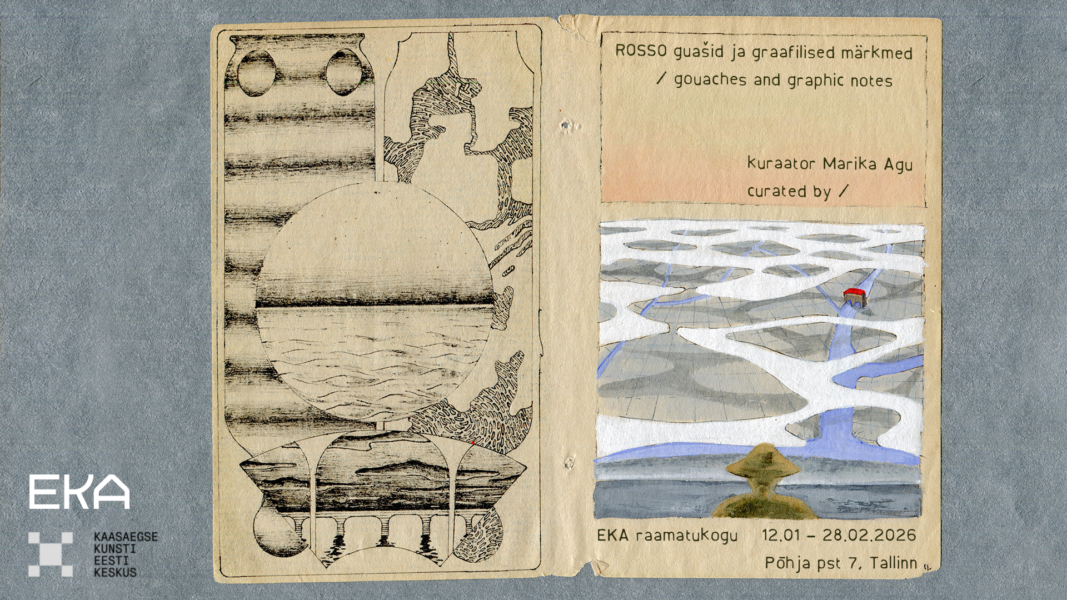
12 Jan – 28 Feb 2026
In the exhibition “Gouaches and Other Graphic Notes,” animator-trained artist Francesco Rosso translates the technological world into a dreamlike, deeply self-reflective inner universe. The world he depicts is guided by disciplined meditation, manual control, and a far-reaching perspective that traces paths laid down by both his predecessors and future generations.
The Estonian Academy of Arts Library, with its atmosphere dense with thought, provides a safe and fitting environment for materials that are intimate by nature. The exhibition’s miniature format is introduced by an electromechanics study cheat sheet from the artist’s personal archive, dating back to his secondary school years. As a coping mechanism while obtaining the field of study, Rosso cultivated meticulous graphic models and writings to break through the curriculum.
Building on this experience, he developed a refined visual handwriting which, across twenty years of diary entries, forms a kind of knitted fabric. Alongside drawings depicting metaphysical matter on the pages of his diaries, he transforms the mental and physical notes of everyday life into visual material that becomes the seed for new techniques.
The gouache paintings in this exhibition serve as a means of testing ideas and developing seriality. Working with material for an animation film currently in progress, Rosso depicts environments gathered during expeditions through human-shaped landscapes. In these paintings, he addresses the accountability in transforming our living environment, the new sensations that accompany it, and its impact on our perception of the world.
Francesco Rosso’s solo exhibition “Gouaches and Other Graphic Notes” at the Estonian Academy of Arts Library presents works created since 2023 that have not previously been publicly exhibited. It is an exhibition that places time-resistant manual skills at its centre, within a context increasingly saturated with automated means of production. The exhibition is curated by Marika Agu from the Estonian Centre for Contemporary Art.
More information:
Rene Mäe
EKA Library
Francesco Rosso (b. 1987) is an animator and artist living and working in Tallinn. His practice explores the mental and physical aspects of everyday life, transforming them into visual material. Rosso devotes a great deal of time to hand-made animation and detailed drawing. He merges animated material with filmed footage collected during exploratory journeys in urban and natural environments. Over the past decade, Rosso has worked across numerous artistic fields, including illustration, film, analogue photography, painting, printmaking, poetry, video art, and various animation techniques. His short animated films have been shown to international audiences, including at festivals in Clermont-Ferrand, Hiroshima, L’Étrange, Hamburg, Seoul, Interfilm, and the Encounters Short Film Festival.
Marika Agu (b. 1989) is a curator and archive project manager at the Estonian Centre for Contemporary Art. Having studied semiotics, art theory, and library and information science, her curatorial practice focuses on creative work with archives, emphasising site- and time-specificity, interdisciplinarity, and symbolic as well as material shifts in the creation and perception of contemporary art. In addition to her curatorial work, Agu publishes articles in both Estonian and international outlets and works as a lecturer at the Estonian Academy of Arts.
“Gouaches and Other Graphic Notes” at EKA Library
Monday 12 January, 2026 — Saturday 28 February, 2026
12 Jan – 28 Feb 2026
In the exhibition “Gouaches and Other Graphic Notes,” animator-trained artist Francesco Rosso translates the technological world into a dreamlike, deeply self-reflective inner universe. The world he depicts is guided by disciplined meditation, manual control, and a far-reaching perspective that traces paths laid down by both his predecessors and future generations.
The Estonian Academy of Arts Library, with its atmosphere dense with thought, provides a safe and fitting environment for materials that are intimate by nature. The exhibition’s miniature format is introduced by an electromechanics study cheat sheet from the artist’s personal archive, dating back to his secondary school years. As a coping mechanism while obtaining the field of study, Rosso cultivated meticulous graphic models and writings to break through the curriculum.
Building on this experience, he developed a refined visual handwriting which, across twenty years of diary entries, forms a kind of knitted fabric. Alongside drawings depicting metaphysical matter on the pages of his diaries, he transforms the mental and physical notes of everyday life into visual material that becomes the seed for new techniques.
The gouache paintings in this exhibition serve as a means of testing ideas and developing seriality. Working with material for an animation film currently in progress, Rosso depicts environments gathered during expeditions through human-shaped landscapes. In these paintings, he addresses the accountability in transforming our living environment, the new sensations that accompany it, and its impact on our perception of the world.
Francesco Rosso’s solo exhibition “Gouaches and Other Graphic Notes” at the Estonian Academy of Arts Library presents works created since 2023 that have not previously been publicly exhibited. It is an exhibition that places time-resistant manual skills at its centre, within a context increasingly saturated with automated means of production. The exhibition is curated by Marika Agu from the Estonian Centre for Contemporary Art.
More information:
Rene Mäe
EKA Library
Francesco Rosso (b. 1987) is an animator and artist living and working in Tallinn. His practice explores the mental and physical aspects of everyday life, transforming them into visual material. Rosso devotes a great deal of time to hand-made animation and detailed drawing. He merges animated material with filmed footage collected during exploratory journeys in urban and natural environments. Over the past decade, Rosso has worked across numerous artistic fields, including illustration, film, analogue photography, painting, printmaking, poetry, video art, and various animation techniques. His short animated films have been shown to international audiences, including at festivals in Clermont-Ferrand, Hiroshima, L’Étrange, Hamburg, Seoul, Interfilm, and the Encounters Short Film Festival.
Marika Agu (b. 1989) is a curator and archive project manager at the Estonian Centre for Contemporary Art. Having studied semiotics, art theory, and library and information science, her curatorial practice focuses on creative work with archives, emphasising site- and time-specificity, interdisciplinarity, and symbolic as well as material shifts in the creation and perception of contemporary art. In addition to her curatorial work, Agu publishes articles in both Estonian and international outlets and works as a lecturer at the Estonian Academy of Arts.
08.01.2026 — 15.02.2026
Liisa Nurklik “Wandering” at EKA Gallery 9.01.–15.02.2026
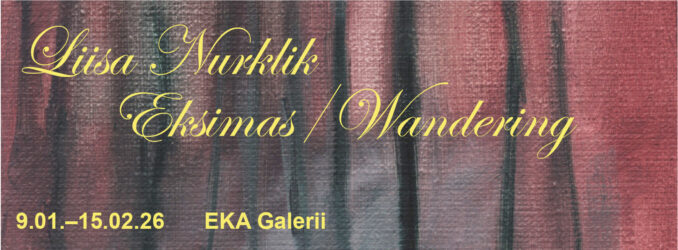
Liisa Nurklik
WANDERING
Second floor of EKA Gallery 9.01.–15.02.2026
Open Tue–Sat 12–6 pm Sun 12–4 pm, free entry
Opening: Thursday, January 8 at 6 pm
Liisa Nurklik’s solo exhibition “Wandering” reflects on abstract painting and the accompanying desire to wander over a prolonged period of time. Explorations of color and surface allow one tone to smoothly shift into another; directions moving one way meet those moving oppositely. Playing with the boring of simplicity evokes a possibility for the painting to be longer looked at, lost and gradually rediscovered.
Liisa Nurklik is currently a third-year student of painting at the Estonian Academy of Arts. Her first solo exhibition “If I Were-a-Person” took place in the Showcase Gallery of the EKA library in the fall of 2025 and presented the viewer with a series of drawings made with charcoal, pastel and pencil, depicting various creatures and objects, skin and hair, and focused primarily on evoking a sense of the uncanny.
Exhibition texts by: Kirke Kits
Graphic design by: Sunny Lei
Technical support by: Ats Kruusing
The exhibitions at EKA Gallery are supported by the Sadolin Estonia.
Opening drinks from mirai™ and Põhjala Brewery.
Liisa Nurklik “Wandering” at EKA Gallery 9.01.–15.02.2026
Thursday 08 January, 2026 — Sunday 15 February, 2026
Liisa Nurklik
WANDERING
Second floor of EKA Gallery 9.01.–15.02.2026
Open Tue–Sat 12–6 pm Sun 12–4 pm, free entry
Opening: Thursday, January 8 at 6 pm
Liisa Nurklik’s solo exhibition “Wandering” reflects on abstract painting and the accompanying desire to wander over a prolonged period of time. Explorations of color and surface allow one tone to smoothly shift into another; directions moving one way meet those moving oppositely. Playing with the boring of simplicity evokes a possibility for the painting to be longer looked at, lost and gradually rediscovered.
Liisa Nurklik is currently a third-year student of painting at the Estonian Academy of Arts. Her first solo exhibition “If I Were-a-Person” took place in the Showcase Gallery of the EKA library in the fall of 2025 and presented the viewer with a series of drawings made with charcoal, pastel and pencil, depicting various creatures and objects, skin and hair, and focused primarily on evoking a sense of the uncanny.
Exhibition texts by: Kirke Kits
Graphic design by: Sunny Lei
Technical support by: Ats Kruusing
The exhibitions at EKA Gallery are supported by the Sadolin Estonia.
Opening drinks from mirai™ and Põhjala Brewery.
08.01.2026 — 15.02.2026
“We Need More Indoor Spaces” at EKA Gallery 9.01.–15.02.2026
WE NEED MORE INDOOR SPACES
Ground floor of EKA Gallery 9.01.–15.02.2026
Open Tue–Sat 12–6 pm Sun 12–4 pm, free entry
Opening: Thursday, January 8 at 6 pm
The group exhibition “We Need More Indoor Spaces” is catalysed by the moving process of Krulli Skate Hall, bringing together local and international artists from Tallinn’s skateboard scene, framing skateboarding as an art form. The makers of the exhibition want to draw attention to the availability of indoor skate parks in the inner city, in the hopes of opening more spaces for skaters.
Jaagup Mägi and Éric-Olivier Thériault, two artists studying installation and sculpture at the Estonian Academy of Arts, came together with the idea of temporarily transforming the gallery space into a gathering hub in honour of the perseverant local skateboarding culture. Working within the constraints of the gallery, their aim is to demonstrate how skateboarding, as an artistic practice, parallels contemporary art in many ways: through experimentation, resilience, and a strong DIY ethos. The exhibition seeks to channel that energy into a broader conversation: What could happen if greater awareness of indoor skateparks was fostered? If these creative environments built by skateboarders for skateboarders were more actively supported?
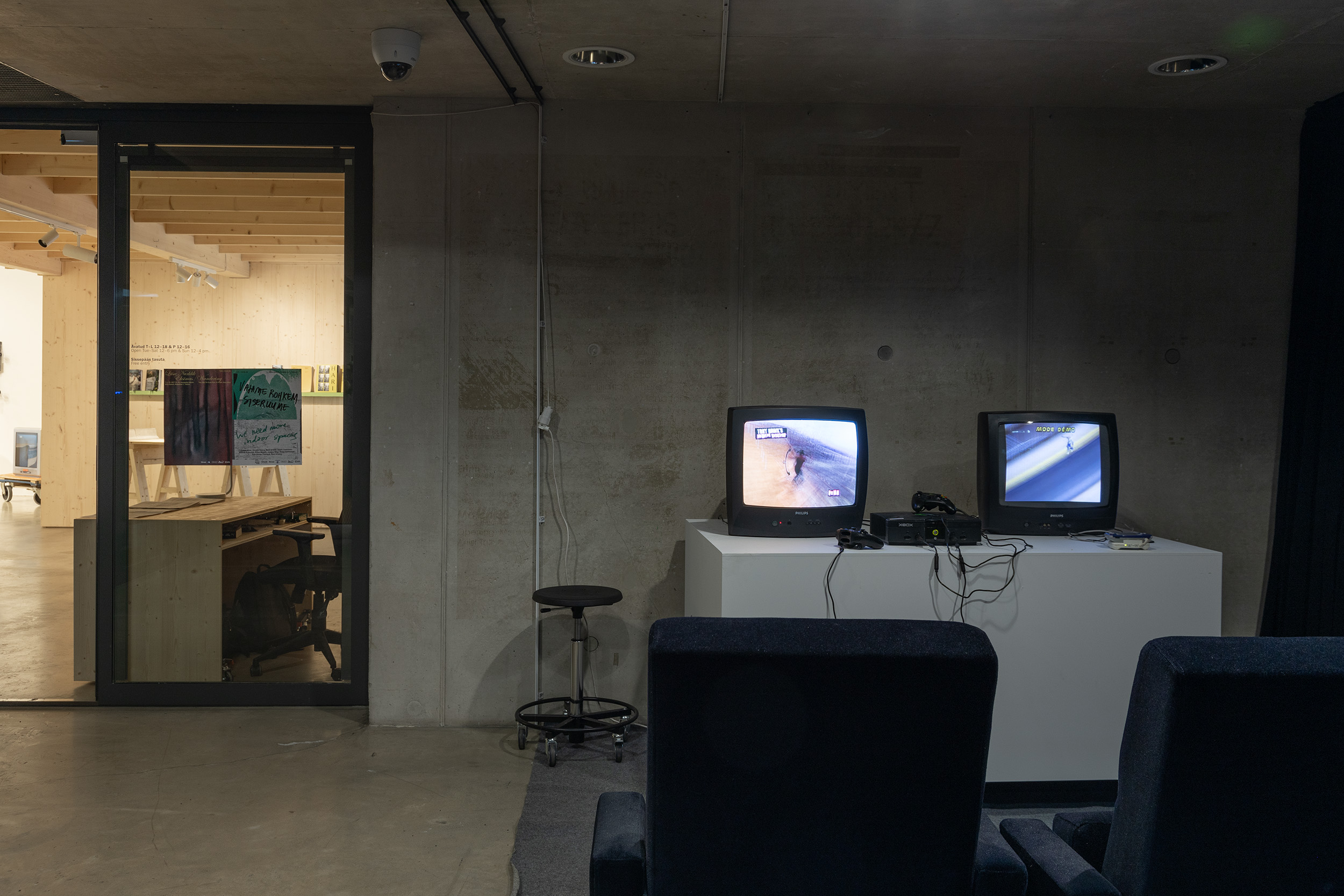
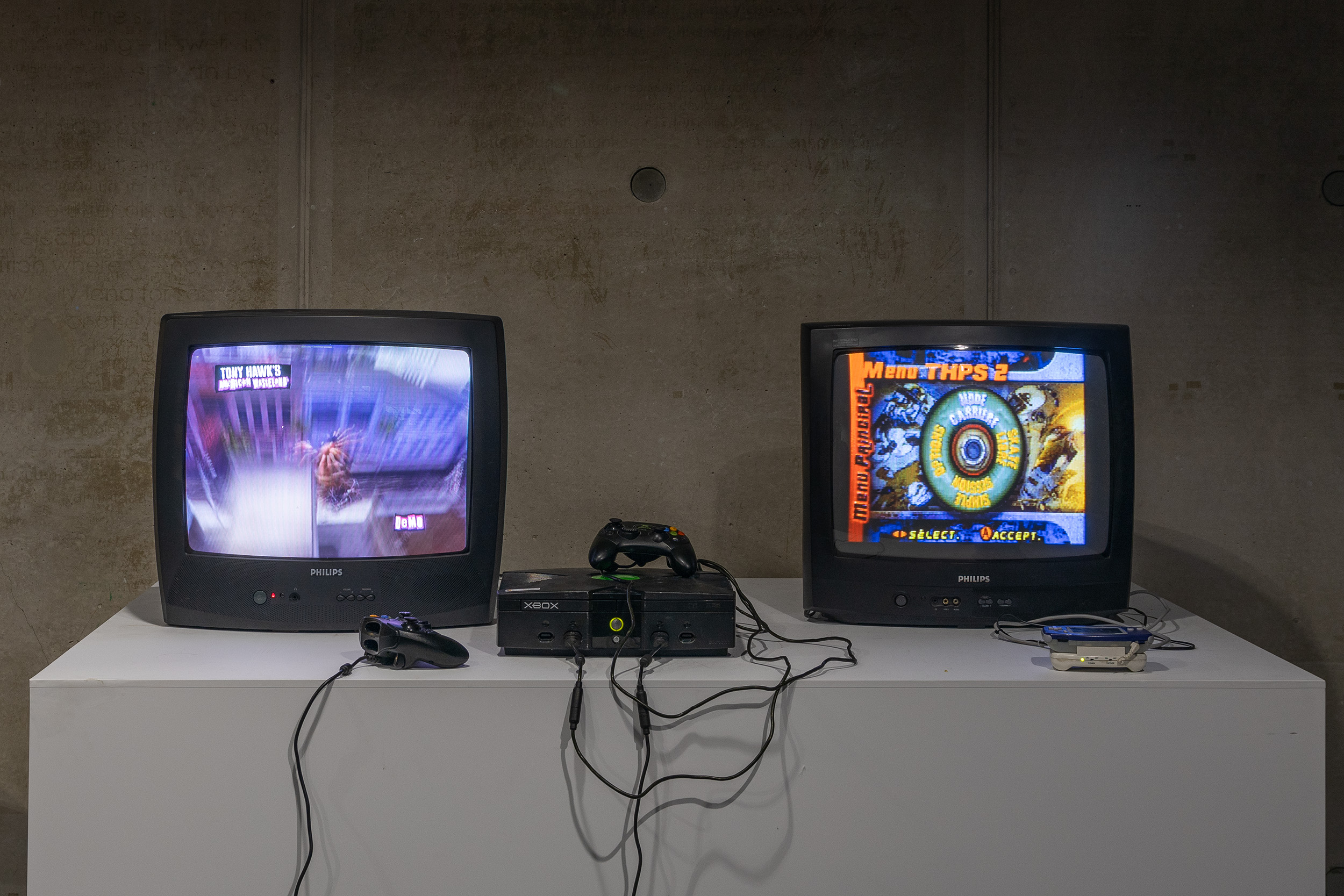
As part of the exhibition, in collaboration with the interactive video game museum LVLup! and Camille Laurelli, there will be an opportunity to play skateboarding-themed video games in the video box area of the EKA Gallery during the opening times of the gallery.
You are welcome to ride the course with your personal skateboard at your own risk until February 11 on Wednesdays from 6 to 9 pm and Sundays from 4 to 8 pm.
Artists: Frank Abner, Nicolas Bouvy, Maik Grüner, Daniil Južaninov, Andrew Kuus-Hill, Kaisa Maasik, Jaagup Mägi, Reigo Nahksepp, Éric-Olivier Thériault, Raul Ulberg
Curators: Jaagup Mägi & Éric-Olivier Thériault
Graphic design: Sunny Lei
Technical support: Ats Kruusing
The exhibition is supported by the Cultural Endowment of Estonia and Sadolin Estonia.
Opening drinks from mirai™ and Põhjala Brewery.
“We Need More Indoor Spaces” at EKA Gallery 9.01.–15.02.2026
Thursday 08 January, 2026 — Sunday 15 February, 2026
WE NEED MORE INDOOR SPACES
Ground floor of EKA Gallery 9.01.–15.02.2026
Open Tue–Sat 12–6 pm Sun 12–4 pm, free entry
Opening: Thursday, January 8 at 6 pm
The group exhibition “We Need More Indoor Spaces” is catalysed by the moving process of Krulli Skate Hall, bringing together local and international artists from Tallinn’s skateboard scene, framing skateboarding as an art form. The makers of the exhibition want to draw attention to the availability of indoor skate parks in the inner city, in the hopes of opening more spaces for skaters.
Jaagup Mägi and Éric-Olivier Thériault, two artists studying installation and sculpture at the Estonian Academy of Arts, came together with the idea of temporarily transforming the gallery space into a gathering hub in honour of the perseverant local skateboarding culture. Working within the constraints of the gallery, their aim is to demonstrate how skateboarding, as an artistic practice, parallels contemporary art in many ways: through experimentation, resilience, and a strong DIY ethos. The exhibition seeks to channel that energy into a broader conversation: What could happen if greater awareness of indoor skateparks was fostered? If these creative environments built by skateboarders for skateboarders were more actively supported?
As part of the exhibition, in collaboration with the interactive video game museum LVLup! and Camille Laurelli, there will be an opportunity to play skateboarding-themed video games in the video box area of the EKA Gallery during the opening times of the gallery.
You are welcome to ride the course with your personal skateboard at your own risk until February 11 on Wednesdays from 6 to 9 pm and Sundays from 4 to 8 pm.
Artists: Frank Abner, Nicolas Bouvy, Maik Grüner, Daniil Južaninov, Andrew Kuus-Hill, Kaisa Maasik, Jaagup Mägi, Reigo Nahksepp, Éric-Olivier Thériault, Raul Ulberg
Curators: Jaagup Mägi & Éric-Olivier Thériault
Graphic design: Sunny Lei
Technical support: Ats Kruusing
The exhibition is supported by the Cultural Endowment of Estonia and Sadolin Estonia.
Opening drinks from mirai™ and Põhjala Brewery.
12.01.2026 — 18.01.2026
Exhibition “Where u at? We in the know”
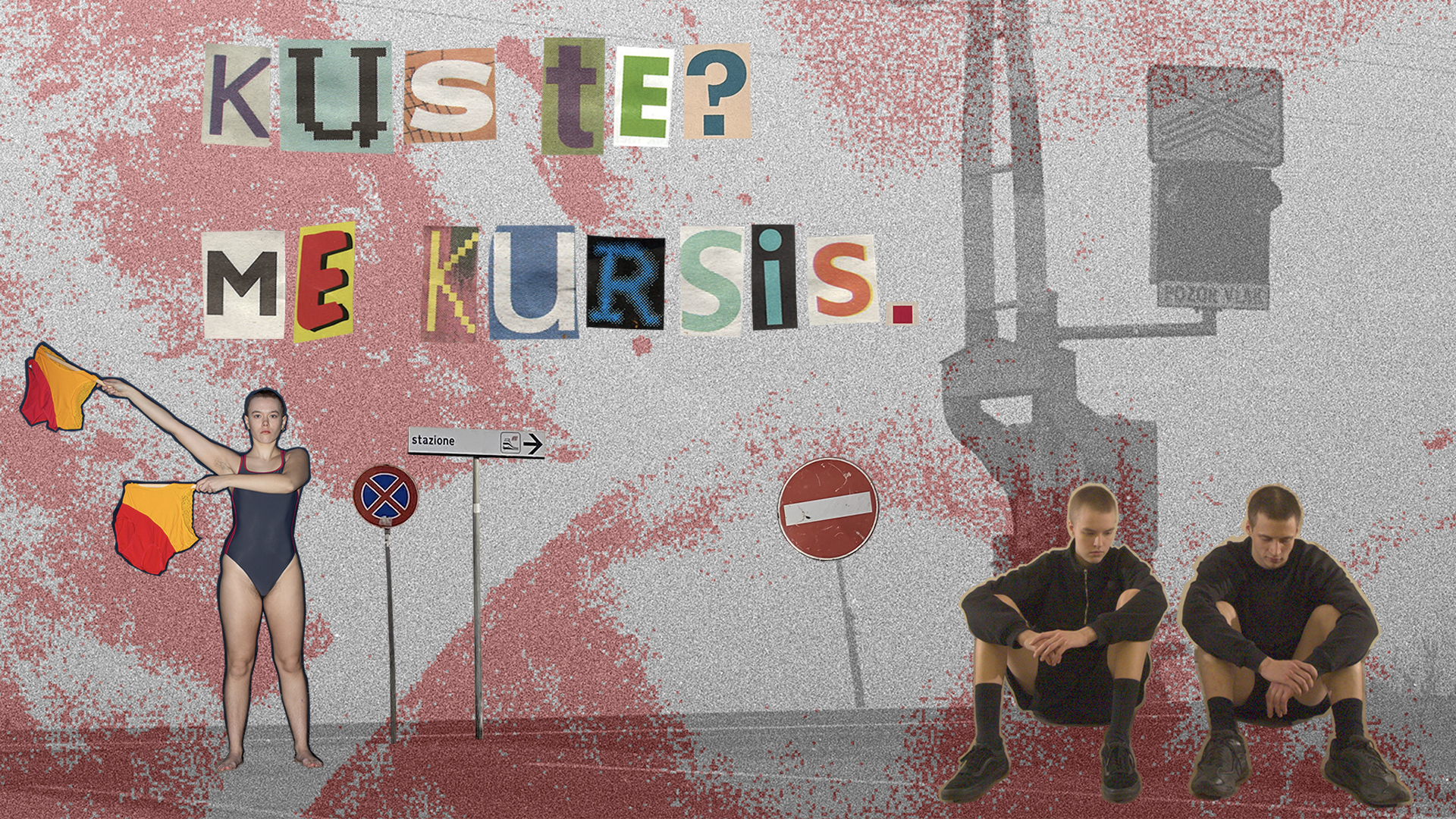
Exhibition “Where u at? We in the know”
Contemporary Art Museum of Estonia (EKKM)
Kursi 5, Tallinn
Mon – Sun 12.01. – 18.01.
13:00 – 19:00
Starting Monday, January 12th, the exhibition “Where u at? We in the know.” will open in the Contemporary Art Museum of Estonia (EKKM). The opening ceremony will take place a day later on Tuesday the 13th of January at 18:00
“Where u at? We in the know.” Meaning we’ve been allowed access to EKKM with it’s three floors. We’ve been offered help and benefits. Enough but not too much. Just enough to ward off fear in these spacious cold rooms.
And we in the know in the sense that we know what’s up. But are we IN the know? We would like to think we are. But who even is IN the know? A contemporary artist should be (by all rights). The president too. And the prime minister. But they have advisors. We don’t. We only have each other and this big cold building. And lots of thoughts. Concerning gender, taboos, underwear, the economy, childhood, hockey and refusal.
Participating artists:
Mari Karjus
Mikk Keis
August Kilmi
Olesja Prants
Rasmus Puksmann
Gen-Horret Rand
Katarina Kuningas
Greta Sauter
Grete Tuiken
Kaur Tõra
Gleb Volodtšenko
Viktoria Weiszova
Exhibition “Where u at? We in the know”
Monday 12 January, 2026 — Sunday 18 January, 2026
Exhibition “Where u at? We in the know”
Contemporary Art Museum of Estonia (EKKM)
Kursi 5, Tallinn
Mon – Sun 12.01. – 18.01.
13:00 – 19:00
Starting Monday, January 12th, the exhibition “Where u at? We in the know.” will open in the Contemporary Art Museum of Estonia (EKKM). The opening ceremony will take place a day later on Tuesday the 13th of January at 18:00
“Where u at? We in the know.” Meaning we’ve been allowed access to EKKM with it’s three floors. We’ve been offered help and benefits. Enough but not too much. Just enough to ward off fear in these spacious cold rooms.
And we in the know in the sense that we know what’s up. But are we IN the know? We would like to think we are. But who even is IN the know? A contemporary artist should be (by all rights). The president too. And the prime minister. But they have advisors. We don’t. We only have each other and this big cold building. And lots of thoughts. Concerning gender, taboos, underwear, the economy, childhood, hockey and refusal.
Participating artists:
Mari Karjus
Mikk Keis
August Kilmi
Olesja Prants
Rasmus Puksmann
Gen-Horret Rand
Katarina Kuningas
Greta Sauter
Grete Tuiken
Kaur Tõra
Gleb Volodtšenko
Viktoria Weiszova
17.12.2025
EKA New Media students’ exhibition “I’m not playing games, I swear” at RaRa
Students of EVA Lab, the Experimental Video Games in Art laboratory of the Estonian Academy of Arts New Media Department, present their exhibition in a new gallery space inside the National Library of Estonia. Although the National Library or RaRa building itself will only reopen to the general public in 2027, this exhibition offers an early glimpse into a yet unnamed art space that has not previously existed and is being opened temporarily for this occasion.
*Important! Visits are only possible with a guide. Gathering takes place at the main entrance of RARA at the following times:
17.12 at 17:00, 17:30, 18:00 and 18:30
During the autumn semester, EVA Lab students explore video game and interactive art theory, engaged in conversations with artists and game makers, and were given an optional workshop for learning a game engine to support their development. Through these encounters, students were questioning how video games occupy an enormous role in global popular culture, yet discussions of “games” can still meet a complicated reception within the field of visual arts.
Within art education, students are expected to devote themselves to understanding and critically navigating visual culture. Meanwhile, their personal experiences with gaming often belong to the realms of leisure, hobbies, and everyday play. Activities not always granted the same artistic legitimacy. This tension informs the exhibition’s title, “I’m not playing games, I swear”, a statement that is both slightly defensive and quietly humorous, acknowledging how the vocabulary of games can feel out of place in certain art discourse.
For this exhibition, the supervisors invited students to articulate their own relationships with gaming and game culture. The works on display, spanning interactive and non-interactive formats, transform personal memories, play habits, aesthetic intuitions, and critical reflections into artistic responses that reimagine what games can mean within contemporary art. From introspective narratives to speculative systems, the exhibition presents a variery of approaches to thinking through games as more than pastime.
Rather than insisting that we are not playing, the exhibition asks what becomes possible when play, experimentation, and game culture are allowed to enter artistic practice on their own terms.
Participating artists: Lotta Karoliina Räsänen, Maria Cecilie Wrang-Rasmussen, Irmak Semiz, Sarah Riley, Robert Kapanen, Kimathi Agbanu, Filémon Aufort, Paul Rannik, Triin Mänd, Edward Mcgeorge Allport-Bryson, Rover Indigo Bertels
Supervisors: Camille Laurelli, Sten Saarits
Exhibition is supported by RaRa, EKA, EVA Lab, LVLup! Museum
EKA New Media students’ exhibition “I’m not playing games, I swear” at RaRa
Wednesday 17 December, 2025
Students of EVA Lab, the Experimental Video Games in Art laboratory of the Estonian Academy of Arts New Media Department, present their exhibition in a new gallery space inside the National Library of Estonia. Although the National Library or RaRa building itself will only reopen to the general public in 2027, this exhibition offers an early glimpse into a yet unnamed art space that has not previously existed and is being opened temporarily for this occasion.
*Important! Visits are only possible with a guide. Gathering takes place at the main entrance of RARA at the following times:
17.12 at 17:00, 17:30, 18:00 and 18:30
During the autumn semester, EVA Lab students explore video game and interactive art theory, engaged in conversations with artists and game makers, and were given an optional workshop for learning a game engine to support their development. Through these encounters, students were questioning how video games occupy an enormous role in global popular culture, yet discussions of “games” can still meet a complicated reception within the field of visual arts.
Within art education, students are expected to devote themselves to understanding and critically navigating visual culture. Meanwhile, their personal experiences with gaming often belong to the realms of leisure, hobbies, and everyday play. Activities not always granted the same artistic legitimacy. This tension informs the exhibition’s title, “I’m not playing games, I swear”, a statement that is both slightly defensive and quietly humorous, acknowledging how the vocabulary of games can feel out of place in certain art discourse.
For this exhibition, the supervisors invited students to articulate their own relationships with gaming and game culture. The works on display, spanning interactive and non-interactive formats, transform personal memories, play habits, aesthetic intuitions, and critical reflections into artistic responses that reimagine what games can mean within contemporary art. From introspective narratives to speculative systems, the exhibition presents a variery of approaches to thinking through games as more than pastime.
Rather than insisting that we are not playing, the exhibition asks what becomes possible when play, experimentation, and game culture are allowed to enter artistic practice on their own terms.
Participating artists: Lotta Karoliina Räsänen, Maria Cecilie Wrang-Rasmussen, Irmak Semiz, Sarah Riley, Robert Kapanen, Kimathi Agbanu, Filémon Aufort, Paul Rannik, Triin Mänd, Edward Mcgeorge Allport-Bryson, Rover Indigo Bertels
Supervisors: Camille Laurelli, Sten Saarits
Exhibition is supported by RaRa, EKA, EVA Lab, LVLup! Museum
01.12.2025 — 15.02.2026
“How to Reframe Monuments” at EKA Billboard Gallery 1.12.2025–15.02.2026
HOW TO REFRAME MONUMENTS
EKA Billboard Gallery 1.12.2025–15.02.2026
Open 24/7, free admission
The Past as Artistic Material
We live in a time when monuments cannot be ignored. Around the world, debates rage over their meaning and over whether – and how – contested monuments should be displayed in public space. Russia’s full-scale war in Ukraine has brought one of the epicentres of monumental conflict to Eastern Europe. To date, a large number of Soviet-era monuments in Estonia, particularly World War II memorials, have been removed.
The project “How to Reframe Monuments” is based on the premise that removing a monument does not resolve the problem – complex heritage cannot simply be bypassed, but must be worked through. By bringing together knowledge and expertise from multiple fields, we have developed solutions that, through academic research, heritage conservation and digitisation practices, as well as artistic interventions, enable dissonant heritage not to be demolished but to be reframed within a new critical context.
At the heart of the outdoor exhibition is the potential of art in addressing memory conflicts in public space – and, through this, the social role of contemporary art. Three design competitions carried out in the frame- work of this project illustrate ways of reframing different types of dissonant heritage – memori- als, paintings and sculptures. To date, already one of the artistic interventions has been realised: the reframing of the Tehumardi memorial by Neeme Külm.
Between 2024 and 2025, a total of 17 artists took part in the art competitions. The conceptualisation of the Tehumardi memorial complex on Saaremaa—now partially dismantled—involved Kirke Kangro, Neeme Külm, Anna Mari Liivrand, Johannes Säre, Kristina Norman, and Taavi Piibemann.
Anna Škodenko, Hanna Piksarv, Jevgeni Zolotko, Kati Saarits, and Sigrid Viir proposed their own solutions for redesigning the monumental paintings, completed in 1955, in the old passenger terminal of Tallinn Airport.
Trevor Kinna, Bob Bicknell-Knight, Hasso Krull, Camille Laurelli, Samuel Lehikoinen, Ülo Pikkov, and Yiyang Sun created digital artworks based on the monument “Vyatchko and Meelis Defending Tartu” (1950/1956) located in Tartu. These works are shown as part of the exhibition “The Monument and the Fairy Tale” in the EKA foyer during 1.–12.12.2025.
Exhibition team: Linda Kaljundi, Kirke Kangro, Annika Tiko, Maris Veeremäe
Design: Kristjan Mändmaa
Language editing: Hille Saluäär, Jason Finch
“How to reframe monuments” is a collaborative project between the Estonian Academy of Arts and Tallinn University, funded by the Estonian Ministry of Culture.
The project’s follow-up exhibition will open in February 2026 at EKA Gallery.
“How to Reframe Monuments” at EKA Billboard Gallery 1.12.2025–15.02.2026
Monday 01 December, 2025 — Sunday 15 February, 2026
HOW TO REFRAME MONUMENTS
EKA Billboard Gallery 1.12.2025–15.02.2026
Open 24/7, free admission
The Past as Artistic Material
We live in a time when monuments cannot be ignored. Around the world, debates rage over their meaning and over whether – and how – contested monuments should be displayed in public space. Russia’s full-scale war in Ukraine has brought one of the epicentres of monumental conflict to Eastern Europe. To date, a large number of Soviet-era monuments in Estonia, particularly World War II memorials, have been removed.
The project “How to Reframe Monuments” is based on the premise that removing a monument does not resolve the problem – complex heritage cannot simply be bypassed, but must be worked through. By bringing together knowledge and expertise from multiple fields, we have developed solutions that, through academic research, heritage conservation and digitisation practices, as well as artistic interventions, enable dissonant heritage not to be demolished but to be reframed within a new critical context.
At the heart of the outdoor exhibition is the potential of art in addressing memory conflicts in public space – and, through this, the social role of contemporary art. Three design competitions carried out in the frame- work of this project illustrate ways of reframing different types of dissonant heritage – memori- als, paintings and sculptures. To date, already one of the artistic interventions has been realised: the reframing of the Tehumardi memorial by Neeme Külm.
Between 2024 and 2025, a total of 17 artists took part in the art competitions. The conceptualisation of the Tehumardi memorial complex on Saaremaa—now partially dismantled—involved Kirke Kangro, Neeme Külm, Anna Mari Liivrand, Johannes Säre, Kristina Norman, and Taavi Piibemann.
Anna Škodenko, Hanna Piksarv, Jevgeni Zolotko, Kati Saarits, and Sigrid Viir proposed their own solutions for redesigning the monumental paintings, completed in 1955, in the old passenger terminal of Tallinn Airport.
Trevor Kinna, Bob Bicknell-Knight, Hasso Krull, Camille Laurelli, Samuel Lehikoinen, Ülo Pikkov, and Yiyang Sun created digital artworks based on the monument “Vyatchko and Meelis Defending Tartu” (1950/1956) located in Tartu. These works are shown as part of the exhibition “The Monument and the Fairy Tale” in the EKA foyer during 1.–12.12.2025.
Exhibition team: Linda Kaljundi, Kirke Kangro, Annika Tiko, Maris Veeremäe
Design: Kristjan Mändmaa
Language editing: Hille Saluäär, Jason Finch
“How to reframe monuments” is a collaborative project between the Estonian Academy of Arts and Tallinn University, funded by the Estonian Ministry of Culture.
The project’s follow-up exhibition will open in February 2026 at EKA Gallery.
03.12.2025 — 24.01.2026
Photography Department students Photobook exhibition at EKA Library
This exhibition features handmade books by EKA students as the culmination of a course in which they worked with photographs in book format. They explored the similarities and differences between artist books, self-publishing, and book dummies. In addition to creating and editing visual materials, students tried their hand at design, pre-press, and binding by hand.
The books contain both analog and digital photos in the form of collages, typologies, narratives, and archival materials. The subjects explored include personal themes such as hometown, friendship, family, and childhood, as well as everyday life, the inexpressibility of feelings and perceptions, and mundane architecture.
Artists participating in the exhibition: Mikk Keis, Olesja Prants, Gleb Volodtšenko, Mari Karjus, Viktoria Weiszova, Tobias Tikenberg, Jana Mätas (MACA), Kristiina Aarna (DKT).
Supervisor Mirjam Varik.
Photography Department students Photobook exhibition at EKA Library
Wednesday 03 December, 2025 — Saturday 24 January, 2026
This exhibition features handmade books by EKA students as the culmination of a course in which they worked with photographs in book format. They explored the similarities and differences between artist books, self-publishing, and book dummies. In addition to creating and editing visual materials, students tried their hand at design, pre-press, and binding by hand.
The books contain both analog and digital photos in the form of collages, typologies, narratives, and archival materials. The subjects explored include personal themes such as hometown, friendship, family, and childhood, as well as everyday life, the inexpressibility of feelings and perceptions, and mundane architecture.
Artists participating in the exhibition: Mikk Keis, Olesja Prants, Gleb Volodtšenko, Mari Karjus, Viktoria Weiszova, Tobias Tikenberg, Jana Mätas (MACA), Kristiina Aarna (DKT).
Supervisor Mirjam Varik.
07.12.2025 — 31.01.2026
Exhibition “Estonian Heritage on the World Map.”
The UNESCO Chair at the Estonian Academy of Arts is opening the exhibition “Estonian Heritage on the World Map” at Valga Railway Station.
We are proud of our heritage and confident that it also speaks to the wider world. Yet we know surprisingly little about what from Estonia is actually considered remarkable internationally, and what opportunities the presentation of our heritage together with others in shared networks can offer.
The exhibition by the Estonian Academy of Arts presents what from Estonia has been included on UNESCO’s World Heritage List, the Intangible Cultural Heritage List, and the Memory of the World Register. It also highlights which places have been awarded the European Heritage Label. Several European Cultural Routes run through Estonia. Over the years, Estonian works have also been recognized with Europa Nostra awards. We usually talk about such places one by one. With this exhibition, EKA aims to create a bigger picture, to inspire owners and local governments, and to remind everyone that by working together we can achieve more. Cultural heritage offers endless opportunities for presenting ourselves and for finding like-minded partners.
EKA will open the exhibition on “Heritage Sunday,” 7 December at 12:15 at Valga Railway Station, in cooperation with the Valga Museum and ICOMOS Estonia. The exhibition will be introduced by Riin Alatalu, holder of the EKA UNESCO Chair and vice-president of the international expert organization for heritage conservation.
For more information, please contact:
Riin Alatalu
riin.alatalu@artun.ee
+372 511 9439
Exhibition “Estonian Heritage on the World Map.”
Sunday 07 December, 2025 — Saturday 31 January, 2026
The UNESCO Chair at the Estonian Academy of Arts is opening the exhibition “Estonian Heritage on the World Map” at Valga Railway Station.
We are proud of our heritage and confident that it also speaks to the wider world. Yet we know surprisingly little about what from Estonia is actually considered remarkable internationally, and what opportunities the presentation of our heritage together with others in shared networks can offer.
The exhibition by the Estonian Academy of Arts presents what from Estonia has been included on UNESCO’s World Heritage List, the Intangible Cultural Heritage List, and the Memory of the World Register. It also highlights which places have been awarded the European Heritage Label. Several European Cultural Routes run through Estonia. Over the years, Estonian works have also been recognized with Europa Nostra awards. We usually talk about such places one by one. With this exhibition, EKA aims to create a bigger picture, to inspire owners and local governments, and to remind everyone that by working together we can achieve more. Cultural heritage offers endless opportunities for presenting ourselves and for finding like-minded partners.
EKA will open the exhibition on “Heritage Sunday,” 7 December at 12:15 at Valga Railway Station, in cooperation with the Valga Museum and ICOMOS Estonia. The exhibition will be introduced by Riin Alatalu, holder of the EKA UNESCO Chair and vice-president of the international expert organization for heritage conservation.
For more information, please contact:
Riin Alatalu
riin.alatalu@artun.ee
+372 511 9439