
Open Lectures
10.12.2025
Open Lecture: Palestinian Literature Today
What is Palestinian literature talking about today? And who is it talking to? Hazem Jamjoum and Heba Hayek, curators of the November issue of Vikerkaar magazine devoted to Palestinian literature, discuss the role of art in dark times – in the Middle East and around the world.
On December 10th at 4 p.m., an open lecture entitled “Palestinian Literature Today” will take place in the EKA foyer event area. The lecture takes place in English. It will be followed by a discussion and moderated by Hille Hanso.
Hazem Jamjoum is a cultural historian, archivist, and teacher based in London. He is the managing editor of the recently established publishing house Safarjal Press. His translation of Ghassan Kanafani’s “The Revolution of 1936–1939 in Palestine” published by 1804 Books won the 2024 Palestinian Book Award. Her translation of Maya Abu al-Hayyati’s novel “No One Knows Their Blood Type” was published by CSU Poetry Center in 2024.Heba Hayek is a writer, workshop facilitator, and communications consultant based primarily in London. She seeks out stories that challenge traditional archives and imposed conditions of visibility. Her debut book, “Sambac Beneath Unlikely Skies” won the 2022 Palestine Book Award. The White Review, Middle East Eye, and The New Arab named it Book of the Year 2021.
Open Lecture: Palestinian Literature Today
Wednesday 10 December, 2025
What is Palestinian literature talking about today? And who is it talking to? Hazem Jamjoum and Heba Hayek, curators of the November issue of Vikerkaar magazine devoted to Palestinian literature, discuss the role of art in dark times – in the Middle East and around the world.
On December 10th at 4 p.m., an open lecture entitled “Palestinian Literature Today” will take place in the EKA foyer event area. The lecture takes place in English. It will be followed by a discussion and moderated by Hille Hanso.
Hazem Jamjoum is a cultural historian, archivist, and teacher based in London. He is the managing editor of the recently established publishing house Safarjal Press. His translation of Ghassan Kanafani’s “The Revolution of 1936–1939 in Palestine” published by 1804 Books won the 2024 Palestinian Book Award. Her translation of Maya Abu al-Hayyati’s novel “No One Knows Their Blood Type” was published by CSU Poetry Center in 2024.Heba Hayek is a writer, workshop facilitator, and communications consultant based primarily in London. She seeks out stories that challenge traditional archives and imposed conditions of visibility. Her debut book, “Sambac Beneath Unlikely Skies” won the 2022 Palestine Book Award. The White Review, Middle East Eye, and The New Arab named it Book of the Year 2021.
20.11.2025
Open Architecture Lecture: Sir Peter Cook
With an extraordinary Open Architecture Lecture, legendary architect and lecturer Sir Peter Cook will take the stage at the EKA hall on November 20 at 6 pm with a presentation “Piquant Motivations”, which will be supplemented by a quick overview of Archigram 10.
The lecture will examine the topics “The piquancy of the isolated object”, “The insidious charm of vegetation” and “Odd skins and clothing” through the prism of architecture, but will also seek an answer to the question, is color analogous to chatter?
“There is no more vivid dean, architect, and professional changer than Peter, who has spoken to several generations of practitioners in doing all this. I am sincerely pleased that he will come to EKA to introduce his new work and will also be selling the book in the Architecture Museum’s bookstore,” says Sille Pihlak, Dean of the Faculty of Architecture, inviting everybody to listen to the lecture.
Professor Sir Peter Cook, founder of Archigram, former Director the Institute for Contemporary Art, London (the ICA) and Bartlett School of Architecture at University College London has been a dominant figure in the architectural world for over half a century. His ongoing contribution to architectural innovation was recognised in 2007 when he was knighted by the Queen for his services to architecture. Cook’s achievements with radical experimentalist group Archigram have been the subject of numerous publications and public exhibitions and were recognised by the Royal Institute of British Architects in 2002, when members of the group were awarded the RIBA’s highest award, the Royal Gold Medal.
Cook’s continuing work as a lecturer of considerable renown makes him a familiar voice within cultural institutions around the world. With his team of architects and innovators, he continues to make waves with visionary architecture built around the world.
Also check out https://www.petercookarchitecture.com/
The lecture will be held in English and is free and open to all interested parties.
Open Architecture Lecture: Sir Peter Cook
Thursday 20 November, 2025
With an extraordinary Open Architecture Lecture, legendary architect and lecturer Sir Peter Cook will take the stage at the EKA hall on November 20 at 6 pm with a presentation “Piquant Motivations”, which will be supplemented by a quick overview of Archigram 10.
The lecture will examine the topics “The piquancy of the isolated object”, “The insidious charm of vegetation” and “Odd skins and clothing” through the prism of architecture, but will also seek an answer to the question, is color analogous to chatter?
“There is no more vivid dean, architect, and professional changer than Peter, who has spoken to several generations of practitioners in doing all this. I am sincerely pleased that he will come to EKA to introduce his new work and will also be selling the book in the Architecture Museum’s bookstore,” says Sille Pihlak, Dean of the Faculty of Architecture, inviting everybody to listen to the lecture.
Professor Sir Peter Cook, founder of Archigram, former Director the Institute for Contemporary Art, London (the ICA) and Bartlett School of Architecture at University College London has been a dominant figure in the architectural world for over half a century. His ongoing contribution to architectural innovation was recognised in 2007 when he was knighted by the Queen for his services to architecture. Cook’s achievements with radical experimentalist group Archigram have been the subject of numerous publications and public exhibitions and were recognised by the Royal Institute of British Architects in 2002, when members of the group were awarded the RIBA’s highest award, the Royal Gold Medal.
Cook’s continuing work as a lecturer of considerable renown makes him a familiar voice within cultural institutions around the world. With his team of architects and innovators, he continues to make waves with visionary architecture built around the world.
Also check out https://www.petercookarchitecture.com/
The lecture will be held in English and is free and open to all interested parties.
17.11.2025
Matter of Scale – graduation project by TU Delft students in Tallinn
We invite all architecture and urbanism students to join on Monday, November 17, at 18:00, in EKA auditorium A101, to the presentation of TU Delft students work in the city of Tallinn, which is going on now for the third consecutive year. Professor Klaske Havik will give an overview of earlier projects, as this year’s students during the ongoing two weeks are researching the city’s diverse urban spaces and developing their own design briefs based on these studies.
The graduation studio ‘A Matter of Scale’ examines the Estonian capital Tallinn, where the human scale is constantly challenged by buildings and urban plans of very different sizes. Layers of Hanseatic, Soviet, and contemporary market-driven developments coexist as much as they clash in Tallinn, conditioned as they are by the city’s distinct natural and cultural conditions.
The graduation studio is the chair of Methods of Analysis and Imagination is led by Klaske Havik (Prof.Dr.Ir.), Jorge Mejía Hernández (Dr.Ir.), Pierre Jennen (Ir.), and Freek Speksnijder (Ir.).
Matter of Scale – graduation project by TU Delft students in Tallinn
Monday 17 November, 2025
We invite all architecture and urbanism students to join on Monday, November 17, at 18:00, in EKA auditorium A101, to the presentation of TU Delft students work in the city of Tallinn, which is going on now for the third consecutive year. Professor Klaske Havik will give an overview of earlier projects, as this year’s students during the ongoing two weeks are researching the city’s diverse urban spaces and developing their own design briefs based on these studies.
The graduation studio ‘A Matter of Scale’ examines the Estonian capital Tallinn, where the human scale is constantly challenged by buildings and urban plans of very different sizes. Layers of Hanseatic, Soviet, and contemporary market-driven developments coexist as much as they clash in Tallinn, conditioned as they are by the city’s distinct natural and cultural conditions.
The graduation studio is the chair of Methods of Analysis and Imagination is led by Klaske Havik (Prof.Dr.Ir.), Jorge Mejía Hernández (Dr.Ir.), Pierre Jennen (Ir.), and Freek Speksnijder (Ir.).
18.11.2025
Open Lecture: Bintan Titisari “Natural Dyes Ecosystem in Textile and Fashion Industry”
Teams link:
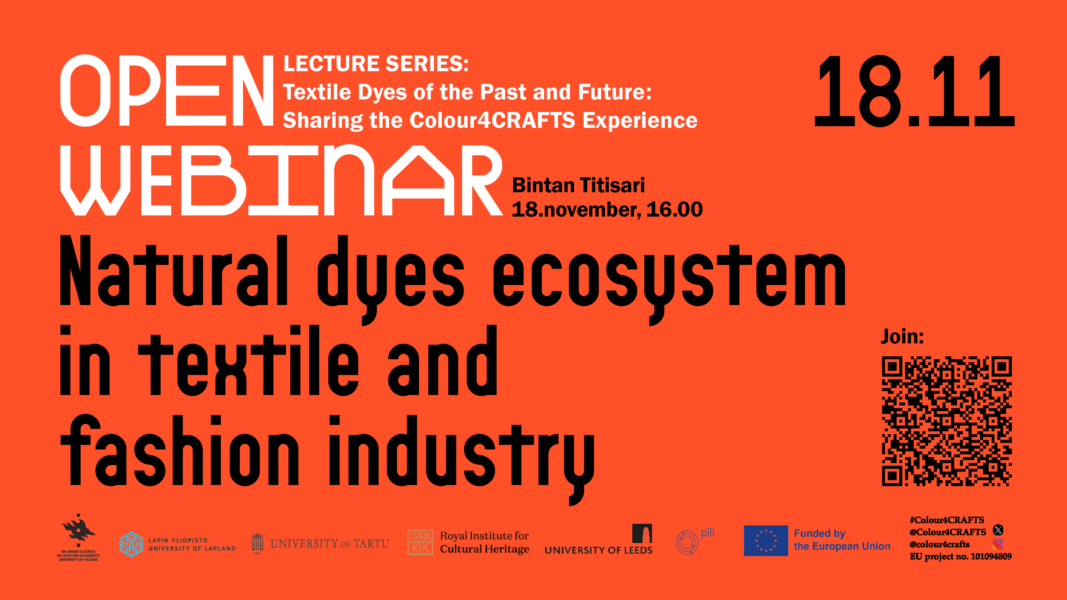
Bintan Titisari (Postdoctoral researcher, University of Leeds, Colour4CRAFTS)
“Natural dyes ecosystem in textile and fashion industry” (in English, online)
Description: Natural dyeing is one of the oldest traditions in European textiles, deeply tied to cultural heritage and local craftsmanship. Today, it is re-emerging as an important practice in the textile and fashion industries, extending from small workshops into larger-scale production. This lecture examines the broader ecosystem of natural dyes, exploring how they intersect with heritage, sustainability, design practice, and trend forecasting. The relationship between artisanal and industrial approaches can appear divided, yet each contributes valuable knowledge and innovation. By recognising these interconnections, we can better understand how natural dyes offer not only a link to tradition but also a pathway toward more sustainable and creative futures for fashion and textiles.
Bintan Titisari (PhD), University of Leeds, postdoctoral researcher. Bintan Titisari (PhD) is a postdoctoral researcher at the School of Design, University of Leeds. Her research interests are in the textile and fashion design industry, focusing on the interdisciplinary aspects of textile design, colourants, sustainable practices, and consumer behaviour. With over a decade of academic experience in Indonesia, Brunei, and the UK, she has taught and developed courses in sustainable fashion, craft design, resist dyeing, and smart textiles. In her textile-making practice, she combines natural dyes with the resist dyeing technique to create unique textiles. She is a member of the EU Horizon project Colour4CRAFTS.
–
The lecture is part of a series “Textile Dyes of the Past and Future: sharing the Colour4CRAFTS Experience” begins, initiated by the EU Horizon project Colour4CRAFTS.
The webinar series brings together EU Horizon project Colour4CRAFTS members and important guests to discuss and share their knowledge on textile dyes of the past and future. The series is brought together by the University of Tartu and Viljandi Culture Academy in collaboration with the Estonian Academy of Arts.
EU Horizon project Colour4CRAFTS combines a multidisciplinary team of experts from research institutes and R&D companies to carry out studies of bio-based textile colouration in traditional historic perspective and in combination with cutting-edge technologies of colourants biosynthesis and waterless applications techniques. Colour4CRAFTS members are the University of Helsinki, University of Lapland, University of Tartu, KIK-IRPA, University of Leeds and PILI Bio.
Open Lecture: Bintan Titisari “Natural Dyes Ecosystem in Textile and Fashion Industry”
Tuesday 18 November, 2025
Teams link:
Bintan Titisari (Postdoctoral researcher, University of Leeds, Colour4CRAFTS)
“Natural dyes ecosystem in textile and fashion industry” (in English, online)
Description: Natural dyeing is one of the oldest traditions in European textiles, deeply tied to cultural heritage and local craftsmanship. Today, it is re-emerging as an important practice in the textile and fashion industries, extending from small workshops into larger-scale production. This lecture examines the broader ecosystem of natural dyes, exploring how they intersect with heritage, sustainability, design practice, and trend forecasting. The relationship between artisanal and industrial approaches can appear divided, yet each contributes valuable knowledge and innovation. By recognising these interconnections, we can better understand how natural dyes offer not only a link to tradition but also a pathway toward more sustainable and creative futures for fashion and textiles.
Bintan Titisari (PhD), University of Leeds, postdoctoral researcher. Bintan Titisari (PhD) is a postdoctoral researcher at the School of Design, University of Leeds. Her research interests are in the textile and fashion design industry, focusing on the interdisciplinary aspects of textile design, colourants, sustainable practices, and consumer behaviour. With over a decade of academic experience in Indonesia, Brunei, and the UK, she has taught and developed courses in sustainable fashion, craft design, resist dyeing, and smart textiles. In her textile-making practice, she combines natural dyes with the resist dyeing technique to create unique textiles. She is a member of the EU Horizon project Colour4CRAFTS.
–
The lecture is part of a series “Textile Dyes of the Past and Future: sharing the Colour4CRAFTS Experience” begins, initiated by the EU Horizon project Colour4CRAFTS.
The webinar series brings together EU Horizon project Colour4CRAFTS members and important guests to discuss and share their knowledge on textile dyes of the past and future. The series is brought together by the University of Tartu and Viljandi Culture Academy in collaboration with the Estonian Academy of Arts.
EU Horizon project Colour4CRAFTS combines a multidisciplinary team of experts from research institutes and R&D companies to carry out studies of bio-based textile colouration in traditional historic perspective and in combination with cutting-edge technologies of colourants biosynthesis and waterless applications techniques. Colour4CRAFTS members are the University of Helsinki, University of Lapland, University of Tartu, KIK-IRPA, University of Leeds and PILI Bio.
14.11.2025
Public Lecture: Spolka: Research and design for feminist futures
Spolka is a non-profit architecture and sociology studio and collective based in Košice, Bratislava, and Berlin.
Public Lecture: Spolka: Research and design for feminist futures
Friday 14 November, 2025
Spolka is a non-profit architecture and sociology studio and collective based in Košice, Bratislava, and Berlin.
11.11.2025
Open Lecture: Deb Bamford ”What Can We Learn from Using Mordants?”
11.11 16.00
Deb Bamford (doctoral researcher, University of Leeds, Colour4CRAFTS)
” What can we learn from using mordants?” (in English, online)
In natural dyeing, mordants are often required. These substances help dye molecules bind to the fiber and can influence the final hue. Their effectiveness depends on the type of fiber, the dye used, and the mordanting method. The most commonly used mordants are various metal salts, historically among which alum-based compounds are particularly popular. How do mordants work, and what should be considered when using them?
Deb Bamford, University of Leeds, doctoral researcher. Deb Bamford is a doctoral student at the University of Leeds, School of Design. Her research interests include history of dyes, dyeing and textiles. Her thesis title is “Investigations to improve the mordanting process for natural dyes on cotton and wool using aluminium salts or alternative bio-mordants”. She is a member of the EU Horizon project Colour4CRAFTS project.
The lecture is part of a series “Textile Dyes of the Past and Future: sharing the Colour4CRAFTS Experience” begins, initiated by the EU Horizon project Colour4CRAFTS.
The webinar series brings together EU Horizon project Colour4CRAFTS members and important guests to discuss and share their knowledge on textile dyes of the past and future. The series is brought together by the University of Tartu and Viljandi Culture Academy in collaboration with the Estonian Academy of Arts.
EU Horizon project Colour4CRAFTS combines a multidisciplinary team of experts from research institutes and R&D companies to carry out studies of bio-based textile colouration in traditional historic perspective and in combination with cutting-edge technologies of colourants biosynthesis and waterless applications techniques. Colour4CRAFTS members are the University of Helsinki, University of Lapland, University of Tartu, KIK-IRPA, University of Leeds and PILI Bio.
Open Lecture: Deb Bamford ”What Can We Learn from Using Mordants?”
Tuesday 11 November, 2025
11.11 16.00
Deb Bamford (doctoral researcher, University of Leeds, Colour4CRAFTS)
” What can we learn from using mordants?” (in English, online)
In natural dyeing, mordants are often required. These substances help dye molecules bind to the fiber and can influence the final hue. Their effectiveness depends on the type of fiber, the dye used, and the mordanting method. The most commonly used mordants are various metal salts, historically among which alum-based compounds are particularly popular. How do mordants work, and what should be considered when using them?
Deb Bamford, University of Leeds, doctoral researcher. Deb Bamford is a doctoral student at the University of Leeds, School of Design. Her research interests include history of dyes, dyeing and textiles. Her thesis title is “Investigations to improve the mordanting process for natural dyes on cotton and wool using aluminium salts or alternative bio-mordants”. She is a member of the EU Horizon project Colour4CRAFTS project.
The lecture is part of a series “Textile Dyes of the Past and Future: sharing the Colour4CRAFTS Experience” begins, initiated by the EU Horizon project Colour4CRAFTS.
The webinar series brings together EU Horizon project Colour4CRAFTS members and important guests to discuss and share their knowledge on textile dyes of the past and future. The series is brought together by the University of Tartu and Viljandi Culture Academy in collaboration with the Estonian Academy of Arts.
EU Horizon project Colour4CRAFTS combines a multidisciplinary team of experts from research institutes and R&D companies to carry out studies of bio-based textile colouration in traditional historic perspective and in combination with cutting-edge technologies of colourants biosynthesis and waterless applications techniques. Colour4CRAFTS members are the University of Helsinki, University of Lapland, University of Tartu, KIK-IRPA, University of Leeds and PILI Bio.
27.11.2025
KVI + ARH Open Lecture: Robert Mull “The Free World”
The 2025/2026 academic year open lecture series will be held in collaboration with the Institute of Art History and Visual Culture and the Faculty of Architecture. The theme of this academic year is “Architecture and the Ethics of Care” and the lectures will be curated by KVI Senior Researcher Dr. Ingrid Ruudi.
On November 27 at 6 pm Robert Mull will give a lecture “The Free World”.
Robert Mull will discuss the ethical responsibility of architecture and its duty of care to others through the work of the Global Free Unit in areas of displacement and conflict including France, Greece and Turkey and now in support of Ukraine and Gaza.
Robert Mull is Adjunct Professor of Architecture at the University of Limerick, a visiting Professor at Umeå University Sweden, and a Director at Publica, London. Robert was previously Director of Architecture and Dean of The Cass Faculty of Art, Architecture and Head of Architecture and Design at Brighton University. Robert now leads the Global Free Unit, a transnational educational structure with academic, research, NGO and institutional partners focusing on live projects within areas of displacement and war and institutions including prisons, schools and communities. Robert is currently working with partners in Ukraine in support of the Kharkiv School of Architecture and on projects in Cairo in support of displaced Gazan students and academics. Robert is also part of the Office of Displaced Designers.
Within the framework of a series of open lectures, the Faculty of Architecture of EKA presents a dozen unique practitioners and valued theorists in the field in Tallinn every academic year.
The lectures are intended for all disciplines, not only for students and professionals in the field of architecture.
All lectures are held on Thursdays at 6 pm in the EKA main auditorium. All lectures are in English and free of charge.
The lecture series is supported by the Cultural Endowment of Estonia.
Previous open architecture lectures can be viewed at www.avatudloengud.ee
KVI + ARH Open Lecture: Robert Mull “The Free World”
Thursday 27 November, 2025
The 2025/2026 academic year open lecture series will be held in collaboration with the Institute of Art History and Visual Culture and the Faculty of Architecture. The theme of this academic year is “Architecture and the Ethics of Care” and the lectures will be curated by KVI Senior Researcher Dr. Ingrid Ruudi.
On November 27 at 6 pm Robert Mull will give a lecture “The Free World”.
Robert Mull will discuss the ethical responsibility of architecture and its duty of care to others through the work of the Global Free Unit in areas of displacement and conflict including France, Greece and Turkey and now in support of Ukraine and Gaza.
Robert Mull is Adjunct Professor of Architecture at the University of Limerick, a visiting Professor at Umeå University Sweden, and a Director at Publica, London. Robert was previously Director of Architecture and Dean of The Cass Faculty of Art, Architecture and Head of Architecture and Design at Brighton University. Robert now leads the Global Free Unit, a transnational educational structure with academic, research, NGO and institutional partners focusing on live projects within areas of displacement and war and institutions including prisons, schools and communities. Robert is currently working with partners in Ukraine in support of the Kharkiv School of Architecture and on projects in Cairo in support of displaced Gazan students and academics. Robert is also part of the Office of Displaced Designers.
Within the framework of a series of open lectures, the Faculty of Architecture of EKA presents a dozen unique practitioners and valued theorists in the field in Tallinn every academic year.
The lectures are intended for all disciplines, not only for students and professionals in the field of architecture.
All lectures are held on Thursdays at 6 pm in the EKA main auditorium. All lectures are in English and free of charge.
The lecture series is supported by the Cultural Endowment of Estonia.
Previous open architecture lectures can be viewed at www.avatudloengud.ee
05.11.2025
Artist Talk: Duncan Wooldridge “Encounters with Photographic Materialities”
Artist and writer Duncan Wooldridge will hold an open artist talk “Encounters with Photographic Materialities: From the Infra-thin to the Stickiness of the Image” at 18:00 on Wednesday, November 5th, 2025 in room A501 at EKA.
Wooldridge is curating the group exhibition “Sensing Matter: From Infra-thin to Photographic Object” which opens on November 6 at the Punctum Gallery, Tallinn.
https://punctum.ee/exhibitions/sensing-matter-from-the-infra-thin-to-the-photographic-object
Duncan Wooldridge is an artist and writer, and is Reader in Photography in the School of Digital Arts, Manchester School of Art, MMU. His research spans photographic materiality, experimental photography and conceptual art, the photograph’s future tense, and the stickiness of images. He is the author of ‘To Be Determined: Photography and the Future’ (2021, SPBH/MACK), and the co-editor with Lucy Soutter of ‘The Routledge Companion to Global Photographies’ (2025, Routledge) and ‘Writer Conversations’ (2023, 1000 Words), as well as the editor with Ana Casas Broda and Anshika Varma of ‘Photobook Conversations’ (2025, 1000 Words) He is also the editor of the forthcoming ‘Written Up/Written Down: The Selected Writings of John Hilliard (2026, MACK).
Artist Talk: Duncan Wooldridge “Encounters with Photographic Materialities”
Wednesday 05 November, 2025
Artist and writer Duncan Wooldridge will hold an open artist talk “Encounters with Photographic Materialities: From the Infra-thin to the Stickiness of the Image” at 18:00 on Wednesday, November 5th, 2025 in room A501 at EKA.
Wooldridge is curating the group exhibition “Sensing Matter: From Infra-thin to Photographic Object” which opens on November 6 at the Punctum Gallery, Tallinn.
https://punctum.ee/exhibitions/sensing-matter-from-the-infra-thin-to-the-photographic-object
Duncan Wooldridge is an artist and writer, and is Reader in Photography in the School of Digital Arts, Manchester School of Art, MMU. His research spans photographic materiality, experimental photography and conceptual art, the photograph’s future tense, and the stickiness of images. He is the author of ‘To Be Determined: Photography and the Future’ (2021, SPBH/MACK), and the co-editor with Lucy Soutter of ‘The Routledge Companion to Global Photographies’ (2025, Routledge) and ‘Writer Conversations’ (2023, 1000 Words), as well as the editor with Ana Casas Broda and Anshika Varma of ‘Photobook Conversations’ (2025, 1000 Words) He is also the editor of the forthcoming ‘Written Up/Written Down: The Selected Writings of John Hilliard (2026, MACK).
04.11.2025
Open Lecture: Sergio Dávila “Biosemiotics, Otherness, and the Ontological Turn”
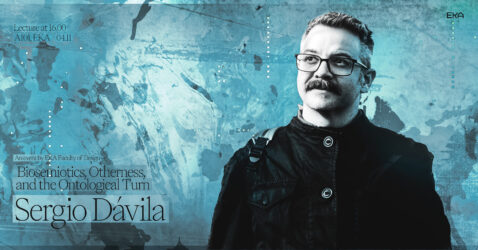
On November 4 at 16:00 in room A101, Sergio Dávila will give a public lecture titled “Biosemiotics, Otherness, and the Ontological Turn”. The lecture is part of the Faculty of Design’s public lecture series “Public Lectures in Design: Adjusting Perspectives,” curated by Stella Runnel and Taavi Hallimäe.
Humanity faces a profound ecological and civilizational crisis that is not only environmental but also symbolic and ontological. Modern urban development and governance, driven by extractivist logics and capital accumulation, have treated the living world as a backdrop for human progress, erasing reciprocity with other forms of life. This prevailing anthropocentric worldview, placing humans and the economy at the center, has led to climate breakdown, biodiversity loss, and social alienation. In contrast, an alternative ecocentric paradigm is germinating, one that seeks not dominance but coexistence.
Biophilic governance is proposed as a framework for this transformative shift. Biophilic denotes an orientation of deep interdependence and care among all life, while governance here refers not merely to institutions and laws but to the collective practices, rituals, and decisions that shape our relationships with the living world. Biophilic governance is, in essence, a politics of making-with Earth, a practice of coexistence that extends care, communication, and even representation beyond the human realm. It aligns with Donna Haraway’s notion of sympoiesis (“making-with”) and Escobar’s call for ontological design, both of which advocate redefining human–nature relations in terms of interdependence rather than domination. It resonates as well with Bayo Akómoláfé’s provocative call for an “ontological mutiny,” a rebellion at the level of being, through which humanity might unlearn its delusions of separateness and experiment with new forms of earthly belonging.
This talk will be a place for sharing ideas about the spirit of our era. A positive view as a stand of resistance against cynicism, ecological anxiety, and despair. Participants will review some cases of biophilic governance and then be guided to develop their own public policies, strategies, actions, and proposals for public space as radical collaboration with other earth-beings.
The public lectures are open to students, faculty, as well as anyone else interested in design!
Sergio Dávila is a PhD candidate in Urban Studies at the Universidad Autónoma Metropolitana in Mexico City and an exchange researcher at the Estonian Academy of Arts. His work explores how cities can become spaces of coexistence between humans and other species through biophilic design, participatory processes, and creative governance. As a researcher, teacher, and frequent conference speaker, Sergio bridges design, ecology, and politics to imagine more-than-human futures for our urban environments.
Open Lecture: Sergio Dávila “Biosemiotics, Otherness, and the Ontological Turn”
Tuesday 04 November, 2025
On November 4 at 16:00 in room A101, Sergio Dávila will give a public lecture titled “Biosemiotics, Otherness, and the Ontological Turn”. The lecture is part of the Faculty of Design’s public lecture series “Public Lectures in Design: Adjusting Perspectives,” curated by Stella Runnel and Taavi Hallimäe.
Humanity faces a profound ecological and civilizational crisis that is not only environmental but also symbolic and ontological. Modern urban development and governance, driven by extractivist logics and capital accumulation, have treated the living world as a backdrop for human progress, erasing reciprocity with other forms of life. This prevailing anthropocentric worldview, placing humans and the economy at the center, has led to climate breakdown, biodiversity loss, and social alienation. In contrast, an alternative ecocentric paradigm is germinating, one that seeks not dominance but coexistence.
Biophilic governance is proposed as a framework for this transformative shift. Biophilic denotes an orientation of deep interdependence and care among all life, while governance here refers not merely to institutions and laws but to the collective practices, rituals, and decisions that shape our relationships with the living world. Biophilic governance is, in essence, a politics of making-with Earth, a practice of coexistence that extends care, communication, and even representation beyond the human realm. It aligns with Donna Haraway’s notion of sympoiesis (“making-with”) and Escobar’s call for ontological design, both of which advocate redefining human–nature relations in terms of interdependence rather than domination. It resonates as well with Bayo Akómoláfé’s provocative call for an “ontological mutiny,” a rebellion at the level of being, through which humanity might unlearn its delusions of separateness and experiment with new forms of earthly belonging.
This talk will be a place for sharing ideas about the spirit of our era. A positive view as a stand of resistance against cynicism, ecological anxiety, and despair. Participants will review some cases of biophilic governance and then be guided to develop their own public policies, strategies, actions, and proposals for public space as radical collaboration with other earth-beings.
The public lectures are open to students, faculty, as well as anyone else interested in design!
Sergio Dávila is a PhD candidate in Urban Studies at the Universidad Autónoma Metropolitana in Mexico City and an exchange researcher at the Estonian Academy of Arts. His work explores how cities can become spaces of coexistence between humans and other species through biophilic design, participatory processes, and creative governance. As a researcher, teacher, and frequent conference speaker, Sergio bridges design, ecology, and politics to imagine more-than-human futures for our urban environments.
13.11.2025
KVI + ARH Open Lecture: Emma Cheatle “Lying in the Dark Room: Architectures of British Maternity “
New Date!
The 2025/2026 academic year open lecture series will be held in collaboration with the Institute of Art History and Visual Culture and the Faculty of Architecture. The theme of this academic year is “Architecture and the Ethics of Care” and the lectures will be curated by KVI Senior Researcher Dr. Ingrid Ruudi.
Architecture will be addressed from the perspective of the ethics of care: how does architecture take care of people’s physical, emotional and social needs, both today and in a historical perspective?
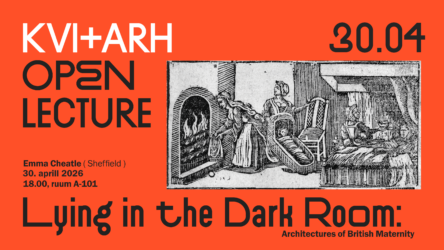
On April 3oth at 6 pm Dr Emma Cheatle will give a lecture “Lying in the Dark Room: Architectures of British Maternity”.
This research, and my book of the same name, studies the spatial, architectural experience of childbirth, through both a critical history of maternity (lying in) spaces and buildings and a creative exploration of those that we use today.
Where conventional architectural histories objectify buildings (in parallel with the objectification of the maternal body), the book presents a creative-critical autotheory of the architecture of lying-in. It uses feminist, subjective modes of thinking, which travel across disciplines, registers and arguments. The research assesses the transformation of maternity spaces—from the female bedchamber of the eighteenth-century marital home, to the lying-in hospitals of the eighteenth and nineteenth centuries purpose built by man-midwives, to the late-twentieth-century spaces of home and the modern hospital maternity wing—and the parallel shifts in maternal practices. The spaces are not treated as mute or neutral backdrops to maternal history, but as a series of vital, entangled atmospheres, materials, practices and objects that are produced by, and, in turn, produce particular social and political conditions, gendered structures and experiences.
Moving across spaces, systems, protagonists and their subjectivities, I show how historic hospital design and protocol altered ordinary birth at home and continues to shape maternal spatial experience today.
Dr Emma Cheatle is Senior Lecturer in Architecture at University of Sheffield. She trained as an architect in the UK and has a PhD in Architecture from the Bartlett, UCL which was awarded RIBA President’s Award for Outstanding PhD Thesis, 2014. Her research is interdisciplinary and examines the political, cultural and social implications of architecture, art and urban space, with a particular interest in addressing health, gender, race and disability inequalities. Her monograph Part-Architecture: The Maison de Verre, Duchamp, Domesticity and Desire in 1930s Paris (Routledge 2017) is a complex architectural humanities project, which engages critical and creative writing and drawing to analyse the building the Maison de Verre and the artwork “the Large Glass”, placing new primary and archival material in the context of social, sexual and medical histories of 1920s and 30s Paris. Her second book, Lying in the Dark Room: the Architectures of British Maternity (Routledge 2024), examines how the spatial histories of lying-in and maternal practices continue to shape the maternal body today. Emma is the UK Editor for the Bloomsbury Global Encyclopaedia of Women in Architecture 1960–2015 (Bloomsbury 2025), and part of several feminist projects including the Feminist Art and Architecture Collaborative (FAAC). Her collaboration with Hélène Frichot, University of Melbourne, led to a major edited collection of articles on the feminist theorist Jennifer Bloomer, for the Journal of Architecture (2024).
The lectures are intended for all disciplines, not only for students and professionals in the field of architecture.
All lectures are held on Thursdays at 6 pm in the EKA main auditorium. All lectures are in English and free of charge.
The lecture series is supported by the Cultural Endowment of Estonia.
Previous open architecture lectures can be viewed at www.avatudloengud.ee
KVI + ARH Open Lecture: Emma Cheatle “Lying in the Dark Room: Architectures of British Maternity “
Thursday 13 November, 2025
New Date!
The 2025/2026 academic year open lecture series will be held in collaboration with the Institute of Art History and Visual Culture and the Faculty of Architecture. The theme of this academic year is “Architecture and the Ethics of Care” and the lectures will be curated by KVI Senior Researcher Dr. Ingrid Ruudi.
Architecture will be addressed from the perspective of the ethics of care: how does architecture take care of people’s physical, emotional and social needs, both today and in a historical perspective?
On April 3oth at 6 pm Dr Emma Cheatle will give a lecture “Lying in the Dark Room: Architectures of British Maternity”.
This research, and my book of the same name, studies the spatial, architectural experience of childbirth, through both a critical history of maternity (lying in) spaces and buildings and a creative exploration of those that we use today.
Where conventional architectural histories objectify buildings (in parallel with the objectification of the maternal body), the book presents a creative-critical autotheory of the architecture of lying-in. It uses feminist, subjective modes of thinking, which travel across disciplines, registers and arguments. The research assesses the transformation of maternity spaces—from the female bedchamber of the eighteenth-century marital home, to the lying-in hospitals of the eighteenth and nineteenth centuries purpose built by man-midwives, to the late-twentieth-century spaces of home and the modern hospital maternity wing—and the parallel shifts in maternal practices. The spaces are not treated as mute or neutral backdrops to maternal history, but as a series of vital, entangled atmospheres, materials, practices and objects that are produced by, and, in turn, produce particular social and political conditions, gendered structures and experiences.
Moving across spaces, systems, protagonists and their subjectivities, I show how historic hospital design and protocol altered ordinary birth at home and continues to shape maternal spatial experience today.
Dr Emma Cheatle is Senior Lecturer in Architecture at University of Sheffield. She trained as an architect in the UK and has a PhD in Architecture from the Bartlett, UCL which was awarded RIBA President’s Award for Outstanding PhD Thesis, 2014. Her research is interdisciplinary and examines the political, cultural and social implications of architecture, art and urban space, with a particular interest in addressing health, gender, race and disability inequalities. Her monograph Part-Architecture: The Maison de Verre, Duchamp, Domesticity and Desire in 1930s Paris (Routledge 2017) is a complex architectural humanities project, which engages critical and creative writing and drawing to analyse the building the Maison de Verre and the artwork “the Large Glass”, placing new primary and archival material in the context of social, sexual and medical histories of 1920s and 30s Paris. Her second book, Lying in the Dark Room: the Architectures of British Maternity (Routledge 2024), examines how the spatial histories of lying-in and maternal practices continue to shape the maternal body today. Emma is the UK Editor for the Bloomsbury Global Encyclopaedia of Women in Architecture 1960–2015 (Bloomsbury 2025), and part of several feminist projects including the Feminist Art and Architecture Collaborative (FAAC). Her collaboration with Hélène Frichot, University of Melbourne, led to a major edited collection of articles on the feminist theorist Jennifer Bloomer, for the Journal of Architecture (2024).
The lectures are intended for all disciplines, not only for students and professionals in the field of architecture.
All lectures are held on Thursdays at 6 pm in the EKA main auditorium. All lectures are in English and free of charge.
The lecture series is supported by the Cultural Endowment of Estonia.
Previous open architecture lectures can be viewed at www.avatudloengud.ee