
Open Lectures
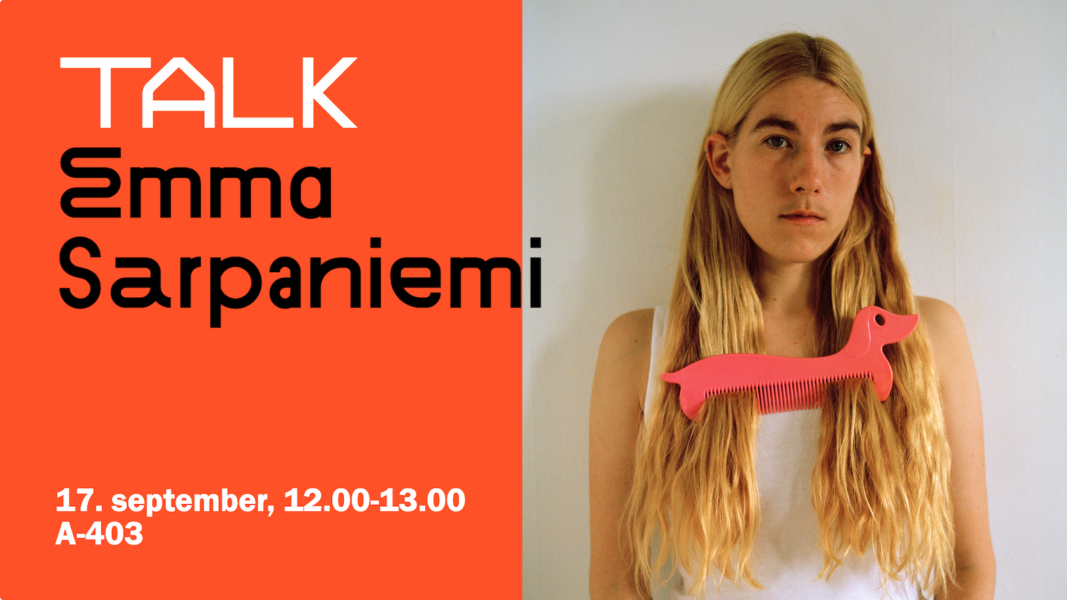
17.09.2026 Talk: Emma Sarpaniemi Thursday 17 September, 2026 Photography
Koht: A-403
Aeg: N 17.9. kell 12:00-13:00
Emma Sarpaniemi is a visual artist based between Helsinki and Reykjavík. Sarpaniemi received a BA in photography from the Royal Academy of Art, The Hague (KABK) in 2019. In her practice, Sarpaniemi explores womanhood and definitions of femininity through performative self-portraits. For her, self-portraiture is a playground, a realm for exploring representation and resisting conventions of the gaze. The portrayed characters offer the possibility to continuously reconstruct oneself. The shutter release cable, often clearly visible in her photographs, serves as a symbol of the subject being in control of their own image. The characters she creates are fictional, but they are not alter egos. For her it’s inevitable that she regoznised herself in the images, where identity, reality and imagination intertwine.
For Sarpaniemi, photography is a medium of joy and playfulness, empowering to dream of new possibilities of femininity, gender roles and the gaze. Collaboration and collectivity also hold important roles in her work. Traces of friends’ presence appear in individual portraits through elements such as a painted house, wooden frames, or a friend focusing behind the camera. Her works have been extensively exhibited in galleries, museums, and festivals throughout Europe and are included in notable public art collections as well as numerous private collections.
Emma Sarpaniemi will participate in the Foto Tallinn art fair on September 18-20, where she will be represented by the Helsinki Contemporary Gallery.
07.09.2026 Talk: “Designing with Loneliness” Monday 07 September, 2026 Faculty of Design
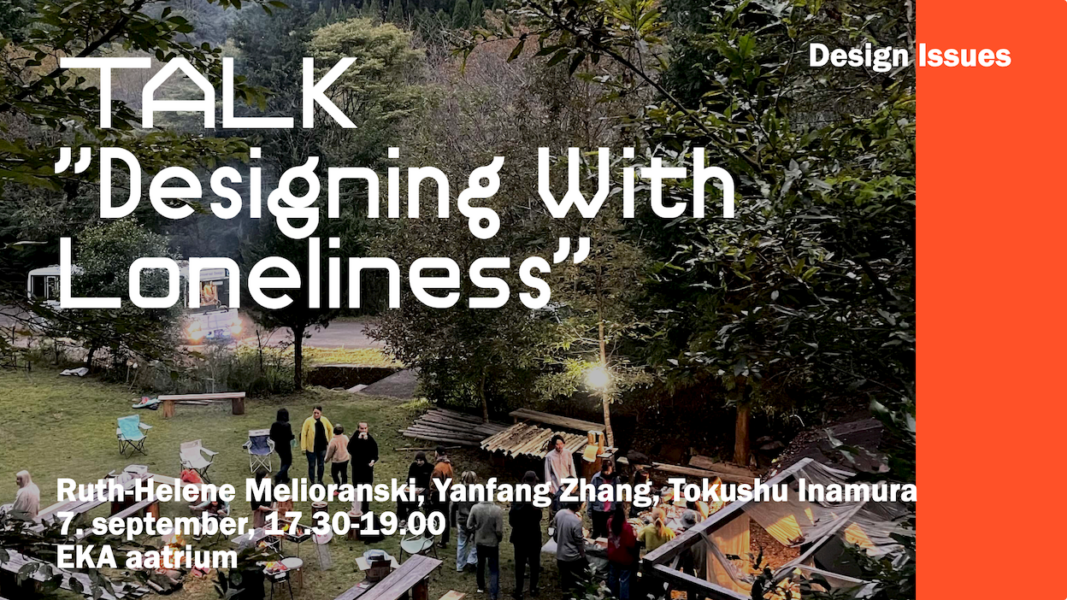
On September 7, from 5:30 PM to 7:00 PM, a discussion group “Designing with Loneliness” will take place in the stairwell of the EKA atrium, where Ruth-Helene Melioranski, a researcher at the EKA Faculty of Design, will talk with Yanfang Zhang and Tokushu Inamura, lecturers at Kyushu University.
How do different cultural understandings of loneliness shape design?
How do globalization and social changes affect our understanding of loneliness?
What relationships, trust, and forms of knowledge are needed when design enters such a personal realm?
The discussion group will introduce the Faculty of Design’s autumn lecture series “Design Issues”, the subtheme of which in 2026 is “Design and Futures”.
18.09.2026 KVI open lecture: Anne-Solène Rolland “Provenance Research and Heritage Repatriations in France: Case Studies in Museums and Research Institutions” Friday 18 September, 2026 Institute of Art History and Visual Culture
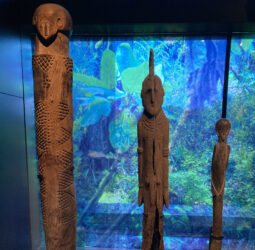
Anne-Solène Rolland is General Director of the Institut national d’histoire de l’art in Paris (French national institute for art history). She previously served as Head of Museum Department at the French Ministry for Culture, and as Scientific Director at the Musée du quai Branly-Jacques Chirac. In both positions she dealed with restitutions and provenance research of museum artefacts. Based on these experiences, and on research currently lead at INHA, she will give a insight on how French institutions and professionals have addressed these issues.
21.06.2026 OPEN CALL: Under the Oak / (Re)building a Garden Sunday 21 June, 2026 T4EU
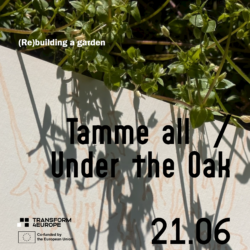
EKA students, staff, alumni and friends; join us for (re)building EKA aed behind K10 building under the oak tree. We will work to initiate the beginnings of a new garden site, this one-day event (with some additional preparation days if you feel like it!) will be a starting point, somewhere to lay down our roots, take up space within the institution’s expanding campus, and dream of ways the garden can unfold and grow.
Throughout the day we’ll spend time building a garden; practically, poetically and politically..
Breakfast and lunch will be provided. Materials and plants will also be provided, but if there is anything specific that you want to plant we welcome you to bring seeds/plants.
You are welcome to join whether you would like to be involved in the garden’s future, have been involved in its past, or if you just want to spend a mid-summers Sunday under the oak tree; the garden will be passed between hands year after year.
All welcome, no experience necessary.
Please sign up for the garden day here: https://tally.so/r/PdrNYP
Day content:
- 10-10.30: Arriving, simple breakfast and introductions
- 10.30-11.45: reading together (excerpts of texts that cover various garden-foundations: compost, seeds, the commons, poetics/politics of community gardens)
- 11.45-13.00: filling raised beds with compost, mulch
- 13:00-14.00: lunch
- 14:00-14:45: A notion to the future gardeners (yourselves or others) – manifesto, a list, a promise, an intention, a hope,
- 14:45-15.15: planting plants/seeds
- 15:15-16:15: A holding space (rug decoration, from the previous activity)
- 16:15-1700: final reflections, tidying up, ending.
One-day workshop is led by Jake Shepherd and Yvette Bathgate and funded by Transform4Europe.


04.06.2026 Artist Talk: Mikala Dwyer Thursday 04 June, 2026 Faculty of Fine Arts
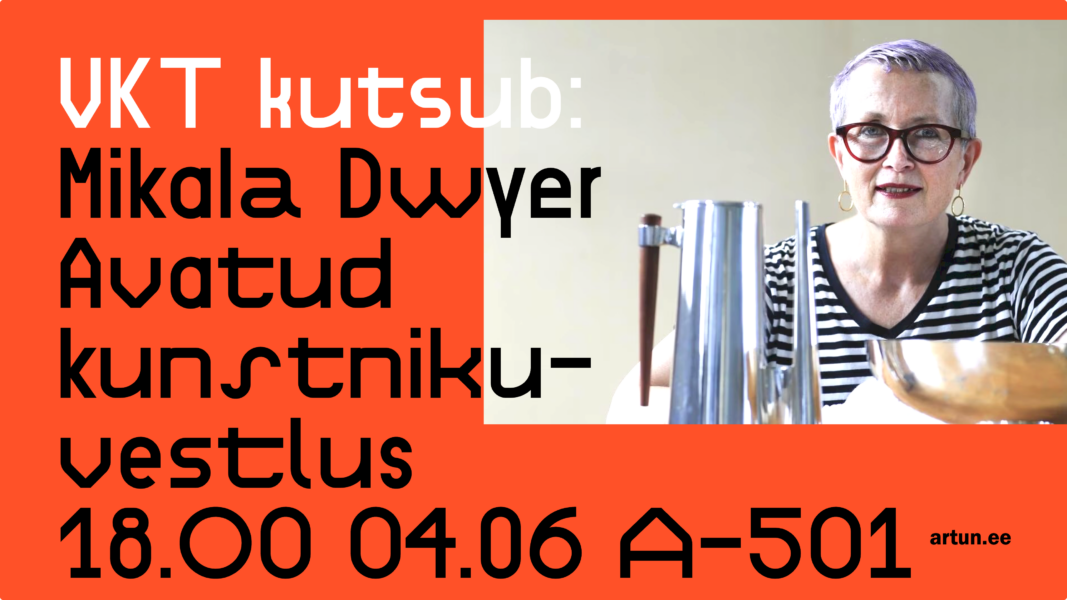
Faculty of Fine Arts invites: Public artist talk by acknowledged Australian contemporary artist Mikala Dwyer at 18.00 on June 4th in EKA, A-501
In works that explore how we relate to the object-world, Mikala Dwyer has pushed the limits of sculpture, painting and performance, establishing herself as one of Australia’s most important contemporary artists. She has been honoured with solo survey exhibitions at Sydney’s two major art museums, the Art Gallery of New South Wales and the Museum of Contemporary Art, as well as at the Museum of New Zealand Te Papa Tongarewa, the Australian Centre for Contemporary Art, Melbourne, and the Institute of Modern Art in Brisbane.
Her many exhibitions internationally include The Recent, Talbot Rice gallery, Edinburgh, Ichiahara Art + Mix Triennale, Japan, Blessed Be, MOCA Tucson, USA (2018); The End of the 20th Century, The Best is Yet to Come—A Dialogue with the Marx Collection, Hamburger Bahnhof, Berlin (2013); Face Up: Contemporary Art from Australia at Hamburger Bahnhof, Berlin (2003); Verso Süd at Palazzo Doria Pamphilj, Rome, curated by Franz West (2000); and shows at The Graz Museum, Austria; Zachęta National Gallery of Art, Warsaw; and Chapter Arts Centre, Cardiff, UK. Her work has been selected for the Lyon Biennale (2026) Istanbul Biennale (1995), the Biennale of Sydney (2010 and 2014) and the Adelaide Biennial of Contemporary Australian Art (2010 and 2020)
Mikala Dwyer’s compounds invite open-ended interaction and take the viewer across boundaries of time, space and geography. While playful and exuberant on the surface, they almost always impel us to imagine something darker beneath—or above. Ordinary and familiar materials draw us in, transformed so as to bring attention to the unseen or occult or what society banishes from view. Emerging from a deep and disobedient engagement with modernist form and space, Dwyer’s works have an eye on the future and relationship at their heart—they have been described as ‘profoundly sociable’.
Dwyer’s work is always responsive to site and context, and her successful public art commissions include Monuments for Fishes, Barangaroo, Sydney 2026; Sydney Metro, 2024; Apparition, University square, Melbourne, 2020; In the Smoke of Ghosts, MUMA 2020; Egg Swing, 2012, Royal Women’s Hospital, Paddington, Sydney; Windwatcher, 2011, Central Park, Chippendale, Sydney; A Lamp for Mary, 2010, Mary Place, Surry Hills, Sydney; Swamp Sculpture, 2006, Omi Sculpture Park, New York, NY; and IOU, 2005, Docklands, Melbourne.
https://www.mikaladwyer.com/
02.06.2026 EKA in cooperation with Tallinn Business Incubator presents: Charles Johnson – From Design Leadership to Scalable Innovation Tuesday 02 June, 2026 Faculty of Design
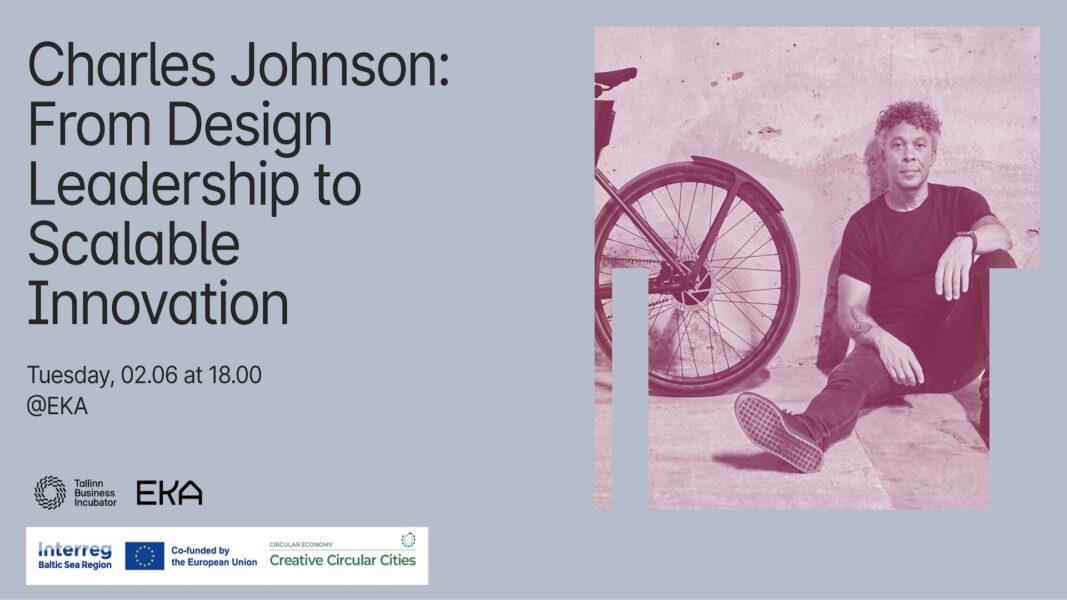
Lecture will be held on 2nd of june at Estonian Academy of Arts (room A101)
SYNOPSIS
The open lecture will explore the intersection of high-level design leadership and the practical mechanics of scaling impactful ideas. Drawing from the experience of a global design leader and former Global Director of Innovation at Puma Headquarters, the lecture will present case studies that reveal how innovation is navigated within complex creative and commercial environments.
At the core of the lecture is the question of what it truly means to be a “good” designer today. Referencing David Epstein’s concept of Range, the discussion will examine why breadth of experience, interdisciplinary curiosity, and analogical thinking often outperform narrow specialization when addressing contemporary challenges.
Moving beyond individual creative practice, the lecture will also introduce frameworks for scaling ideas through innovation stress-testing — a process designed to distinguish short-lived trends from commercially and culturally sustainable concepts. This approach is grounded in meaningful definition and purpose-driven thinking, inspired by Simon Sinek’s principle of Start with Why.
The lecture concludes by addressing the human side of innovation: the communication skills, persuasion strategies, and stakeholder management required to guide ambitious ideas through the inevitable friction of growth and implementation.
Key themes include:
– Global design and innovation case studies from Puma and beyond
– The value of interdisciplinary thinking and creative range
– Purpose-driven innovation and idea stress-testing
– Communication, persuasion, and stakeholder alignment in scaling innovation
Charles Johnson
Assistant Teaching Professor, Carnegie Mellon University Entertainment Technology Center
Principal, Driven By Charles LLC
For four decades, Charles has shaped the product visions and strategies of world-leading brands including Adidas and Puma. Originally trained as an Industrial Designer, his career evolved from specialized footwear design to executive-level leadership across sports, fashion, and connected products.
Today, Charles bridges the gap between high-level consulting and academia. As Assistant Professor of Leadership and Innovation at the Carnegie Mellon University Entertainment Technology Center, he teaches students how to scale innovations from inception to mass market while navigating the complex “adverse interests” of organizational functions and stakeholders. As a consulting practice Driven By Charles he helps startups ground their vision in product and brand strategy. Charles is driven by a humanistic approach to design, specializing in experiences that bridge the digital and physical worlds and that promote health and world balance.
12.05.2026 Open Lecture by Pankaj Tiwari: “I Will Not Wait for the Institution to Change; I Will Build a New One” Tuesday 12 May, 2026
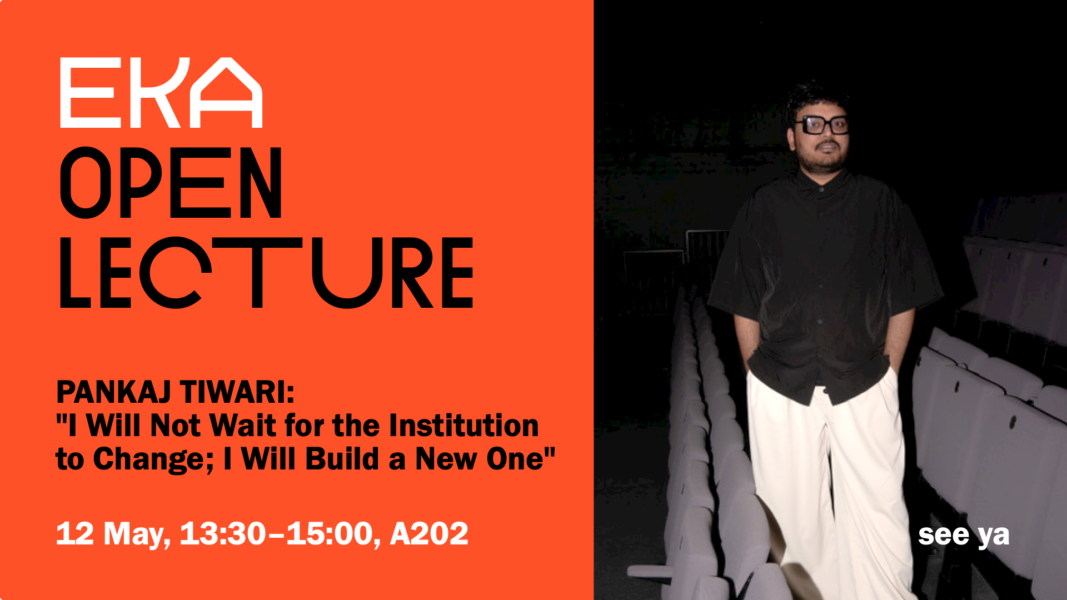
Date: Tuesday, 12 May 2026, 13:30–15:00
Venue: Estonian Academy of Arts, Room A202
Admission: free and open to the public
The MAKK&MACA programme (Master of Contemporary Arts) at the Estonian Academy of Arts invites students, artists, educators, and the wider public to an open lecture by contemporary artist, performance maker, and curator Pankaj Tiwari on Tuesday, 12 May 2026.
In the lecture, Tiwari will introduce TENT: A School of Performative Practices — not as a proposal, but as an intervention. TENT is a nomadic, collective, and deliberately unfinished institution that refuses permanence, refuses neutrality, and refuses to wait for permission. Emerging from lived experience and structural exclusion, TENT is built from the ground up: without fixed walls, without inherited authority, and without the illusion that change can happen from within the same frameworks that produced the problem.
“Contemporary art institutions speak the language of inclusion, while their structures remain largely unchanged,” says Tiwari. “This is not a conversation about reform. It is an attempt at construction.”
The lecture moves between dream and reality, critique and action, asking a simple but urgent question: if institutions cannot change, what does it take to build new ones — and who gets to build them?
TENT operates as a temporary, mobile space of mutual learning and collective imagination. It uses interactive formats such as talks, residencies, dinners, and temporal togetherness at host institutions for specific durations to engage with their politics and practice. It is a space for imagining, thinking, listening, and responding to social injustices.
TENT at Kumu Art Museum and Rehearsals for Solidarity
In May 2026, to mark Kumu Art Museum’s 20th anniversary, TENT is erected in the museum’s inner courtyard. Around it, a twelve-day programme titled Rehearsals for Solidarity runs from 9–20 May 2026. The programme responds to a growing need to find common ground at a time when wars and geopolitical and ecological crises are deepening. The challenges affecting our shared lives have grown so large that they demand collaboration — yet we face an increasingly polarised society that undermines our very capacity to cooperate. Rehearsals for Solidarity tackles exactly this: practising the skill of finding common ground in an era when doing so feels ever more difficult. The programme encompasses performances, workshops, reading circles, lectures, communal meals, and more.
Rehearsals for Solidarity is organised collaboratively by Pankaj Tiwari, Kumu Art Museum, Kumu Youth Club, Lasnaidee, and students of the Estonian Academy of Arts’ MA Contemporary Art programme, and is curated by Frederik Klanberg. The initiative is supported by the City of Tallinn.
TENTative Practices — A Satellite Programme by EKA Students
As part of Rehearsals for Solidarity, students of the Estonian Academy of Arts have devised their own satellite programme, TENTative Practices, which unfolds across several days within and around the tent.
On Monday, 11 May, TENTative Practices opens with a communal pillow-making workshop. Instructions, materials, and tools are provided on site; the finished pillows will furnish a cosy reading nook inside the tent, complete with a small library that remains open for the duration of the programme — a space for quiet encounters and playful exploration. That afternoon, artist Ming Zhu presents the performance OOOcarina, an invitation to slow down, attune to one’s breathing, body, and the ground beneath, and to enter a shared space of resonance.
On Wednesday, 13 May, the programme turns to mending and washing — an activation of the tent’s surroundings and the museum’s “backyard” through communal care. The result is a temporary clothesline exhibition to which visitors are invited to contribute their own everyday garments, becoming co-authors of an evolving collective composition. The evening closes with an adapted game of football on the hill beside the museum courtyard — a team-building exercise with the shared goal of getting the ball uphill.
On Monday, 18 May, a new week brings a new format: TENT Radio, featuring interviews, experimental sound works, radio theatre, essays, and more. Local and international artists discuss the relationship between artist and institution live on air. TENT Radio can be listened to at https://oh.eka-gd-ma.ee/.
On Tuesday, 19 May, the programme gathers the texts, drawings, and photographs produced over the preceding days into a collectively made zine — a document of all that has been shared during Rehearsals for Solidarity. The day continues with communal cooking: each participant chops one onion, one carrot, and one clove of garlic, and everything goes into the pot. Many small contributions make one shared meal, enjoyed together.
The full programme is available at https://kumu.ekm.ee/en/syndmus/pankaj-tiwari-tent-school-rehearsals-for-solidarity/.
About Pankaj Tiwari
Pankaj Tiwari is a contemporary artist, performance maker, writer, and curator from Balrampur, India. Currently based in Amsterdam, he holds a Master’s degree in Theatre & Curation from DAS Theatre Amsterdam. Since 2026, he has been working as a trajectory artist with the international arts centre CAMPO in Ghent.
His works bring Eastern perspectives into Western discourse on socio-political issues. Tiwari is the winner of the 3Package Deal Award (2021–2022) from Amsterdam Funds for the Arts and served as a curator for Gessnerallee Zurich from 2020 to 2024. He is currently the artistic director of Stichting Studio Current in Amsterdam.
Tiwari’s work has been invited and supported by numerous international festivals and production houses, including Thalia Theatre Hamburg, Romaeuropa Rome, Steirischer Herbst Graz, MC93 Bobigny, Theater Rotterdam, Frascati Theatre Amsterdam, Kaaitheater Brussels, DE SINGEL Antwerp, Grand Theatre Groningen, SpielArt Munich, Holland Festival Amsterdam, Zürcher Theaterspektakel Zurich, University of Minnesota Minneapolis, Radialsystem Berlin, Santarcangelo Festival Italy, and performingborderslive UK, among others.
14.05.2026 KVI+ARH open lecture: Landscapes of care with wildflowers: Women, plants and domesticity in (post)socialist Romania Thursday 14 May, 2026 Faculty of Architecture
The 2025/2026 academic year open lecture series will be held in collaboration with the Institute of Art History and Visual Culture and the Faculty of Architecture. The theme of this academic year is “Architecture and the Ethics of Care” and the lectures will be curated by KVI Senior Researcher Dr. Ingrid Ruudi.
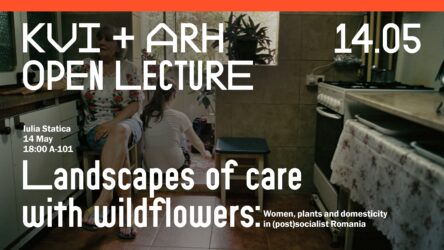
On May 1that 6 pm Iulia Statica will give a lecture “Landscapes of care with wildflowers: Women, plants and domesticity in (post)socialist Romania”.
This research project examines the ways in which women’s domestic and ecological labour under state socialism reshaped urban landscapes in Romania, revealing care as an environmental and gendered spatial practice. It focuses on two semi-domestic spaces of housing blocks—balconies and urban courtyards—tracing how generational knowledge of plants and flowers enabled women to reimagine these spaces in ways that contradicted state planning and pronatalist regulation. Drawing on archival and ethnographic research, the talk explores the ways in which “care” was redefined within this repressive context, mediated in women’s everyday practices linking natality to landscape-making through the intimacies of what we might term “clandestine care”. The project experiments with multiple media, including installation, video and photography, to document and explore the multiple layers of these gendered networks of care.
Iulia Statica is Senior Lecturer at the School of Architecture and Landscape at the University of Sheffield, UK and the 2025/26 Mellon Fellow in Democracy and Landscape at Harvard University’s Dumbarton Oaks Institute in Washington DC. She previously held postdoctoral positions at The Bartlett School of Architecture, UCL, and Cornell University. Her research focuses on the legacies of socialist-built environments in Eastern Europe, particularly mass housing, and the gendered experiences of these spaces. Statica uses documentary film in her research; her film My Socialist Home premiered in her exhibition Archiving the Home in London in 2021. She is the author of Urban Phantasmagorias: Domesticity, Production, and the Politics of Modernity in Communist Bucharest.
The 2025/2026 academic year open lecture series is organised in collaboration between the Institute of Art History and Visual Culture and the Faculty of Architecture, and is connected to the research project Built environments of care from the late Socialist to post-Socialist Estonia (PSG 2025–2029).
The lecture series is supported by:

Previous open architecture lectures can be viewed at www.avatudloengud.ee
14.05.2026 Conference “Metamorphosis as a Creator of the Future” Thursday 14 May, 2026 Faculty of Fine Arts
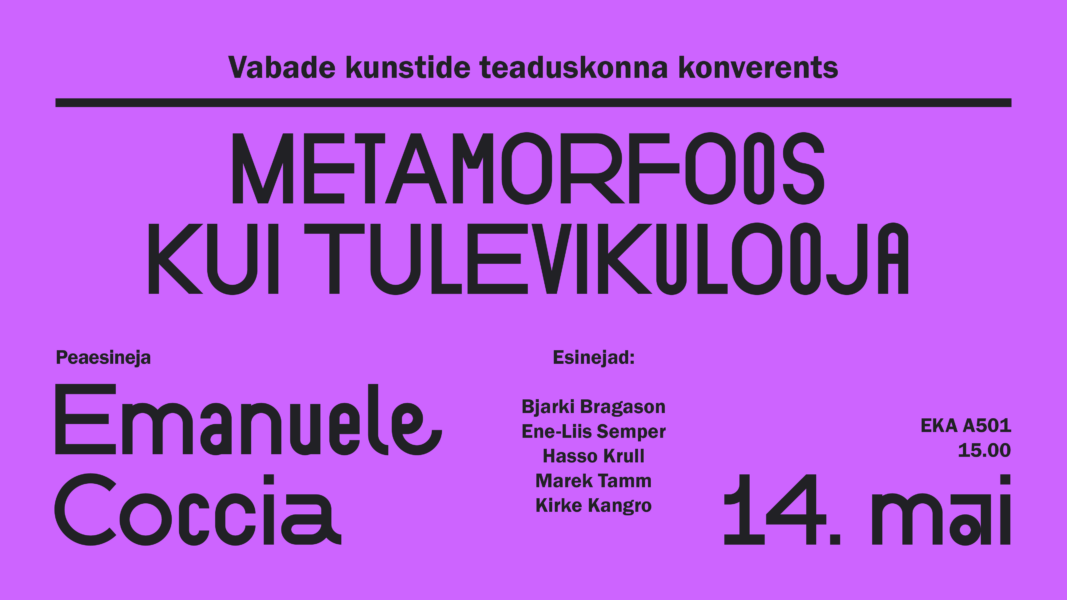
On May 14, 2026, the Estonian Academy of Arts will host an open conference titled “Metamorphosis as a Creator of the Future” in room A501, featuring internationally acknowledged Italian philosopher Emanuele Coccia as the keynote speaker.
The conference will be held in English.
The conference will focus on the philosophy of Emanuele Coccia, with metamorphosis as the key term. Life is an incessant series of metamorphoses that happen everywhere, and the first natural technology is the cocoon, where preparation for transformation takes place. The keynote speaker at the conference will be Emanuele Coccia. The floor will also be given to artists and thinkers who, through their work, have explored change and its impact on the world around us.
Programme:
15.00 Opening words and introduction
I session: Contemporary Art and Language as a Form of Transformations
Bjarki Bragason (artist, educator, Iceland University of the Arts):
The Garden That Was: Memory, Ecology and Transformation
Ene-Liis Semper (artist, stage director, educator, Estonian Academy of Arts)
Large-Scale Performances as the Agents of Change in Society
Hasso Krull (poet, essayist, philosopher, Tallinn University)
A Metamorphic Event: Hommages à Artur Alliksaar and Emanuele Coccia
16.00 Coffee break
16.15 II session: Philosophy of Metamorphosis
Marek Tamm (cultural historian, theorist, Tallinn University)
Philosophy as Metamorphosis: Emanuele Coccia
Emanuele Coccia (philosopher, Italy/France, EHESS)
Metamorphosis as the Creator of Future
17.30 -18.30 final panel: Metamorphosis as the Creator of Future
Coccia, Bragason, Semper, Krull, Tamm – moderated by Kirke Kangro
Emanuele Coccia is Associate Professor at the École des Hautes Études en Sciences Sociales (EHESS) in Paris. He has been a visiting professor and researcher at numerous international institutions, including universities in Tokyo, Buenos Aires, Düsseldorf, Columbia University, Harvard, Penn University and New York University. His work bridges philosophy, ecology, contemporary art, architecture, and visual theory, proposing a renewed understanding of life, form, and habitation on a planetary scale.
He is the author of several books translated into many languages, including The Life of Plants (Polity, 2018; Gallimard, 2016), Metamorphoses (Polity, 2021; Rivages, 2020), and Philosophy of the Home (Penguin, 2024; Rivages, 2024) and A Treatise on Modern Love (Flammarion and Einaudi 2026) . Together with photographer Viviane Sassen, he published Modern Alchemy (JBE Books, 2022), a book on photographic theory and image-thinking; with Paolo Roversi, Lettres sur la lumière (Gallimard, 2024), a philosophical epistolary on light as a principle of visibility and creation; and with Alessandro Michele, creative director of Valentino, The Life of Forms. Philosophy of Re-enchantment (HarperCollins, 2024). His forthcoming book, New Natures. Planetary Museums (Park Books, 2026), co-authored with author and curator Béatrice Grenier and architect Jeanne Gang, examines the emergence of planetary museums as living ecologies at the intersection of nature, architecture, and culture.
In 2019 and 2021, he contributed to Nous les Arbres, presented at the Fondation Cartier pour l’art contemporain in Paris and the Power Station of Art in Shanghai, where he is also a member of the Academic Committee. Together with Olivier Saillard, he curated The Many Lives of a Garment (ITS Arcademy, Trieste 2024) and Borderless (ITS Arcademy, Trieste, 2025), two exhibitions reflecting on the philosophical and social metamorphoses of fashion.
With Yuko Hasegawa, he co-curated Dancing with All at the 21st Century Museum of Contemporary Art in Kanazawa, centered on ecology, coexistence, and the poetics of movement. He is a member of the Scientific Committee of the Power Station of Art of Shanghai. In 2024, Coccia was awarded the Mondriaan Prize for his theoretical and curatorial work bridging philosophy, art, and architecture.
Bjarki Bragason (b. 1983) studied at the Iceland University of the Arts, Universität der Künste Berlin and CalArts in Los Angeles. He is Associate Professor and Dean of the Fine Art Department at the Iceland University of the Arts and has taught at institutions internationally since 2014. His work has been represented in numerous solo- and group exhibitions internationally, and is in the collection of museums and private collections.
Hasso Krull (b. 1964) is an Estonian poet, translator and philosopher who has published nineteen books of poetry and eleven collections of essays that include literary criticism as well as writings concerning art, cinema and society. During 1990–2017 he was teaching cultural theory at the Estonian Institute of Humanities (special courses on continental philosophy, psychoanalysis, creation myths and oral tradition). From 2019 he has been teaching creative writing in the Estonian Academy of Arts. His latest books are The Eternal Recurrence (2025) and Twilight Remembrance (2025). He currently works as a researcher at Tallinn University.
Ene-Liis Semper (b. 1969) is an Estonian video, performance, and theatre director, and professor in the Department of Scenography at the Estonian Academy of Arts. In 2004, she co-founded Teater NO99 with Tiit Ojasoo, where she worked as artistic director and stage director until the theatre closed in 2018. Semper has created numerous set and costume designs for both drama and opera productions, and is known for her visually powerful and grandiose style. Her solo exhibitions have been held at prestigious museums, including the Kumu Art Museum (2011) and the Estonian Museum of Contemporary Art (EKKM) (2024). Her most recent major production projects include the concert-performance “Where Are You?” (2026), “The Master and Margarita” (2024, Riga Dailes Theater), “Macbeth” (2023, Estonian Drama Theatre/ERSO/Estonian Concert), “Now We Can Talk About It” (2023, Theater Expedition), and many more.
Marek Tamm is professor of cultural history in Tallinn University and head of the Institute of History, Archaeology and Art History. His primary research fields are cultural history of medieval Europe, theory and methodology of history, and cultural memory studies. He has recently published Breakthroughs in Cultural Psychology (ed. with Jaan Valsiner; Tallinn University Press, 2024), The Fabric of Historical Time (co-authored with Zoltán Boldizsár Simon; Cambridge University Press, 2023), and The Companion to Juri Lotman: A Semiotic Theory of Culture (ed. with Peeter Torop; Bloomsbury, 2022).
Event on Facebook
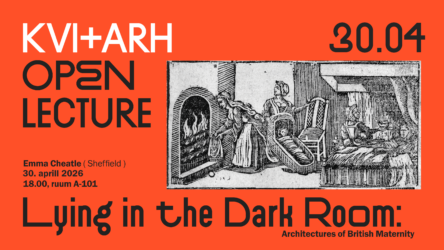
30.04.2026 KVI + ARH Open Lecture: Emma Cheatle “Lying in the Dark Room: Architectures of British Maternity “ Thursday 30 April, 2026 Architecture and Urban Design
New Date!
The 2025/2026 academic year open lecture series will be held in collaboration with the Institute of Art History and Visual Culture and the Faculty of Architecture. The theme of this academic year is “Architecture and the Ethics of Care” and the lectures will be curated by KVI Senior Researcher Dr. Ingrid Ruudi.
Architecture will be addressed from the perspective of the ethics of care: how does architecture take care of people’s physical, emotional and social needs, both today and in a historical perspective?
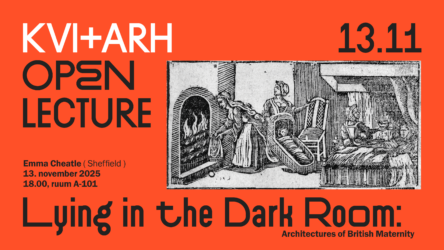
On April 3oth at 6 pm Dr Emma Cheatle will give a lecture “Lying in the Dark Room: Architectures of British Maternity”.
This research, and my book of the same name, studies the spatial, architectural experience of childbirth, through both a critical history of maternity (lying in) spaces and buildings and a creative exploration of those that we use today.
Where conventional architectural histories objectify buildings (in parallel with the objectification of the maternal body), the book presents a creative-critical autotheory of the architecture of lying-in. It uses feminist, subjective modes of thinking, which travel across disciplines, registers and arguments. The research assesses the transformation of maternity spaces—from the female bedchamber of the eighteenth-century marital home, to the lying-in hospitals of the eighteenth and nineteenth centuries purpose built by man-midwives, to the late-twentieth-century spaces of home and the modern hospital maternity wing—and the parallel shifts in maternal practices. The spaces are not treated as mute or neutral backdrops to maternal history, but as a series of vital, entangled atmospheres, materials, practices and objects that are produced by, and, in turn, produce particular social and political conditions, gendered structures and experiences.
Moving across spaces, systems, protagonists and their subjectivities, I show how historic hospital design and protocol altered ordinary birth at home and continues to shape maternal spatial experience today.
Dr Emma Cheatle is Senior Lecturer in Architecture at University of Sheffield. She trained as an architect in the UK and has a PhD in Architecture from the Bartlett, UCL which was awarded RIBA President’s Award for Outstanding PhD Thesis, 2014. Her research is interdisciplinary and examines the political, cultural and social implications of architecture, art and urban space, with a particular interest in addressing health, gender, race and disability inequalities. Her monograph Part-Architecture: The Maison de Verre, Duchamp, Domesticity and Desire in 1930s Paris (Routledge 2017) is a complex architectural humanities project, which engages critical and creative writing and drawing to analyse the building the Maison de Verre and the artwork “the Large Glass”, placing new primary and archival material in the context of social, sexual and medical histories of 1920s and 30s Paris. Her second book, Lying in the Dark Room: the Architectures of British Maternity (Routledge 2024), examines how the spatial histories of lying-in and maternal practices continue to shape the maternal body today. Emma is the UK Editor for the Bloomsbury Global Encyclopaedia of Women in Architecture 1960–2015 (Bloomsbury 2025), and part of several feminist projects including the Feminist Art and Architecture Collaborative (FAAC). Her collaboration with Hélène Frichot, University of Melbourne, led to a major edited collection of articles on the feminist theorist Jennifer Bloomer, for the Journal of Architecture (2024).
The lectures are intended for all disciplines, not only for students and professionals in the field of architecture.
All lectures are held on Thursdays at 6 pm in the EKA main auditorium. All lectures are in English and free of charge.
The 2025/2026 academic year open lecture series is organised in collaboration between the Institute of Art History and Visual Culture and the Faculty of Architecture, and is connected to the research project Built environments of care from the late Socialist to post-Socialist Estonia (PSG 2025–2029).
The lecture series is supported by the Cultural Endowment of Estonia.
Previous open architecture lectures can be viewed at www.avatudloengud.ee