
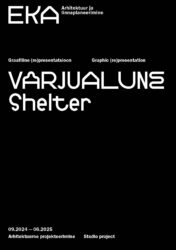
Find the booklet HERE
The goal of the first-year fall semester assignments is to introduce the prerequisites, causes, and possibilities of architecture. While solving the assignments, students are expected to explore and conceptualize the relationship between humans and their surrounding environment. The semester is divided into four parts.
In analog graphics, each student selects a small building and describes it using a chosen adjective, which is carried forward in various ways through all the assignments. Throughout the course, students must graphically depict the building’s most characteristic drawings, such as the plan, section, and elevation, based on which they create a mutation of the initial drawings based on the adjective.
In the following five-day VR studio, students will create a three-dimensional environment based on their chosen adjective, using a VR headset and other 3D modeling tools.
The main focus of the fall semester is architectural design, where students create a shelter based on their self-image. Since 2021, the shelters have been designed for Tartu.
For the first time, students had the opportunity to engage in material reuse and circular economy in-depth. The assignment was to design and construct a shelter using partially or entirely recycled materials and industrial leftovers.
The first year culminates in a summer construction practice, where students will build one of the designed shelters. Collective construction work helps students understand the complex relationship between architecture and real construction while also creating a strong course spirit.
Thus the shelter of 2025: ÕRRED was born.
“The purpose of the shelter Õrred is to offer city dwellers a break from their daily worries. The shape of the shelter is inspired by Estonian farm architecture. The idea of the form is to depict a wooden house that has been taken over and broken in half by nature. The shelter, located in tall grass, aims to convey the image of the ruins of a wooden house floating in the middle of nature. The growing greenery supports the peaceful and slightly wild mood of the artificial ruins, as if it had been there for a long time.”
Supervisors: Paco Ulman, Madli Kaljuste, Elina Liiva, Helena Männa, Margus Tammik
Compilers: Liisa Marii Mathisen, Astrid Lepist.
Estonian Academy of Arts Department of Architecture and Urban Design, 2026.
Supported by The Cultural Endowment of Estonia.
ISBN 978-9916-740-63-7 (print)
ISBN 978-9916-740-64-4 (pdf)
ISSN 2461-2359