
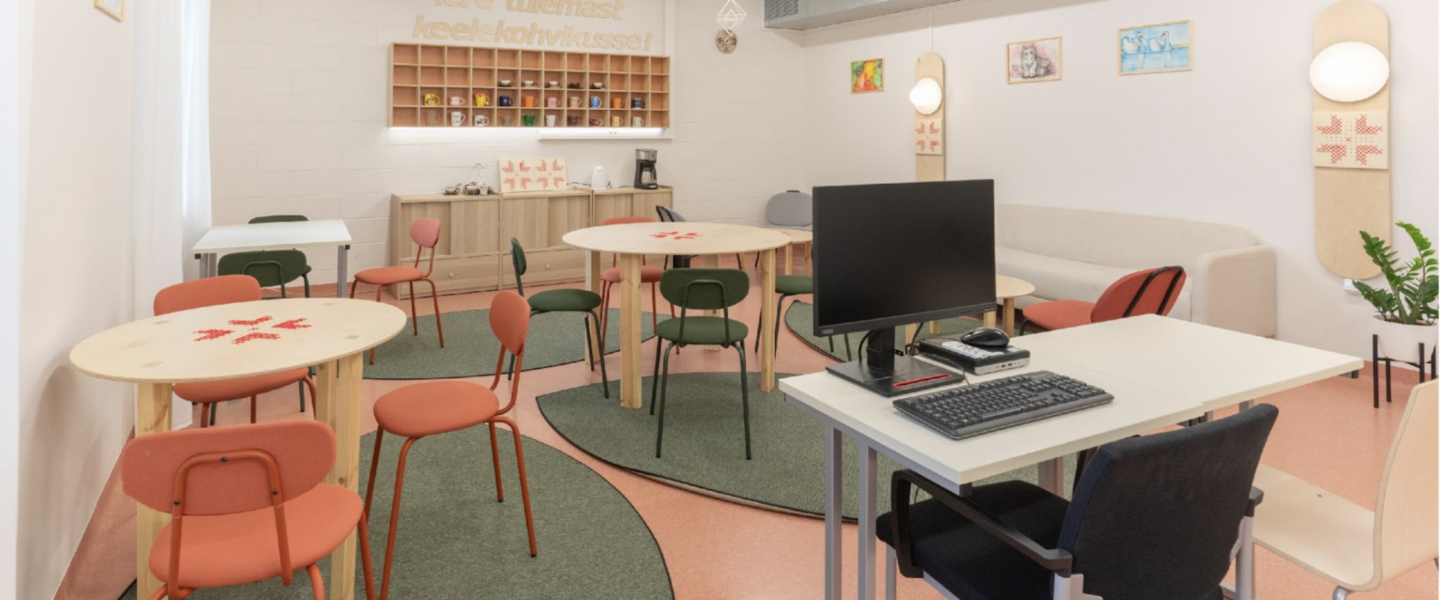
Language café in Viru Prison. Design: Kelli Puusepp and Ljudmila Funika-Müür. Photo: Evert Palmets
As of June 2025, there are a total of 898 prisoners with other mother tongues in Estonian prisons (56% of all prisoners). All of them will be released at some point and return to society, where knowledge of the Estonian language is key to entering the labor market and in everyday social communication. Since the end of last year, prisoners with other mother tongues have also had the opportunity to learn the state language in language cafés.
Language cafés are more informal places for communication training, where prisoners can practice speaking Estonian in a supportive and relaxed atmosphere. This creates an opportunity to learn the language also for those who cannot participate in a full-length level course and who feel that they need support most in developing their communication language.
However, most prisons do not support communication-based learning – they are characterized by monotonous blank walls, rigid furniture and a dreary atmosphere. At the same time, language learning is one of the most important skills to develop during imprisonment. If the space does not support learning, it is difficult to maintain the motivation of participants. For example, acoustically uncomfortable rooms where speech echoes or where you have to speak loudly do not encourage natural communication. Conversely, a cozy and bright environment supports learning a communication language, making the experience more positive and productive.
The design was created in collaboration with the Estonian Academy of Arts
The prison environment is unique – strict security requirements apply there, and therefore close and trusting cooperation between designers and prison representatives is very important. The interior design of the language cafes in Tartu, Viru and Tallinn prisons was created in collaboration with the Estonian Academy of Arts and the Prison Service. The Department of Interior Architecture organized a separate course for this, supervised by Ljudmila Funika-Müür and Kelli Puusepp. Students from several other disciplines also took part in the study. During the course, the students had to develop a conceptual design solution for a language café as a group. The students’ diverse ideas were later combined into one whole by the supervisors, who led to the final solution of the project.
The aim was to design spaces that support learning, a sense of security and participation. The starting point of the design is a space designed for people – the color palette is calm and inspired by nature, and the materials are recycled. The space uses textiles, plants, warm light and details that create a homely feeling, which contribute to concentration and creative self-expression.
Some of the furniture and interior design elements were made by the prisoners themselves, which strengthens the connection and participation with the environment being created. A symbolic part of the design was the use of national patterns – for example, the octagon as a symbol of balance and protection. These elements create a visual connection with cultural belonging and give the space meaning.
Language learning class before:
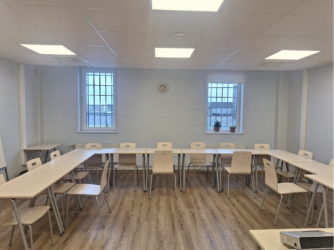
Photo: Prison Service
After:
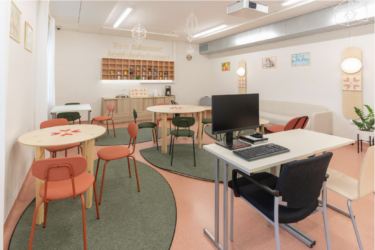
Photo by Evert Palmets
International examples support the approach
Various international studies confirm that the physical environment has a significant impact on learning success, concentration and mental well-being. Design therefore plays an important role, but this can only be implemented in cross-disciplinary cooperation. The primary task of a prison is to ensure the safety of all those staying there, and this must be taken into account when designing the rooms.
For example, the practice of Norwegian prisons, where educational spaces are spacious and comfortable, has shown that such an environment reduces stress and increases commitment to learning. One of the best known is Halden Prison in Norway.
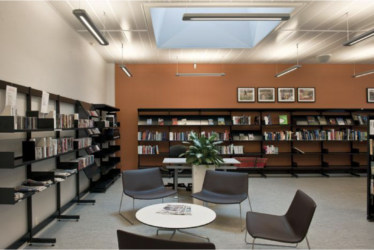
In Halden, prisoners move between their living space, work, study and leisure areas during the day, which helps to maintain a connection with the usual rhythm of life. Author: Erik Arkitekter.
International scientific literature also confirms that calming and light tones, natural materials and ordinary furniture create an environment that promotes a sense of security and social inclusion (Prison Design: How Architecture Can Help Restore the Humanity Lost in Correctional Facilities).
A good example of such an approach is the normalisation principle of the Danish prison system, which is not just a theoretical ideal, but a practical design basis that influences every prison project. Its aim is to design spaces where prisoners can experience a structured but humane living arrangement that reflects the rhythms of life outside prison walls. This is achieved by an environment that supports everyday activities – work, education, community, privacy, leisure and independent living (The Danish approach: How architecture can promote normalisation – JUSTICE TRENDS Magazine).
Prisoners’ feedback on the created spaces is positive
Estonian prisoners have also emphasised in their feedback the positive impact of language café spaces on communication and language practice.
“The same furniture as at home.”
“When I’m here, I forget for a moment that I’m in prison.”
“I feel freer in this room than in other rooms, I can communicate freely.”
These are just a few examples of feedback from the prisoners themselves. They appreciate the opportunity to be in an environment that is different from the usual prison life.
In summary, contemporary research and cross-disciplinary cooperation confirm that a well-designed physical environment supports learning, mental health and social development in prisons as well. If the space reduces stress and promotes a sense of security, a person can focus on self-development. This is a cost-effective way to maintain human dignity and support reintegration into society.
The activities carried out were co-financed by the European Social Fund+ project “Language learning and integration activities for prisoners”. The prison language cafes were implemented based on the methodological guidelines of the Estonian Integration Foundation (INSA), and the Prison Service closely cooperated with INSA in their preparation.
*
The announcement was prepared by Elis Maria Oldekop, project manager of the Ministry of Justice and Digital Affairs, and Gregor Taul, visiting lecturer at the Department of Interior Architecture at the Estonian Academy of Arts.