
Gert Christjanson
Sheltering Together: Cross-Use Shelter Strategies in Soviet-Era Apartment Buildings
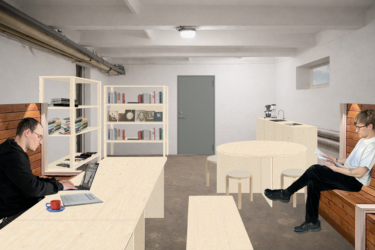
In my master’s thesis, I seek to answer the question: how can the basement floors of apartment buildings be adapted into shelters in a way that allows them to function as communal spaces integrated into residents’ everyday lives?
The current geopolitical situation and the shelter requirements being implemented in Estonia draw attention to the existing housing stock and the role of apartment building basements in civil protection. In the thesis, I approach the shelter not only as a space designed for crisis situations, but also as a community-supporting and multifunctional environment.
Through fieldwork, I analyzed the current condition of Soviet-era communal spaces located in basement floors, pilot shelter projects in Tallinn, and dual-use shelters in Finland and Denmark. In addition, I examined the spatial, social, and practical challenges of creating shelters from the perspective of an interior architect.
As a practical outcome of the thesis, a design project was developed based on the apartment building at J. Sütiste tee 34 in Mustamäe. Within the project, I developed various dual-use shelter scenarios, including a reading room, playroom, repair workshop, and party hall, to visualize how shelters can support safety during crises while also fostering community and everyday use in peacetime.
Supervisors: Mariann Drell, Pavle Stamenović, Gregor Taul.
***
Liina Pärn
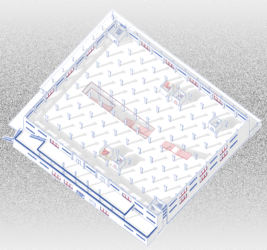
Sections. Adapted reuse in Kakaoladu
The master’s thesis “Cutouts: Adaptive Reuse at Cocoa warehouse” focuses on adaptive reuse in conjunction with the circular economy, as exemplified by Cocoa warehouse in Paljassaare.
The study primarily addresses the question of how to improve spatial quality while reusing existing materials. Cuts in the building’s structure bring in light, guide movement, and allow for division into smaller units. Following the idea of circular architecture, Kakaolao’s adaptive reuse connects the port area’s past and future, creating a modern and environmentally friendly environment.
Supervisors: Mariann Drell, Pavle Stamenović, Gregor Taul.
***
Mari-Liis Ardens
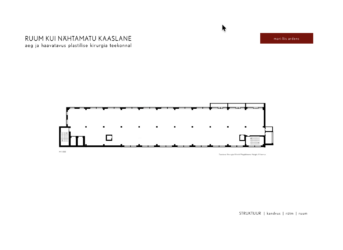
Space as an Invisible Companion: Vulnerability and Time in the Journey of Plastic Surgery
This master’s thesis examines the spatial experience of plastic surgery and the impact of the hospital environment on individuals in a vulnerable and transformative situation. The thesis focuses on the Reconstructive Surgery Clinic at Magdaleena Hospital, analyzing the patient journey, spatial orientation, privacy, and factors that support psychological well-being. The thesis combines theoretical research, site-specific analysis, and spatial proposals, treating the hospital environment as an active part of a person’s experience of recovery and change.
Supervisors: Mariann Drell, Pavle Stamenović, Gregor Taul.
***
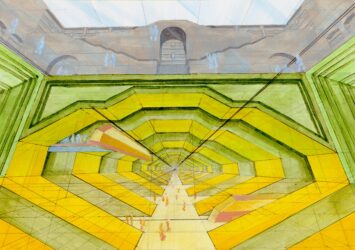
Peeter Klaas
Science fiction – in literature, movies, and in spaces
The aim of the thesis is to study Science Fiction as a phenomenon through literature, films, and spaces, and thereby arrive at the creation of science fiction spaces through a literary theoretical system. The result of the work is the creation of five metro stations in Tallinn at different times and in different places.
Supervisors: Mariann Drell, Pavle Stamenović, Gregor Taul.
***
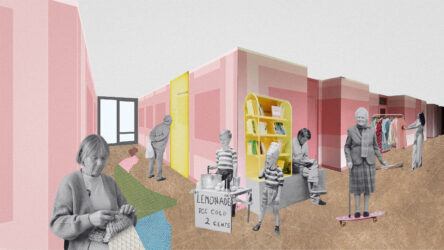
Rebeka Kollo
Unbounded Security: A Journey Through Urban Streets and Women’s Fears
Through this work, I wish to share my journey of self-discovery: to reveal my fear and reach as many fellow women as possible—women who share this same fear with me. The fear of walking alone (at night) on the street. Yet we do it anyway—we have developed our own methods for doing so. We avoid certain places and times of day; we choose what we wear and how we travel longer distances. We are ready to fight for our lives, because this is a “natural” fear inherent to women—the fear of being an object of desire on the street at night. In my master’s thesis, I’m exploring why this is the case and whether there are ways to improve this situation through architecture.
Supervisors: Mariann Drell, Pavle Stamenović, Gregor Taul.