
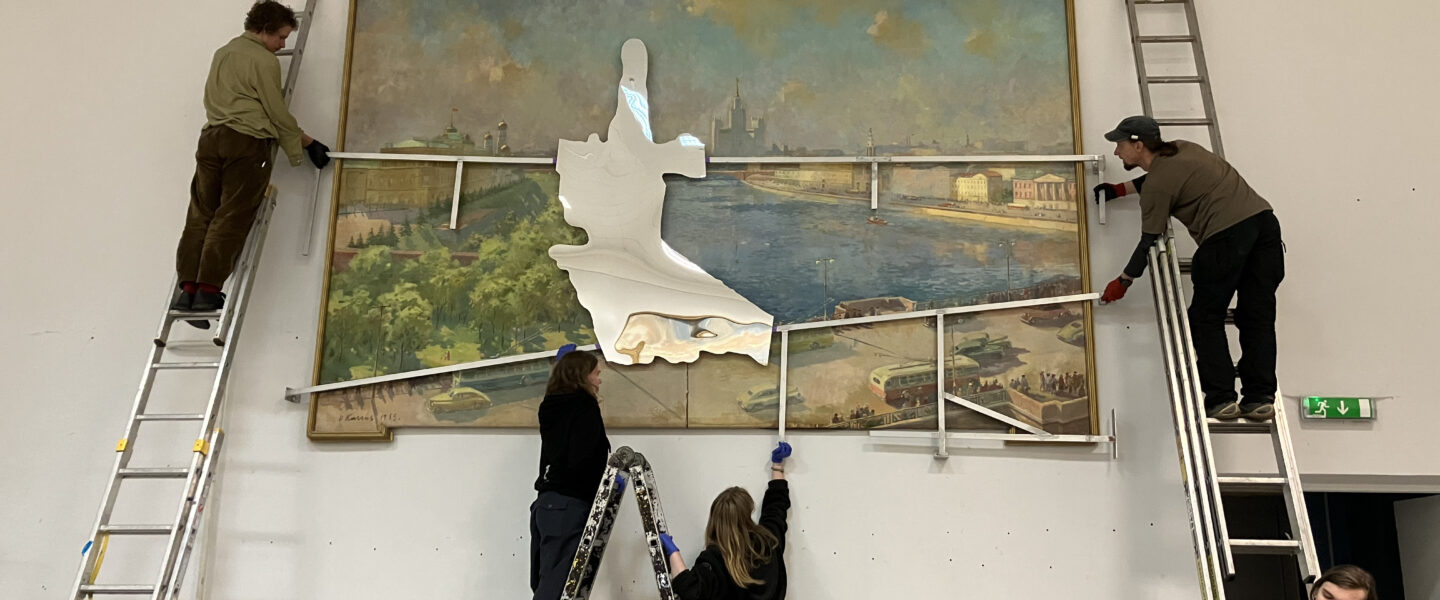
On Thursday, 16 July at 5 pm, the outdoor exhibition Reframing Monuments: The Past as Artistic Material will open at Kohtla-Järve Central Square. The exhibition explores the capacity of contemporary art to engage with Soviet heritage and the memory conflicts associated with it. The outdoor exhibition has been created as part of the How to Reframe Monuments research project by the Estonian Academy of Arts and Tallinn University.
Around the world, there is ongoing debate about whether and how controversial heritage should be presented in public space. Russia’s full-scale war against Ukraine has brought one of the focal points of monument-related conflicts to Eastern Europe.
The outdoor exhibition presents the results of three artistic intervention competitions held in 2024–2025. A total of 17 artists participated in the competitions, proposing 25 different approaches to reinterpreting various types of heritage: the Tehumardi Memorial on Saaremaa (Riho Kuld, Mati Varik, Allan Murdmaa, 1967/1975), the monumental paintings in the former passenger terminal of Tallinn Airport (1955, Viktor Karrus and Richard Sagrits), and the monument Vyachko and Meelis Defending Tartu (Olav Männi, 1950/1956).
The exhibition opening begins at 5 pm with presentations by Estonian Academy of Arts Rector Hilkka Hiiop, exhibition curators Linda Kaljundi and Kirke Kangro (Estonian Academy of Arts), and historian Kristo Nurmis (Tallinn University), who will introduce the exhibition and discuss new approaches to reinterpreting Soviet heritage. Ainar Varinurm, Director of the Kohtla-Järve Oil Shale Museum, will speak about the nearby miners’ monument Glory to Labour! (1967, Olavi Männi and Udo Ivask).
At 6 pm, a guided tour will take place at the Stalker Museum exhibition Väljasõit (“Setting Out”), located in the Stalinist-era club building in Kukruse (Lehe 10a). The group exhibition brings together industrial heritage, the history of Ida-Viru County and contemporary art. It features works by Peeter Laurits, Arne Maasik, Raoul Kurvitz, Ernst Hallop and others, alongside interventions by contemporary artists Anna Škodenko, Hanna Piksarv, Jevgeni Zolotko, Kati Saarits and Sigrid Viir responding to the socialist realist monumental paintings at Tallinn Airport. The tour will be led by Hilkka Hiiop, Linda Kaljundi, Kirke Kangro, Indrek Leht and Ainar Varinurm.
The Kukruse exhibition will be open by prior appointment throughout July and August 2026 (telephone +372 515 5365), and from 17 July to 29 August on Fridays and Saturdays from 3–8 pm. The outdoor exhibition at Kohtla-Järve Central Square will remain open to the public until the end of the summer.
The exhibitions and the works on display are part of the joint research project How to Reframe Monuments (2024–2026) by the Estonian Academy of Arts and Tallinn University, funded by the Estonian Ministry of Culture. The project aims to develop new approaches to reinterpreting monuments and other forms of dissonant heritage by bringing together expertise from different fields and involving diverse stakeholders and communities.
Participating artists: proposals for interventions at the Tehumardi Memorial were created by Kirke Kangro, Neeme Külm, Anna Mari Liivrand, Johannes Säre, Kristina Norman and Taavi Piibemann. Anna Škodenko, Hanna Piksarv, Jevgeni Zolotko, Kati Saarits and Sigrid Viir proposed new frameworks for the monumental paintings in the former Tallinn Airport terminal. Trevor Kinna, Bob Bicknell-Knight, Hasso Krull, Camille Laurelli, Samuel Lehtikoinen, Ülo Pikkov and Yiyang Sun created digital artworks inspired by the monument Vyachko and Meelis Defending Tartu.
The organizers would like to thank the Estonian Ministry of Culture, the Cultural Endowment of Estonia, the Kohtla-Järve City Government, the Kohtla-Järve Oil Shale Museum, and the Just Transition Fund, without whose support this project could not have taken place.