
Open Lectures
09.04.2026
KVI + ARH Open Lecture: Katarina Bonnevier “Living Organisms”
The 2025/2026 academic year open lecture series will be held in collaboration with the Institute of Art History and Visual Culture and the Faculty of Architecture. The theme of this academic year is “Architecture and the Ethics of Care” and the lectures will be curated by KVI Senior Researcher Dr. Ingrid Ruudi.
On March 26 at 6 pm Katarina Bonnevier will give a lecture “Living Organisms – Queerying Architecture with Trolls and Clay” at EKA lecture hall A-101.
She says: Let’s go on a date with my Heartlands. The talk will depart from a Pit of Clay, wander through the Secret Garden and into the Living Legend of the former casino in Malmö. A site that me and my pack MYCKET are courting right now. In my practice I engage with folklore, legends, and the unhuman to imagine relational futures – because the visions of trolls are sometimes helpful to overcome the technocrats’ devastating business as usual.
Dr. Katarina Bonnevier practices through the art and architecture collective MYCKET working with co-creation across species, across disciplines, and across realities. Their practice blends artistic research (supported by Swedish Research Council and Linnaeus University) with hands-on making of public places, installations, and social situations. An architect by training, Bonnevier connects queer and feminist perspectives with ecological care and spatial justice through storytelling and hands-on crafting.
MYCKETs work has received national and international recognition, including the Ganneviksstipendiet (2021), and Architectural Review’s and the Architects’ Journal’s joint W-award (2024) for Heaven by MYCKET at Oslo National Museum. Her dissertation Behind Straight Curtains: Towards a Queer Feminist Theory of Architecture (Stockholm: Axl Books, 2007) from the Royal Institute of Technology (KTH), Stockholm, is available open access (DiVA portal, more than 35 000 downloads). In her early career she was engaged in Kalamaja, Tallinn, and was awarded the National Endowment of Estonia’s Cultural Prize for Young Architects (1995).
Within the framework of a series of open lectures, the Faculty of Architecture of EKA presents a dozen unique practitioners and valued theorists in the field in Tallinn every academic year.
The lectures are intended for all disciplines, not only for students and professionals in the field of architecture.
Spring programme:
- 26.02 at 18:00 in A-101 Kaisa Karvinen “From Care to Concrete: Exhibiting Architecture”
- 26.03 at 18:00 in A-101 Jos Boys “Doing Disability Differently in Architecture”
- 9.04 at 18:00 in A-101 Katarina Bonnevier (Stockholm)
- 30.04 at 18:00 in A-101 Emma Cheatle (The University of Sheffield) “Lying in the Dark Room: Architectures of British Maternity”
- 14.05 at 18:00 in A-101 Iulia Statica (The University of Sheffield)
All lectures are held on Thursdays at 6 pm in the EKA main auditorium. All lectures are in English and free of charge.
The lecture series is supported by the Cultural Endowment of Estonia.
Previous open architecture lectures can be viewed at www.avatudloengud.ee
KVI + ARH Open Lecture: Katarina Bonnevier “Living Organisms”
Thursday 09 April, 2026
The 2025/2026 academic year open lecture series will be held in collaboration with the Institute of Art History and Visual Culture and the Faculty of Architecture. The theme of this academic year is “Architecture and the Ethics of Care” and the lectures will be curated by KVI Senior Researcher Dr. Ingrid Ruudi.
On March 26 at 6 pm Katarina Bonnevier will give a lecture “Living Organisms – Queerying Architecture with Trolls and Clay” at EKA lecture hall A-101.
She says: Let’s go on a date with my Heartlands. The talk will depart from a Pit of Clay, wander through the Secret Garden and into the Living Legend of the former casino in Malmö. A site that me and my pack MYCKET are courting right now. In my practice I engage with folklore, legends, and the unhuman to imagine relational futures – because the visions of trolls are sometimes helpful to overcome the technocrats’ devastating business as usual.
Dr. Katarina Bonnevier practices through the art and architecture collective MYCKET working with co-creation across species, across disciplines, and across realities. Their practice blends artistic research (supported by Swedish Research Council and Linnaeus University) with hands-on making of public places, installations, and social situations. An architect by training, Bonnevier connects queer and feminist perspectives with ecological care and spatial justice through storytelling and hands-on crafting.
MYCKETs work has received national and international recognition, including the Ganneviksstipendiet (2021), and Architectural Review’s and the Architects’ Journal’s joint W-award (2024) for Heaven by MYCKET at Oslo National Museum. Her dissertation Behind Straight Curtains: Towards a Queer Feminist Theory of Architecture (Stockholm: Axl Books, 2007) from the Royal Institute of Technology (KTH), Stockholm, is available open access (DiVA portal, more than 35 000 downloads). In her early career she was engaged in Kalamaja, Tallinn, and was awarded the National Endowment of Estonia’s Cultural Prize for Young Architects (1995).
Within the framework of a series of open lectures, the Faculty of Architecture of EKA presents a dozen unique practitioners and valued theorists in the field in Tallinn every academic year.
The lectures are intended for all disciplines, not only for students and professionals in the field of architecture.
Spring programme:
- 26.02 at 18:00 in A-101 Kaisa Karvinen “From Care to Concrete: Exhibiting Architecture”
- 26.03 at 18:00 in A-101 Jos Boys “Doing Disability Differently in Architecture”
- 9.04 at 18:00 in A-101 Katarina Bonnevier (Stockholm)
- 30.04 at 18:00 in A-101 Emma Cheatle (The University of Sheffield) “Lying in the Dark Room: Architectures of British Maternity”
- 14.05 at 18:00 in A-101 Iulia Statica (The University of Sheffield)
All lectures are held on Thursdays at 6 pm in the EKA main auditorium. All lectures are in English and free of charge.
The lecture series is supported by the Cultural Endowment of Estonia.
Previous open architecture lectures can be viewed at www.avatudloengud.ee
18.03.2026
Craft Studies Live Reading Sessions
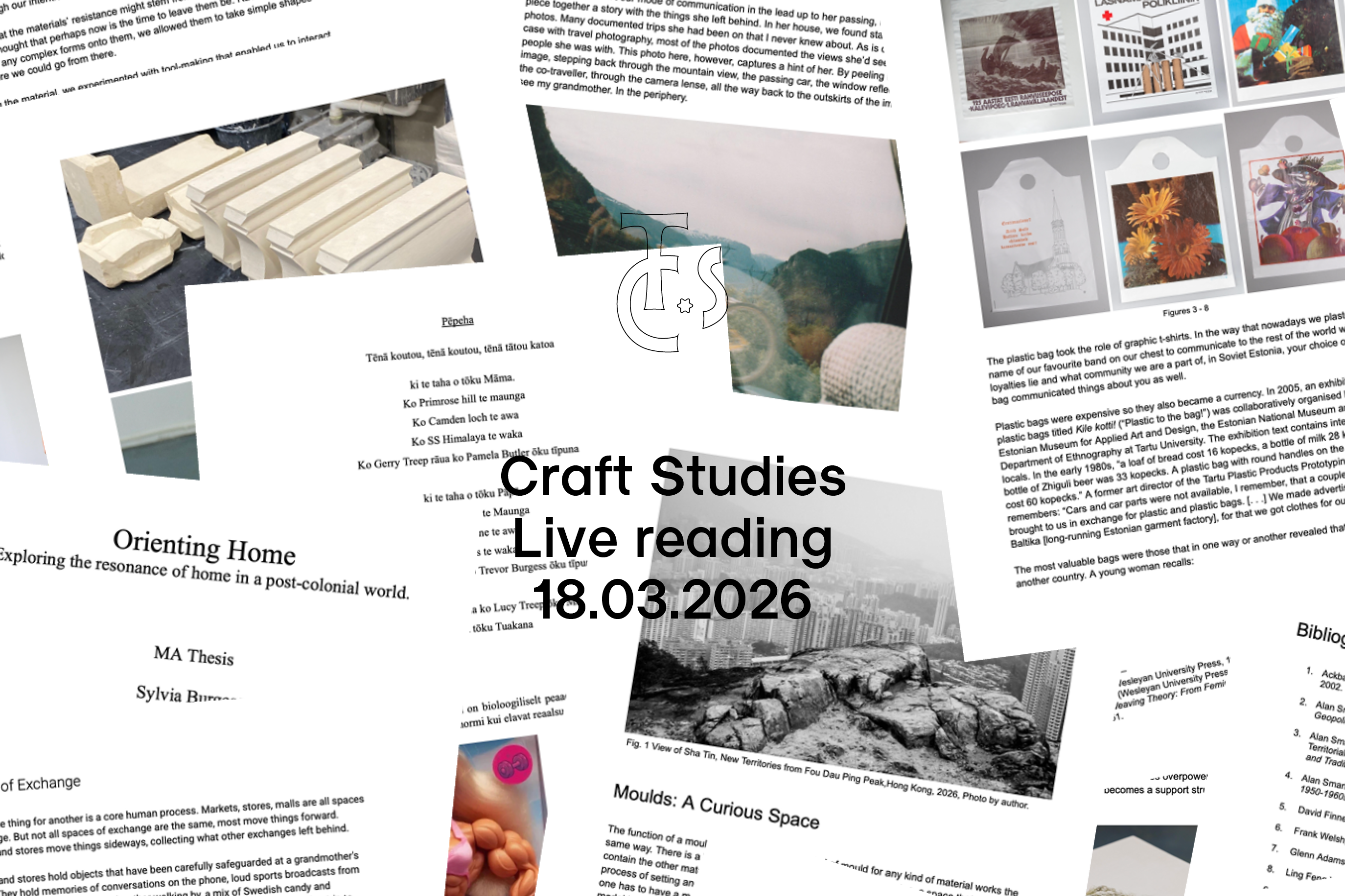
On Wednesday, the 18th of March, a series of written thesis presentations by the graduating students of Craft Studies will be held across different workshops at EKA.
There are 8 texts as part of the components required for graduation, reflecting on a diverse range of topics and approaches relevant to students’ individual practices and the expanded field of design and craft, with links to making and to the relations of legwork, handwork, and headwork. In intimate reading sessions around the studios, graduates share fragments from their research and creative practice.
All texts were composed through research, writing and editing supervised by Else Lagerspetz, Lieven Lahaye and Taavi Hallimäe.
17:00 The silent hovering of forks by Lyly Letzer, Smithy, B106.4.
17:30 Fit olemise kunst: Kehaloomepraktika by Joanne-Heleene Sõrmus, Prototyping Lab, B204.
17:45 Hidden in Plain Sight by Marite Kuus-Hill, Graphic Design Department, C305.
18:00 That Which is Carried by the Spaces in Between by Mariam Mestvirishvili, Weaving Studio, D505.
18:15 Orienting Home: exploring the resonance of home in a post-colonial world by Sylvia Burgess, Jewellery Studio, B504.
18:30 Beyond Wearability: Accessories as Fluid Signs by Peixuan Lin, Accessory Studio, B510.
18:45 Held in Suspension: Ceramic Reproduction and The Lives of Found Objects by Maia Hellman, Ceramics Workshop, B602.
19:00 Moulds for the Wilderness: From the Borders to the Void by Odie Lap Chun Chow, Plaster Workshop, D602.1.
19:15 Gathering with food and refreshments, A200.
Craft Studies Live Reading Sessions
Wednesday 18 March, 2026
On Wednesday, the 18th of March, a series of written thesis presentations by the graduating students of Craft Studies will be held across different workshops at EKA.
There are 8 texts as part of the components required for graduation, reflecting on a diverse range of topics and approaches relevant to students’ individual practices and the expanded field of design and craft, with links to making and to the relations of legwork, handwork, and headwork. In intimate reading sessions around the studios, graduates share fragments from their research and creative practice.
All texts were composed through research, writing and editing supervised by Else Lagerspetz, Lieven Lahaye and Taavi Hallimäe.
17:00 The silent hovering of forks by Lyly Letzer, Smithy, B106.4.
17:30 Fit olemise kunst: Kehaloomepraktika by Joanne-Heleene Sõrmus, Prototyping Lab, B204.
17:45 Hidden in Plain Sight by Marite Kuus-Hill, Graphic Design Department, C305.
18:00 That Which is Carried by the Spaces in Between by Mariam Mestvirishvili, Weaving Studio, D505.
18:15 Orienting Home: exploring the resonance of home in a post-colonial world by Sylvia Burgess, Jewellery Studio, B504.
18:30 Beyond Wearability: Accessories as Fluid Signs by Peixuan Lin, Accessory Studio, B510.
18:45 Held in Suspension: Ceramic Reproduction and The Lives of Found Objects by Maia Hellman, Ceramics Workshop, B602.
19:00 Moulds for the Wilderness: From the Borders to the Void by Odie Lap Chun Chow, Plaster Workshop, D602.1.
19:15 Gathering with food and refreshments, A200.
18.03.2026
Open Lecture by Wangui Kimari “Water, Coloniality and Disobedience”
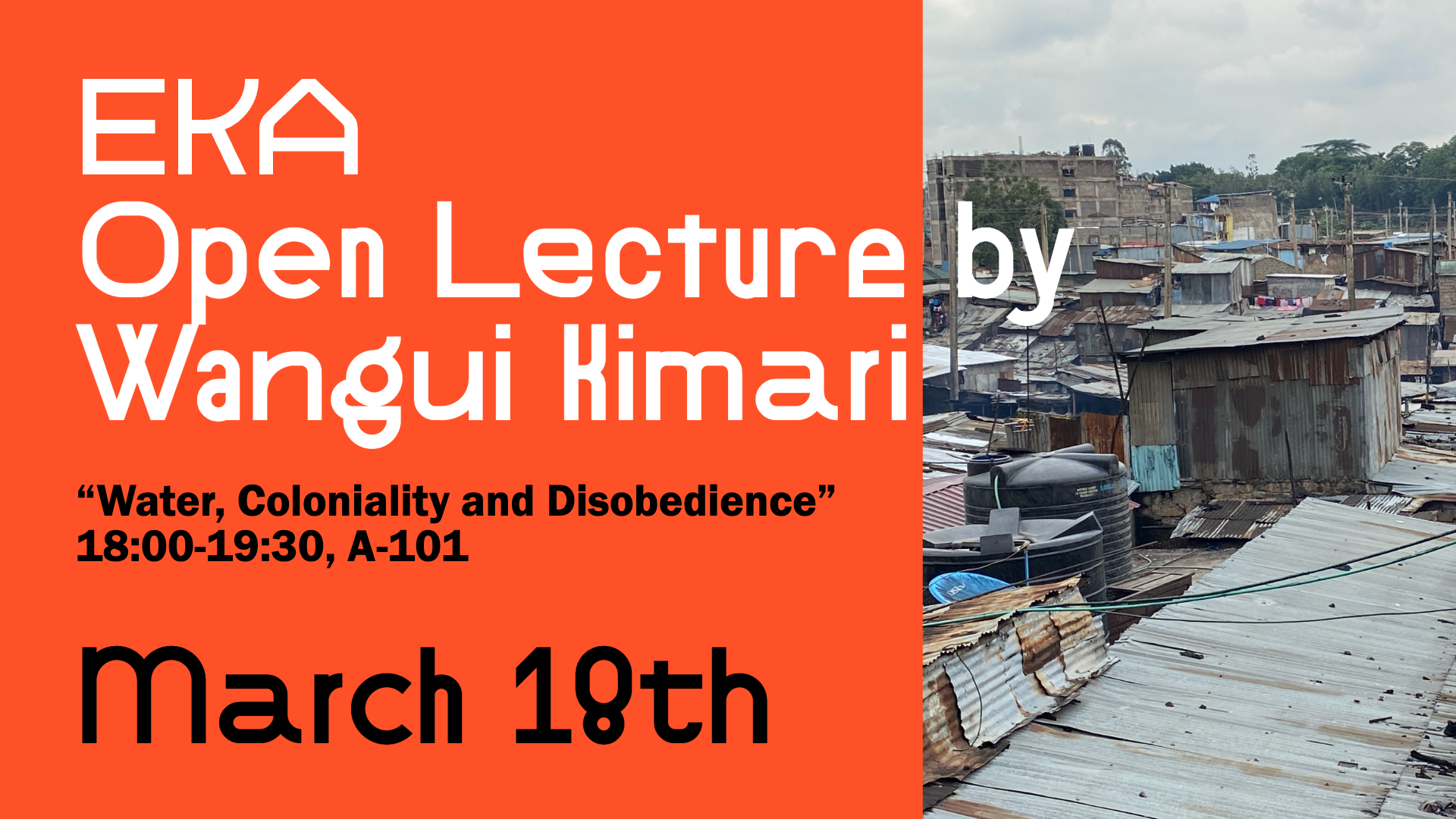
Nairobi, a city of close to five million people, congregates many hopes, experiences and struggles. Yet, across the colonial archive, its challenges have been defined primarily as those concerning ‘vagrants’ and ‘squatters,’ for instance; identities that congregate in the figure of the African. Following independence, the targets of formal city management lament and destruction remain similar: the ‘slum,’ ‘informality’ and urban ‘vice,’ whose geographies map onto the homes and bodies of those long targeted by colonial authorities. Informed by the “abolition ecology” community work of many of this city’s residents, and long-term research in its ontological margins, in this presentation I think about Nairobi’s dynamics through water. Ultimately, my argument is that while the “problem” of the “native,” squatter, vagrant or slum is seen to be defining of this urban agglomeration across the years, when Nairobi is thought from its experiences of water, coloniality and disobedience emerge as its primary dialectical currents, allowing for more (un)just histories to come into view that can allow us to vision more equal belongings and materialities in this East African city.
The Open lecture is being organized by EKA Urban Studies and TLU School of Humanities.
Wangui Kimari is an anthropologist based at the American University Nairobi Abroad Program. She is also a research associate at the African Centre for Cities (ACC), University of Cape Town. Her work draws on many local histories and interdisciplinary theoretical approaches – including oral narratives, assemblage theory, urban political ecology and the black radical tradition – to think through urban spatial management in Nairobi from the vantage point of its most marginalized residents. Wangui is also a regional editor of the online publication Africa Is a Country (AIAC), an Urban Studies Foundation (USF) trustee, on the editorial collective of Antipode and Urban Political Ecology journals, and a co-organizer of the UTA-Do African Cities Workshop.
Open Lecture by Wangui Kimari “Water, Coloniality and Disobedience”
Wednesday 18 March, 2026
Nairobi, a city of close to five million people, congregates many hopes, experiences and struggles. Yet, across the colonial archive, its challenges have been defined primarily as those concerning ‘vagrants’ and ‘squatters,’ for instance; identities that congregate in the figure of the African. Following independence, the targets of formal city management lament and destruction remain similar: the ‘slum,’ ‘informality’ and urban ‘vice,’ whose geographies map onto the homes and bodies of those long targeted by colonial authorities. Informed by the “abolition ecology” community work of many of this city’s residents, and long-term research in its ontological margins, in this presentation I think about Nairobi’s dynamics through water. Ultimately, my argument is that while the “problem” of the “native,” squatter, vagrant or slum is seen to be defining of this urban agglomeration across the years, when Nairobi is thought from its experiences of water, coloniality and disobedience emerge as its primary dialectical currents, allowing for more (un)just histories to come into view that can allow us to vision more equal belongings and materialities in this East African city.
The Open lecture is being organized by EKA Urban Studies and TLU School of Humanities.
Wangui Kimari is an anthropologist based at the American University Nairobi Abroad Program. She is also a research associate at the African Centre for Cities (ACC), University of Cape Town. Her work draws on many local histories and interdisciplinary theoretical approaches – including oral narratives, assemblage theory, urban political ecology and the black radical tradition – to think through urban spatial management in Nairobi from the vantage point of its most marginalized residents. Wangui is also a regional editor of the online publication Africa Is a Country (AIAC), an Urban Studies Foundation (USF) trustee, on the editorial collective of Antipode and Urban Political Ecology journals, and a co-organizer of the UTA-Do African Cities Workshop.
26.03.2026
KVI + ARH Open Lecture: Jos Boys “Doing Disability Differently in Architecture”
The 2025/2026 academic year open lecture series will be held in collaboration with the Institute of Art History and Visual Culture and the Faculty of Architecture. The theme of this academic year is “Architecture and the Ethics of Care” and the lectures will be curated by KVI Senior Researcher Dr. Ingrid Ruudi.
On March 26 at 6 pm Jos Boys will give a lecture “Doing Disability Differently in Architecture” at room A-501.
Disabled people are almost always treated as an afterthought in built environment education and practice. But what if we instead start from disability, valuing our rich bio- and neurodiversity as a creative generator for design and as a critical means of challenging normative building and urban design? In this talk, Jos will explore how, over the last 18 years, DisOrdinary Architecture has been collaborating internationally with disabled artists, designers and architects to co-develop innovative and even radical ways of thinking and doing architecture.
Dr. Jos Boys is co-founder and co-director, with disabled artist Zoe Partington, of The DisOrdinary Architecture Project, a UK-based platform which brings disabled artists into built environment education and practice to critically and creatively re-think access and inclusion. Originally trained in architecture, she was co-founder of Matrix feminist architecture and research collective in London UK in the 1980s, and currently leads on the development of the Matrix Open online archive. Always a design activist, Jos has also been a journalist, critic, researcher, consultant, educator, photographer and artist; and has published many books and articles. These include authoring Doing Disability Differently: an alternative handbook on architecture, dis/ability, and designing for everyday life (Routledge 2014); editing Disability, Space, Architecture: A Reader (Routledge 2017) and co-editing Neurodivergence and Architecture (Elsevier 2022).
Within the framework of a series of open lectures, the Faculty of Architecture of EKA presents a dozen unique practitioners and valued theorists in the field in Tallinn every academic year.
The lectures are intended for all disciplines, not only for students and professionals in the field of architecture.
Spring programme:
- 26.02 at 18:00 in A-101 Kaisa Karvinen “From Care to Concrete: Exhibiting Architecture”
- 26.03 at 18:00 in A-501 Jos Boys (London)
- 9.04 at 18:00 in A-101 Katarina Bonnevier (Stockholm)
- 30.04 at 18:00 in A-101 Emma Cheatle (The University of Sheffield) “Lying in the Dark Room: Architectures of British Maternity”
- 14.05 at 18:00 in A-101 Iulia Statica (The University of Sheffield)
All lectures are held on Thursdays at 6 pm in the EKA main auditorium. All lectures are in English and free of charge.
The lecture series is supported by the Cultural Endowment of Estonia.
Previous open architecture lectures can be viewed at www.avatudloengud.ee
KVI + ARH Open Lecture: Jos Boys “Doing Disability Differently in Architecture”
Thursday 26 March, 2026
The 2025/2026 academic year open lecture series will be held in collaboration with the Institute of Art History and Visual Culture and the Faculty of Architecture. The theme of this academic year is “Architecture and the Ethics of Care” and the lectures will be curated by KVI Senior Researcher Dr. Ingrid Ruudi.
On March 26 at 6 pm Jos Boys will give a lecture “Doing Disability Differently in Architecture” at room A-501.
Disabled people are almost always treated as an afterthought in built environment education and practice. But what if we instead start from disability, valuing our rich bio- and neurodiversity as a creative generator for design and as a critical means of challenging normative building and urban design? In this talk, Jos will explore how, over the last 18 years, DisOrdinary Architecture has been collaborating internationally with disabled artists, designers and architects to co-develop innovative and even radical ways of thinking and doing architecture.
Dr. Jos Boys is co-founder and co-director, with disabled artist Zoe Partington, of The DisOrdinary Architecture Project, a UK-based platform which brings disabled artists into built environment education and practice to critically and creatively re-think access and inclusion. Originally trained in architecture, she was co-founder of Matrix feminist architecture and research collective in London UK in the 1980s, and currently leads on the development of the Matrix Open online archive. Always a design activist, Jos has also been a journalist, critic, researcher, consultant, educator, photographer and artist; and has published many books and articles. These include authoring Doing Disability Differently: an alternative handbook on architecture, dis/ability, and designing for everyday life (Routledge 2014); editing Disability, Space, Architecture: A Reader (Routledge 2017) and co-editing Neurodivergence and Architecture (Elsevier 2022).
Within the framework of a series of open lectures, the Faculty of Architecture of EKA presents a dozen unique practitioners and valued theorists in the field in Tallinn every academic year.
The lectures are intended for all disciplines, not only for students and professionals in the field of architecture.
Spring programme:
- 26.02 at 18:00 in A-101 Kaisa Karvinen “From Care to Concrete: Exhibiting Architecture”
- 26.03 at 18:00 in A-501 Jos Boys (London)
- 9.04 at 18:00 in A-101 Katarina Bonnevier (Stockholm)
- 30.04 at 18:00 in A-101 Emma Cheatle (The University of Sheffield) “Lying in the Dark Room: Architectures of British Maternity”
- 14.05 at 18:00 in A-101 Iulia Statica (The University of Sheffield)
All lectures are held on Thursdays at 6 pm in the EKA main auditorium. All lectures are in English and free of charge.
The lecture series is supported by the Cultural Endowment of Estonia.
Previous open architecture lectures can be viewed at www.avatudloengud.ee
12.03.2026
Open Architecture Lecture: Eero Paloheimo
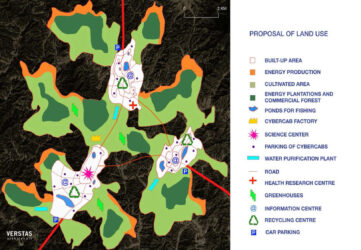
On March 12 at 6 pm, Finnish engineer, scientist and environmental researcher Eero Paloheimo will give a special lecture “Ecological city planning” in the EKA auditorium.
Eero Kalervo Paloheimo has defended his doctoral theses at the University of Munich and the University of Helsinki.
He worked at the company Eero Paloheimo & Matti Ollila from 1965 to 1994, and then was a professor (timber construction) at the Helsinki University of Technology from 1995 to 2000. In 2009, Paloheimo founded Eero Paloheimo EcoCity Ltd., a company specializing in the research and construction of eco-cities.
As a researcher of environmental problems and sustainable development opportunities, Paloheimo has traveled throughout Europe, Africa and Asia. Since 2007, he has consulted on the establishment of eco-cities in China, based on the ideas he originally presented in his book “Syntymättötien sukupolvien Eurooppa” (1996, in Estonian 2004 ). He has also repeatedly introduced the possibilities of establishing eco-cities in Estonia.
Paloheimo served as a representative of the Green Party Vihreä Liitto in the Finnish Parliament from 1987 to 1995 and has been a member of several authoritative international committees dealing with environmental problems.
He is the author of more than ten books on the nature and state of the world.
The lecture will be held in English and is free and open to all interested parties.
Open Architecture Lecture: Eero Paloheimo
Thursday 12 March, 2026
On March 12 at 6 pm, Finnish engineer, scientist and environmental researcher Eero Paloheimo will give a special lecture “Ecological city planning” in the EKA auditorium.
Eero Kalervo Paloheimo has defended his doctoral theses at the University of Munich and the University of Helsinki.
He worked at the company Eero Paloheimo & Matti Ollila from 1965 to 1994, and then was a professor (timber construction) at the Helsinki University of Technology from 1995 to 2000. In 2009, Paloheimo founded Eero Paloheimo EcoCity Ltd., a company specializing in the research and construction of eco-cities.
As a researcher of environmental problems and sustainable development opportunities, Paloheimo has traveled throughout Europe, Africa and Asia. Since 2007, he has consulted on the establishment of eco-cities in China, based on the ideas he originally presented in his book “Syntymättötien sukupolvien Eurooppa” (1996, in Estonian 2004 ). He has also repeatedly introduced the possibilities of establishing eco-cities in Estonia.
Paloheimo served as a representative of the Green Party Vihreä Liitto in the Finnish Parliament from 1987 to 1995 and has been a member of several authoritative international committees dealing with environmental problems.
He is the author of more than ten books on the nature and state of the world.
The lecture will be held in English and is free and open to all interested parties.
26.02.2026
KVI + ARH Open Lecture: Kaisa Karvinen “From Care to Concrete: Exhibiting Architecture”
The 2025/2026 academic year open lecture series will be held in collaboration with the Institute of Art History and Visual Culture and the Faculty of Architecture. The theme of this academic year is “Architecture and the Ethics of Care” and the lectures will be curated by KVI Senior Researcher Dr. Ingrid Ruudi.
On February 26 at 6 pm Kaisa Karvinen will give a lecture “From Care to Concrete: Exhibiting Architecture”.
Architect, curator, and researcher Kaisa Karvinen’s lecture examines exhibitions within architectural discourse in a time of ecological crisis, when questions of repair and maintenance become increasingly urgent. The analysis draws on Karvinen’s exhibitions, including Stripped Frame, at Merihaka, Helsinki (2022), which addressed the demolition and reuse of modernist concrete buildings; FIX: Care and Repair, at Architecture & Design museum, Helsinki (2024), which approached maintenance and care as forms of skilled labour and as aesthetic questions; and Teo Ala-Ruonas Industry Muscle: Five Scores for Architecture, Nordic Countries Pavilion, Biennale Architettura, Venice (2025), which examined the entanglements of fossil culture, architectural production, and the body.
Kaisa Karvinen works across exhibition-making and academic research. She is currently preparing an exhibition for the Finnish Pavilion at the 2027 Venice Architecture Biennale and is undertaking doctoral research at the University of Oulu. Karvinen is also a co-founder of the Trojan Horse collective.
Within the framework of a series of open lectures, the Faculty of Architecture of EKA presents a dozen unique practitioners and valued theorists in the field in Tallinn every academic year.
The lectures are intended for all disciplines, not only for students and professionals in the field of architecture.
All lectures are held on Thursdays at 6 pm in the EKA main auditorium. All lectures are in English and free of charge.
The lecture series is supported by the Cultural Endowment of Estonia.
Previous open architecture lectures can be viewed at www.avatudloengud.ee
KVI + ARH Open Lecture: Kaisa Karvinen “From Care to Concrete: Exhibiting Architecture”
Thursday 26 February, 2026
The 2025/2026 academic year open lecture series will be held in collaboration with the Institute of Art History and Visual Culture and the Faculty of Architecture. The theme of this academic year is “Architecture and the Ethics of Care” and the lectures will be curated by KVI Senior Researcher Dr. Ingrid Ruudi.
On February 26 at 6 pm Kaisa Karvinen will give a lecture “From Care to Concrete: Exhibiting Architecture”.
Architect, curator, and researcher Kaisa Karvinen’s lecture examines exhibitions within architectural discourse in a time of ecological crisis, when questions of repair and maintenance become increasingly urgent. The analysis draws on Karvinen’s exhibitions, including Stripped Frame, at Merihaka, Helsinki (2022), which addressed the demolition and reuse of modernist concrete buildings; FIX: Care and Repair, at Architecture & Design museum, Helsinki (2024), which approached maintenance and care as forms of skilled labour and as aesthetic questions; and Teo Ala-Ruonas Industry Muscle: Five Scores for Architecture, Nordic Countries Pavilion, Biennale Architettura, Venice (2025), which examined the entanglements of fossil culture, architectural production, and the body.
Kaisa Karvinen works across exhibition-making and academic research. She is currently preparing an exhibition for the Finnish Pavilion at the 2027 Venice Architecture Biennale and is undertaking doctoral research at the University of Oulu. Karvinen is also a co-founder of the Trojan Horse collective.
Within the framework of a series of open lectures, the Faculty of Architecture of EKA presents a dozen unique practitioners and valued theorists in the field in Tallinn every academic year.
The lectures are intended for all disciplines, not only for students and professionals in the field of architecture.
All lectures are held on Thursdays at 6 pm in the EKA main auditorium. All lectures are in English and free of charge.
The lecture series is supported by the Cultural Endowment of Estonia.
Previous open architecture lectures can be viewed at www.avatudloengud.ee
18.02.2026
Open Lecture: Huda Tayob “Archival Imaginaries”
Urban Studies presents:
Huda Tayob “Archival Imaginaries”
February 18th, at 18:00-19:30, 4th floor open area A-400
This talk will focus on the co-curated online exhibition, Archive of Forgetfulness – a pan-African digital exhibition and podcast series. This project is a space for interrogating the archival encounter, from the bodily and spoken, to the written and performed. As a collection of work centered on the African continent, the various contributors interrogate archival gestures, raise questions on personal and political histories that emerge through borders, and resurface forgotten conversations. In these works, archival labour and memory-work are understood simultaneously as deeply political, personal and speculative. The project opens up a space to question how an archival shift might open the space for pedagogical interventions and alternative ways of reading global urban environments.
Huda Tayob is a South African architectural historian and theorist, currently Senior Tutor (Research) at the Royal College of Art. She has previously taught at the University of Manchester, the University of Cape Town, the Graduate School of Architecture (University of Johannesburg), and the Bartlett School of Architecture. She holds a PhD from the Bartlett School of Architecture, UCL, awarded a RIBA Commendation for research, and undergraduate and Master’s degrees in Architecture from the University of Cape Town. Her research focuses on minor, migrant, and subaltern architectures across the African continent and the global south. She is co-curator of the open-access curriculum Race, Space & Architecture and lead curator of the pan-African digital exhibition Archive of Forgetfulness. In 2023, she participated in the 18th International Architecture Exhibition in Venice with Index of Edges, tracing watery archives and coastal histories from Cape Town to Port Said.
Open Lecture: Huda Tayob “Archival Imaginaries”
Wednesday 18 February, 2026
Urban Studies presents:
Huda Tayob “Archival Imaginaries”
February 18th, at 18:00-19:30, 4th floor open area A-400
This talk will focus on the co-curated online exhibition, Archive of Forgetfulness – a pan-African digital exhibition and podcast series. This project is a space for interrogating the archival encounter, from the bodily and spoken, to the written and performed. As a collection of work centered on the African continent, the various contributors interrogate archival gestures, raise questions on personal and political histories that emerge through borders, and resurface forgotten conversations. In these works, archival labour and memory-work are understood simultaneously as deeply political, personal and speculative. The project opens up a space to question how an archival shift might open the space for pedagogical interventions and alternative ways of reading global urban environments.
Huda Tayob is a South African architectural historian and theorist, currently Senior Tutor (Research) at the Royal College of Art. She has previously taught at the University of Manchester, the University of Cape Town, the Graduate School of Architecture (University of Johannesburg), and the Bartlett School of Architecture. She holds a PhD from the Bartlett School of Architecture, UCL, awarded a RIBA Commendation for research, and undergraduate and Master’s degrees in Architecture from the University of Cape Town. Her research focuses on minor, migrant, and subaltern architectures across the African continent and the global south. She is co-curator of the open-access curriculum Race, Space & Architecture and lead curator of the pan-African digital exhibition Archive of Forgetfulness. In 2023, she participated in the 18th International Architecture Exhibition in Venice with Index of Edges, tracing watery archives and coastal histories from Cape Town to Port Said.
20.01.2026
Public lecture: Dan Dubowitz: Cultural Masterplanning
The Estonian Academy of Arts will organize its 2026 workshop “Abandoned Landscapes” in Tallinn from 19 to 22 January, with the City Hall as the focus.
The aim of the workshop, which is already being held for the 14th time, is to practice international cooperation between students of architecture, heritage conservation and interior architecture, and to understand the needs and opportunities for preserving and using local heritage. This year, the workshop will be held in collaboration with lecturers and students of the Manchester School of Architecture (MSA).
On Tuesday, January 20 at 5 pm, Dan Dubowitz will give a public lecture in the EKA auditorium: Cultural Masterplanning.
Dan Dubowitz, Visiting Professor from Manchester School of Architecture, will introduce his celebrated work on Cultural Masterplanning, which has been developing new methods for engaging people earlier and better in the transformation of their city across the UK. He will introduce his current research project, Megalomania, which includes sites in Estonia (Naissaare and Hiiumaa), the Helsinki Archipelago, Latvia (Karosta) and Lithuania (Visiginas).
This lecture is the inaugural event of a new research and public pedagogy collaboration between MSA and EKA to investigate how mobile architectural methods, such as walking and talking after dark, choreographic things and slow photography can give voice and awaken a building with narcolepsy.
Several events open to the public will also take place as part of the workshop. All interested parties are welcome to attend for free.
- Wednesday, January 21st at 5 pm, Ingel Vaikla’s documentary “The Housekeeper” (2015) will be screened in the EKA auditorium.
- On Thursday, January 22nd at 5 pm at lobby stairs, student groups will present their short films about Linnahall made during the week.
Public lecture: Dan Dubowitz: Cultural Masterplanning
Tuesday 20 January, 2026
The Estonian Academy of Arts will organize its 2026 workshop “Abandoned Landscapes” in Tallinn from 19 to 22 January, with the City Hall as the focus.
The aim of the workshop, which is already being held for the 14th time, is to practice international cooperation between students of architecture, heritage conservation and interior architecture, and to understand the needs and opportunities for preserving and using local heritage. This year, the workshop will be held in collaboration with lecturers and students of the Manchester School of Architecture (MSA).
On Tuesday, January 20 at 5 pm, Dan Dubowitz will give a public lecture in the EKA auditorium: Cultural Masterplanning.
Dan Dubowitz, Visiting Professor from Manchester School of Architecture, will introduce his celebrated work on Cultural Masterplanning, which has been developing new methods for engaging people earlier and better in the transformation of their city across the UK. He will introduce his current research project, Megalomania, which includes sites in Estonia (Naissaare and Hiiumaa), the Helsinki Archipelago, Latvia (Karosta) and Lithuania (Visiginas).
This lecture is the inaugural event of a new research and public pedagogy collaboration between MSA and EKA to investigate how mobile architectural methods, such as walking and talking after dark, choreographic things and slow photography can give voice and awaken a building with narcolepsy.
Several events open to the public will also take place as part of the workshop. All interested parties are welcome to attend for free.
- Wednesday, January 21st at 5 pm, Ingel Vaikla’s documentary “The Housekeeper” (2015) will be screened in the EKA auditorium.
- On Thursday, January 22nd at 5 pm at lobby stairs, student groups will present their short films about Linnahall made during the week.
13.01.2026
Open Lecture: Alison J. Clarke “Design Anthropology: Its History and Its Discontents”
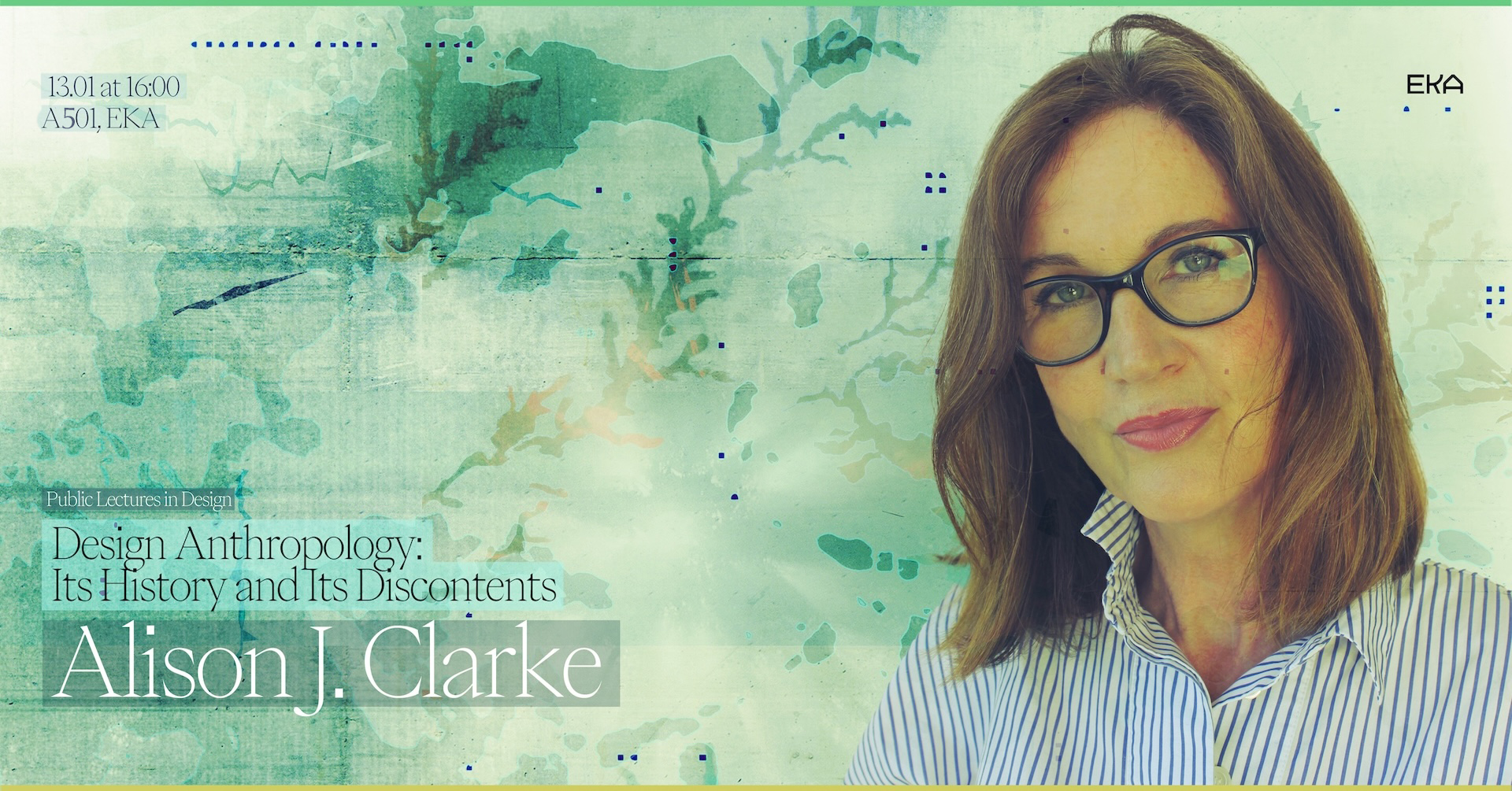

On January 13 at 16:00 in room A-501, Alison J. Clarke will give a public lecture titled “Design Anthropology: Its History and Its Discontents”. The lecture is part of the Faculty of Design’s public lecture series “Public Lectures in Design: Adjusting Perspectives,” curated by Stella Runnel and Taavi Hallimäe.
This talk explores the emergence of design anthropology as an approach that has gained popularity over the last two decades by melding social science and design practice. Clarke will argue the need to understand the phenomenon’s origins in the Cold War geopolitics of US expansionism, whereby it was applied as a political force to decolonized nations, in order to cast a critical eye over a contemporary practice that has come to operate as the invisible hand behind multiple facets of global life from health care provision, through to governance and data harnessing.
The public lectures are open to students, faculty, as well as anyone else interested in design!
Alison J. Clarke is a professor at the University of Applied Arts Vienna and the director of Papanek Foundation. As a design historian and social anthropologist, Clarke’s research deals with the intersection of these disciplines, specifically in terms of their shared focus on the politics of material culture and social relations. Her most recent monograph Victor Papanek: Designer for the Real World (MIT Press, 2021) explores the controversial origins of social design, casting a critical perspective on the origins of a movement that has claimed to promote social justice through people-centred approaches. Her present book and research project Design Anthropology: Decolonizing and Recolonizing the Material World (MIT Press) explores the blurred historical boundaries between design practice and anthropology, and the social consequences of the uptake of this melding in the contemporary corporate sector. Clarke’s research has been supported by the Graham Foundation, the Smithsonian Institution, the Austrian Science Fund and the Arts and Humanities Research Council, among others.
Open Lecture: Alison J. Clarke “Design Anthropology: Its History and Its Discontents”
Tuesday 13 January, 2026
On January 13 at 16:00 in room A-501, Alison J. Clarke will give a public lecture titled “Design Anthropology: Its History and Its Discontents”. The lecture is part of the Faculty of Design’s public lecture series “Public Lectures in Design: Adjusting Perspectives,” curated by Stella Runnel and Taavi Hallimäe.
This talk explores the emergence of design anthropology as an approach that has gained popularity over the last two decades by melding social science and design practice. Clarke will argue the need to understand the phenomenon’s origins in the Cold War geopolitics of US expansionism, whereby it was applied as a political force to decolonized nations, in order to cast a critical eye over a contemporary practice that has come to operate as the invisible hand behind multiple facets of global life from health care provision, through to governance and data harnessing.
The public lectures are open to students, faculty, as well as anyone else interested in design!
Alison J. Clarke is a professor at the University of Applied Arts Vienna and the director of Papanek Foundation. As a design historian and social anthropologist, Clarke’s research deals with the intersection of these disciplines, specifically in terms of their shared focus on the politics of material culture and social relations. Her most recent monograph Victor Papanek: Designer for the Real World (MIT Press, 2021) explores the controversial origins of social design, casting a critical perspective on the origins of a movement that has claimed to promote social justice through people-centred approaches. Her present book and research project Design Anthropology: Decolonizing and Recolonizing the Material World (MIT Press) explores the blurred historical boundaries between design practice and anthropology, and the social consequences of the uptake of this melding in the contemporary corporate sector. Clarke’s research has been supported by the Graham Foundation, the Smithsonian Institution, the Austrian Science Fund and the Arts and Humanities Research Council, among others.
02.12.2025
Open Lecture: “Bright Ecologies: Experiences, Forms, Materials”
On December 2 at 16:00 in room A101, Andrea Caretto and Raffaella Spagna will give a public lecture titled “Bright Ecologies: Experiences, Forms, Materials”. The lecture is part of the Faculty of Design’s public lecture series “Public Lectures in Design: Adjusting Perspectives,” curated by Stella Runnel and Taavi Hallimäe.
The Italian artist duo Caretto/Spagna approach art as a space for radical openness, undisciplined inquiry, and deep engagement with the Things of the World: earth, seeds, people, stones, museums, rivers, quarries, trees, micro-organisms, and more. Through the activation of a constellation of objects – small sculptures, drawings, plants, found objects, etc – drawn from their personal archive, the artists will invite the audience on an interactive journey into their artistic research.
The public lectures are open to students, faculty, as well as anyone else interested in design!
Andrea Caretto (Torino, 1970, Degree in Natural Sciences) and Raffaella Spagna (Rivoli, 1967, Degree in Architecture) have been working together since 2002, collaborating with public and private institutions in Italy and abroad. They live and work in Cambiano (TO).
Caretto and Spagna explore the complex web of relationships from which things emerge: the fluxes and cycles of matter and morphogenesis, the perception of the environment, the transformations of the landscape, the wild/cultivated relationship and the processes of domestication, the relationships between living/inhabiting/building. Their approach is based on an aptitude for “presence” and experience in the world, in close contact with matter in all its transformations and individualisations. An exercise of attention and care for things, understood as nodes in an interweave, which trains the ability to perceive everything that exists as a system of elements in continuous correspondence. They are among the founding members of the artists’ association Diogene in Torino, and Pianpicollo Selvatico ETS Foundation – center for research in the arts and the sciences, Levice (TO), and artistic consultants for Munlab Ecomuseo dell’Argilla in Cambiano (TO). They collaborate with the Department of Philosophy and Educational Sciences at the University of Torino and with Unidee Academy of Cittadellarte-Fondazione Pistoletto, Biella (IT).
Open Lecture: “Bright Ecologies: Experiences, Forms, Materials”
Tuesday 02 December, 2025
On December 2 at 16:00 in room A101, Andrea Caretto and Raffaella Spagna will give a public lecture titled “Bright Ecologies: Experiences, Forms, Materials”. The lecture is part of the Faculty of Design’s public lecture series “Public Lectures in Design: Adjusting Perspectives,” curated by Stella Runnel and Taavi Hallimäe.
The Italian artist duo Caretto/Spagna approach art as a space for radical openness, undisciplined inquiry, and deep engagement with the Things of the World: earth, seeds, people, stones, museums, rivers, quarries, trees, micro-organisms, and more. Through the activation of a constellation of objects – small sculptures, drawings, plants, found objects, etc – drawn from their personal archive, the artists will invite the audience on an interactive journey into their artistic research.
The public lectures are open to students, faculty, as well as anyone else interested in design!
Andrea Caretto (Torino, 1970, Degree in Natural Sciences) and Raffaella Spagna (Rivoli, 1967, Degree in Architecture) have been working together since 2002, collaborating with public and private institutions in Italy and abroad. They live and work in Cambiano (TO).
Caretto and Spagna explore the complex web of relationships from which things emerge: the fluxes and cycles of matter and morphogenesis, the perception of the environment, the transformations of the landscape, the wild/cultivated relationship and the processes of domestication, the relationships between living/inhabiting/building. Their approach is based on an aptitude for “presence” and experience in the world, in close contact with matter in all its transformations and individualisations. An exercise of attention and care for things, understood as nodes in an interweave, which trains the ability to perceive everything that exists as a system of elements in continuous correspondence. They are among the founding members of the artists’ association Diogene in Torino, and Pianpicollo Selvatico ETS Foundation – center for research in the arts and the sciences, Levice (TO), and artistic consultants for Munlab Ecomuseo dell’Argilla in Cambiano (TO). They collaborate with the Department of Philosophy and Educational Sciences at the University of Torino and with Unidee Academy of Cittadellarte-Fondazione Pistoletto, Biella (IT).