Workshops

21.06.2026

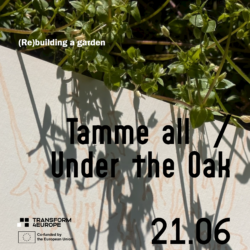
OPEN CALL: Under the Oak / (Re)building a Garden

EN_Co-fundedbytheEU_RGB_Monochrome
logo_black_&_white

EKA students, staff, alumni and friends; join us for (re)building EKA aed behind K10 building under the oak tree. We will work to initiate the beginnings of a new garden site, this one-day event (with some additional preparation days if you feel like it!) will be a starting point, somewhere to lay down our roots, take up space within the institution’s expanding campus, and dream of ways the garden can unfold and grow. 

Throughout the day we’ll spend time building a garden; practically, poetically and politically.. 

Breakfast and lunch will be provided. Materials and plants will also be provided, but if there is anything specific that you want to plant we welcome you to bring seeds/plants. 

You are welcome to join whether you would like to be involved in the garden’s future, have been involved in its past, or if you just want to spend a mid-summers Sunday under the oak tree; the garden will be passed between hands year after year.

All welcome, no experience necessary. 

Please sign up for the garden day here: https://tally.so/r/PdrNYP

Day content:

  • 10-10.30: Arriving, simple breakfast and introductions 
  • 10.30-11.45: reading together (excerpts of texts that cover various garden-foundations: compost, seeds, the commons, poetics/politics of community gardens)
  • 11.45-13.00: filling raised beds with compost, mulch
  • 13:00-14.00: lunch
  • 14:00-14:45: A notion to the future gardeners (yourselves or others) – manifesto, a list, a promise, an intention, a hope, 
  • 14:45-15.15: planting plants/seeds
  • 15:15-16:15: A holding space (rug decoration, from the previous activity)
  • 16:15-1700: final reflections, tidying up, ending.

One-day workshop is led by Jake Shepherd and Yvette Bathgate and funded by Transform4Europe.

 

Posted by Kati Saarits — Permalink

OPEN CALL: Under the Oak / (Re)building a Garden

Sunday 21 June, 2026

EN_Co-fundedbytheEU_RGB_Monochrome
logo_black_&_white

EKA students, staff, alumni and friends; join us for (re)building EKA aed behind K10 building under the oak tree. We will work to initiate the beginnings of a new garden site, this one-day event (with some additional preparation days if you feel like it!) will be a starting point, somewhere to lay down our roots, take up space within the institution’s expanding campus, and dream of ways the garden can unfold and grow. 

Throughout the day we’ll spend time building a garden; practically, poetically and politically.. 

Breakfast and lunch will be provided. Materials and plants will also be provided, but if there is anything specific that you want to plant we welcome you to bring seeds/plants. 

You are welcome to join whether you would like to be involved in the garden’s future, have been involved in its past, or if you just want to spend a mid-summers Sunday under the oak tree; the garden will be passed between hands year after year.

All welcome, no experience necessary. 

Please sign up for the garden day here: https://tally.so/r/PdrNYP

Day content:

  • 10-10.30: Arriving, simple breakfast and introductions 
  • 10.30-11.45: reading together (excerpts of texts that cover various garden-foundations: compost, seeds, the commons, poetics/politics of community gardens)
  • 11.45-13.00: filling raised beds with compost, mulch
  • 13:00-14.00: lunch
  • 14:00-14:45: A notion to the future gardeners (yourselves or others) – manifesto, a list, a promise, an intention, a hope, 
  • 14:45-15.15: planting plants/seeds
  • 15:15-16:15: A holding space (rug decoration, from the previous activity)
  • 16:15-1700: final reflections, tidying up, ending.

One-day workshop is led by Jake Shepherd and Yvette Bathgate and funded by Transform4Europe.

 

Posted by Kati Saarits — Permalink

27.08.2026

Seminar: Circular and Modular Construction Systems for Small Structures

At the seminar, we will introduce Met(s)aRING, a joint research and development project by EKA PAKK (Estonian Academy of Arts) and RMK (State Forest Management Centre), which aims to develop a circular and modular construction system for RMK’s visitor infrastructure, including small-scale structures and cabins.

The project explores how infrastructure can be designed to be adaptable, upgradable, and reusable over time. The focus is on recurring standardized timber components, the use of production residues, and solutions that reduce material consumption, simplify maintenance, and extend the lifespan of structures.

The aim of the seminar is to gather practical feedback from builders and manufacturers on the applicability of the system currently under development. We will discuss how standardized or flexible a construction system should be, the opportunities for using reclaimed or lower-grade timber, and how procurement models and collaboration frameworks influence the implementation of sustainable solutions.

You can register for the event HERE!

PROGRAMME

27 August 2026, 9:30–12:30
EKA White Building (Kotzebue 10, Tallinn)

9:30 Introduction to the ongoing research project, RMK’s long-term goals and ambitions (RMK)

9:45 Eight Design Principles for Visitor Infrastructure Design (EKA)

10:00 Introduction to the Construction System (EKA)

10:15 The Use of Underutilized and Lower-Value Timber in Construction (TalTech)

10:30 Coffee Break and Introduction to the Construction System Prototype

11:00–12:30 Workshop

Research at EKA PAKK is co-funded by the European Union and the Estonian Research Council through the project “PUUSTER: Development of Methods for Valorising Underutilized Timber and Wood Materials in Construction” (TEM-TA80).

This event is part of the Adapter Network Collaboration Club Series, a platform where researchers, companies, and representatives of the public and private sectors come together to engage in meaningful discussions and explore opportunities for collaboration. You can find all Adapter Collaboration Clubs here.

Posted by Eeros Lees — Permalink

Seminar: Circular and Modular Construction Systems for Small Structures

Thursday 27 August, 2026

At the seminar, we will introduce Met(s)aRING, a joint research and development project by EKA PAKK (Estonian Academy of Arts) and RMK (State Forest Management Centre), which aims to develop a circular and modular construction system for RMK’s visitor infrastructure, including small-scale structures and cabins.

The project explores how infrastructure can be designed to be adaptable, upgradable, and reusable over time. The focus is on recurring standardized timber components, the use of production residues, and solutions that reduce material consumption, simplify maintenance, and extend the lifespan of structures.

The aim of the seminar is to gather practical feedback from builders and manufacturers on the applicability of the system currently under development. We will discuss how standardized or flexible a construction system should be, the opportunities for using reclaimed or lower-grade timber, and how procurement models and collaboration frameworks influence the implementation of sustainable solutions.

You can register for the event HERE!

PROGRAMME

27 August 2026, 9:30–12:30
EKA White Building (Kotzebue 10, Tallinn)

9:30 Introduction to the ongoing research project, RMK’s long-term goals and ambitions (RMK)

9:45 Eight Design Principles for Visitor Infrastructure Design (EKA)

10:00 Introduction to the Construction System (EKA)

10:15 The Use of Underutilized and Lower-Value Timber in Construction (TalTech)

10:30 Coffee Break and Introduction to the Construction System Prototype

11:00–12:30 Workshop

Research at EKA PAKK is co-funded by the European Union and the Estonian Research Council through the project “PUUSTER: Development of Methods for Valorising Underutilized Timber and Wood Materials in Construction” (TEM-TA80).

This event is part of the Adapter Network Collaboration Club Series, a platform where researchers, companies, and representatives of the public and private sectors come together to engage in meaningful discussions and explore opportunities for collaboration. You can find all Adapter Collaboration Clubs here.

Posted by Eeros Lees — Permalink

20.01.2026

Public lecture: Dan Dubowitz: Cultural Masterplanning

The Estonian Academy of Arts will organize its 2026 workshop “Abandoned Landscapes” in Tallinn from 19 to 22 January, with the City Hall as the focus.

The aim of the workshop, which is already being held for the 14th time, is to practice international cooperation between students of architecture, heritage conservation and interior architecture, and to understand the needs and opportunities for preserving and using local heritage. This year, the workshop will be held in collaboration with lecturers and students of the Manchester School of Architecture (MSA).

On Tuesday, January 20 at 5 pm, Dan Dubowitz will give a public lecture in the EKA auditorium: Cultural Masterplanning.

Dan Dubowitz, Visiting Professor from Manchester School of Architecture, will introduce his celebrated work on Cultural Masterplanning, which has been developing new methods for engaging people earlier and better in the transformation of their city across the UK. He will introduce his current research project, Megalomania, which includes sites in Estonia (Naissaare and Hiiumaa), the Helsinki Archipelago, Latvia (Karosta) and Lithuania (Visiginas).


This lecture is the inaugural event of a new research and public pedagogy collaboration between MSA and EKA to investigate how mobile architectural methods, such as walking and talking after dark, choreographic things and slow photography can give voice and awaken a building with narcolepsy.

Several events open to the public will also take place as part of the workshop. All interested parties are welcome to attend for free.

  • Wednesday, January 21st at 5 pm, Ingel Vaikla’s documentary “The Housekeeper” (2015) will be screened in the EKA auditorium.
  • On Thursday, January 22nd at 5 pm at lobby stairs, student groups will present their short films about Linnahall made during the week.


Posted by Tiina Tammet — Permalink

Public lecture: Dan Dubowitz: Cultural Masterplanning

Tuesday 20 January, 2026

The Estonian Academy of Arts will organize its 2026 workshop “Abandoned Landscapes” in Tallinn from 19 to 22 January, with the City Hall as the focus.

The aim of the workshop, which is already being held for the 14th time, is to practice international cooperation between students of architecture, heritage conservation and interior architecture, and to understand the needs and opportunities for preserving and using local heritage. This year, the workshop will be held in collaboration with lecturers and students of the Manchester School of Architecture (MSA).

On Tuesday, January 20 at 5 pm, Dan Dubowitz will give a public lecture in the EKA auditorium: Cultural Masterplanning.

Dan Dubowitz, Visiting Professor from Manchester School of Architecture, will introduce his celebrated work on Cultural Masterplanning, which has been developing new methods for engaging people earlier and better in the transformation of their city across the UK. He will introduce his current research project, Megalomania, which includes sites in Estonia (Naissaare and Hiiumaa), the Helsinki Archipelago, Latvia (Karosta) and Lithuania (Visiginas).


This lecture is the inaugural event of a new research and public pedagogy collaboration between MSA and EKA to investigate how mobile architectural methods, such as walking and talking after dark, choreographic things and slow photography can give voice and awaken a building with narcolepsy.

Several events open to the public will also take place as part of the workshop. All interested parties are welcome to attend for free.

  • Wednesday, January 21st at 5 pm, Ingel Vaikla’s documentary “The Housekeeper” (2015) will be screened in the EKA auditorium.
  • On Thursday, January 22nd at 5 pm at lobby stairs, student groups will present their short films about Linnahall made during the week.


Posted by Tiina Tammet — Permalink

13.12.2025

Queer Feminist Zine Workshop “How to Recognize Queer Feminism?”

How to Recognize Queer Feminism?

Queer Feminist Zine Workshop – Sat. 13.12.2025

You’re warmly welcomed to take part in a queer feminist zine workshop “How to Recognise Queer Feminism?” taking place 13 December 2025, at 15:00 at Kumu Art Museum, seminar room on the second floor. After the lecture “Queer Feminism as a Form of Resistance” by Aet Kuusik, Maria Izabella Lehtsaar will lead the zine workshop that explores queer feminist thinking through the zine medium. Lehtsaar will offer guidance, share their own practice and accompany participants as they create their zines. The event is for free.

Rooted in feminist and queer DIY cultures, zines – self-made mini magazines or booklets – have long been tools for self-expression, resistance and community building. They allow us to work freely with text, image and collage – no artistic background is required. You can experiment with zines and reflect on how artistic practice can become a tool for empowerment and reclaiming space. The finished zines will be replicated, printed and spread around the city in various cafés, cultural hotpots and shops for free.

Please register here, participation is limited. Registration closes 08.12.2025.

Posted by Andres Lõo — Permalink

Queer Feminist Zine Workshop “How to Recognize Queer Feminism?”

Saturday 13 December, 2025

How to Recognize Queer Feminism?

Queer Feminist Zine Workshop – Sat. 13.12.2025

You’re warmly welcomed to take part in a queer feminist zine workshop “How to Recognise Queer Feminism?” taking place 13 December 2025, at 15:00 at Kumu Art Museum, seminar room on the second floor. After the lecture “Queer Feminism as a Form of Resistance” by Aet Kuusik, Maria Izabella Lehtsaar will lead the zine workshop that explores queer feminist thinking through the zine medium. Lehtsaar will offer guidance, share their own practice and accompany participants as they create their zines. The event is for free.

Rooted in feminist and queer DIY cultures, zines – self-made mini magazines or booklets – have long been tools for self-expression, resistance and community building. They allow us to work freely with text, image and collage – no artistic background is required. You can experiment with zines and reflect on how artistic practice can become a tool for empowerment and reclaiming space. The finished zines will be replicated, printed and spread around the city in various cafés, cultural hotpots and shops for free.

Please register here, participation is limited. Registration closes 08.12.2025.

Posted by Andres Lõo — Permalink

14.12.2025

WORKSHOP: “Jewellery Workshop Inspired by Ethnography”

DSC_3192_resized
DSC_3198_resized
DSC_3222_resized
DSC_3263_resized
DSC_3321_resized
DSC_3328_resized
DSC_3435_resized
DSC_3443_resized
DSC_3510_resized
DSC_3562_resized
DSC_3580_resized
DSC_3613_resized
DSC_3944_resized
DSC_5304_resized
“Jewellery Workshop Inspired by Ethnography”
On Sunday, 14th December, from 14:00 to 16:30, the Jewellery Workshop Inspired by Ethnography will be held in the NART artist residency spaces, led by Piret Puppart, head of the fashion design department at the Estonian Academy of Arts, and internationally recognized Sámi fashion designer Ramona Salo.
During the workshop, Ramona will introduce the creation of earrings inspired by Sámi traditions, and Piret will demonstrate how to make Christmas decorations using symbols originating from the Ingrian, Votian, and Izhorian regions. Participants may focus on just one direction or explore both. The final result will surely bring joy—either to keep for yourself or to place in a gift bag.

The workshop accommodates 10 participants, lasts 2.5 hours, and communication will take place in Estonian, Russian, and English. All materials are provided free of charge.

To participate, please register at: https://forms.gle/xJzMbdRuh2LcW6yc9
In addition to the workshop, guided tours of the contemporary Finno-Ugric fashion exhibition “Threads of Kinship” will take place:
Sat 13 December, 14:00–14:50 — Piret Puppart & Ramona Salo. Tour in English.
Sun 14 December, 13:15–14:00 — Piret Puppart. Tour in Estonian with additional comments in Russian.
Sun 11 January, 13:30–14:25 — Piret Puppart. Tour in Estonian with additional comments in Russian.

Sponsors: EKA, Eesti Kunstiakadeemia moedisaini osakond, Hõimurahvaste programm, Kultuurkapital, MTÜ Fennougria, NART, Narva soome-ugri kultuuripealinn 2025
Piltide autor Jelizaveta Gross (ig: @onlooker.photo)
Posted by Kristiina Nurk — Permalink

WORKSHOP: “Jewellery Workshop Inspired by Ethnography”

Sunday 14 December, 2025

DSC_3192_resized
DSC_3198_resized
DSC_3222_resized
DSC_3263_resized
DSC_3321_resized
DSC_3328_resized
DSC_3435_resized
DSC_3443_resized
DSC_3510_resized
DSC_3562_resized
DSC_3580_resized
DSC_3613_resized
DSC_3944_resized
DSC_5304_resized
“Jewellery Workshop Inspired by Ethnography”
On Sunday, 14th December, from 14:00 to 16:30, the Jewellery Workshop Inspired by Ethnography will be held in the NART artist residency spaces, led by Piret Puppart, head of the fashion design department at the Estonian Academy of Arts, and internationally recognized Sámi fashion designer Ramona Salo.
During the workshop, Ramona will introduce the creation of earrings inspired by Sámi traditions, and Piret will demonstrate how to make Christmas decorations using symbols originating from the Ingrian, Votian, and Izhorian regions. Participants may focus on just one direction or explore both. The final result will surely bring joy—either to keep for yourself or to place in a gift bag.

The workshop accommodates 10 participants, lasts 2.5 hours, and communication will take place in Estonian, Russian, and English. All materials are provided free of charge.

To participate, please register at: https://forms.gle/xJzMbdRuh2LcW6yc9
In addition to the workshop, guided tours of the contemporary Finno-Ugric fashion exhibition “Threads of Kinship” will take place:
Sat 13 December, 14:00–14:50 — Piret Puppart & Ramona Salo. Tour in English.
Sun 14 December, 13:15–14:00 — Piret Puppart. Tour in Estonian with additional comments in Russian.
Sun 11 January, 13:30–14:25 — Piret Puppart. Tour in Estonian with additional comments in Russian.

Sponsors: EKA, Eesti Kunstiakadeemia moedisaini osakond, Hõimurahvaste programm, Kultuurkapital, MTÜ Fennougria, NART, Narva soome-ugri kultuuripealinn 2025
Piltide autor Jelizaveta Gross (ig: @onlooker.photo)
Posted by Kristiina Nurk — Permalink

29.09.2025 — 05.10.2025

EKA Design Week

FB new
EDNädal_disiniöö-web

EKA invites you from September 29 to October 5 on a journey through different layers of young design.

The exhibition and event program bring together the heritage of EKA’s design past, the diversity of the present, and future directions, opening doors to fresh ideas and creative courage.

During EKA Design Week, a variety of events will take place:

Public lectures and discussion evenings – inspiring meetings where designers, faculty, and students discuss the role and meaning of design in today’s world.

Design workshops – our students and faculty offer the opportunity to experience the design creation process firsthand and explore new knowledge and skills in various fields. Workshops are open to all interested in contemporary design thinking and practical experimentation.

Pop-up shop – The pop-up shop offers visitors a rare chance to purchase unique products, support the journey of young designers, and take home a piece of EKA’s creative energy. Get young and fresh design directly from the creators.

Come and experience the vibrant and ever-changing landscape of young design – look back, be present, and peek into the future.

The EKA Design Week schedule:

September 29 – October 5 – Exhibition “Lines of the Past, Directions for the Future”
Open Mon–Fri 10:00–19:00, Sat–Sun 10:00–15:00 at EKA White House, Kotzebue 10.
Exhibition opening: September 29 at 16:00.

September 29 – October 5 – Design & Innovation Program 10th Anniversary Exhibition
Open Mon–Fri 10:00–19:00, Sat–Sun 10:00–15:00 at EKA White House, Kotzebue 10.

September 30 – October 1 – Two-day social design workshop “Designing Our Future for All”
Day 1: 09:45–13:00, Day 2: 14:00–17:15 + independent work between the two days.
Location: EKA White House, Kotzebue 10.

Workshop will be held in English.
Detailed description and schedule of the workshop.
REGISTER HERE.

September 30 at 17:30 – ERKI Fashion Show Discussion Evening
The discussion evening brings together the organizers, designers, and alumni of the ERKI Fashion Show to discuss the significance of the runway, behind-the-scenes stories of the creative process, and ERKI’s role in the Estonian design landscape. This is an opportunity to hear inspiring experiences, ask questions, and see how young fashion designers bring their ideas to life.
Location: EKA Main Building Foyer, Põhja pst 10.

The event will be in Estonian.

September 30, 14:00–16:00 – Open Workshop “Gardenly Slowness”
Instructors: Marta Põldma and Jane Remm (places are full).
Location: EKA White House Monumental Studio, Kotzebue 10.
(Join the waiting list, the event will be in Estonian.)

October 1 at 17:30 – Open Lecture “Creative Design Research: Body-Inclusive Play for Children and Their Grandparents Living Far Away”
Lecturer: Kristi Kuusk.
Location: EKA Foyer, Põhja pst 7
The lecture will be held in English.

October 2 at 18:00 – LEIDA Article Collection Presentation
Introduction of a new edition gathering reflections and analyses in the field of design.
Location: EKA Foyer, Põhja pst 7
(Please RSVP)

October 7 at 19:00 – Design and Innovation Program 10th Anniversary Celebration
Location: EKA White House Monumental Studio (invitation only)

EKA Design Week Facebook event here.

Posted by Sirle Rohusaar — Permalink

EKA Design Week

Monday 29 September, 2025 — Sunday 05 October, 2025

FB new
EDNädal_disiniöö-web

EKA invites you from September 29 to October 5 on a journey through different layers of young design.

The exhibition and event program bring together the heritage of EKA’s design past, the diversity of the present, and future directions, opening doors to fresh ideas and creative courage.

During EKA Design Week, a variety of events will take place:

Public lectures and discussion evenings – inspiring meetings where designers, faculty, and students discuss the role and meaning of design in today’s world.

Design workshops – our students and faculty offer the opportunity to experience the design creation process firsthand and explore new knowledge and skills in various fields. Workshops are open to all interested in contemporary design thinking and practical experimentation.

Pop-up shop – The pop-up shop offers visitors a rare chance to purchase unique products, support the journey of young designers, and take home a piece of EKA’s creative energy. Get young and fresh design directly from the creators.

Come and experience the vibrant and ever-changing landscape of young design – look back, be present, and peek into the future.

The EKA Design Week schedule:

September 29 – October 5 – Exhibition “Lines of the Past, Directions for the Future”
Open Mon–Fri 10:00–19:00, Sat–Sun 10:00–15:00 at EKA White House, Kotzebue 10.
Exhibition opening: September 29 at 16:00.

September 29 – October 5 – Design & Innovation Program 10th Anniversary Exhibition
Open Mon–Fri 10:00–19:00, Sat–Sun 10:00–15:00 at EKA White House, Kotzebue 10.

September 30 – October 1 – Two-day social design workshop “Designing Our Future for All”
Day 1: 09:45–13:00, Day 2: 14:00–17:15 + independent work between the two days.
Location: EKA White House, Kotzebue 10.

Workshop will be held in English.
Detailed description and schedule of the workshop.
REGISTER HERE.

September 30 at 17:30 – ERKI Fashion Show Discussion Evening
The discussion evening brings together the organizers, designers, and alumni of the ERKI Fashion Show to discuss the significance of the runway, behind-the-scenes stories of the creative process, and ERKI’s role in the Estonian design landscape. This is an opportunity to hear inspiring experiences, ask questions, and see how young fashion designers bring their ideas to life.
Location: EKA Main Building Foyer, Põhja pst 10.

The event will be in Estonian.

September 30, 14:00–16:00 – Open Workshop “Gardenly Slowness”
Instructors: Marta Põldma and Jane Remm (places are full).
Location: EKA White House Monumental Studio, Kotzebue 10.
(Join the waiting list, the event will be in Estonian.)

October 1 at 17:30 – Open Lecture “Creative Design Research: Body-Inclusive Play for Children and Their Grandparents Living Far Away”
Lecturer: Kristi Kuusk.
Location: EKA Foyer, Põhja pst 7
The lecture will be held in English.

October 2 at 18:00 – LEIDA Article Collection Presentation
Introduction of a new edition gathering reflections and analyses in the field of design.
Location: EKA Foyer, Põhja pst 7
(Please RSVP)

October 7 at 19:00 – Design and Innovation Program 10th Anniversary Celebration
Location: EKA White House Monumental Studio (invitation only)

EKA Design Week Facebook event here.

Posted by Sirle Rohusaar — Permalink

25.08.2025 — 29.08.2025

The Erasmus BIP workshop “Navigating Through the Complexities of the Digital Jungle

The Erasmus BIP workshop “Navigating Through the Complexities of the Digital Jungle” will be held on 25–29 August 2025, organized by the Department of Ceramics of the Estonian Academy of Arts.

19 students from five partner schools will participate: Aalto University, Vilnius Academy of Arts, Latvian Academy of Arts, Saarland University of the Arts and Estonian Academy of Arts.

The course will be supervised by Dries Verbruggen (Belgium), Lauri Kilusk, Kaiko Kivi and Martin Melioranski.

The workshop will focus on the application of 3D design and printing in design. Students will be tasked with identifying spatial conditions in the human living environment where biological diversity and coexistence are limited. They will then use 3D design to create site-specific interventions aimed at increasing species diversity and/or the circulation of energy and matter, while trying to respect the architecture and other specificities of the place.

The workshop will include lectures, presentations, discussions and practical activities. Technical sessions will cover various slicing software and parametric modeling techniques, placing the practice of 3D printing within a broader theoretical framework.

The project will end with a pop-up exhibition on August 29th and a roundtable discussion with participants and teachers.

Coordinator: Kersti Laanmaa

Posted by Kersti Laanmaa — Permalink

The Erasmus BIP workshop “Navigating Through the Complexities of the Digital Jungle

Monday 25 August, 2025 — Friday 29 August, 2025

The Erasmus BIP workshop “Navigating Through the Complexities of the Digital Jungle” will be held on 25–29 August 2025, organized by the Department of Ceramics of the Estonian Academy of Arts.

19 students from five partner schools will participate: Aalto University, Vilnius Academy of Arts, Latvian Academy of Arts, Saarland University of the Arts and Estonian Academy of Arts.

The course will be supervised by Dries Verbruggen (Belgium), Lauri Kilusk, Kaiko Kivi and Martin Melioranski.

The workshop will focus on the application of 3D design and printing in design. Students will be tasked with identifying spatial conditions in the human living environment where biological diversity and coexistence are limited. They will then use 3D design to create site-specific interventions aimed at increasing species diversity and/or the circulation of energy and matter, while trying to respect the architecture and other specificities of the place.

The workshop will include lectures, presentations, discussions and practical activities. Technical sessions will cover various slicing software and parametric modeling techniques, placing the practice of 3D printing within a broader theoretical framework.

The project will end with a pop-up exhibition on August 29th and a roundtable discussion with participants and teachers.

Coordinator: Kersti Laanmaa

Posted by Kersti Laanmaa — Permalink

22.08.2025

Marta Konovalov Workshop “Mundane Spots”

You are invited to Marta Konovalov’s home and garden. There you will have the possibility to investigate the development of the aesthetics of affect and promote emotional durability. To be engaged with my practice – to repair and to regenerate textiles. Or just to observe. I will also invite you for a walk in the landscape and my garden. To share some food together.

Please bring some textile artefacts or a piece of clothing with you – something that has worn out or perhaps has stains or holes. I will appreciate it if you will bring your observations and ideas.
You will meet all sorts of critters there. Your kin and children are also welcome.
Hope to see you soon, at the periphery.
Marta

Location: Veisjärve Village; Viljandi County

Duration: 22.08.2025 12.00–17.30
Language: English and Estonian

Contact: marta.konovalov@artun.ee
+37256630717

Registration: https://forms.gle/hgA818TaHnjMv15o7

Marta Konovalov is a designer-researcher, craftivist and educator focusing on repair and regenerative textile design. She is a lecturer and doctoral student at Estonian Academy of Arts.

Photo: Kärt Petser

Posted by Andres Lõo — Permalink

Marta Konovalov Workshop “Mundane Spots”

Friday 22 August, 2025

You are invited to Marta Konovalov’s home and garden. There you will have the possibility to investigate the development of the aesthetics of affect and promote emotional durability. To be engaged with my practice – to repair and to regenerate textiles. Or just to observe. I will also invite you for a walk in the landscape and my garden. To share some food together.

Please bring some textile artefacts or a piece of clothing with you – something that has worn out or perhaps has stains or holes. I will appreciate it if you will bring your observations and ideas.
You will meet all sorts of critters there. Your kin and children are also welcome.
Hope to see you soon, at the periphery.
Marta

Location: Veisjärve Village; Viljandi County

Duration: 22.08.2025 12.00–17.30
Language: English and Estonian

Contact: marta.konovalov@artun.ee
+37256630717

Registration: https://forms.gle/hgA818TaHnjMv15o7

Marta Konovalov is a designer-researcher, craftivist and educator focusing on repair and regenerative textile design. She is a lecturer and doctoral student at Estonian Academy of Arts.

Photo: Kärt Petser

Posted by Andres Lõo — Permalink

02.06.2025 — 07.06.2025

Para-educational Research Seminar

PARA-EDUCATIONAL RESEARCH SEMINAR BY PROF. DR. NORA STERNFELD
in collaboration with Grégoire Rousseau, Mira Samonig and Julia Stolba

How can educational and curatorial practices of knowledge production challenge what can be said, done and seen? In an international transdisciplinary research seminar, we think about educational research and exhibition studies within and beyond the exhibition, about case studies within and beyond the canon and about research within and beyond western methodologies.

Running from Monday, 2nd of June – Saturday, 7th of June 2025 at EKA, the seminar is an ongoing open context for researchers in educational research and exhibition studies. It follows strategies of knowledge production as exploration, investigation, imagination and reflection. Although registration at the seminar is now closed, feel free to drop by and listen in if you are interested.

Join us for the public radio broadcast about ‘para-educational research’ aired by Station of Commons!

Thursday, 5th of June 2025 from 5pm – in Tallinn at ETC (Niine 8a) or from anywhere via stationofcommons.com.


Posted by Andres Lõo — Permalink

Para-educational Research Seminar

Monday 02 June, 2025 — Saturday 07 June, 2025

PARA-EDUCATIONAL RESEARCH SEMINAR BY PROF. DR. NORA STERNFELD
in collaboration with Grégoire Rousseau, Mira Samonig and Julia Stolba

How can educational and curatorial practices of knowledge production challenge what can be said, done and seen? In an international transdisciplinary research seminar, we think about educational research and exhibition studies within and beyond the exhibition, about case studies within and beyond the canon and about research within and beyond western methodologies.

Running from Monday, 2nd of June – Saturday, 7th of June 2025 at EKA, the seminar is an ongoing open context for researchers in educational research and exhibition studies. It follows strategies of knowledge production as exploration, investigation, imagination and reflection. Although registration at the seminar is now closed, feel free to drop by and listen in if you are interested.

Join us for the public radio broadcast about ‘para-educational research’ aired by Station of Commons!

Thursday, 5th of June 2025 from 5pm – in Tallinn at ETC (Niine 8a) or from anywhere via stationofcommons.com.


Posted by Andres Lõo — Permalink

02.05.2025

Growing smaller? Lessons from Ida-Virumaa

In Ida-Virumaa, a region that once was a home to numerous vibrant settlements sustained by the oil shale mining industry which brought many people to the area, significant signs of shrinkage have emerged following the industry’s decline.

Today, a significant number of  people are relocating, often leaving behind only the memory of a home. As part of our research on the urban landscape of Ida-Virumaa, we spent a day exploring some abandoned properties in Kiviõli, Kohtla-Järve and Jõhvi. Many of these homes continue to contain an abundance of personal items and unspoken stories that reveal not only the past, but also the potential future of the region. Our exhibition will guide  you through the series of seven exhibits all over EKA, each offering a unique perspective on the transitioning identity of Ida-Virumaa.

From installations and maps to TikTok, our projects explore diverse ways of showcasing the everyday of shrinking communities and their ongoing transformation. Through stories of dachas, renovation efforts and the everyday struggles of youth and seniors, we confront the challenges of decline. This includes the sense of entrapment experiences by individuals and their mental health challenges that often stem from systemic failure. At the same time, we search for the possibility of sparks and moments of light in these shrinking places. Our work aims to give insight on both the challenges and the resilience found in these spaces, where accessibility, support and opportunity remain crucial for people of all ages.

SAVE THE DATE!
2nd of May, 15:00 in the open area of A-400.

Projects:

Does the JTF really LNOB?

Annabel Pops, Paula Fischer

The Just Transition Fund is the latest effort under the European Green Deal to ease the burden of the transition from oil shale mining on the workers and regions. Ida-Virumaa is the region in Estonia to receive funding, and one that finds itself between a negative view on the mining industry’s past and a somewhat overly optimistic vision of the future. By questioning the justness of the transition, we are mapping out the new narratives positioned upon the region and ask critically, if the forthcoming change will really LNOB (leave no one behind).

#IdaIsHome

Anna Dzebliuk, Melissa Lee

After visiting Ida-Virumaa, we noticed a deep sense of care among its residents even though this place may often be labelled as “shrinking”. This research explores how perceptions of “home” and ground-up initiatives can support local resilience. TikTok became a tool to test how digital storytelling and informal media can spark dialogue around identity, belonging and the everyday realities of so-called “shrinking” cities. By tapping into a space where many young people already express themselves, we asked: can social media help reimagine these places not as abandoned, but as alive with care, creativity and potential?

Dachniki for Future

Yiğithan Akçay, Sarah John von Zydowitz

Dachas, the iconic countryside retreats of the former Soviet Union, have a rich and complex history serving as both leisure spaces and essential sources of food production. Today dachas function not only as places of leisure but also as social and ecological safety nets. They provide a contrast to urban community gardens, offering more autonomy and stronger intergenerational connections. We visited three Dacha allotment garden cooperatives to get into contact with Dachnikis through letters, asking about their commoning and community practices.

Shifting the Narrative: “Chronic” Struggles of Renovation

Ləman Məmmədli, Viktorija Kolomažņikova

Declining towns have become a reality in regions of eastern Estonia. They have been mostly dependent on heavy industries such as oil shale mining to support their economies. In pursuit of reducing climate damages, such areas that produce fossil fuels have been left in a tricky situation. This industry is planned to be phased out completely soon and replaced with more environmentally sustainable options. In order to make the transition smoother, different grants and funds have been allocated to these areas. These allocations were supposed to create more job opportunities, develop the urban fabric and infrastructure, and improve the living conditions of the citizens. However, through a deeper dive struggles of a senior demographic, especially with the housing renovations, become apparent. This research aims to identify, analyze, and possibly open up a larger discussion on the issues faced by elderly communities when it comes to the topic of renovating their homes and improving their quality of life in shrinking cities.

Decades of Slow Retreat:short leap to social realities and mental health condition

Adeolu Afolabi, Zoë Lipp

Mental health is often the silent echo of long-term neglect. In shrinking regions like Ida-Virumaa—where buildings stand half-empty, the population ages, and public spaces quietly disappear—the impact isn’t just demographic; it’s emotional. Missing park benches, broken stairwells, and fading services aren’t just details—they shape how people live, connect, and endure. This game transforms these everyday realities into tangible experiences. Through each event card, we open a window into the lives of those navigating the in-betweens: between generations, between collapsing systems, between floors in buildings without elevators. Most residents don’t break—they adapt. But the strain leaves its mark, even when no one talks about it. By playing, reflecting, and stepping into these roles, we’re reminded that mental health is not just personal—it’s spatial, social, and political. And sometimes, a warm bowl of soup, a fixed light bulb, or simply an unlocked door is enough to hold a community together.

Trapped at one’s own home

Anna Böhmová, Hanna Steckl

By visiting an old man’s home in Kivioli, Ida-Virumaa, we delved into the topics and problems faced by the elderly in this region. By exploring the health care and financial situation, we came to the issue of the accessibility of Soviet-era apartment blocks. Most of the elderly in this area live in these houses, which are up to five floors high and have no elevators. For many of these people, it is not possible to move anywhere else, and therefore, they end up trapped in their homes. They have nowhere to go, but their current home doesn’t allow them to engage with daily needs and activities. We explore this topic by discussing different possible solutions- some are physical, and some are more on an imaginative level…

Yes / No / Other

Lukas Laubre, Katrīna Stīna Jesikena

With the changing of the guard over thirty years ago, some have found themselves in the middle of a major international dispute forced to choose sides between two or more parents bickering for their loyalty, allegiance. “Yes / No / Other” explores the tough questions these people are forced to answer every day. Questions that, for the sake of supposed national security (of the right side), reach deep into the most private of spheres: identity, domestic life, ideology. In reality, most would rather be left alone and are at best indifferent to these issues. But the questions keep coming, relentlessly and one-sidedly, as if loyalty were a simple box to check and a lifetime of complexity could be conveniently filed away — while others, with the right passports or the right surnames, live freely without ever being harassed.

Urban Studies Urban Models course, tutored by Keiti Kljavin & Johanna Holvandus

Posted by Andres Lõo — Permalink

Growing smaller? Lessons from Ida-Virumaa

Friday 02 May, 2025

In Ida-Virumaa, a region that once was a home to numerous vibrant settlements sustained by the oil shale mining industry which brought many people to the area, significant signs of shrinkage have emerged following the industry’s decline.

Today, a significant number of  people are relocating, often leaving behind only the memory of a home. As part of our research on the urban landscape of Ida-Virumaa, we spent a day exploring some abandoned properties in Kiviõli, Kohtla-Järve and Jõhvi. Many of these homes continue to contain an abundance of personal items and unspoken stories that reveal not only the past, but also the potential future of the region. Our exhibition will guide  you through the series of seven exhibits all over EKA, each offering a unique perspective on the transitioning identity of Ida-Virumaa.

From installations and maps to TikTok, our projects explore diverse ways of showcasing the everyday of shrinking communities and their ongoing transformation. Through stories of dachas, renovation efforts and the everyday struggles of youth and seniors, we confront the challenges of decline. This includes the sense of entrapment experiences by individuals and their mental health challenges that often stem from systemic failure. At the same time, we search for the possibility of sparks and moments of light in these shrinking places. Our work aims to give insight on both the challenges and the resilience found in these spaces, where accessibility, support and opportunity remain crucial for people of all ages.

SAVE THE DATE!
2nd of May, 15:00 in the open area of A-400.

Projects:

Does the JTF really LNOB?

Annabel Pops, Paula Fischer

The Just Transition Fund is the latest effort under the European Green Deal to ease the burden of the transition from oil shale mining on the workers and regions. Ida-Virumaa is the region in Estonia to receive funding, and one that finds itself between a negative view on the mining industry’s past and a somewhat overly optimistic vision of the future. By questioning the justness of the transition, we are mapping out the new narratives positioned upon the region and ask critically, if the forthcoming change will really LNOB (leave no one behind).

#IdaIsHome

Anna Dzebliuk, Melissa Lee

After visiting Ida-Virumaa, we noticed a deep sense of care among its residents even though this place may often be labelled as “shrinking”. This research explores how perceptions of “home” and ground-up initiatives can support local resilience. TikTok became a tool to test how digital storytelling and informal media can spark dialogue around identity, belonging and the everyday realities of so-called “shrinking” cities. By tapping into a space where many young people already express themselves, we asked: can social media help reimagine these places not as abandoned, but as alive with care, creativity and potential?

Dachniki for Future

Yiğithan Akçay, Sarah John von Zydowitz

Dachas, the iconic countryside retreats of the former Soviet Union, have a rich and complex history serving as both leisure spaces and essential sources of food production. Today dachas function not only as places of leisure but also as social and ecological safety nets. They provide a contrast to urban community gardens, offering more autonomy and stronger intergenerational connections. We visited three Dacha allotment garden cooperatives to get into contact with Dachnikis through letters, asking about their commoning and community practices.

Shifting the Narrative: “Chronic” Struggles of Renovation

Ləman Məmmədli, Viktorija Kolomažņikova

Declining towns have become a reality in regions of eastern Estonia. They have been mostly dependent on heavy industries such as oil shale mining to support their economies. In pursuit of reducing climate damages, such areas that produce fossil fuels have been left in a tricky situation. This industry is planned to be phased out completely soon and replaced with more environmentally sustainable options. In order to make the transition smoother, different grants and funds have been allocated to these areas. These allocations were supposed to create more job opportunities, develop the urban fabric and infrastructure, and improve the living conditions of the citizens. However, through a deeper dive struggles of a senior demographic, especially with the housing renovations, become apparent. This research aims to identify, analyze, and possibly open up a larger discussion on the issues faced by elderly communities when it comes to the topic of renovating their homes and improving their quality of life in shrinking cities.

Decades of Slow Retreat:short leap to social realities and mental health condition

Adeolu Afolabi, Zoë Lipp

Mental health is often the silent echo of long-term neglect. In shrinking regions like Ida-Virumaa—where buildings stand half-empty, the population ages, and public spaces quietly disappear—the impact isn’t just demographic; it’s emotional. Missing park benches, broken stairwells, and fading services aren’t just details—they shape how people live, connect, and endure. This game transforms these everyday realities into tangible experiences. Through each event card, we open a window into the lives of those navigating the in-betweens: between generations, between collapsing systems, between floors in buildings without elevators. Most residents don’t break—they adapt. But the strain leaves its mark, even when no one talks about it. By playing, reflecting, and stepping into these roles, we’re reminded that mental health is not just personal—it’s spatial, social, and political. And sometimes, a warm bowl of soup, a fixed light bulb, or simply an unlocked door is enough to hold a community together.

Trapped at one’s own home

Anna Böhmová, Hanna Steckl

By visiting an old man’s home in Kivioli, Ida-Virumaa, we delved into the topics and problems faced by the elderly in this region. By exploring the health care and financial situation, we came to the issue of the accessibility of Soviet-era apartment blocks. Most of the elderly in this area live in these houses, which are up to five floors high and have no elevators. For many of these people, it is not possible to move anywhere else, and therefore, they end up trapped in their homes. They have nowhere to go, but their current home doesn’t allow them to engage with daily needs and activities. We explore this topic by discussing different possible solutions- some are physical, and some are more on an imaginative level…

Yes / No / Other

Lukas Laubre, Katrīna Stīna Jesikena

With the changing of the guard over thirty years ago, some have found themselves in the middle of a major international dispute forced to choose sides between two or more parents bickering for their loyalty, allegiance. “Yes / No / Other” explores the tough questions these people are forced to answer every day. Questions that, for the sake of supposed national security (of the right side), reach deep into the most private of spheres: identity, domestic life, ideology. In reality, most would rather be left alone and are at best indifferent to these issues. But the questions keep coming, relentlessly and one-sidedly, as if loyalty were a simple box to check and a lifetime of complexity could be conveniently filed away — while others, with the right passports or the right surnames, live freely without ever being harassed.

Urban Studies Urban Models course, tutored by Keiti Kljavin & Johanna Holvandus

Posted by Andres Lõo — Permalink