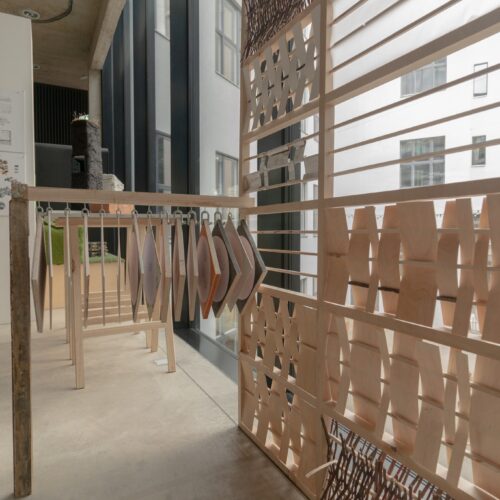
Peer review event of Jane Remm’s doctoral project

04.10.2024

Peer review event of Jane Remm’s doctoral project

On 4 October the peer review event of Jane Remm’s project “Interspecies Social Sculpture” will take place in Karula National Park. The event begins at 13:00 with a tour of the exhibition (starting point: Mähkli bus stop https://maps.app.goo.gl/fidsotPcnY2HtJgc9) and continues with the review at 15:30.
“Interspecies Social Sculpture” is the second peer-reviewed project of Jane Remm’s artistic research doctoral thesis.

Supervisor: Dr. Urve Sinijärv
Project reviewers: Prof. Linda Kaljundi (Estonian Academy of Arts), dr Taru Elfving (CAA Contemporary Art Archipelago, Finland)

“Interspecies Social Sculpture” conceptualizes the garden and the forest as a multi-perspective creative environment. Expanding Joseph Beuys’ concept of social sculpture into a multifaceted context, the artist explores what it means to harness everyone’s creative potential in a modern age, when the world in an ecological crisis needs to adapt to degrowth.
“Interspecies social sculpture” combines the ecological dimension in the form of increasing biodiversity, the dimension of interspecies co-creation and the social dimension through public events. The experiential exhibition tour opens up different perspectives on the garden and forest through active participation. Read more.

Jane Remm is an artist, art teacher and artistic researcher, doctoral student at EKA and art didactics lecturer at Tallinn University BFM. Jane Remm’s work focuses on the representation of the experience of nature, co-creation and communication with different life forms. She is interested in what are the possibilities to understand and interpret the life experience of other species and communicate with them as equal dialogue partners using the means of art. She values manual working and co-creation with other species as a way of perceiving herself as part of nature.

CV: https://www.etis.ee/CV/Jane_Remm/, creative portfolio: www.janeremm.ee


Posted by Irene Hütsi — Permalink

Peer review event of Jane Remm’s doctoral project

Friday 04 October, 2024

On 4 October the peer review event of Jane Remm’s project “Interspecies Social Sculpture” will take place in Karula National Park. The event begins at 13:00 with a tour of the exhibition (starting point: Mähkli bus stop https://maps.app.goo.gl/fidsotPcnY2HtJgc9) and continues with the review at 15:30.
“Interspecies Social Sculpture” is the second peer-reviewed project of Jane Remm’s artistic research doctoral thesis.

Supervisor: Dr. Urve Sinijärv
Project reviewers: Prof. Linda Kaljundi (Estonian Academy of Arts), dr Taru Elfving (CAA Contemporary Art Archipelago, Finland)

“Interspecies Social Sculpture” conceptualizes the garden and the forest as a multi-perspective creative environment. Expanding Joseph Beuys’ concept of social sculpture into a multifaceted context, the artist explores what it means to harness everyone’s creative potential in a modern age, when the world in an ecological crisis needs to adapt to degrowth.
“Interspecies social sculpture” combines the ecological dimension in the form of increasing biodiversity, the dimension of interspecies co-creation and the social dimension through public events. The experiential exhibition tour opens up different perspectives on the garden and forest through active participation. Read more.

Jane Remm is an artist, art teacher and artistic researcher, doctoral student at EKA and art didactics lecturer at Tallinn University BFM. Jane Remm’s work focuses on the representation of the experience of nature, co-creation and communication with different life forms. She is interested in what are the possibilities to understand and interpret the life experience of other species and communicate with them as equal dialogue partners using the means of art. She values manual working and co-creation with other species as a way of perceiving herself as part of nature.

CV: https://www.etis.ee/CV/Jane_Remm/, creative portfolio: www.janeremm.ee


Posted by Irene Hütsi — Permalink

18.09.2024 — 02.10.2024

Eleftheria Irene Kofidou in Uus Rada Gallery

You are warmly invited to “A little bit calmer than before” by Eleftheria Irene Kofidou

Opening and a performance: 18.09 18:00

Exhibition opening times: 19.09-02.10 on the weekdays 14:00-18:00; 21.-22.09 14:00-16:00; 28.09-29.09 closed

A little bit calmer than before, is an additional instructional comment by composer J. Strauss for his musical piece Don Quixote op. 35 variation VII – The Ride through the Air. As ‘a little bit’ is a vaguely countable amount, it becomes very hard to place it inside a spectrum, unless someone has access to the other variables of the equation. In Kofidou’s installation the composer’s directory line lies out of context, as there is no before, nor afterwards to compare the present moment to, but in a quixotic analogy to her homeland’s socio-political situation.

“I will pay off for my everyday victories by losing the war” states the burnt slogan on the gallery wall, a recreation of a graffiti that existed in Aristotle University Campus, during the artist’s teenage years. As Orthodox tradition has it, during Easter, believers mark the sign of the cross on their door frames, using the flame of the holy light from their candles; an act of shielding the household from evil and a wish for good luck. The campus looks very different now, the once messy wall is now white, the legendary punk squat of the Department of Biology is closed down and a new special police unit is established. The slogan, long gone, is recreated again, burnt on the wall as a tribute to the missing particles, the lost fractures of collective memory. But enough with pessimism in politics; Under its surface, it doesn’t wish to become another loaded message in limbo; fights will be given at any cost, even the cost of an already foreseen outcome. In the Dispossessed, Ursula K. Le Guin mentions “There was a wall. It did not look important (…) But the idea was real. It was important. (…) Like all walls it was ambiguous, two-faced. What was inside it and what was outside it depended upon which side of it you were on.” There are two walls, one that already exists and another one; fractured and initially horizontal; is it there to dominate or to seal?

The installation becomes a set and the objects act as props for the performance; trying to grasp this certain type of calmness that comes after the strong fumes of anger have evaporated and resides in the process of preparation of oneself; the anticipation for something that is coming and is not calm at all. Is it there to be later broken?

The artist wishes to thank: Anu Vahtra, Ats Kruusing, Eleni Kofidou, Erik Hõim.

Graphic design: Eleni Kofidou

Eleftheria Irene Kofidou (1995) is a Greek artist based in Tallinn, who is mostly working with installations, performance art and text. Her art practice is often interconnected with poetry and focuses on processes of layering meanings, socio political connotations related mostly to her background and exploring ways that language triggers movement.

Posted by Andres Lõo — Permalink

Eleftheria Irene Kofidou in Uus Rada Gallery

Wednesday 18 September, 2024 — Wednesday 02 October, 2024

You are warmly invited to “A little bit calmer than before” by Eleftheria Irene Kofidou

Opening and a performance: 18.09 18:00

Exhibition opening times: 19.09-02.10 on the weekdays 14:00-18:00; 21.-22.09 14:00-16:00; 28.09-29.09 closed

A little bit calmer than before, is an additional instructional comment by composer J. Strauss for his musical piece Don Quixote op. 35 variation VII – The Ride through the Air. As ‘a little bit’ is a vaguely countable amount, it becomes very hard to place it inside a spectrum, unless someone has access to the other variables of the equation. In Kofidou’s installation the composer’s directory line lies out of context, as there is no before, nor afterwards to compare the present moment to, but in a quixotic analogy to her homeland’s socio-political situation.

“I will pay off for my everyday victories by losing the war” states the burnt slogan on the gallery wall, a recreation of a graffiti that existed in Aristotle University Campus, during the artist’s teenage years. As Orthodox tradition has it, during Easter, believers mark the sign of the cross on their door frames, using the flame of the holy light from their candles; an act of shielding the household from evil and a wish for good luck. The campus looks very different now, the once messy wall is now white, the legendary punk squat of the Department of Biology is closed down and a new special police unit is established. The slogan, long gone, is recreated again, burnt on the wall as a tribute to the missing particles, the lost fractures of collective memory. But enough with pessimism in politics; Under its surface, it doesn’t wish to become another loaded message in limbo; fights will be given at any cost, even the cost of an already foreseen outcome. In the Dispossessed, Ursula K. Le Guin mentions “There was a wall. It did not look important (…) But the idea was real. It was important. (…) Like all walls it was ambiguous, two-faced. What was inside it and what was outside it depended upon which side of it you were on.” There are two walls, one that already exists and another one; fractured and initially horizontal; is it there to dominate or to seal?

The installation becomes a set and the objects act as props for the performance; trying to grasp this certain type of calmness that comes after the strong fumes of anger have evaporated and resides in the process of preparation of oneself; the anticipation for something that is coming and is not calm at all. Is it there to be later broken?

The artist wishes to thank: Anu Vahtra, Ats Kruusing, Eleni Kofidou, Erik Hõim.

Graphic design: Eleni Kofidou

Eleftheria Irene Kofidou (1995) is a Greek artist based in Tallinn, who is mostly working with installations, performance art and text. Her art practice is often interconnected with poetry and focuses on processes of layering meanings, socio political connotations related mostly to her background and exploring ways that language triggers movement.

Posted by Andres Lõo — Permalink

17.09.2024

Open Lecture: „Design is not Anymore an Accident“ by Alexandra Midal

Design historian, curator and professor Alexandra Midal will give an open lecture, „Design is not anymore an Accident“, on Tuesday, 17 September, at 16:00 in room A501.

Midal’s lecture will be based on her book „Design by Accident: For a New History of Design“ (Sternberg Press, 2019).

Alexandra Midal writes that design history was written by accident. In her lecture, she draws attention to the forgotten history of design and raises the possibility of a 100% and all-pervasive new historiography that reformulates a design discipline.

The Design Open Lecture series 2024 is part of Sandra Nuut and Ruth-Helene Melioranski‘s Design Issues course. It is public and open to all; however, the seminar following the lecture will be held for the course students.

Alexandra Midal is a professor at the University of Art and Design HEAD-Genève and Head of the Department of Critical Thinking at Ensci-Les Ateliers, Paris. Art and design historian, she combines practice and theory-based research as an artist-curator, theoretician and film essayist. Her research explores the blind spots and grey areas of design history, as evident in her two latest books, The Murder Factory (Sternberg Press, 2023) and Design by Accident: For a New History of Design (Sternberg Press, 2019). She studied literature, architecture and art history at Princeton University (NJ) and in Paris (Paris-Sorbonne). She has curated a number of international exhibitions on visual culture, design, film, and politics. She is the guest curator of the next Biennale Bio28, Ljubljana, Slovenia, entitled Double Agent: Do You Speak Flower?

Posted by Andres Lõo — Permalink

Open Lecture: „Design is not Anymore an Accident“ by Alexandra Midal

Tuesday 17 September, 2024

Design historian, curator and professor Alexandra Midal will give an open lecture, „Design is not anymore an Accident“, on Tuesday, 17 September, at 16:00 in room A501.

Midal’s lecture will be based on her book „Design by Accident: For a New History of Design“ (Sternberg Press, 2019).

Alexandra Midal writes that design history was written by accident. In her lecture, she draws attention to the forgotten history of design and raises the possibility of a 100% and all-pervasive new historiography that reformulates a design discipline.

The Design Open Lecture series 2024 is part of Sandra Nuut and Ruth-Helene Melioranski‘s Design Issues course. It is public and open to all; however, the seminar following the lecture will be held for the course students.

Alexandra Midal is a professor at the University of Art and Design HEAD-Genève and Head of the Department of Critical Thinking at Ensci-Les Ateliers, Paris. Art and design historian, she combines practice and theory-based research as an artist-curator, theoretician and film essayist. Her research explores the blind spots and grey areas of design history, as evident in her two latest books, The Murder Factory (Sternberg Press, 2023) and Design by Accident: For a New History of Design (Sternberg Press, 2019). She studied literature, architecture and art history at Princeton University (NJ) and in Paris (Paris-Sorbonne). She has curated a number of international exhibitions on visual culture, design, film, and politics. She is the guest curator of the next Biennale Bio28, Ljubljana, Slovenia, entitled Double Agent: Do You Speak Flower?

Posted by Andres Lõo — Permalink

13.09.2024 — 01.12.2024

Jüri Kermik “Joint Double” at ETDM

The exhibition “Joint Double” by Jüri Kermik engages with the dynamics of the design process and its involvement in looking forward and looking back. “It originates from my long-term interest in regional design and my experience of places I consider home, Estonia and Suffolk,” shares Kermik.

In 2017, having settled to live and work in Suffolk, Kermik noticed similarities and differences between Estonian and Suffolk chair-making traditions. The lightweight vernacular chairs, marked with signs of the conditions they evolved from – whether bodgers’ outworking camps in the woods or seasonally operating village workshops, featured variations of the common frame construction. While observing similarities in the construction of these chairs, one unique difference stood out for the designer. Instead of the seat formed by spindles placed between the legs, a typical Suffolk chair has its seat frame jointed to the front legs from above. Kermik’s designs for Suffolk Chair I & II, and the Wedding Chair explore the design opportunities offered by this joint and the thresholds it sets for structural interventions, proportions and ways of sitting.

In parallel with the “Joint Double” project, Kermik started to work on the site of his ancestral farmstead on the Sõrve peninsula in Saaremaa. The process of building a small hut Mikuelu allowed him to experience how the space could be reimagined. “While constructing a new space, I was unearthing the old. Through the processes of digging and moving earth I found buried components of the activities of the inhabitants and evidence of the layout of the site as it had been.”

Tools and objects are connected to land cultivation and farming: plough blades, cowbells, parts of horse bridles, woodworking chisels and rope-making spikes. Some of these unearthed things will be re-used in constructing the new Mikuelu, and some will be presented in this exhibition as an ‘’archaeological toolbox’’.

Compiled and designed by Jüri Kermik
Graphic design: Stuudio Stuudio
Production team: Kai Lobjakas, Ketli Tiitsar, Toomas Übner

The exhibition is supported by the Cultural Endowment of Estonia and the Estonian Academy of Arts.

The exhibition is part of the Tallinn Design Festival programme.

Posted by Andres Lõo — Permalink

Jüri Kermik “Joint Double” at ETDM

Friday 13 September, 2024 — Sunday 01 December, 2024

The exhibition “Joint Double” by Jüri Kermik engages with the dynamics of the design process and its involvement in looking forward and looking back. “It originates from my long-term interest in regional design and my experience of places I consider home, Estonia and Suffolk,” shares Kermik.

In 2017, having settled to live and work in Suffolk, Kermik noticed similarities and differences between Estonian and Suffolk chair-making traditions. The lightweight vernacular chairs, marked with signs of the conditions they evolved from – whether bodgers’ outworking camps in the woods or seasonally operating village workshops, featured variations of the common frame construction. While observing similarities in the construction of these chairs, one unique difference stood out for the designer. Instead of the seat formed by spindles placed between the legs, a typical Suffolk chair has its seat frame jointed to the front legs from above. Kermik’s designs for Suffolk Chair I & II, and the Wedding Chair explore the design opportunities offered by this joint and the thresholds it sets for structural interventions, proportions and ways of sitting.

In parallel with the “Joint Double” project, Kermik started to work on the site of his ancestral farmstead on the Sõrve peninsula in Saaremaa. The process of building a small hut Mikuelu allowed him to experience how the space could be reimagined. “While constructing a new space, I was unearthing the old. Through the processes of digging and moving earth I found buried components of the activities of the inhabitants and evidence of the layout of the site as it had been.”

Tools and objects are connected to land cultivation and farming: plough blades, cowbells, parts of horse bridles, woodworking chisels and rope-making spikes. Some of these unearthed things will be re-used in constructing the new Mikuelu, and some will be presented in this exhibition as an ‘’archaeological toolbox’’.

Compiled and designed by Jüri Kermik
Graphic design: Stuudio Stuudio
Production team: Kai Lobjakas, Ketli Tiitsar, Toomas Übner

The exhibition is supported by the Cultural Endowment of Estonia and the Estonian Academy of Arts.

The exhibition is part of the Tallinn Design Festival programme.

Posted by Andres Lõo — Permalink

19.09.2024

Open Architecture Lecture: Elina Alatalo

On September 19 at 6 pm Elina Alatalo will hold the lecture “Creating shared spaces together: the power of the new roles of architects”.

Elina Alatalo is an architect and researcher in Environmental Policy of Tampere University, Finland. Her recent work has concentrated on new proactive forms of urban activism, getting vacant spaces back into use and developing sustainable urban neighbourhoods. Elina is a co-founder of Insurgent Spatial Practices, a collective that explores the valuable knowledge that alternative cultures and grassroots develop in the city. She also teaches Landscape Architecture in Aalto University in Helsinki and coordinates interaction for societal impact in Co-Carbon research project of urban nature.

In her work, Elina focuses on co-design methods and self-organising community approaches. In this lecture, she will discuss how to create meaningful participatory processes and how to deal with the messy-quirky situations arising in them. She will also share some theoretical lenses that help in making sense of the dynamics in these processes. The power of the new roles of architects will be illustrated through three inspirational projects. From realizing a community sauna to facilitating the development of a network of self-organising coworking spaces and making the typology of Nordic Superblock real, we will see that co-creation is worth embracing.

The lectures are intended for all disciplines, not only for students and professionals in the field of architecture.


All lectures are held on Thursdays at 6 pm in the EKA main auditorium. All lectures are in English and free of charge.

Schedule of the autumn 2024 lectures:

September 5 at 6 pm Jonas Janke (architects, b+)

September 19 at 6 pm Elina Alatalo (architect, Tampere University)

October 31 at 6 pm Christian Pagh (curator, Oslo Architecture Triennale)

November 28 at 6 pm Petra Marko (architect, Metropolitan Institute of Bratislava)


Within the framework of a series of open lectures, the Faculty of Architecture of EKA presents a dozen unique practitioners and valued theorists in the field in Tallinn every academic year.

The Open Lecture series of the EKA Faculty of Architecture will take place in the autumn of 2024 under the general title S*cial – Values in the built realm, curated by Mattias Malk, PhD student and visiting lecturer at the Faculty of Architecture.

The lecturers will focus on the ongoing shift in planning practice, where considerations other than pure economic viability increasingly play a role in decision-making.

Mattias Malk, curator of the autumn lecture series, PhD student and visiting lecturer at the Faculty of Architecture, describes the main theme of the lecture series as follows:


Participative practices, the valorisation of social space and the changing role of architects, especially in the public sector, are gaining ground in Europe’s spatial development, but things are still moving slowly in Estonia. So far, our economic growth has been based on environmental degradation and, despite rigid market-driven planning, we are among the weakest in the EU in resource use. However, the foundations of a smarter spatial policy, which is more useful than profit, are still undefined and untested.

One of the aims of the lecture series is to define and rehabilitate the word ‘social’ in Estonian spatial policy, including the social responsibility mentioned in the new planned public procurement. All the invited lecturers deal with the issues of space and sociality in their daily work and will share their experiences of the changing role of architects through examples. 

The lecture series is supported by the Cultural Endowment of Estonia.


www.avatudloengud.ee

Posted by Andres Lõo — Permalink

Open Architecture Lecture: Elina Alatalo

Thursday 19 September, 2024

On September 19 at 6 pm Elina Alatalo will hold the lecture “Creating shared spaces together: the power of the new roles of architects”.

Elina Alatalo is an architect and researcher in Environmental Policy of Tampere University, Finland. Her recent work has concentrated on new proactive forms of urban activism, getting vacant spaces back into use and developing sustainable urban neighbourhoods. Elina is a co-founder of Insurgent Spatial Practices, a collective that explores the valuable knowledge that alternative cultures and grassroots develop in the city. She also teaches Landscape Architecture in Aalto University in Helsinki and coordinates interaction for societal impact in Co-Carbon research project of urban nature.

In her work, Elina focuses on co-design methods and self-organising community approaches. In this lecture, she will discuss how to create meaningful participatory processes and how to deal with the messy-quirky situations arising in them. She will also share some theoretical lenses that help in making sense of the dynamics in these processes. The power of the new roles of architects will be illustrated through three inspirational projects. From realizing a community sauna to facilitating the development of a network of self-organising coworking spaces and making the typology of Nordic Superblock real, we will see that co-creation is worth embracing.

The lectures are intended for all disciplines, not only for students and professionals in the field of architecture.


All lectures are held on Thursdays at 6 pm in the EKA main auditorium. All lectures are in English and free of charge.

Schedule of the autumn 2024 lectures:

September 5 at 6 pm Jonas Janke (architects, b+)

September 19 at 6 pm Elina Alatalo (architect, Tampere University)

October 31 at 6 pm Christian Pagh (curator, Oslo Architecture Triennale)

November 28 at 6 pm Petra Marko (architect, Metropolitan Institute of Bratislava)


Within the framework of a series of open lectures, the Faculty of Architecture of EKA presents a dozen unique practitioners and valued theorists in the field in Tallinn every academic year.

The Open Lecture series of the EKA Faculty of Architecture will take place in the autumn of 2024 under the general title S*cial – Values in the built realm, curated by Mattias Malk, PhD student and visiting lecturer at the Faculty of Architecture.

The lecturers will focus on the ongoing shift in planning practice, where considerations other than pure economic viability increasingly play a role in decision-making.

Mattias Malk, curator of the autumn lecture series, PhD student and visiting lecturer at the Faculty of Architecture, describes the main theme of the lecture series as follows:


Participative practices, the valorisation of social space and the changing role of architects, especially in the public sector, are gaining ground in Europe’s spatial development, but things are still moving slowly in Estonia. So far, our economic growth has been based on environmental degradation and, despite rigid market-driven planning, we are among the weakest in the EU in resource use. However, the foundations of a smarter spatial policy, which is more useful than profit, are still undefined and untested.

One of the aims of the lecture series is to define and rehabilitate the word ‘social’ in Estonian spatial policy, including the social responsibility mentioned in the new planned public procurement. All the invited lecturers deal with the issues of space and sociality in their daily work and will share their experiences of the changing role of architects through examples. 

The lecture series is supported by the Cultural Endowment of Estonia.


www.avatudloengud.ee

Posted by Andres Lõo — Permalink

26.09.2024

Peer review of Taavi Varm’s artistic project

On 26 September at 09.30-11.00 the peer review of  Taavi Varm’s doctoral project will take place. Taavi Varm is a PhD student in Art and Design programme. The project “Erasmus Workshop 2024: Integrating participatory learning, video game design and psychological well-being” is the 1st artistic research project of his doctoral studies at the Estonian Academy of Arts.
Taavi’s artistic doctoral thesis entitled “Designing video games for young adults to improve mental health and psychological well-being” at the Estonian Academy of Arts explores the integration of participatory learning, co-creation and experimental video game design to develop innovative methods and find new perspectives for improving psychological well-being of young adults.

Supervisors:
Dr. Varvara Guljajeva (HUSK)
Dr. Helen Uusberg (University of Tartu)

Project reviewers:
Dr. Liina Unt (University of Tartu, Viljandi Culture Academy)
Dr. Ásthildur Jónsdóttir (Iceland University of the Arts)

Peer review event will take place in Zoom:
https://zoom.us/j/95865149077?pwd=dOJbppC0isCyq2QoKPZmxhSgm3xv0d.1

Meeting ID: 958 6514 9077
Passcode: 817972


Mental health issues are a major global concern, especially among young adults. According to the World Health Organization, depression and anxiety are leading causes of disability worldwide. Especially in Estonia, nearly half of young adults report mental health challenges. Addressing these issues is vital for creating a healthier and more productive future generation.

The workshop, which took place at Tallinna Saksa Gümnaasium, was an artistic educational initiative that aimed to combine video game design with participatory learning and psychological well-being.

The workshop explored the potential positive impact of participatory creative methods on the psychological well-being of young adults. The workshop focused on artistic and experimental game design in a supportive environment. The main methods used were specially developed design toolboxes, the psychological concept of flow theory and participatory design principles.

The aim of this research is to offer creative approaches to addressing mental health issues through an artistic research framework. Emphasizing co-creation, the goal is to foster meaningful dialogue and creative synergy among young adults, artists, and professionals, generating evidence-based solutions in both the creative process and the final game projects.

I would like to thank the partners and supporters:
My supervisors Helen Uusberg and Varvara Guljajeva for continuous support.
Erik Joasaare from Tallinna Saksa Gümnaasium, Lisbon German School, Erasmus+ Art Bridge project, Andero Uusberg from University of Tartu and the Doctoral School of the Estonian Academy of Arts.

Posted by Irene Hütsi — Permalink

Peer review of Taavi Varm’s artistic project

Thursday 26 September, 2024

On 26 September at 09.30-11.00 the peer review of  Taavi Varm’s doctoral project will take place. Taavi Varm is a PhD student in Art and Design programme. The project “Erasmus Workshop 2024: Integrating participatory learning, video game design and psychological well-being” is the 1st artistic research project of his doctoral studies at the Estonian Academy of Arts.
Taavi’s artistic doctoral thesis entitled “Designing video games for young adults to improve mental health and psychological well-being” at the Estonian Academy of Arts explores the integration of participatory learning, co-creation and experimental video game design to develop innovative methods and find new perspectives for improving psychological well-being of young adults.

Supervisors:
Dr. Varvara Guljajeva (HUSK)
Dr. Helen Uusberg (University of Tartu)

Project reviewers:
Dr. Liina Unt (University of Tartu, Viljandi Culture Academy)
Dr. Ásthildur Jónsdóttir (Iceland University of the Arts)

Peer review event will take place in Zoom:
https://zoom.us/j/95865149077?pwd=dOJbppC0isCyq2QoKPZmxhSgm3xv0d.1

Meeting ID: 958 6514 9077
Passcode: 817972


Mental health issues are a major global concern, especially among young adults. According to the World Health Organization, depression and anxiety are leading causes of disability worldwide. Especially in Estonia, nearly half of young adults report mental health challenges. Addressing these issues is vital for creating a healthier and more productive future generation.

The workshop, which took place at Tallinna Saksa Gümnaasium, was an artistic educational initiative that aimed to combine video game design with participatory learning and psychological well-being.

The workshop explored the potential positive impact of participatory creative methods on the psychological well-being of young adults. The workshop focused on artistic and experimental game design in a supportive environment. The main methods used were specially developed design toolboxes, the psychological concept of flow theory and participatory design principles.

The aim of this research is to offer creative approaches to addressing mental health issues through an artistic research framework. Emphasizing co-creation, the goal is to foster meaningful dialogue and creative synergy among young adults, artists, and professionals, generating evidence-based solutions in both the creative process and the final game projects.

I would like to thank the partners and supporters:
My supervisors Helen Uusberg and Varvara Guljajeva for continuous support.
Erik Joasaare from Tallinna Saksa Gümnaasium, Lisbon German School, Erasmus+ Art Bridge project, Andero Uusberg from University of Tartu and the Doctoral School of the Estonian Academy of Arts.

Posted by Irene Hütsi — Permalink

20.09.2024

Peer-review event of Joanna Kalm’s artistic project

The peer-review of Joanna Kalm’s artistic project “Kohtkeha. Kehaks olemise ruum” will take place on September 20 12.30–14.00 in Tallinn Art Hall gallery. “Kohtkeha” is the 1st artistic research project of Joanna Kalm’s practice-based doctoral studies at the Estonian Academy of Arts.

The thesis is supervised by Dr. Liina Unt (Tartu University)
The peer-reviewers of the project are Leena Rouhianen (University of the Arts Helsinki) and Madli Teller.

Kohtkeha is open from 17th–21st of September at 15:00–20:00 at Tallinn Kunstihoone Galerii, enter and exit as desired.


Koht – place; keha – body; olemise – being; ruum – room, space.

Following, I would propose the English translation as (although falling short of the sense found in Estonian): Bodyplace. A room for being a body.

It is a room where four people gather to be a body. Unconditionally, without knowing what the practice of being a body entails in its ever evolving entirety. They enter to land within themselves (where were they before?), to perceive their inner spaces. They find themselves in a pressure-free environment where the body, with a tendency to become excessively condensed and accelerated, can find the organicity of its flow. To body is to be in experience. Here, they are guided by the dynamic process, desires and needs of their living matter, and their individual embodiments act as evolving and changing scores of the now. To body is to create and hold space. Experiencing creates a field that fills the seemingly empty room with a felt enmindedness, which can be entered into and joined with.

You are invited within.

The modality of participation is flexible – you may witness, be and feel with, self-experience, be on your own, together. The space is held by dance artists Joanna Kalm, Laura Kvelstein, Nele Suisalu and Tatjana Romanova. They have been meeting since the fall of 2022, sporadically and periodically intensively. Kohtkeha is a practice and/or an extended performance and/or a generator of body-based thinking, almost invisibly formed over time.

Kohtkeha is the 1st artistic research project of Joanna Kalm’s doctoral studies at the Estonian Academy of Arts. Joanna’s research deals with education of attention and perception in the context of somatic movement practice and creative works. The main focus of her doctoral studies is to observe the possible ways of being and expressing the body when sensitive self-listening and self-regulation are allowed. At the same time, Joanna is interested in the effect of somatic practice and works on how bodies start to materialise themselves in given frameworks: how they relax, hold themselves, and transform. She asks: What kind of self-materialisation, meaningfulness and value base does somatic approach facilitate?
The more prominent thematic thread in her work is negotiation of agency: Who and what is and can be considered enminded and capable of self-action? She is interested in de-centering the discursive understandings and experiences further from nervous system agency and application of “willpower”, towards the whole organism as a bundle of mindful matter – one of many “minds”. She researches how the expansion of bodily awareness affects which parts of us “think, move and speak along”. The latter, in her view, makes for an education of attention, which involves movement, relationality and engagement within oneself and the world – thus is based on practice.

I would like to thank the dialogue partners and supporters thanks to whom the project is realized:
the creative team, Liina Unt – my supervisor, Kai Valtna – consultant for the creative project, doctoral school of the Estonian Academy of Arts, Cultural Endowment of Estonia and Tallinn Art Hall. Thank you!

Posted by Irene Hütsi — Permalink

Peer-review event of Joanna Kalm’s artistic project

Friday 20 September, 2024

The peer-review of Joanna Kalm’s artistic project “Kohtkeha. Kehaks olemise ruum” will take place on September 20 12.30–14.00 in Tallinn Art Hall gallery. “Kohtkeha” is the 1st artistic research project of Joanna Kalm’s practice-based doctoral studies at the Estonian Academy of Arts.

The thesis is supervised by Dr. Liina Unt (Tartu University)
The peer-reviewers of the project are Leena Rouhianen (University of the Arts Helsinki) and Madli Teller.

Kohtkeha is open from 17th–21st of September at 15:00–20:00 at Tallinn Kunstihoone Galerii, enter and exit as desired.


Koht – place; keha – body; olemise – being; ruum – room, space.

Following, I would propose the English translation as (although falling short of the sense found in Estonian): Bodyplace. A room for being a body.

It is a room where four people gather to be a body. Unconditionally, without knowing what the practice of being a body entails in its ever evolving entirety. They enter to land within themselves (where were they before?), to perceive their inner spaces. They find themselves in a pressure-free environment where the body, with a tendency to become excessively condensed and accelerated, can find the organicity of its flow. To body is to be in experience. Here, they are guided by the dynamic process, desires and needs of their living matter, and their individual embodiments act as evolving and changing scores of the now. To body is to create and hold space. Experiencing creates a field that fills the seemingly empty room with a felt enmindedness, which can be entered into and joined with.

You are invited within.

The modality of participation is flexible – you may witness, be and feel with, self-experience, be on your own, together. The space is held by dance artists Joanna Kalm, Laura Kvelstein, Nele Suisalu and Tatjana Romanova. They have been meeting since the fall of 2022, sporadically and periodically intensively. Kohtkeha is a practice and/or an extended performance and/or a generator of body-based thinking, almost invisibly formed over time.

Kohtkeha is the 1st artistic research project of Joanna Kalm’s doctoral studies at the Estonian Academy of Arts. Joanna’s research deals with education of attention and perception in the context of somatic movement practice and creative works. The main focus of her doctoral studies is to observe the possible ways of being and expressing the body when sensitive self-listening and self-regulation are allowed. At the same time, Joanna is interested in the effect of somatic practice and works on how bodies start to materialise themselves in given frameworks: how they relax, hold themselves, and transform. She asks: What kind of self-materialisation, meaningfulness and value base does somatic approach facilitate?
The more prominent thematic thread in her work is negotiation of agency: Who and what is and can be considered enminded and capable of self-action? She is interested in de-centering the discursive understandings and experiences further from nervous system agency and application of “willpower”, towards the whole organism as a bundle of mindful matter – one of many “minds”. She researches how the expansion of bodily awareness affects which parts of us “think, move and speak along”. The latter, in her view, makes for an education of attention, which involves movement, relationality and engagement within oneself and the world – thus is based on practice.

I would like to thank the dialogue partners and supporters thanks to whom the project is realized:
the creative team, Liina Unt – my supervisor, Kai Valtna – consultant for the creative project, doctoral school of the Estonian Academy of Arts, Cultural Endowment of Estonia and Tallinn Art Hall. Thank you!

Posted by Irene Hütsi — Permalink

12.09.2024 — 13.10.2024

“Amphibian State (of Mind)” at EKA Gallery 13.09.–13.10.2024

AMPHIBIAN STATE (OF MIND)
13.09.–13.10.2024
Opening: 12.09.2024 at 6pm

Artists: Ida Montgomery Emblemsvåg (NO), Othelie Farstad (NO), Birk André Fredhjem (NO), Dan Grönlund (SE/NO), Sara Marie Hødnebø (NO), Oskar Jensen (NO), Maria Izabella Lehtsaar (EE), Signe Fuglesteg Luksengard (NO), Vilma Lundholm (SE/NO), Rajat Mondal (IN/NO), Triin Mänd (EE), Marten Prei (EE), Sandra Puusepp (EE), Paul Rannik (EE/DE), Elise Marie Skaug (NO), Mathilda Skoglund (SE/NO), Kristian Trana (NO), Nora Hultén Törnerud (SE/NO)

Curator: Maria Erikson
Exhibition design: Maria Erikson, Paul Rannik
Graphic design: Mirjam Varik
Translation, editing: Maria Erikson, Liina Siib

The international exhibition “Amphibian State (of Mind)” explores the relationships between artworks and the discourses they produce. The idea is rooted in Per Nilssons philosophical essay “The Amphibian Stand”. Navigating themes such as relationships between bodies, nature, animism, the exhibition explores artistic practices where a form of material knowledge is applied to an object (lashing belt, copper plate, piece of fabric, lump of clay etc) in order to change the discourse of that object, and gain new knowledge. Working methods represented in the exhibition – printmaking, drawing, textile, ceramics etc – are based on the sensitivity of a touch and its ability to read surface texture. Artists activate the thing-power of the materials through gestures and care they provide.

Artists involved with the exhibition share a posthumanist multidisciplinary approach, as they apply the logic of one medium to another medium. This can also be discussed as intra-acting. It is a term Karen Barad uses instead of interaction. According to Barad, interaction takes place between pre-established bodies that then participate in action with each other while intra-action enhances entanglement. The exhibition “Amphibian State (of Mind)” looks at the sets of relationships between the bodies of the maker and the body of the art object that are inherently intertwined through the discourse they create through intra-acting.

The exhibition is a collaboration between the Department of Graphic Art at the Estonian Academy of Arts and Print and Drawing study area at the Oslo National Academy of the Arts. The exhibition aims to enhance the Baltic and Nordic scene of contemporary printmaking in the expanded field, including collaboration and an exchange between the participating artists. Six artists from KHiO are involved in the installation process and at the opening event of the exhibition.

Exhibition is supported by the Cultural Endowment of Estonia, KUNO and Sadolin Estonia
Opening drinks from Põhjala Brewery.

Special thanks: Estonian Academy of Arts, Department of Graphic Art at the Estonian Academy of Arts, Faculty of Fine Arts at the Estonian Academy of Arts, Print and Drawing study area at the Oslo National Academy of Arts, Liina Siib, Aleksandra Janik, Kjerstin Jensen, Victoria Browne, Kirke Kangro, Mart Saarepuu.

Posted by Kaisa Maasik — Permalink

“Amphibian State (of Mind)” at EKA Gallery 13.09.–13.10.2024

Thursday 12 September, 2024 — Sunday 13 October, 2024

AMPHIBIAN STATE (OF MIND)
13.09.–13.10.2024
Opening: 12.09.2024 at 6pm

Artists: Ida Montgomery Emblemsvåg (NO), Othelie Farstad (NO), Birk André Fredhjem (NO), Dan Grönlund (SE/NO), Sara Marie Hødnebø (NO), Oskar Jensen (NO), Maria Izabella Lehtsaar (EE), Signe Fuglesteg Luksengard (NO), Vilma Lundholm (SE/NO), Rajat Mondal (IN/NO), Triin Mänd (EE), Marten Prei (EE), Sandra Puusepp (EE), Paul Rannik (EE/DE), Elise Marie Skaug (NO), Mathilda Skoglund (SE/NO), Kristian Trana (NO), Nora Hultén Törnerud (SE/NO)

Curator: Maria Erikson
Exhibition design: Maria Erikson, Paul Rannik
Graphic design: Mirjam Varik
Translation, editing: Maria Erikson, Liina Siib

The international exhibition “Amphibian State (of Mind)” explores the relationships between artworks and the discourses they produce. The idea is rooted in Per Nilssons philosophical essay “The Amphibian Stand”. Navigating themes such as relationships between bodies, nature, animism, the exhibition explores artistic practices where a form of material knowledge is applied to an object (lashing belt, copper plate, piece of fabric, lump of clay etc) in order to change the discourse of that object, and gain new knowledge. Working methods represented in the exhibition – printmaking, drawing, textile, ceramics etc – are based on the sensitivity of a touch and its ability to read surface texture. Artists activate the thing-power of the materials through gestures and care they provide.

Artists involved with the exhibition share a posthumanist multidisciplinary approach, as they apply the logic of one medium to another medium. This can also be discussed as intra-acting. It is a term Karen Barad uses instead of interaction. According to Barad, interaction takes place between pre-established bodies that then participate in action with each other while intra-action enhances entanglement. The exhibition “Amphibian State (of Mind)” looks at the sets of relationships between the bodies of the maker and the body of the art object that are inherently intertwined through the discourse they create through intra-acting.

The exhibition is a collaboration between the Department of Graphic Art at the Estonian Academy of Arts and Print and Drawing study area at the Oslo National Academy of the Arts. The exhibition aims to enhance the Baltic and Nordic scene of contemporary printmaking in the expanded field, including collaboration and an exchange between the participating artists. Six artists from KHiO are involved in the installation process and at the opening event of the exhibition.

Exhibition is supported by the Cultural Endowment of Estonia, KUNO and Sadolin Estonia
Opening drinks from Põhjala Brewery.

Special thanks: Estonian Academy of Arts, Department of Graphic Art at the Estonian Academy of Arts, Faculty of Fine Arts at the Estonian Academy of Arts, Print and Drawing study area at the Oslo National Academy of Arts, Liina Siib, Aleksandra Janik, Kjerstin Jensen, Victoria Browne, Kirke Kangro, Mart Saarepuu.

Posted by Kaisa Maasik — Permalink

15.09.2024

EKAS COMPETITION OF APPLIED RESEARCH AND DEVELOPMENT PROJECTS 2024

Each year, the Estonian Academy of Arts Research and Development Office, in conjunction with the Tallinn Strategic Management Office, holds an applied research and development projects competition to motivate the Academy’s members to apply to a greater extent the results of their academic and research work in the public, business and third sectors; to increase the quality and extent of knowledge services provided by the Academy to society and businesses and to raise public awareness of the application of the Academy’s know-how in the economy and society.

The author(s) of the best project are awarded 1000€. If numerous outstanding works are submitted for the competition, additional work(s) will be awarded.

The competition is open BOTH for EKA’s students, whose course or graduation project has reached the stage of developing an applied output, i.e. the results of the work can be applied in businesses or other organisations, AND the applied research or projects by all EKA´s employees and researchers.

The works must be completed between 01.09.2023–31.08.2024.
To submit a project to the competition a completed form together with additional materials must be sent to koostoo@artun.ee no later than 15 September 2024. The e-mail addresses of all authors of the work must be included among the e-mail recipients.

See last year’s winners HERE.

Materials for applying:

Procedure for Competition of Applied Research and Development Works

Submission form

Posted by Pille Epner — Permalink

EKAS COMPETITION OF APPLIED RESEARCH AND DEVELOPMENT PROJECTS 2024

Sunday 15 September, 2024

Each year, the Estonian Academy of Arts Research and Development Office, in conjunction with the Tallinn Strategic Management Office, holds an applied research and development projects competition to motivate the Academy’s members to apply to a greater extent the results of their academic and research work in the public, business and third sectors; to increase the quality and extent of knowledge services provided by the Academy to society and businesses and to raise public awareness of the application of the Academy’s know-how in the economy and society.

The author(s) of the best project are awarded 1000€. If numerous outstanding works are submitted for the competition, additional work(s) will be awarded.

The competition is open BOTH for EKA’s students, whose course or graduation project has reached the stage of developing an applied output, i.e. the results of the work can be applied in businesses or other organisations, AND the applied research or projects by all EKA´s employees and researchers.

The works must be completed between 01.09.2023–31.08.2024.
To submit a project to the competition a completed form together with additional materials must be sent to koostoo@artun.ee no later than 15 September 2024. The e-mail addresses of all authors of the work must be included among the e-mail recipients.

See last year’s winners HERE.

Materials for applying:

Procedure for Competition of Applied Research and Development Works

Submission form

Posted by Pille Epner — Permalink

30.08.2024

Opening ceremony of the 2024/25 academic year

On Friday, August 30th, starting at 12:00, the opening ceremony of the 2024/25 academic year will be held. The ceremony takes place in the main hall (A101) and lasts approximately 1.5 hours.


Posted by Maarja Pabut — Permalink

Opening ceremony of the 2024/25 academic year

Friday 30 August, 2024

On Friday, August 30th, starting at 12:00, the opening ceremony of the 2024/25 academic year will be held. The ceremony takes place in the main hall (A101) and lasts approximately 1.5 hours.


Posted by Maarja Pabut — Permalink