
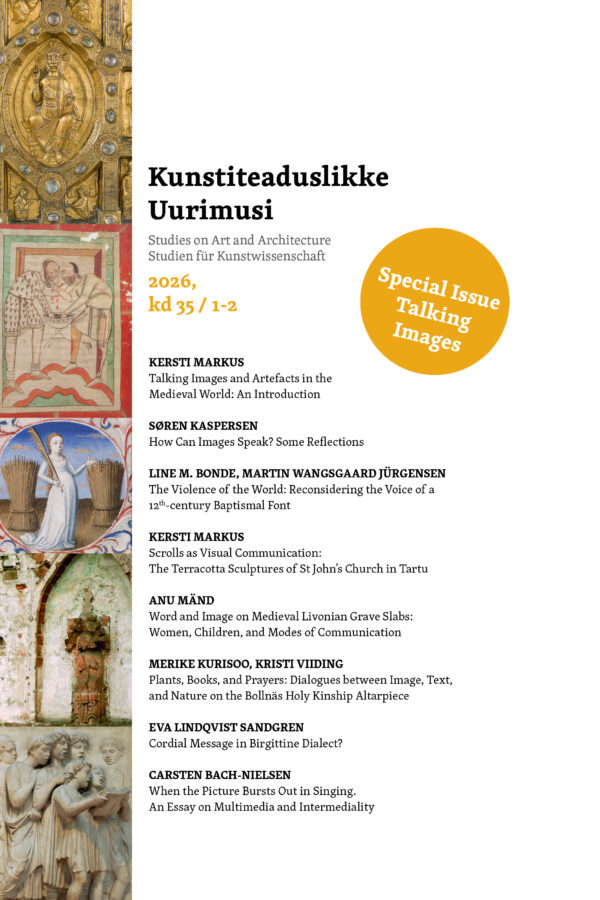
The latest issue of Studies on Art and Architecture (1–2/2026) will be published on 8 June. This special issue is devoted to Talking Images in the Medieval and Early Modern Periods and is guest-edited by Professor Kersti Markus.
The volume brings together six scholarly articles and one essay that explore the “speaking power” of medieval images and objects, as well as their interaction with liturgical practice, prayer, and movement through space. The special issue grew out of the Nordic Iconography Symposium Talking Images and Artefacts, held in Laulasmaa in August 2024, which examined how images and objects communicated meaning in the medieval world.
The issue opens with an article by Søren Kaspersen, who compares theological texts and art-historical examples ranging from manuscript illuminations and monumental painting to gilded Scandinavian altarpieces, demonstrating how the meanings of images were shaped within specific contexts of use. Line M. Bonde and Martin Wangsgaard Jürgensen analyse baptismal fonts, showing how newly baptised members of the community interpreted their world through the animals, plants, and hybrid creatures depicted on these objects, which reflected contemporary understandings of nature and human existence within it.
Kersti Markus examines the terracotta sculptures of St John’s Church in Tartu from the perspective of visual communication, while Anu Mänd investigates how medieval tomb slabs engaged with viewers. Through close readings of the slabs, historical drawings, and inscriptions, Mänd explores how women’s social status, marital relationships, family ties, and the commemoration of children were communicated.
Merike Kurisoo and Kristi Viiding focus on the Holy Kinship altarpiece in Bollnäs, demonstrating that the Latin inscriptions running across the garments of the figures and the botanically accurate medicinal plants depicted in the work are not merely decorative elements, but references to Scripture and nature as two key sources of medieval knowledge. Eva Lindqvist Sandgren analyses the visual culture of the Bridgettines, showing how they developed a distinctive visual language that helped convey the content of divine revelations.
The collection is framed by Carsten Bach-Nielsen’s essay on the continued relevance of the idea of “talking images” in later periods. Bach-Nielsen argues that images have, at different times, been understood not only as capable of speech but also of possessing a voice and even the ability to sing.
The issue also includes a translated article by Cynthia Hahn, who demonstrates that reliquaries were not merely containers for relics; rather, their form and use created connections between the saint’s relic, the liturgical act, and the viewer’s experience.
In the Archives section, Helen Bome introduces a seventeenth-century trophy bundle from the Pärnu city gate that was once housed in the Pärnu Museum, as well as a nineteenth-century model made from it and later sent to Tartu.
The issue further contains conference reports, book reviews, and reflections on cultural heritage preservation and museology.
The journal will be presented on Monday, 8 June, at the Estonian Museum of Architecture, following the general assembly of the Estonian Society of Art Historians and Curators.
During the following week, the journal will also become available at R-Kiosks, the EKA Library, museum shops, Stockmann, and Prisma stores.