
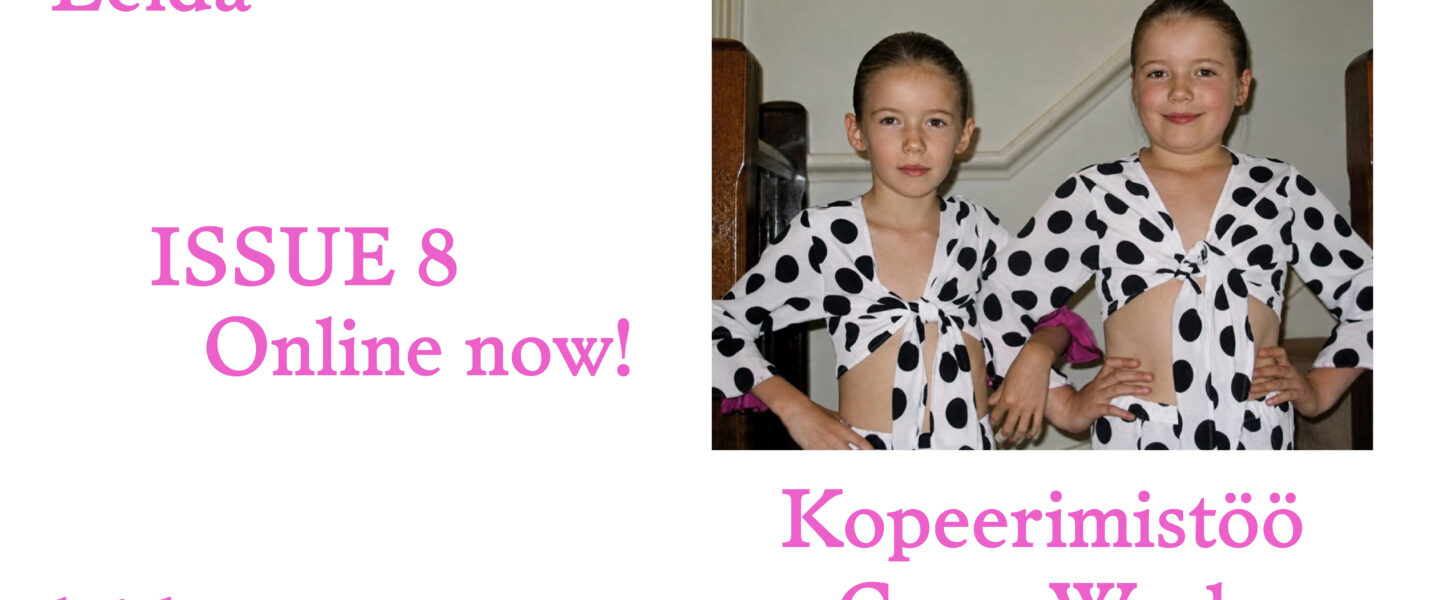
On July 3, the new issue of the design journal Leida, titled Copy Work, was released. The issue brings together stories of different times, cultures and geographical contexts. The focus is on copying as a way of production, adaptation and appropriation: from answering the needs of the consumer and exploiting nature and cultures, to virtual environments, new technologies, communal practices, and aesthetic methods shaped by repressive conditions.
“A copy is an effective conversation starter,” writes the editor-in-chief of Leida Taavi Hallimäe in the preface. “There are many reasons for this – those of practical accessibility and efficiency, but also intrinsic human curiosity, a need to mimic our inspirations, shame, the feeling of inferiority when encountering the original, and the hope of achieving wealth with minimal cost. A copy that disassembles the original, to then reassemble it, sometimes in a different form, does not emerge out of nothingness. Copying always starts with learning the operational logic of the original (or a previous copy).”
The issue opens with design historian and curator Heng Zhi’s interview, where she talks to Taavi Hallimäe about the influence that Chinese producers have on the Global South, connecting this both to the practice of learning by launching a product on the market, as well as to the shanzhai copy culture between Western companies and Chinese factories that still recently captivated the attention of many designers. Designer Ott Metusala draws from archival materials, and in his visual essay, he introduces modes of seeing centred around lamp design sketches by designer Kirsti Metusala for the offices of the Kremlin subsequently produced by the USSR Experimental Plant Estoplast.
Using Soviet Lithuanian graphic design as an example, graphic designer Nerijus Rimkus describes the translations of Western design aesthetics across the Iron Curtain despite technological and cultural isolation. Designer Muj Abdulzade takes a critical look at the visual identity of the 1968 México Olympic Games, which mixed pictograms from the Nazi Germany Olympics with geometric patterns used in Mexican cultural heritage.
The essay by design historian Triin Jerlei dives into science and digital fiction, looking for links between the opportunities and restrictions of augmented reality and the real-life actions of big tech companies. In an interview with Justin Zhuang, architect Immanuel Koh describes his project that, through using artificial intelligence and a monobloc chair, investigates new ways of translating two-dimensional images into physical objects. Graphic designer Rita Davis introduces the annual festival of “Bumba Meu Boi”, deeply ingrained in Brazilian culture, focusing on its months-long preparations and the operational logic of preparing for the festivities anew every year.
The article by designer Vitali Valtanen rethinks human-centric design practice, pointing out design’s historically exploitative influence on nonhuman animals, who in design processes are systematically reduced to mere material. Sergio Dávila, who works at the intersection of urban studies and bio design, introduces the reader to mimicry as a play between species, which, rather than simply copying, creates a space for interpretation and meaning-making. The issue Copy Work ends with artist Mia Tamme’s story, partly based on archival materials and using fiction as a method, about Malle, an Avinurme rug-maker, whose creative work depended on materials sourced from the Narva Kreenholm textile factory.
Leida’s graphic designers are Haron Barashed and Fernanda Saval. The cover image for Copy Work is selected by Jordan Weaver.
Leida is an online journal published twice a year. Leida is initiated by the Faculty of Design of EKA, the journal is supported by the Architecture Endowment of the Cultural Endowment of Estonia, the Research Fund of EKA and the Faculty of Design of EKA.