
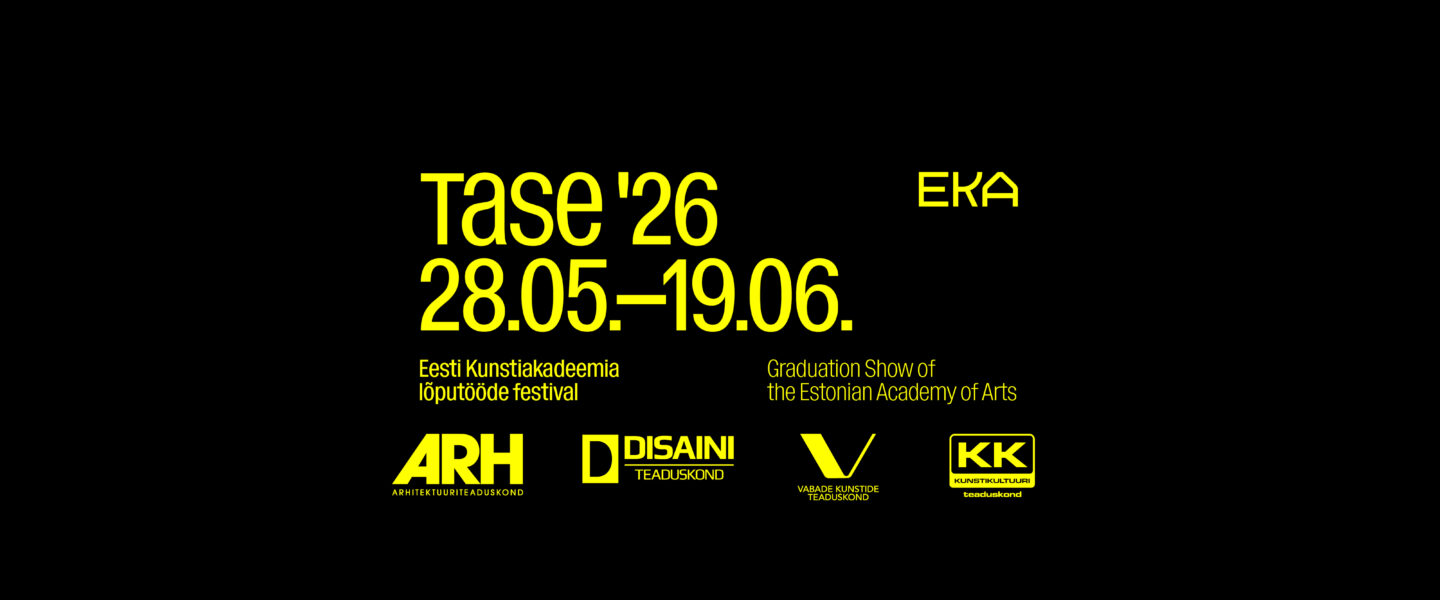
The Estonian Academy of Arts opens the traditional graduation thesis festival TASE, which is an annual top event for young Estonian art, design, architecture and art culture. This year’s festival returns to the EKA campus in its entirety, opening up to the audience the existing study and work spaces, the White House laboratories, the monumental studio, research and development spaces, as well as buildings still under development. The entire creative sphere of the art academy will be highlighted.
TASE takes place on the EKA campus and is part of a broader development, within the framework of which the campus of the art academy is expanding into a learning, creative and research center. The festival opens this change both as a presence and as an ideological direction, spreading to the EKA main building and the White House at the beginning of Kotzebue Street. The openness of the EKA campus creates an opportunity to experience the university as a functioning creative and research environment that extends into the urban space.
TASE‘26 festival opens on Wednesday, May 27 at 5:00 PM on the EKA art campus. The opening event in front of the EKA White House (Kotzebue 10) will feature speeches by the Minister of Culture of the Republic of Estonia, Heidy Purga, EKA Rector Hilkka Hiiop, and the deans of the four faculties, who will present the Young Artist, Young Applied Artist, and Young Designer awards to the graduates. After the awards ceremony, Puuluup and DJ duo Danger from Estonia will perform.
Since the opening will take place outdoors, we recommend dressing according to the weather forecast. On the opening day, the exhibition can be visited throughout the EKA campus until 11:00 p.m.
The centerpiece of the festival is an exhibition of EKA students’ final theses, featuring graduates of the faculties of architecture, design, art culture, and fine arts. The main exhibition will be accompanied by a diverse satellite program with specialist exhibitions, defenses, and TASE Film. TASE ’26 will remain open on the EKA campus until June 19.
This year, EKA graduates will consider the living environment as a space in which community relations, material changes and uncertain perceptions of the future are intertwined. The works highlight the urban environment, creative practices and existing rethinkings, accompanied by a sense of liminality – a state of centrality characterized by search, fatigue, exposure and readiness. The focus is on both slowing down and interruptions, as well as the question of how you can be hooligan and communal in a situation where social and material structures are constantly changing. The young creators relate to the topic, looking for ways to make sense of the person in their environment, in the fragile balance between community and time.
The final theses of the Faculty of Design intertwine healthcare, material circulation, co-creative practices and social issues related to urban space and community behavior. Interaction Design Master’s student Rainer Pits is developing a healthcare development study program aimed at doctors and researchers at the University of Tartu, bringing design products into contact with medicine and research. Social Design focuses on urban space designs and social tensions. Kristiina Laapas directs her work towards drivers behaving more considerately towards fellow road users, and Kristiina Pilvet-Petrov deals with crisis behavior communication in apartment associations.
Master’s students of the Faculty of Architecture deal with socially relevant spatial issues, addressing the challenges of an aging society, the use of undervalued building materials and the rethinking of existing environments and buildings. The works range from critical analysis of landscapes, cities and city districts to discovering new spatial possibilities of streets, buildings and materials. The opening and reconstruction of industrial heritage are explored, the tension between administrative bureaucracy and self-imposed restrictions on abandoned buildings, and the creation of experimental building typologies using digital production technologies and non-standard wood.
The works of graduates of the Faculty of Fine Arts move on the border between the everyday and the poetic, the documentary and the mythological, interweaving personal experiences, the sense of time and the fragility of being human. Elias Kuulmann observes the poetic nature of the work of tram drivers, while Mikk Keis seeks an opportunity to interrupt the linear experience of time. Themes of memory, transience and space emerge in Kail Timuski‘s installation, where the wood of a demolished farmhouse becomes a kind of funeral dirge for disappearing architecture in the form of sound, heat and steam. Sirel Soans explores the fragility of human relationships and the possibility of permanence in today’s individualistic society.
The final theses of the Faculty of Arts and Culture deal with various topics of art history, culture and heritage. The research examines the representation of the body and gender, the social critique of contemporary art, subculture and experience in museums and education. Political art and decolonial approaches also come to the fore, such as Sergei Trofimov‘s study of propaganda museums and Birgit Tohter‘s and Anastassia Langinen‘s themes of Sámi heritage. The entire material analyzed in architecture ranges from Baltic Germans and ERKI fashion show collections to models and Sipsik. Heritage conservation works address heritage from a practical and cultural perspective, such as the history of Getter Zirel‘s pitchers and the preservation of Elo Valner‘s cemetery as a living environment. In architectural heritage, Kaspar Paas highlights historical laundries and Sonja Samuel analyzes the reconstruction practices of industrial quarters.