Academic Affairs OfficeAccessory DesignAnimationArchitecture and Urban DesignArt EducationCenter for Flat TechnologiesCeramicsContemporary ArtCultural Heritage and ConservationDepartmentsDesign and Technology FuturesDoctoral SchoolDrawingFacilities and WorkshopsFaculty of ArchitectureFaculty of Art and CultureFaculty of DesignFaculty of Fine ArtsFashion DesignFinancial DepartmentGalleryGlass ArtGraphic ArtGraphic DesignInstallation and SculptureInstitute of Art History and Visual CultureInternational OfficeIT OfficeJewellery and BlacksmithingLandscape ArchitectureLibraryLinnaehitus @enMaking SpaceNew MediaOffice of the RectorateOpen AcademyPaintingPerforming ArtsPhotographyProduct DesignRectorateResearch and Development OfficeScenographySupport UnitsTextile DesignUncategorizedUrban PlanningUrban Studies
Dr Helena Gabrijelčič Tomc’s open lecture at the EKA Cultural Heritage & Conservation Department
28.11.2018
Dr Helena Gabrijelčič Tomc’s open lecture at the EKA Cultural Heritage & Conservation Department
Cultural Heritage and Conservation
Dr Helena Gabrijelčič Tomc (University of Ljubljana, Faculty of Natural Sciences and Engineering, Department of Textiles, Graphic Arts and Design) open lecture “3D Technologies and Cultural Heritage” on Wednesday, November 28 at 6PM at the EKA auditiorium A101.
The presentations and interpretations of cultural heritage pose many challenges to researchers, as they need to be not only accurate in terms of documenting the facts about the object of interest but also attractive, interactive and engaging regarding the user experience. Implementation of 3D technologies in documentation, preservation and presentation of cultural heritage is a multi-layered process. After the acquisition of the target data, the processes of data storage, archiving and managing are interlaced with the aim of keeping the data accuracy and adding them values with the processing and analysis. In the steps that follow, i.e. presentation, interpretation and reproduction, 3D technologies (3D scanning, 3D printing, 3D computer aided modelling and design) are widely used and applicable due to their accuracy, repeatability and mostly non-invasive nature. The implementation of these technologies in the framework, however, should not overlooked especially to the more subtle aspects of the cultural object(s) included in the study, i.e. preserving the details of the objects and author’s style.
In the lecture the use of 3D technologies and 3D computer aided-design in cultural heritage are presented closely on the results of four project works, including:
1. the use of 3D visualisation in textile cultural heritage;
2. 3D technologies as an interpretative tool to introduce accessibility for the users;
3. 3D technologies as an interpretative realisation and reconstruction of cultural monument, when the documents of the object are inconsistent and poorly preserved and
4. 3D computer-aided visualisation as a facilitation for the preservation process of the object of contemporary design.
In the first part, the review of the use of 3D technologies in textile cultural heritage is presented and 3D-modelling process and visualisation of a woman’s folk costume from the Gorenjska region (Slovenia) is shown. In order to create a realistic 3D visualisation of the clothing, a real dress was modelled and a thorough examination of all the patterns in the costume was conducted. To create a realistic 3D visualisation of the parts of the cloth with visible porosity, the image data from these parts were processed, analysed and reinterpreted in the visualisation. The workflow for visualisation of textile porous structures was determined.
In the second part of the lecture, 3D modelling and 3D printing are presented in the process of 3D interpretation of Snežnik castle, located in the southwest part of the Lož Valle in the municipality of Loška Dolina (Slovenia) and for 3D interpretation of a non-realised sacred monument that was planned by a known Slovenian architect Jože Plečnik.
In the last part of the lecture 3D reconstruction methodologies, i.e. 3D scanning, photogrammetry and 3D computer graphic are introduced in the preservation of lounger Gondola, a product of Oskar Kogoj, a Slovenian contemporary designer. In the workflow, the computer-aided reproduction is presented together conservation-restoration work and the analytical approach that enabled the observations and the determination of the circumstances in which the lounger suffered severe damage of an irreversible nature during the use.
Associate professor Gabrijelčič Tomc is a lecturer and researcher at University of Ljubljana (Slovenia), Faculty of Natural Sciences and Engineering, Department of Textiles, Graphic Arts and Design. Her research work involves a development of constructional and color-mixing models based on physical products and computer-generated simulations; generating, processing and reproduction of data in media and 3D technologies. With her colleagues she is establishing more noticeable role of the use of 3D technologies and 3D computer graphic in Slovenian cultural and natural heritage. In collaboration with the students, she is researching also the novelties in learning approaches and development, testing and implementation of 2D and 3D computer graphic in creative processes of studying. Besides, she is collaborating with Slovenian studios, companies and researching institutions in the projects involving multimedia production, interaction design and graphic visualisations.
More info:
Maris Veeremäe
maris.veeremae@artun.ee
Posted by Mart Vainre — Permalink
Dr Helena Gabrijelčič Tomc’s open lecture at the EKA Cultural Heritage & Conservation Department
Wednesday 28 November, 2018
Cultural Heritage and Conservation
Dr Helena Gabrijelčič Tomc (University of Ljubljana, Faculty of Natural Sciences and Engineering, Department of Textiles, Graphic Arts and Design) open lecture “3D Technologies and Cultural Heritage” on Wednesday, November 28 at 6PM at the EKA auditiorium A101.
The presentations and interpretations of cultural heritage pose many challenges to researchers, as they need to be not only accurate in terms of documenting the facts about the object of interest but also attractive, interactive and engaging regarding the user experience. Implementation of 3D technologies in documentation, preservation and presentation of cultural heritage is a multi-layered process. After the acquisition of the target data, the processes of data storage, archiving and managing are interlaced with the aim of keeping the data accuracy and adding them values with the processing and analysis. In the steps that follow, i.e. presentation, interpretation and reproduction, 3D technologies (3D scanning, 3D printing, 3D computer aided modelling and design) are widely used and applicable due to their accuracy, repeatability and mostly non-invasive nature. The implementation of these technologies in the framework, however, should not overlooked especially to the more subtle aspects of the cultural object(s) included in the study, i.e. preserving the details of the objects and author’s style.
In the lecture the use of 3D technologies and 3D computer aided-design in cultural heritage are presented closely on the results of four project works, including:
1. the use of 3D visualisation in textile cultural heritage;
2. 3D technologies as an interpretative tool to introduce accessibility for the users;
3. 3D technologies as an interpretative realisation and reconstruction of cultural monument, when the documents of the object are inconsistent and poorly preserved and
4. 3D computer-aided visualisation as a facilitation for the preservation process of the object of contemporary design.
In the first part, the review of the use of 3D technologies in textile cultural heritage is presented and 3D-modelling process and visualisation of a woman’s folk costume from the Gorenjska region (Slovenia) is shown. In order to create a realistic 3D visualisation of the clothing, a real dress was modelled and a thorough examination of all the patterns in the costume was conducted. To create a realistic 3D visualisation of the parts of the cloth with visible porosity, the image data from these parts were processed, analysed and reinterpreted in the visualisation. The workflow for visualisation of textile porous structures was determined.
In the second part of the lecture, 3D modelling and 3D printing are presented in the process of 3D interpretation of Snežnik castle, located in the southwest part of the Lož Valle in the municipality of Loška Dolina (Slovenia) and for 3D interpretation of a non-realised sacred monument that was planned by a known Slovenian architect Jože Plečnik.
In the last part of the lecture 3D reconstruction methodologies, i.e. 3D scanning, photogrammetry and 3D computer graphic are introduced in the preservation of lounger Gondola, a product of Oskar Kogoj, a Slovenian contemporary designer. In the workflow, the computer-aided reproduction is presented together conservation-restoration work and the analytical approach that enabled the observations and the determination of the circumstances in which the lounger suffered severe damage of an irreversible nature during the use.
Associate professor Gabrijelčič Tomc is a lecturer and researcher at University of Ljubljana (Slovenia), Faculty of Natural Sciences and Engineering, Department of Textiles, Graphic Arts and Design. Her research work involves a development of constructional and color-mixing models based on physical products and computer-generated simulations; generating, processing and reproduction of data in media and 3D technologies. With her colleagues she is establishing more noticeable role of the use of 3D technologies and 3D computer graphic in Slovenian cultural and natural heritage. In collaboration with the students, she is researching also the novelties in learning approaches and development, testing and implementation of 2D and 3D computer graphic in creative processes of studying. Besides, she is collaborating with Slovenian studios, companies and researching institutions in the projects involving multimedia production, interaction design and graphic visualisations.
More info:
Maris Veeremäe
maris.veeremae@artun.ee
Posted by Mart Vainre — Permalink
15.11.2018
Open Lecture in Architecture: Caroline Voet
Architecture and Urban Design
In search for an architectural ontology: Open Lecture by Caroline Voet
The next lecturer of the Open Lecture Series this autumn will beCaroline Voet – Belgian architect and professor at the KU Leuven, Faculty of Architecture. Voet will be stepping on the stage of the main auditorium of the new EKA building on the 15th of November at 6 pm to talk about the work of Dom Hans van der Laan and the search for an architectural ontology.
Voet is the co-founder of the award-winning architectural practice Voet en De Brabandere in Antwerp, Belgium. Her research and teaching have always been combined with an architectural practice. After working for Zaha Hadid Architects in London and Christian Kieckens Architects in Brussels, she founded her own office in Antwerp, working on a range of award-winning projects from furniture and museum interiors to housing and schools. She focuses on reconversions and the design of cultural buildings, public interiors, scenography and furniture. Voet is professor at the KU Leuven, Faculty of Architecture, Campus St-Lucas Ghent and Brussels, where she received her Ph.D. in 2013 on the work of Dom Hans van der Laan. She holds degrees in architecture from the Architectural Association in London and the Henry van de Velde Institute in Antwerp. She has been published in for example ARQ and Interiors Routledge. She wrote for the Architectural Yearbook Flanders and in 2016 she was co-editor of the book Autonomous Architecture in Flanders. She recently published “Dom Hans van der Laan. Tomelilla (Architectura and Natura)” and “Dom Hans van der Laan. A House for the Mind” (VAi).
In 1977, the Dutch Benedictine monk and architect Dom Hans van der Laan (1904-1991) published his treatise Architectonic Space, fifteen lessons on the disposition of the human habitat. At the same time, he built four convents and a house, a typical elementary and austere architecture that strongly communicates through tactility, colour and light. Through philosophical concepts like mass / space, inside / outside, the book tried to define a deep-level structure that would explain how we perceive space and how we build. Is it possible to grasp experience and tactility within a philosophical and rational framework? Voet’s lecture unravels the interwoven genealogy of theory, design practice and building. It links Dom van der Laan’s philosophical concepts of dwelling with the concrete experience of his architecture. What is the connection between theory and practice, if any?
Caroline Voet’s open lecture takes place in co-operation with EKKM, where on 16 November at 6 pm, Ingel Vaikla exhibition You Have Become the Space opens (curated by Laura Toots). More info on the exhibition: https://www.facebook.com/events/2229621923950764/
The architecture and urban design department of the Estonian Academy of Arts has been curating the Open Lectures on Architecture series since 2012 – each year, a dozen architects, urbanists, both practicing as well as academics, introduce their work and field of research to the audience in Tallinn. All lectures are in English, free and open to all interested.
The series is funded by the Estonian Cultural Endowment.
Curators: Sille Pihlak, Johan Tali, for this lecture: Siim Tuksam.
www.avatudloengud.ee
https://www.facebook.com/EKAarhitektuur/
More info:
Pille Epner
E-post: arhitektuur@artun.ee
Posted by Pille Epner — Permalink
Open Lecture in Architecture: Caroline Voet
Thursday 15 November, 2018
Architecture and Urban Design
In search for an architectural ontology: Open Lecture by Caroline Voet
The next lecturer of the Open Lecture Series this autumn will beCaroline Voet – Belgian architect and professor at the KU Leuven, Faculty of Architecture. Voet will be stepping on the stage of the main auditorium of the new EKA building on the 15th of November at 6 pm to talk about the work of Dom Hans van der Laan and the search for an architectural ontology.
Voet is the co-founder of the award-winning architectural practice Voet en De Brabandere in Antwerp, Belgium. Her research and teaching have always been combined with an architectural practice. After working for Zaha Hadid Architects in London and Christian Kieckens Architects in Brussels, she founded her own office in Antwerp, working on a range of award-winning projects from furniture and museum interiors to housing and schools. She focuses on reconversions and the design of cultural buildings, public interiors, scenography and furniture. Voet is professor at the KU Leuven, Faculty of Architecture, Campus St-Lucas Ghent and Brussels, where she received her Ph.D. in 2013 on the work of Dom Hans van der Laan. She holds degrees in architecture from the Architectural Association in London and the Henry van de Velde Institute in Antwerp. She has been published in for example ARQ and Interiors Routledge. She wrote for the Architectural Yearbook Flanders and in 2016 she was co-editor of the book Autonomous Architecture in Flanders. She recently published “Dom Hans van der Laan. Tomelilla (Architectura and Natura)” and “Dom Hans van der Laan. A House for the Mind” (VAi).
In 1977, the Dutch Benedictine monk and architect Dom Hans van der Laan (1904-1991) published his treatise Architectonic Space, fifteen lessons on the disposition of the human habitat. At the same time, he built four convents and a house, a typical elementary and austere architecture that strongly communicates through tactility, colour and light. Through philosophical concepts like mass / space, inside / outside, the book tried to define a deep-level structure that would explain how we perceive space and how we build. Is it possible to grasp experience and tactility within a philosophical and rational framework? Voet’s lecture unravels the interwoven genealogy of theory, design practice and building. It links Dom van der Laan’s philosophical concepts of dwelling with the concrete experience of his architecture. What is the connection between theory and practice, if any?
Caroline Voet’s open lecture takes place in co-operation with EKKM, where on 16 November at 6 pm, Ingel Vaikla exhibition You Have Become the Space opens (curated by Laura Toots). More info on the exhibition: https://www.facebook.com/events/2229621923950764/
The architecture and urban design department of the Estonian Academy of Arts has been curating the Open Lectures on Architecture series since 2012 – each year, a dozen architects, urbanists, both practicing as well as academics, introduce their work and field of research to the audience in Tallinn. All lectures are in English, free and open to all interested.
The series is funded by the Estonian Cultural Endowment.
Curators: Sille Pihlak, Johan Tali, for this lecture: Siim Tuksam.
www.avatudloengud.ee
https://www.facebook.com/EKAarhitektuur/
More info:
Pille Epner
E-post: arhitektuur@artun.ee
Posted by Pille Epner — Permalink
13.11.2018
Open lecture_jewellery artist Jiro Kamata
Jewellery and Blacksmithing

Jiro Kamata, 1978, born in Hirosaki, Japan.
Artist that lives and works in Munich, studied at The Academy of Fine Arts Munich, with Prof.Otto Künzli and has works at the following collections: Hiko-Mizuno Collection, Tokyo. Marzee Collection, Nijmegen. Alice and Louis Koch Ring Collection, Basel. Helen Drutt Collection, Philadelphia.
The work of Jiro Kamata is fascinating because of it’s perfect surface, highlevel goldsmithing and also because of it’s affinity to fashion. It is young and powerful and in the same moment very delicate and poetic. Jiro Kamata likes to play with traditional moments and transform them into our contemporary view on things. / Klimt02.net /
Jiro Kamata was inivited to give masterclass “Mirror, mirror on the wall…” for jewellery students on November 12-16, 2018.
More:
http://www.jirokamata.com/
https://klimt02.net/jewellers/jiro-kamata
Posted by Eve Margus-Villems — Permalink
Open lecture_jewellery artist Jiro Kamata
Tuesday 13 November, 2018
Jewellery and Blacksmithing

Jiro Kamata, 1978, born in Hirosaki, Japan.
Artist that lives and works in Munich, studied at The Academy of Fine Arts Munich, with Prof.Otto Künzli and has works at the following collections: Hiko-Mizuno Collection, Tokyo. Marzee Collection, Nijmegen. Alice and Louis Koch Ring Collection, Basel. Helen Drutt Collection, Philadelphia.
The work of Jiro Kamata is fascinating because of it’s perfect surface, highlevel goldsmithing and also because of it’s affinity to fashion. It is young and powerful and in the same moment very delicate and poetic. Jiro Kamata likes to play with traditional moments and transform them into our contemporary view on things. / Klimt02.net /
Jiro Kamata was inivited to give masterclass “Mirror, mirror on the wall…” for jewellery students on November 12-16, 2018.
More:
http://www.jirokamata.com/
https://klimt02.net/jewellers/jiro-kamata
Posted by Eve Margus-Villems — Permalink
20.11.2018 — 05.01.2019
80 Years of Interior Architecture Studies in EKA Gallery
“We are pleased to invite you to the opening of the Estonian Association of Interior Architects exhibition called 80 Years of Interior Architecture Studies on Tuesday, November 20th at 6 p.m at EKA Gallery.
The exhibition curated by Karin Paulus tells the story of eighty years of interior architecture studies in Estonia. The exhibition will feature exciting student projects and furniture designs, the department’s faculty members as well as academic events and fun undertakings. The designer of the exhibition is Toivo Raidmets, the longtime director of the Interior Architecture and Furniture Design Department.
A seminar will take place in the Estonian Academy of Arts auditorium on November 23rd. More information available soon.
The exhibition will be open until 5 January 2019.
Curator: Karin Paulus
Contact: karinpaulus@gmail.com
Posted by Pire Sova — Permalink
80 Years of Interior Architecture Studies in EKA Gallery
Tuesday 20 November, 2018 — Saturday 05 January, 2019
“We are pleased to invite you to the opening of the Estonian Association of Interior Architects exhibition called 80 Years of Interior Architecture Studies on Tuesday, November 20th at 6 p.m at EKA Gallery.
The exhibition curated by Karin Paulus tells the story of eighty years of interior architecture studies in Estonia. The exhibition will feature exciting student projects and furniture designs, the department’s faculty members as well as academic events and fun undertakings. The designer of the exhibition is Toivo Raidmets, the longtime director of the Interior Architecture and Furniture Design Department.
A seminar will take place in the Estonian Academy of Arts auditorium on November 23rd. More information available soon.
The exhibition will be open until 5 January 2019.
Curator: Karin Paulus
Contact: karinpaulus@gmail.com
Posted by Pire Sova — Permalink
20.11.2018 — 05.01.2019
“80 Years of Interior Architecture Studies” at EKA Gallery 21.11.2018–5.01.2019
Gallery
“We are pleased to invite you to the opening of the Estonian Association of Interior Architects exhibition called 80 Years of Interior Architecture Studies on Tuesday, November 20th at 6 p.m at EKA Gallery.
The exhibition curated by Karin Paulus tells the story of eighty years of interior architecture studies in Estonia. The exhibition will feature exciting student projects and furniture designs, the department’s faculty members as well as academic events and fun undertakings. The designer of the exhibition is Toivo Raidmets, the longtime director of the Interior Architecture and Furniture Design Department.
A seminar will take place in the Estonian Academy of Arts auditorium on November 23rd. More information available soon.
The exhibition will be open until 5 January 2019.
Curator: Karin Paulus
Contact: karinpaulus@gmail.com
Posted by Pire Sova — Permalink
“80 Years of Interior Architecture Studies” at EKA Gallery 21.11.2018–5.01.2019
Tuesday 20 November, 2018 — Saturday 05 January, 2019
Gallery
“We are pleased to invite you to the opening of the Estonian Association of Interior Architects exhibition called 80 Years of Interior Architecture Studies on Tuesday, November 20th at 6 p.m at EKA Gallery.
The exhibition curated by Karin Paulus tells the story of eighty years of interior architecture studies in Estonia. The exhibition will feature exciting student projects and furniture designs, the department’s faculty members as well as academic events and fun undertakings. The designer of the exhibition is Toivo Raidmets, the longtime director of the Interior Architecture and Furniture Design Department.
A seminar will take place in the Estonian Academy of Arts auditorium on November 23rd. More information available soon.
The exhibition will be open until 5 January 2019.
Curator: Karin Paulus
Contact: karinpaulus@gmail.com
Posted by Pire Sova — Permalink
06.11.2018 — 28.11.2018
Exhibition Fibrous is opening on November 6 at Old EKA Gallery
Installation and Sculpture
Fibrous, the 1st exhibition held in the international Skulpakuu event. From November 6th until the 14th, seven international sculpture and installation artists will take over the Old EKA Gallery. The exhibition will explore the topics of power and authority. There will also be a curator tour on 08.11 and a panel-discussion about the current notion of sculpture in contemporary thought on 13.11.
You resonate with this. To take over this basement room, seven artists come together in a symbiotic relationship. Though being aware of the rules in the cooperation, they seek to grow laterally.
Fibrous, an exhibition about power, control, choice, force… themes that are suggested in the individual artworks, as well as where the works meet each other in space. The artists seek to expose the connecting fibres, the strategies of taking over and persisting within a defined room. This might show an internal struggle occuring as they give and take to find balance.
The form is fragile, it dissolves, when you touch it, it is not the same as before. It is mutable. I look around and it permeates all. It throbs in our veins, and with it, we are able to change anything.
The exhibition is curated by Laura De Jaeger with artistic director Stacey Koosel. Itwill open on November 6th at 18.00, featuring works by Barbara Kocsis, Ben Caro, Darja Krasnopevtseva, Johannes Luik, Laura De Jaeger, LAURi and Martina Buck.
Fibrousis a part of Skulpakuu, theinternational sculpture- and installation month, andis made possible by the Estonian Academy of Arts, EKA Student Union, Õllenaut, Kalamaja pruulikoda, Peninuki craftery, with Marko Mrkobrad and Arne Nuyts for the graphic design.
Posted by Mart Vainre — Permalink
Exhibition Fibrous is opening on November 6 at Old EKA Gallery
Tuesday 06 November, 2018 — Wednesday 28 November, 2018
Installation and Sculpture
Fibrous, the 1st exhibition held in the international Skulpakuu event. From November 6th until the 14th, seven international sculpture and installation artists will take over the Old EKA Gallery. The exhibition will explore the topics of power and authority. There will also be a curator tour on 08.11 and a panel-discussion about the current notion of sculpture in contemporary thought on 13.11.
You resonate with this. To take over this basement room, seven artists come together in a symbiotic relationship. Though being aware of the rules in the cooperation, they seek to grow laterally.
Fibrous, an exhibition about power, control, choice, force… themes that are suggested in the individual artworks, as well as where the works meet each other in space. The artists seek to expose the connecting fibres, the strategies of taking over and persisting within a defined room. This might show an internal struggle occuring as they give and take to find balance.
The form is fragile, it dissolves, when you touch it, it is not the same as before. It is mutable. I look around and it permeates all. It throbs in our veins, and with it, we are able to change anything.
The exhibition is curated by Laura De Jaeger with artistic director Stacey Koosel. Itwill open on November 6th at 18.00, featuring works by Barbara Kocsis, Ben Caro, Darja Krasnopevtseva, Johannes Luik, Laura De Jaeger, LAURi and Martina Buck.
Fibrousis a part of Skulpakuu, theinternational sculpture- and installation month, andis made possible by the Estonian Academy of Arts, EKA Student Union, Õllenaut, Kalamaja pruulikoda, Peninuki craftery, with Marko Mrkobrad and Arne Nuyts for the graphic design.
Posted by Mart Vainre — Permalink
16.11.2018
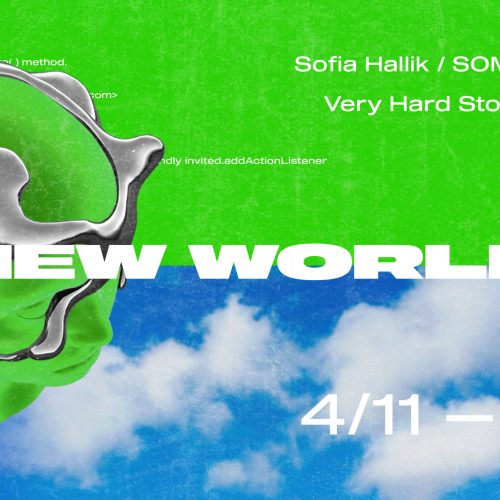
Exhibition “Tangibility Matters” Sofia Hallik
Academic Affairs Office
Exhibition dates:
15.11.2018 12-18
16.11.2018 12-20
Sofia Hallik’s “Tangibility Matters” exhibition finissage takes place on Friday, November 16th, in the ARS Project Room at 18.00.
Peer-review event takes place in Nov 16th, at 14.00 in ARS Project Room (Pärnu mnt 154, Tallinn)
Supervisors: prof Kadri Mälk and dr Jaak Tomberg
Peer – reviewers: dr Kärt Ojavee and dr Raivo Kelomees
Works on display are made as a part of a PhD thesis, and consist of wearable objects that are a hybrid of hand work and digital production. While working on a jewellery, the author is in need of touch and tactility, while an object that is made using 3D printing appears as an empty form, which demands substance. In the world of tech, because the process of work using CAD or 3D printing excludes tangibility, the author is lacking physical contact with a work of art. That is exactly why in these series of works the artist razes in a way the digital tarnish from the surface of the printed object by implementing hand work and traditional jewellery techniques. In this way a 3D printed object gains emotional expressiveness.
The works presented during the exhibition originate from two contradictory principles: digital production and hand work, and embody the mutual closeness of human and the machine. In other words, while people approach the digital world, technology becomes more and more humane.
Sofia Hallik (1991) is a jewellery artist, designer and PhD student at the Estonian Academy of Arts. In her doctoral thesis “Hand vs. Machine: Three Methods of Jewellery Making” (supervisors prof. Kadri Mälk and Dr. Jaak Tomberg) Sofia focuses on innovative materials and digital technologies. What interests her the most is the way digital technology influences jewellery.
Special thanks to: Kadri Mälk, Jaak Tomberg, Oskar Narusberk, EAA Jewellery and Blacksmithing department, 3D Koda OÜ.
The exhibition was made possible with the support of the Cultural Endowment of Estonia.
Posted by Elika Kiilo — Permalink
Exhibition “Tangibility Matters” Sofia Hallik
Friday 16 November, 2018
Academic Affairs Office
Exhibition dates:
15.11.2018 12-18
16.11.2018 12-20
Sofia Hallik’s “Tangibility Matters” exhibition finissage takes place on Friday, November 16th, in the ARS Project Room at 18.00.
Peer-review event takes place in Nov 16th, at 14.00 in ARS Project Room (Pärnu mnt 154, Tallinn)
Supervisors: prof Kadri Mälk and dr Jaak Tomberg
Peer – reviewers: dr Kärt Ojavee and dr Raivo Kelomees
Works on display are made as a part of a PhD thesis, and consist of wearable objects that are a hybrid of hand work and digital production. While working on a jewellery, the author is in need of touch and tactility, while an object that is made using 3D printing appears as an empty form, which demands substance. In the world of tech, because the process of work using CAD or 3D printing excludes tangibility, the author is lacking physical contact with a work of art. That is exactly why in these series of works the artist razes in a way the digital tarnish from the surface of the printed object by implementing hand work and traditional jewellery techniques. In this way a 3D printed object gains emotional expressiveness.
The works presented during the exhibition originate from two contradictory principles: digital production and hand work, and embody the mutual closeness of human and the machine. In other words, while people approach the digital world, technology becomes more and more humane.
Sofia Hallik (1991) is a jewellery artist, designer and PhD student at the Estonian Academy of Arts. In her doctoral thesis “Hand vs. Machine: Three Methods of Jewellery Making” (supervisors prof. Kadri Mälk and Dr. Jaak Tomberg) Sofia focuses on innovative materials and digital technologies. What interests her the most is the way digital technology influences jewellery.
Special thanks to: Kadri Mälk, Jaak Tomberg, Oskar Narusberk, EAA Jewellery and Blacksmithing department, 3D Koda OÜ.
The exhibition was made possible with the support of the Cultural Endowment of Estonia.
Posted by Elika Kiilo — Permalink
02.11.2018
Seminar: Using Psychoanalysis in Artistic Research
Academic Affairs Office
Date: November 19, 2018 at 14.00 – 17.30
Venue: Estonian Academy of Arts, Põhja pst 7, room A502
Lecturer: Pia Sivenius
The idea of using psychoanalysis for artistic research seems tempting for artists in various fields, designers and architects. The aim of the seminar is to introduce the cornerstones of the theories of psychoanalysis and reflect on their uses in the field of arts. The seminar is open to PhD and MA students.
Pia Sivenius specialises in the French psychoanalysis theories. She has published numerous articles on the subject and translated the works of Lacan, Kristeva and Irigaray into the Finnish language. She is the long standing research coordinator in Aalto Arts (formerly University of Art and Design Helsinki) which gives her valuable insight into current artistic research.
Registration
Theseminar is open to PhD and MA students. Registration is open until16.11.
Program
14.00-15.30 seminar
15.30-16.00 break
16.00-17.30 seminar
Posted by Elika Kiilo — Permalink
Seminar: Using Psychoanalysis in Artistic Research
Friday 02 November, 2018
Academic Affairs Office
Date: November 19, 2018 at 14.00 – 17.30
Venue: Estonian Academy of Arts, Põhja pst 7, room A502
Lecturer: Pia Sivenius
The idea of using psychoanalysis for artistic research seems tempting for artists in various fields, designers and architects. The aim of the seminar is to introduce the cornerstones of the theories of psychoanalysis and reflect on their uses in the field of arts. The seminar is open to PhD and MA students.
Pia Sivenius specialises in the French psychoanalysis theories. She has published numerous articles on the subject and translated the works of Lacan, Kristeva and Irigaray into the Finnish language. She is the long standing research coordinator in Aalto Arts (formerly University of Art and Design Helsinki) which gives her valuable insight into current artistic research.
Registration
Theseminar is open to PhD and MA students. Registration is open until16.11.
Program
14.00-15.30 seminar
15.30-16.00 break
16.00-17.30 seminar
Posted by Elika Kiilo — Permalink
Artist Talk – Young Sculptor Award 2018 “Prediction and Preservation”
Product Design
You are warmly welcome to the discussion with Taavi Talve, Kirke Kangro and the students Darja Krasnopevtseva, Izabella Neff, Johannes Luik, Katrin Enni, LAURi, Nele Tiidelepp, Olesja Semenkova. The talk is moderated by Pire Sova.
The talk is in Estonian language.
Posted by Pire Sova — Permalink
Artist Talk – Young Sculptor Award 2018 “Prediction and Preservation”
Product Design
You are warmly welcome to the discussion with Taavi Talve, Kirke Kangro and the students Darja Krasnopevtseva, Izabella Neff, Johannes Luik, Katrin Enni, LAURi, Nele Tiidelepp, Olesja Semenkova. The talk is moderated by Pire Sova.
The talk is in Estonian language.
Posted by Pire Sova — Permalink
11.01.2018
Open Lecture on Architecture: Wolfgang Tschapeller
Architecture and Urban Design
From Carpenter to Architect: Open Lecture by Wolfgang Tschapeller
The next lecturer of the Open Lecture Series this autumn will be Austrian architect and head of the Institute of Art and Architecture at the Academy of Fine Arts in Vienna – Wolfgang Tschapeller. Tschapeller will be stepping on the stage of the main auditorium of the new EKA building on the 1st of November at 6 pm to talk about Architecture with a capital A.
Wolfgang Tschapeller was initially trained as a carpenter and studied architecture at the University of Applied Arts in Vienna and at Cornell University in Ithaca, NY. Tschapeller has taught as a visiting professor at Cornell University, the University of Art and Design in Linz, Austria, and the State University of New York in Buffalo, as well as other academic institutions.
Johan Tali, one of the curators of the Architecture Open Lecture series, points out that Wolfgang Tschapeller is considered today one of the most important contemporary Austrian architects. “The longtime dean of the Academy of Fine Arts, Vienna Institute of Art and Architecture, Tschapeller is a proponent of progressive spatial education and an uncompromising practitioner. He employs contemporary design and new technologies and materials in his work to create new and exciting spatial experiences, and to – if only for a moment – sway the persistent gravitational force and the comfort zone of human perception. His background in woodworking gives him a unique advantage: the detailed and painstaking process of designing and constructing structures out of minute parts leads to an original architectural whole nearly without exception.”
More about Wolfgang Tschapeller: www.tschapeller.com
Known for his unusual building proposals, Tschapeller’s large-scale projects include the BVA 1, 2, and 3 series for the Vienna headquarters of the Austrian Insurance Fund for Public Employees; the design for the construction of a hotel in the Schwarzenberg Palace Garden in Vienna; the European Cultural Centre between the Palatine Chapel and the city hall in Aachen, Germany; the project for the Centre for Promotion of Science in Belgrade and the University of Applied Arts Vienna. The administrative building of the municipal authority in Murau, Austria (2002) and the St. Joseph House (2007) embody some of his quintessential ideas.
The architecture and urban design department of the Estonian Academy of Arts has been curating the Open Lectures on Architecture series since 2012 – each year, a dozen architects, urbanists, both practicing as well as academics, introduce their work and field of research to the audience in Tallinn. All lectures are in English, free and open to all interested.
The series is funded by the Estonian Cultural Endowment.
Curators: Sille Pihlak, Johan Tali
www.avatudloengud.ee
https://www.facebook.com/EKAarhitektuur/
More info:
Pille Epner
E-post: arhitektuur@artun.ee
Posted by Pille Epner — Permalink
Open Lecture on Architecture: Wolfgang Tschapeller
Thursday 11 January, 2018
Architecture and Urban Design
From Carpenter to Architect: Open Lecture by Wolfgang Tschapeller
The next lecturer of the Open Lecture Series this autumn will be Austrian architect and head of the Institute of Art and Architecture at the Academy of Fine Arts in Vienna – Wolfgang Tschapeller. Tschapeller will be stepping on the stage of the main auditorium of the new EKA building on the 1st of November at 6 pm to talk about Architecture with a capital A.
Wolfgang Tschapeller was initially trained as a carpenter and studied architecture at the University of Applied Arts in Vienna and at Cornell University in Ithaca, NY. Tschapeller has taught as a visiting professor at Cornell University, the University of Art and Design in Linz, Austria, and the State University of New York in Buffalo, as well as other academic institutions.
Johan Tali, one of the curators of the Architecture Open Lecture series, points out that Wolfgang Tschapeller is considered today one of the most important contemporary Austrian architects. “The longtime dean of the Academy of Fine Arts, Vienna Institute of Art and Architecture, Tschapeller is a proponent of progressive spatial education and an uncompromising practitioner. He employs contemporary design and new technologies and materials in his work to create new and exciting spatial experiences, and to – if only for a moment – sway the persistent gravitational force and the comfort zone of human perception. His background in woodworking gives him a unique advantage: the detailed and painstaking process of designing and constructing structures out of minute parts leads to an original architectural whole nearly without exception.”
More about Wolfgang Tschapeller: www.tschapeller.com
Known for his unusual building proposals, Tschapeller’s large-scale projects include the BVA 1, 2, and 3 series for the Vienna headquarters of the Austrian Insurance Fund for Public Employees; the design for the construction of a hotel in the Schwarzenberg Palace Garden in Vienna; the European Cultural Centre between the Palatine Chapel and the city hall in Aachen, Germany; the project for the Centre for Promotion of Science in Belgrade and the University of Applied Arts Vienna. The administrative building of the municipal authority in Murau, Austria (2002) and the St. Joseph House (2007) embody some of his quintessential ideas.
The architecture and urban design department of the Estonian Academy of Arts has been curating the Open Lectures on Architecture series since 2012 – each year, a dozen architects, urbanists, both practicing as well as academics, introduce their work and field of research to the audience in Tallinn. All lectures are in English, free and open to all interested.
The series is funded by the Estonian Cultural Endowment.
Curators: Sille Pihlak, Johan Tali
www.avatudloengud.ee
https://www.facebook.com/EKAarhitektuur/
More info:
Pille Epner
E-post: arhitektuur@artun.ee
Posted by Pille Epner — Permalink