
Exhibitions
16.05.2024 — 17.06.2024
“Noise” – EKA Glass and Ceramics Departement Joint Exhibition
“NOISE” – A joint exhibition from students of The Estonian Academy of Arts in the Ceramics and Glass department will take place at MUBA (Tallinn Music and Ballet School) on the 3rd floor, from May 15th to June 17th, 2024, 09:00-18:00.
The exhibition opening will be on Wednesday, May 15th, at 17:00.
While noise may initially repel us, we invite you to get a little closer instead. We encourage you to create a kind of bond with all kinds of noise, to at least try to get to know it – perhaps there’s a detail that surprises you or quite the opposite. We invite you directly into the heart of noise, into its spell…
Participating artists:
Kaja Knowers, Elisabeth Tõnne, Anna-Liisa Villmann, Johanna Hint, Keily Kerem, Karl Markus Gauk
Thanks to:
Tallinn Music and Ballet School, Estonian Academy of Arts, Punch Club, Printon Printing House, Reval Confectionery
“Noise” – EKA Glass and Ceramics Departement Joint Exhibition
Thursday 16 May, 2024 — Monday 17 June, 2024
“NOISE” – A joint exhibition from students of The Estonian Academy of Arts in the Ceramics and Glass department will take place at MUBA (Tallinn Music and Ballet School) on the 3rd floor, from May 15th to June 17th, 2024, 09:00-18:00.
The exhibition opening will be on Wednesday, May 15th, at 17:00.
While noise may initially repel us, we invite you to get a little closer instead. We encourage you to create a kind of bond with all kinds of noise, to at least try to get to know it – perhaps there’s a detail that surprises you or quite the opposite. We invite you directly into the heart of noise, into its spell…
Participating artists:
Kaja Knowers, Elisabeth Tõnne, Anna-Liisa Villmann, Johanna Hint, Keily Kerem, Karl Markus Gauk
Thanks to:
Tallinn Music and Ballet School, Estonian Academy of Arts, Punch Club, Printon Printing House, Reval Confectionery
14.05.2024 — 16.05.2024
DD/MM/YYYY at Krulli Mehhaanikatsehh
Léan Hötzel, Nils Geffre, Louisa Seidl, Tomasz Jarosz, Anna Broučková, Lucille Gonzalez, Katariina Kesküla, Halyna Yaroshenko, Clara-Marlen Wilke, Charlotte Gisèle Chapuis, Martí Castillo, Marína Gerða Bjarnadóttir, Asmus Soodla
Opening: 14.05.2024 18:00
Open: 15.05–16.05.2024 10:00 – 18:00
That old village, the sun in August, a European desert. A flock of birds moving South. Nobody’s around, except the warm noise of bugs, sunshine, and water, pool water, pool water really far away.
Splashes, wetting the sandstone. The warm limestone of the house, the coldness of the granite kitchen countertop. Splashes of memories come from time to time. I guess it’s part of running away, or just running. Poor Doe is still afraid.
The train was still at high speed when it suddenly stopped. You can go by train from Beijing to Madrid. Doe was just going back home. Europe is a good place to be a nomad, like the Tartars that helped Beuys in Crimea. Doe wished to be buried, like Beuys, at least for a few days.
Doe looked through the window. It was dark outside, train rails, the horizon really far, and the first green traces in the wheat fields. Doe thought about the suburbs, the small window in the bedroom, blocks as far as the eye can see. Why did the train stop? Doe woke up from the seat, and the train was empty. Almost, not really, but Doe remembers the train being empty. The doors opened when Doe started to walk. A cold breeze entered the train. Some pages of the book Doe left behind on the seat started to move. Doe remembers it was a green-covered book. Doe couldn’t give me more details.
Involved:
Curators: Léan Hötzel, Clio Pavlidis Andersson
Exhibition manager: Katariina Kesküla, Joost Jansohn
Exhibition writer: Martí Castillo; translation into Estonian by Triinu Ojala + Emma Johanson
Exhibition designer: Lin Puype, Martí Castillo, Emma Johansohn, Asmus Soodla
Communication: Emilia Santaella, Lucille Gonzalez
Internal communication: Louisa Seidl
Photodocumentation Exhibition: Clio Pavlidis Andersson, Diána Rakonczai, Tomasz Jarosz
Graphic designer: Charlotte Gisèle Chapuis, Joost Jansohn
Venue liaison: Laura De Jaeger
Publics: Clara
Co-producers: Tobias Laborie
We’d like to thank everybody who took part in realising this exhibition. Without their help this wonderful event would not have been possible. Special thanks to Laura De Jaeger, who initiated this whole project. She energised us with her weekly input and helped everyone find their specific role. We also want to thank our guest artists, Alex Webber and Siebert Mispelon, for their fun and interesting exercises. Moreover we want to thank the international department of EKA and Erasmus+ for their financial support. We are grateful to Krulli for supporting us with this space. And last but not least we want to thank everyone who came to our exhibition.
The exhibition is supported by Erasmus+ and the International office of the Estonian Academy of Arts.
DD/MM/YYYY at Krulli Mehhaanikatsehh
Tuesday 14 May, 2024 — Thursday 16 May, 2024
Léan Hötzel, Nils Geffre, Louisa Seidl, Tomasz Jarosz, Anna Broučková, Lucille Gonzalez, Katariina Kesküla, Halyna Yaroshenko, Clara-Marlen Wilke, Charlotte Gisèle Chapuis, Martí Castillo, Marína Gerða Bjarnadóttir, Asmus Soodla
Opening: 14.05.2024 18:00
Open: 15.05–16.05.2024 10:00 – 18:00
That old village, the sun in August, a European desert. A flock of birds moving South. Nobody’s around, except the warm noise of bugs, sunshine, and water, pool water, pool water really far away.
Splashes, wetting the sandstone. The warm limestone of the house, the coldness of the granite kitchen countertop. Splashes of memories come from time to time. I guess it’s part of running away, or just running. Poor Doe is still afraid.
The train was still at high speed when it suddenly stopped. You can go by train from Beijing to Madrid. Doe was just going back home. Europe is a good place to be a nomad, like the Tartars that helped Beuys in Crimea. Doe wished to be buried, like Beuys, at least for a few days.
Doe looked through the window. It was dark outside, train rails, the horizon really far, and the first green traces in the wheat fields. Doe thought about the suburbs, the small window in the bedroom, blocks as far as the eye can see. Why did the train stop? Doe woke up from the seat, and the train was empty. Almost, not really, but Doe remembers the train being empty. The doors opened when Doe started to walk. A cold breeze entered the train. Some pages of the book Doe left behind on the seat started to move. Doe remembers it was a green-covered book. Doe couldn’t give me more details.
Involved:
Curators: Léan Hötzel, Clio Pavlidis Andersson
Exhibition manager: Katariina Kesküla, Joost Jansohn
Exhibition writer: Martí Castillo; translation into Estonian by Triinu Ojala + Emma Johanson
Exhibition designer: Lin Puype, Martí Castillo, Emma Johansohn, Asmus Soodla
Communication: Emilia Santaella, Lucille Gonzalez
Internal communication: Louisa Seidl
Photodocumentation Exhibition: Clio Pavlidis Andersson, Diána Rakonczai, Tomasz Jarosz
Graphic designer: Charlotte Gisèle Chapuis, Joost Jansohn
Venue liaison: Laura De Jaeger
Publics: Clara
Co-producers: Tobias Laborie
We’d like to thank everybody who took part in realising this exhibition. Without their help this wonderful event would not have been possible. Special thanks to Laura De Jaeger, who initiated this whole project. She energised us with her weekly input and helped everyone find their specific role. We also want to thank our guest artists, Alex Webber and Siebert Mispelon, for their fun and interesting exercises. Moreover we want to thank the international department of EKA and Erasmus+ for their financial support. We are grateful to Krulli for supporting us with this space. And last but not least we want to thank everyone who came to our exhibition.
The exhibition is supported by Erasmus+ and the International office of the Estonian Academy of Arts.
13.05.2024
Screening: “Kaarel Kurismaa. Beyond the Limits of Timelessness”
Kaarel Kurismaa. Beyond the Limits of Timelessness
Documentary
59 min
Estonia 2024
A documentary about the Estonian artist Kaarel Kurismaa shows the viewer an insight into the world of artists.
Kaarel Kurismaa laid the foundations for Estonian kinetic and sound art. He is a highly versatile artist whose creative energy is divided between painting, sound, installation, monumental art, and film. Kaarel has changed his creative direction several times; he has explored different artistic styles.
On the crest of the avant-garde wave of the 1970s, he created several important sound and kinetic objects in Estonian art history. From the mid-1970s, Kurismaa worked as an artist, director, and cinematographer at Eesti Joonisfilm and Nukufilm. In the 1980s, Kurismaa became more interested in making space and monumental art. He created a number of remarkable public space objects that synthesised the key elements of his work – sound and movement. Only one of these objects has survived to this day – the Tallinn tram.
The 1990s marked another turning point in Kurismaa’s work. Sound objects inspired by pop art aesthetics were replaced by contemporary site-specific space and sound installations.
The film features friends and colleagues of Kaarel Kurismaa: Tiit Pääsuke, Tamara Luuk, Olga Temnikova, Ragne Soosalu, Sirje Helme, Andres Kurg and Kiwa, who share their experiences and talk about their collaboration with the artist. We can see unique archival footage and private archive photographs, get a glimpse of the work of various artists, and follow the process of creating art.
Director: Aljona Suržikova
Producer: Sergei Trofimov
diafilm.ee
Screening: “Kaarel Kurismaa. Beyond the Limits of Timelessness”
Monday 13 May, 2024
Kaarel Kurismaa. Beyond the Limits of Timelessness
Documentary
59 min
Estonia 2024
A documentary about the Estonian artist Kaarel Kurismaa shows the viewer an insight into the world of artists.
Kaarel Kurismaa laid the foundations for Estonian kinetic and sound art. He is a highly versatile artist whose creative energy is divided between painting, sound, installation, monumental art, and film. Kaarel has changed his creative direction several times; he has explored different artistic styles.
On the crest of the avant-garde wave of the 1970s, he created several important sound and kinetic objects in Estonian art history. From the mid-1970s, Kurismaa worked as an artist, director, and cinematographer at Eesti Joonisfilm and Nukufilm. In the 1980s, Kurismaa became more interested in making space and monumental art. He created a number of remarkable public space objects that synthesised the key elements of his work – sound and movement. Only one of these objects has survived to this day – the Tallinn tram.
The 1990s marked another turning point in Kurismaa’s work. Sound objects inspired by pop art aesthetics were replaced by contemporary site-specific space and sound installations.
The film features friends and colleagues of Kaarel Kurismaa: Tiit Pääsuke, Tamara Luuk, Olga Temnikova, Ragne Soosalu, Sirje Helme, Andres Kurg and Kiwa, who share their experiences and talk about their collaboration with the artist. We can see unique archival footage and private archive photographs, get a glimpse of the work of various artists, and follow the process of creating art.
Director: Aljona Suržikova
Producer: Sergei Trofimov
diafilm.ee
07.05.2024 — 21.05.2024
Charlotte Gisele Chapuis and Clio Pavlidis Andersson in Lainurga Gallery
On Tuesday 7.05 at 19:00, the exhibition “Ruhig Dimma” by Charlotte Gisele Chapuis and Clio Pavlidis Andersson will open in Lainurga Gallery.
Location: on the 4th floor in front of the photography department, B-405
Start of the exhibition: 07.05 19:00
End of the exhibition: 21.05
Two artists from two different countries exhibit works from their personal archives, resulting in a blend of intimate portraits and still landscapes. They might have different backgrounds, but their two narratives meet in a longing for home and an appreciation for the connections created around them. “Ruhig Dimma” exhibits intimacy and symbolism, by using close to heart-photographies and found objects complementing the pictures.
Clio Pavlidis Andersson (b. 1998) is currently on exchange at Estonian Academy of Arts and is studying her second year at the BFA programme in photography, at HDK-Valand. Her practice often features family and close friends as central figures, allowing her to delve into the soreness and fragility that inevitably comes with long and deep relationships.
Charlotte Giséle Chapuis (b. 1998) is studying her fourth year at the BFA programme in photography at Folkwang University of Arts and is also currently on exchange at Estonian Academy of Arts. Rooted in closeness and vulnerability, she’s working a lot with her own archive material, trying to find and show patterns that tell an intimate story.
Charlotte Gisele Chapuis and Clio Pavlidis Andersson in Lainurga Gallery
Tuesday 07 May, 2024 — Tuesday 21 May, 2024
On Tuesday 7.05 at 19:00, the exhibition “Ruhig Dimma” by Charlotte Gisele Chapuis and Clio Pavlidis Andersson will open in Lainurga Gallery.
Location: on the 4th floor in front of the photography department, B-405
Start of the exhibition: 07.05 19:00
End of the exhibition: 21.05
Two artists from two different countries exhibit works from their personal archives, resulting in a blend of intimate portraits and still landscapes. They might have different backgrounds, but their two narratives meet in a longing for home and an appreciation for the connections created around them. “Ruhig Dimma” exhibits intimacy and symbolism, by using close to heart-photographies and found objects complementing the pictures.
Clio Pavlidis Andersson (b. 1998) is currently on exchange at Estonian Academy of Arts and is studying her second year at the BFA programme in photography, at HDK-Valand. Her practice often features family and close friends as central figures, allowing her to delve into the soreness and fragility that inevitably comes with long and deep relationships.
Charlotte Giséle Chapuis (b. 1998) is studying her fourth year at the BFA programme in photography at Folkwang University of Arts and is also currently on exchange at Estonian Academy of Arts. Rooted in closeness and vulnerability, she’s working a lot with her own archive material, trying to find and show patterns that tell an intimate story.
09.05.2024
Book Launch & Talk: Maria Kapajeva – A Year-Long Scream
Supported by Cultural Endowment of Estonian and Estonian Academy of Arts
Book Launch & Talk: Maria Kapajeva – A Year-Long Scream
Thursday 09 May, 2024
Supported by Cultural Endowment of Estonian and Estonian Academy of Arts
03.05.2024
Unearth it again! Life and Hope in Idaviru
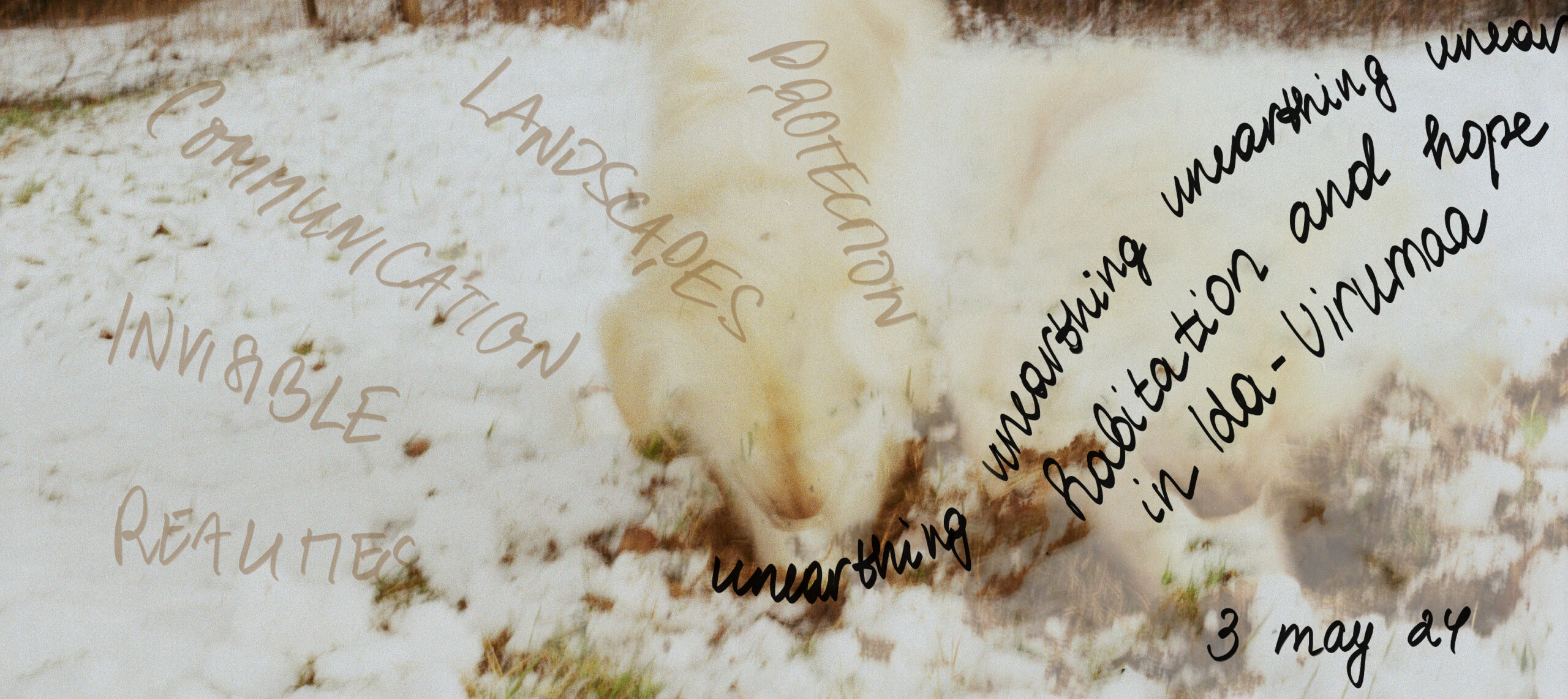
Our group of students studying Urban Studies, Architecture, and Urban Planning warmly invites you to join us on this journey of collectively curated exhibition.
SAVE THE DATE! 3rd OF MAY at 16:00 at the Sea terrace of EKA. The final grading of Urban Studies Urban Models course is tutored by Kristi Grišakov & Keiti Kljavin.
If you dig a new hole in a degraded landscape, you can see the excavated trench. If you open the door of an apartment that has stood empty for years, the room is full of stories. The reference to excavation in the title sums up our task of relating to what has already left, to find in the traces of past activity the material for understanding larger regional changes.
Five different creative experiments aim to reflect the sense of displacement, longing and disempowerment of a region on the edge of Estonia to resist change. We will look at the districts of Ahtme and Järve and the city of Kiviõli, where the monofunctionality of extractive manufacturing has challenged the response to the housing surplus caused by emigration. Exploring different issues related to (non)material aspects of Ida-Viru County settlements, our projects are based on field analysis and research, market analysis of housing conditions, reinterpretation of individual challenges of adaptation to depopulation. There is always a mist of hope in the air, a bit toxic and perhaps greenwashed, but full of the power of re-launching structural funds and the limits of the social adaptability of the population.
Students: Marta Bodnar; Ayse Betul Gesen; Mariana Gomes Pedro; Lion Herrmann; Sofia Ignateva; Maria Kazlovskaya; Madita Laura Kümmeringer; Ella Nikulina; Henry Rikk; Piret Saar; Annika Ülejõe; Anneli Virts; Clara-Marlen Wilke.
Unearth it again! Life and Hope in Idaviru
Friday 03 May, 2024
Our group of students studying Urban Studies, Architecture, and Urban Planning warmly invites you to join us on this journey of collectively curated exhibition.
SAVE THE DATE! 3rd OF MAY at 16:00 at the Sea terrace of EKA. The final grading of Urban Studies Urban Models course is tutored by Kristi Grišakov & Keiti Kljavin.
If you dig a new hole in a degraded landscape, you can see the excavated trench. If you open the door of an apartment that has stood empty for years, the room is full of stories. The reference to excavation in the title sums up our task of relating to what has already left, to find in the traces of past activity the material for understanding larger regional changes.
Five different creative experiments aim to reflect the sense of displacement, longing and disempowerment of a region on the edge of Estonia to resist change. We will look at the districts of Ahtme and Järve and the city of Kiviõli, where the monofunctionality of extractive manufacturing has challenged the response to the housing surplus caused by emigration. Exploring different issues related to (non)material aspects of Ida-Viru County settlements, our projects are based on field analysis and research, market analysis of housing conditions, reinterpretation of individual challenges of adaptation to depopulation. There is always a mist of hope in the air, a bit toxic and perhaps greenwashed, but full of the power of re-launching structural funds and the limits of the social adaptability of the population.
Students: Marta Bodnar; Ayse Betul Gesen; Mariana Gomes Pedro; Lion Herrmann; Sofia Ignateva; Maria Kazlovskaya; Madita Laura Kümmeringer; Ella Nikulina; Henry Rikk; Piret Saar; Annika Ülejõe; Anneli Virts; Clara-Marlen Wilke.
25.04.2024 — 18.05.2024
Group Exhibition “Allow Yourself to Change” in the ARS Project Space
On Thursday, April 25, at 6 p.m., the exhibition “Allow Yourself to Change” will be opened in the ARS Project Space on the intersection of painting and artificial branches.
At the center of painting has always been humanity with its special flaws and virtues – the uniqueness and imperfection of the human hand, the inability to perform movements quickly and flawlessly and to repeat them identically has been the core of painting throughout the centuries-long history of the medium. While today’s artificial intelligence can create flawless forms at lightning speed, repeat them an infinite number of times, and draw images from the entire stock of human visual culture.
But what happens when the slow processuality of painting meets a working method that quickly and efficiently involves machine art instances and global data arrays? What role could an art oriented to deceleration have in the era of total acceleration, when people trust themselves more and more in the care of such technological systems, the working mechanisms of which they do not know, for the sake of efficiency, competitiveness and economic growth?
The exhibition features five Estonian artists, who in recent years have devoted themselves to the study of the relationship between painting and the artificial branch and cross traditional painting techniques with various digital technologies. Vano Allsalu feeds the artificial forest with paintings in his signature style and maps its capabilities in an abstract way of expression; Gerda Hansen plays with the idea of whether a painter of the era of machine art can step into the same river twice; Siiri Jüris allows his figural abstract paintings to mutate with the help of digital technology; Carl-Robert Kagge uses Photoshop’s generative fill feature to create painting screens, and Mart Vainre has developed an ouroboros analog-digital-analog color transformer. The curator of the exhibition is Liisa Kaljula, who works in the painting collection of the Estonian Art Museum and has curated several art exhibitions.
The preparation process of the exhibition is different from the usual curated group exhibition – the curator and the artists have met regularly in the studios of the participating artists to discuss the new situation in which art has been placed by the powerful appearance of the artificial branch: could painting, with its celebration of slowness, physical work and human error, be a counterculture of the age of digital acceleration? The temporary community created between the participants has helped to make sense of this moment in time, when the paths of painting and artificial branches inevitably cross and human and machine intertwine.
Artists: Vano Allsalu, Gerda Hansen, Siiri Jüris, Carl-Robert Kagge, Mart Vainre
Curator: Liisa Kaljula
Graphic design: Carl-Robert Kagge
Exhibition project manager: Mart Vainre
Installation: Johannes Säre
The exhibition “Allow yourself to change.” From painting in the age of machine art” will remain open in the ARS Projektiruumi until May 18, 2024.
The exhibition is supported by the Estonian Cultural Foundation and the Estonian Artists’ Union, the opening is supported by Põhjala.
In connection with the ARS Open Ateliers Day, on May 17th, tours conducted by the exhibition participants will take place, the finale of the exhibition will end with a discussion about the relationship between painting and new technologies.
ARS Projektiruum, Pärnu mnt 154, Tallinn
Open Mon-Sat 12-6pm
Free entrance
arsfactory.ee
Group Exhibition “Allow Yourself to Change” in the ARS Project Space
Thursday 25 April, 2024 — Saturday 18 May, 2024
On Thursday, April 25, at 6 p.m., the exhibition “Allow Yourself to Change” will be opened in the ARS Project Space on the intersection of painting and artificial branches.
At the center of painting has always been humanity with its special flaws and virtues – the uniqueness and imperfection of the human hand, the inability to perform movements quickly and flawlessly and to repeat them identically has been the core of painting throughout the centuries-long history of the medium. While today’s artificial intelligence can create flawless forms at lightning speed, repeat them an infinite number of times, and draw images from the entire stock of human visual culture.
But what happens when the slow processuality of painting meets a working method that quickly and efficiently involves machine art instances and global data arrays? What role could an art oriented to deceleration have in the era of total acceleration, when people trust themselves more and more in the care of such technological systems, the working mechanisms of which they do not know, for the sake of efficiency, competitiveness and economic growth?
The exhibition features five Estonian artists, who in recent years have devoted themselves to the study of the relationship between painting and the artificial branch and cross traditional painting techniques with various digital technologies. Vano Allsalu feeds the artificial forest with paintings in his signature style and maps its capabilities in an abstract way of expression; Gerda Hansen plays with the idea of whether a painter of the era of machine art can step into the same river twice; Siiri Jüris allows his figural abstract paintings to mutate with the help of digital technology; Carl-Robert Kagge uses Photoshop’s generative fill feature to create painting screens, and Mart Vainre has developed an ouroboros analog-digital-analog color transformer. The curator of the exhibition is Liisa Kaljula, who works in the painting collection of the Estonian Art Museum and has curated several art exhibitions.
The preparation process of the exhibition is different from the usual curated group exhibition – the curator and the artists have met regularly in the studios of the participating artists to discuss the new situation in which art has been placed by the powerful appearance of the artificial branch: could painting, with its celebration of slowness, physical work and human error, be a counterculture of the age of digital acceleration? The temporary community created between the participants has helped to make sense of this moment in time, when the paths of painting and artificial branches inevitably cross and human and machine intertwine.
Artists: Vano Allsalu, Gerda Hansen, Siiri Jüris, Carl-Robert Kagge, Mart Vainre
Curator: Liisa Kaljula
Graphic design: Carl-Robert Kagge
Exhibition project manager: Mart Vainre
Installation: Johannes Säre
The exhibition “Allow yourself to change.” From painting in the age of machine art” will remain open in the ARS Projektiruumi until May 18, 2024.
The exhibition is supported by the Estonian Cultural Foundation and the Estonian Artists’ Union, the opening is supported by Põhjala.
In connection with the ARS Open Ateliers Day, on May 17th, tours conducted by the exhibition participants will take place, the finale of the exhibition will end with a discussion about the relationship between painting and new technologies.
ARS Projektiruum, Pärnu mnt 154, Tallinn
Open Mon-Sat 12-6pm
Free entrance
arsfactory.ee
12.04.2024 — 20.06.2024
EKA Museum presents:
Singular Inner Worlds
Marju Mutsu and Reti Saks (Laanemäe)
This exhibition presents the graduation projects of two notably distinct female print artists: Marju Mutsu (1941–1980), who graduated in 1969, and Reti Saks, formerly Laanemäe (1960), who obtained her diploma in print art in 1987. From the outset, both artists displayed a unique and unmistakable style. They both engrave their visions with a sharp needle onto the acid resistant layer of a metal plate using intaglio printing, specifically etching. Their interpretations of the world are profound and characterised by a strong sense of generalisation – albeit expressed in entirely different ways.
Marju Mutsu’s vibrant series Youth comprises six prints, each titled thematically: Wind, Truth, Tenderness, Song, School and Earth. On one hand, we observe the spirit of the 1960s reflected here, capturing the fast-paced rhythms of contemporary life, alongside determined-looking men with strong jawlines. On the other hand, we encounter unprecedented forms in Estonian printmaking, witty suggestions, fragmentation of the pictorial space, as well as emotional experiences, mental states, and the beauty of nature’s fragments. The uniqueness of Mutsu’s print art lies not only in its dynamic expression and Astrid Lindgren-like humour, but also in its exploration of all the possibilities of intaglio printing and bold experimentation: at times, the plate is not completely wiped clean of printing ink, the outlines of recognisable figures blend into abstraction, and the surface of the printing plate itself becomes a character.
The joyful print artist departed from us prematurely, at the young age of just 39.
Reti Saks’ series of seven images Games exudes a more subdued and static tone. From the outset, the artist has been on a quest for answers to life’s profound mysteries, delving into the enigma of life and death. The depth of exploration, sometimes even penetrating the surface of the image itself, is evident in the sheet titled Deep Print. Other prints, like Stairs, Ribbon and Walker, signify human choices, whereas works such as Eye to Eye, Hand and Picture illustrate the enigmatic ways in which the world can be perceived. The artist reflects the world through herself, with her images literally bearing her own visage. In a metaphysical expanse of imagery, a semi-frozen figure of a child-woman emerges, often in repetitive iterations, reminiscent of the artist herself. This deeply introspective exploration of the world is both painful and melancholic, yet it is also rich and multi-layered.
Reeli Kõiv
curator of the exhibition
Graphic design: Pärtel Eelmere
EKA Museum presents:
Friday 12 April, 2024 — Thursday 20 June, 2024
Singular Inner Worlds
Marju Mutsu and Reti Saks (Laanemäe)
This exhibition presents the graduation projects of two notably distinct female print artists: Marju Mutsu (1941–1980), who graduated in 1969, and Reti Saks, formerly Laanemäe (1960), who obtained her diploma in print art in 1987. From the outset, both artists displayed a unique and unmistakable style. They both engrave their visions with a sharp needle onto the acid resistant layer of a metal plate using intaglio printing, specifically etching. Their interpretations of the world are profound and characterised by a strong sense of generalisation – albeit expressed in entirely different ways.
Marju Mutsu’s vibrant series Youth comprises six prints, each titled thematically: Wind, Truth, Tenderness, Song, School and Earth. On one hand, we observe the spirit of the 1960s reflected here, capturing the fast-paced rhythms of contemporary life, alongside determined-looking men with strong jawlines. On the other hand, we encounter unprecedented forms in Estonian printmaking, witty suggestions, fragmentation of the pictorial space, as well as emotional experiences, mental states, and the beauty of nature’s fragments. The uniqueness of Mutsu’s print art lies not only in its dynamic expression and Astrid Lindgren-like humour, but also in its exploration of all the possibilities of intaglio printing and bold experimentation: at times, the plate is not completely wiped clean of printing ink, the outlines of recognisable figures blend into abstraction, and the surface of the printing plate itself becomes a character.
The joyful print artist departed from us prematurely, at the young age of just 39.
Reti Saks’ series of seven images Games exudes a more subdued and static tone. From the outset, the artist has been on a quest for answers to life’s profound mysteries, delving into the enigma of life and death. The depth of exploration, sometimes even penetrating the surface of the image itself, is evident in the sheet titled Deep Print. Other prints, like Stairs, Ribbon and Walker, signify human choices, whereas works such as Eye to Eye, Hand and Picture illustrate the enigmatic ways in which the world can be perceived. The artist reflects the world through herself, with her images literally bearing her own visage. In a metaphysical expanse of imagery, a semi-frozen figure of a child-woman emerges, often in repetitive iterations, reminiscent of the artist herself. This deeply introspective exploration of the world is both painful and melancholic, yet it is also rich and multi-layered.
Reeli Kõiv
curator of the exhibition
Graphic design: Pärtel Eelmere
12.04.2024 — 20.06.2024
EKA Museum presents: Nature and Abstraction
Nature and Abstraction
Designs for Monumental Paintings from the 1970–1980s
Monumental painting emerged as a significant medium in Estonian art during the 1960s. However, formal instruction in this area gained momentum at the art academy over the subsequent two decades. During this period, the ideas of several painting students progressed from concept to completion in various materials. Examples include the stained glass works of Urve Dzidzaria and Heli Tuksam, which originated from their diploma projects. The preliminary work of these projects is also displayed at the current exhibition.
While Soviet official art typically featured propagandistic content in works intended for public spaces, neither our professional monumental painting nor the students’ works adhere to this approach. Guided by the enthusiastic mentorship of Dolores Hoffmann, students developed universally human and aesthetic solutions in monumental painting. One noticeable trend is the oscillation between nature-inspired, realistic design creation and the abstract style, where recognisable figures have been lost. This selection presents various personal approaches, ranging from a slightly stylised manner to completely abstract expression. In each case, the artists have carefully considered the future technique of execution, whether it be fresco, sgraffito, mosaic or stained glass.
Several artworks that were removed from the old EKA building on Tartu Road before its demolition have been subsequently reinstalled and showcased in the new academy building. Furthermore, contemporary pieces have been introduced, as instruction in monumental painting continues under the guidance of Heldur Lassi at the Estonian Academy of Arts, albeit on a more modest scale today. Present-day students are not constrained by traditional boundaries – they do employ classical techniques but boldly blend them together as dictated by the content. This exhibition provides viewers with the opportunity to establish conceptual links between different approaches from various periods, prompting them to seek out the completed monumental paintings, both old and new, within the public spaces of the EKA.
The artworks showcased in the exhibition were initially featured at the comprehensive exhibition Invisible Monumental Painting at the EKA Gallery in 2020, offering a vibrant display designed by Kristi Kongi.
Reeli Kõiv
curator of the exhibition
Passepartouts: Kristi Kongi
Graphic design: Pärtel Eelmere
EKA Museum presents: Nature and Abstraction
Friday 12 April, 2024 — Thursday 20 June, 2024
Nature and Abstraction
Designs for Monumental Paintings from the 1970–1980s
Monumental painting emerged as a significant medium in Estonian art during the 1960s. However, formal instruction in this area gained momentum at the art academy over the subsequent two decades. During this period, the ideas of several painting students progressed from concept to completion in various materials. Examples include the stained glass works of Urve Dzidzaria and Heli Tuksam, which originated from their diploma projects. The preliminary work of these projects is also displayed at the current exhibition.
While Soviet official art typically featured propagandistic content in works intended for public spaces, neither our professional monumental painting nor the students’ works adhere to this approach. Guided by the enthusiastic mentorship of Dolores Hoffmann, students developed universally human and aesthetic solutions in monumental painting. One noticeable trend is the oscillation between nature-inspired, realistic design creation and the abstract style, where recognisable figures have been lost. This selection presents various personal approaches, ranging from a slightly stylised manner to completely abstract expression. In each case, the artists have carefully considered the future technique of execution, whether it be fresco, sgraffito, mosaic or stained glass.
Several artworks that were removed from the old EKA building on Tartu Road before its demolition have been subsequently reinstalled and showcased in the new academy building. Furthermore, contemporary pieces have been introduced, as instruction in monumental painting continues under the guidance of Heldur Lassi at the Estonian Academy of Arts, albeit on a more modest scale today. Present-day students are not constrained by traditional boundaries – they do employ classical techniques but boldly blend them together as dictated by the content. This exhibition provides viewers with the opportunity to establish conceptual links between different approaches from various periods, prompting them to seek out the completed monumental paintings, both old and new, within the public spaces of the EKA.
The artworks showcased in the exhibition were initially featured at the comprehensive exhibition Invisible Monumental Painting at the EKA Gallery in 2020, offering a vibrant display designed by Kristi Kongi.
Reeli Kõiv
curator of the exhibition
Passepartouts: Kristi Kongi
Graphic design: Pärtel Eelmere
20.04.2024
Melina Unterhauser at Keskpuur
Performance “What if there is no place called home” by Melina Unterhauser in Keskpuur on 20th of April from 12.00 to 15.30.
“This I will only tell myself in confidence because it comes from a little part where I don’t go often and there is still a place for you. Come and sit next to my kitchen to hear a story of our past. Follow the unheard story of my grandfather.”
The performance takes place at Keskpuur activating the installation of Inessa Saarits and Liisa-Lota Jõeleht. Melina Unterhauser transforms the installation by inviting audience to have a homemade meal together, the performance explores and questions the overlapping and contradictions of the culture heritage in different countries. Where are the intersections and what isolate us from each other? How to live as a nomad in a new country with a different cultural background?
Unterhauser is interested in involvements of the individuals and groups in society, specifically in rituals, social movements and political systems. For that she works mostly in installation and performance to combine haptic materials with body movement.
Melina Unterhauser is a German artist based in Karlsruhe and Tallinn. She is currently studying in the installation and sculpture department at the Estonia Academy of Arts for an exchange semester. In Germany she is a student of Ulla von Brandenburg in the Fine Arts Academy of Karlsruhe. She has participated in several group exhibitions in Germany and Italy.
12:00-14:30 Sound installation and preparation of the meal
15:00 Eating together
Melina Unterhauser at Keskpuur
Saturday 20 April, 2024
Performance “What if there is no place called home” by Melina Unterhauser in Keskpuur on 20th of April from 12.00 to 15.30.
“This I will only tell myself in confidence because it comes from a little part where I don’t go often and there is still a place for you. Come and sit next to my kitchen to hear a story of our past. Follow the unheard story of my grandfather.”
The performance takes place at Keskpuur activating the installation of Inessa Saarits and Liisa-Lota Jõeleht. Melina Unterhauser transforms the installation by inviting audience to have a homemade meal together, the performance explores and questions the overlapping and contradictions of the culture heritage in different countries. Where are the intersections and what isolate us from each other? How to live as a nomad in a new country with a different cultural background?
Unterhauser is interested in involvements of the individuals and groups in society, specifically in rituals, social movements and political systems. For that she works mostly in installation and performance to combine haptic materials with body movement.
Melina Unterhauser is a German artist based in Karlsruhe and Tallinn. She is currently studying in the installation and sculpture department at the Estonia Academy of Arts for an exchange semester. In Germany she is a student of Ulla von Brandenburg in the Fine Arts Academy of Karlsruhe. She has participated in several group exhibitions in Germany and Italy.
12:00-14:30 Sound installation and preparation of the meal
15:00 Eating together