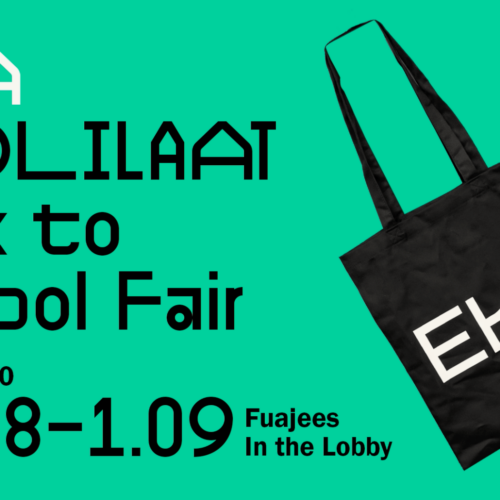
EKA Design Week workshop: “Designing Our Future for All”

30.09.2025 — 01.10.2025

EKA Design Week workshop: “Designing Our Future for All”

Are you a student passionate about creating a more inclusive and socially sustainable world? You are invited to an inspiring workshop, “Designing Our Future for All,” conducted by the design and architecture facilitator, Jasmien Herssens from Fourmind.

“Design for All” concept is about exploring how design can enrich the lives of every person. The goal is to create a more inclusive and socially sustainable world for everyone by designing environments where people know and feel their needs are supported. Ultimately, it aims to create a world where design based on caring and humanity is the norm, rather than the exception.

This is a unique opportunity to gain hands-on training in the implementation of Design for All, providing you with the insights and methodologies that enrich skills and contribute to a world where caring and humanity are the norm.

The workshop is structured in two parts:

Day 1 | 30.09.2025 | 9:45 AM – 1:00 PM | Part 1: Insight & Knowledge
Delve into the latest approaches, research, and perspectives in architectural and design practice.

Day 2 | 01.10.2025 | 2:00 PM – 5:15 PM | Part 2: Application
Apply the Design for All methodology directly to one of your own personal projects or ideas.


REGISTER HERE


Workshop is part of the EKA Design Week programme.


Posted by Maarja Pabut — Permalink

EKA Design Week workshop: “Designing Our Future for All”

Tuesday 30 September, 2025 — Wednesday 01 October, 2025

Are you a student passionate about creating a more inclusive and socially sustainable world? You are invited to an inspiring workshop, “Designing Our Future for All,” conducted by the design and architecture facilitator, Jasmien Herssens from Fourmind.

“Design for All” concept is about exploring how design can enrich the lives of every person. The goal is to create a more inclusive and socially sustainable world for everyone by designing environments where people know and feel their needs are supported. Ultimately, it aims to create a world where design based on caring and humanity is the norm, rather than the exception.

This is a unique opportunity to gain hands-on training in the implementation of Design for All, providing you with the insights and methodologies that enrich skills and contribute to a world where caring and humanity are the norm.

The workshop is structured in two parts:

Day 1 | 30.09.2025 | 9:45 AM – 1:00 PM | Part 1: Insight & Knowledge
Delve into the latest approaches, research, and perspectives in architectural and design practice.

Day 2 | 01.10.2025 | 2:00 PM – 5:15 PM | Part 2: Application
Apply the Design for All methodology directly to one of your own personal projects or ideas.


REGISTER HERE


Workshop is part of the EKA Design Week programme.


Posted by Maarja Pabut — Permalink

29.09.2025

New visions in Slovak and Estonian architecture

New Visions in Slovak and Estonian Architecture: Exhibition and Discussion

Under the leadership of Sille Pihlak, Dean of the Faculty of Architecture, a discussion with a group of Slovak architects will be held on the contemporary development and visions of Slovak and Estonian architecture.

At the same time, we will also open the landscape/nature/architecture exhibition of students of the Academy of Fine Arts and Design in Bratislava.

The exhibition and event are organized by The Embassy of the Slovak Republic in Helsinki.


All interested parties are welcome!

Posted by Tiina Tammet — Permalink

New visions in Slovak and Estonian architecture

Monday 29 September, 2025

New Visions in Slovak and Estonian Architecture: Exhibition and Discussion

Under the leadership of Sille Pihlak, Dean of the Faculty of Architecture, a discussion with a group of Slovak architects will be held on the contemporary development and visions of Slovak and Estonian architecture.

At the same time, we will also open the landscape/nature/architecture exhibition of students of the Academy of Fine Arts and Design in Bratislava.

The exhibition and event are organized by The Embassy of the Slovak Republic in Helsinki.


All interested parties are welcome!

Posted by Tiina Tammet — Permalink

26.09.2025 — 19.10.2025

Alejandra Alarcón & Sandra Mirka “Grounded Gatherings: Rooted Beginnings” at EKA Gallery 27.09.–19.10.2025

Alejandra Alarcón & Sandra Mirka
GROUNDED GATHERINGS: ROOTED BEGINNINGS
Ground floor of EKA Gallery 27.09.–19.10.2025
Open Tue–Sat 12–6 pm Sun 12–4 pm
Opening: Friday, September 26 at 6 pm

As the seasons turn, “Grounded Gatherings: Rooted Beginnings” invites us to slow down, share food, and reflect on our relationship with the landscape. It offers a space to come together around the table, to simmer jams, and to share seasonal bites. This exhibition is imagined as a place for learning and unlearning, for exchanging different kinds of memories and knowledge. The work focuses on specific locations in Finland and Estonia, places where encounters with humans and more-than-humans have been flourishing. Through visual documentation from Spring and Summer, recipes, workshop events, and communal meals, the project invites us to build and maintain a long-lasting relationship with our surroundings through taste.

“Grounded Gatherings” is a multidisciplinary project by Alejandra Alarcón and Sandra Mirka, unfolding between Finland and Estonia. Sandra Mirka holds an MA in interior architecture and is a certified chef based in Tallinn. Her practice is led by sourcing and building with up-cycled materials, connecting spatial design with food cultures. Alejandra Alarcón is an interdisciplinary artist and designer based in Helsinki. She holds an MA in Contemporary Design. Her interest in (food) sustainability—the seasonality of things, non-human collaborations—is deeply tied to embodied practices such as walking, foraging, cooking, and digesting. Both creatives share a passion for food and cooking, working with it in different ways throughout their individual practices. Both creatives are deeply interested in how humans and more than humans co-exist in ways that create opportunities for more caring and sustainable practices.

Graphic design: Daria Titova
Technical support: Erik Hõim
The exhibition is supported by Sadolin Estonia and Tallinn City.
Special thanks to Joni Judén, Kaitlyn D. Hamilton, TUOTUO, Lenne Nigul, Anumai Raska, Estonian Centre for Architecture, Mariann Drell, Markus Koistinen and Radul Radulović.
Opening drinks from mirai™ and Põhjala Brewery.

Posted by Kaisa Maasik — Permalink

Alejandra Alarcón & Sandra Mirka “Grounded Gatherings: Rooted Beginnings” at EKA Gallery 27.09.–19.10.2025

Friday 26 September, 2025 — Sunday 19 October, 2025

Alejandra Alarcón & Sandra Mirka
GROUNDED GATHERINGS: ROOTED BEGINNINGS
Ground floor of EKA Gallery 27.09.–19.10.2025
Open Tue–Sat 12–6 pm Sun 12–4 pm
Opening: Friday, September 26 at 6 pm

As the seasons turn, “Grounded Gatherings: Rooted Beginnings” invites us to slow down, share food, and reflect on our relationship with the landscape. It offers a space to come together around the table, to simmer jams, and to share seasonal bites. This exhibition is imagined as a place for learning and unlearning, for exchanging different kinds of memories and knowledge. The work focuses on specific locations in Finland and Estonia, places where encounters with humans and more-than-humans have been flourishing. Through visual documentation from Spring and Summer, recipes, workshop events, and communal meals, the project invites us to build and maintain a long-lasting relationship with our surroundings through taste.

“Grounded Gatherings” is a multidisciplinary project by Alejandra Alarcón and Sandra Mirka, unfolding between Finland and Estonia. Sandra Mirka holds an MA in interior architecture and is a certified chef based in Tallinn. Her practice is led by sourcing and building with up-cycled materials, connecting spatial design with food cultures. Alejandra Alarcón is an interdisciplinary artist and designer based in Helsinki. She holds an MA in Contemporary Design. Her interest in (food) sustainability—the seasonality of things, non-human collaborations—is deeply tied to embodied practices such as walking, foraging, cooking, and digesting. Both creatives share a passion for food and cooking, working with it in different ways throughout their individual practices. Both creatives are deeply interested in how humans and more than humans co-exist in ways that create opportunities for more caring and sustainable practices.

Graphic design: Daria Titova
Technical support: Erik Hõim
The exhibition is supported by Sadolin Estonia and Tallinn City.
Special thanks to Joni Judén, Kaitlyn D. Hamilton, TUOTUO, Lenne Nigul, Anumai Raska, Estonian Centre for Architecture, Mariann Drell, Markus Koistinen and Radul Radulović.
Opening drinks from mirai™ and Põhjala Brewery.

Posted by Kaisa Maasik — Permalink

21.10.2025

KVI Open Lecture: “Decolonial Museology Re-centered: Thinking Theory and Practice through East-Central Europe”

image

Decolonization has become an important keyword and marker of change in contemporary museum landscape. But how could we understand and embed it in the Estonian context?

On Tuesday, October 21st at 6PM Estonian Academy of Arts will host a public event that will focus on the meanings of decolonization in museums by bringing together local, regional and international perspectives and by juxtaposing recent developments in the Estonian and Polish museum fields.

The questions that will serve as the starting point for the event are: How has decolonization been conceptualized in relation to Eastern European museums? What are positive examples and chosen approaches in recent exhibition practices? How do the perspectives of museum staff, audience and researchers differ from each other?

The event will start with a short lecture by Erica Lehrer, it will continue with responses by Joanna Wawrzyniak and Mariann Raisma and a discussion with the audience on the meanings of the decolonial approach in Estonian and Eastern European museum contexts. Moderated by Margaret Tali.

Erica Lehrer is a sociocultural anthropologist, historian, and curator. She is a Professor in the History Department and held the Canada Research Chair in Museum and Heritage Studies (2007-2017) at Concordia University, Montreal,
where she is also Founding Director of the Curating and Public Scholarship Lab (CaPSL). She is the author of Jewish Poland Revisited: Heritage Tourism in Unquiet Places (2013); and co-editor of Terribly Close: Polish Vernacular Artists Face the Holocaust (2023); My Museum, A Museum About Me (2023); Curatorial Dreams: Critics Imagine Exhibitions (2016); Jewish Space in Contemporary Poland (2015); and Curating Difficult Knowledge: Violent Pasts in Public Places (2011), among others, as well as numerous articles. She is Principal Investigator on the international team project Thinking Through the Museum: A Partnership Approach to Curating Difficult Knowledge in Public (2021-2028).

Joanna Wawrzyniak is a university professor of sociology and the founding director of the Center for Research on Social Memory at the University of Warsaw. She has a long-standing experience in oral history and museum research. Her current projects relate to the memories of socialism, neoliberal transformation, deindustrialization, and decolonization of heritage.   She is the past President of Memory Studies Association (2024-2025) and vice-Chair of the COST Action Slow Memory: Transformative Practices for Times of Uneven and Accelerating Change.  Her most recent books include co-edited Remembering the Neoliberal Turn: Economic Change and Collective Memory in Eastern Europe after 1989 (Routledge 2023), Regions of Memory: Transnational Formations (Palgrave 2022) and co-authored Cuts: Oral History of Transformation (in Polish, Krytyka Polityczna 2020). She co-edited special issues for, among others, Memory Studies, Contemporary European History, and East European Politics and Societies.

Mariann Raisma is the director of the University of Tartu Museum. She has written articles about the history of Estonian museums but also about the future; she has also been a lecturer of museology and curator of exhibitions. She has defended her doctoral thesis on the subject “The Power of the Museum. Shaping Collective Memory in Estonia during the Turning Points of the 20th Century”

Margaret Tali is assistant professor in Tallinn university, whose research focuses on the history of Estonian museums and practices of collecting. She is the author of “Absence and Difficult Knowledge in Contemporary Art Museums” (2017) and co-curator of the project “Communicating Difficult Pasts” (2019-2024).


Talk is held in collaboration with the Embassy of Canada and the Estonian Doctoral School of Humanities and Arts (Project “Cooperation between universities to promote doctoral studies” (2021-2027.4.04.24-0003) is co-funded by the European Union). Co-funded by Erasmus+.

Posted by Annika Tiko — Permalink

KVI Open Lecture: “Decolonial Museology Re-centered: Thinking Theory and Practice through East-Central Europe”

Tuesday 21 October, 2025

image

Decolonization has become an important keyword and marker of change in contemporary museum landscape. But how could we understand and embed it in the Estonian context?

On Tuesday, October 21st at 6PM Estonian Academy of Arts will host a public event that will focus on the meanings of decolonization in museums by bringing together local, regional and international perspectives and by juxtaposing recent developments in the Estonian and Polish museum fields.

The questions that will serve as the starting point for the event are: How has decolonization been conceptualized in relation to Eastern European museums? What are positive examples and chosen approaches in recent exhibition practices? How do the perspectives of museum staff, audience and researchers differ from each other?

The event will start with a short lecture by Erica Lehrer, it will continue with responses by Joanna Wawrzyniak and Mariann Raisma and a discussion with the audience on the meanings of the decolonial approach in Estonian and Eastern European museum contexts. Moderated by Margaret Tali.

Erica Lehrer is a sociocultural anthropologist, historian, and curator. She is a Professor in the History Department and held the Canada Research Chair in Museum and Heritage Studies (2007-2017) at Concordia University, Montreal,
where she is also Founding Director of the Curating and Public Scholarship Lab (CaPSL). She is the author of Jewish Poland Revisited: Heritage Tourism in Unquiet Places (2013); and co-editor of Terribly Close: Polish Vernacular Artists Face the Holocaust (2023); My Museum, A Museum About Me (2023); Curatorial Dreams: Critics Imagine Exhibitions (2016); Jewish Space in Contemporary Poland (2015); and Curating Difficult Knowledge: Violent Pasts in Public Places (2011), among others, as well as numerous articles. She is Principal Investigator on the international team project Thinking Through the Museum: A Partnership Approach to Curating Difficult Knowledge in Public (2021-2028).

Joanna Wawrzyniak is a university professor of sociology and the founding director of the Center for Research on Social Memory at the University of Warsaw. She has a long-standing experience in oral history and museum research. Her current projects relate to the memories of socialism, neoliberal transformation, deindustrialization, and decolonization of heritage.   She is the past President of Memory Studies Association (2024-2025) and vice-Chair of the COST Action Slow Memory: Transformative Practices for Times of Uneven and Accelerating Change.  Her most recent books include co-edited Remembering the Neoliberal Turn: Economic Change and Collective Memory in Eastern Europe after 1989 (Routledge 2023), Regions of Memory: Transnational Formations (Palgrave 2022) and co-authored Cuts: Oral History of Transformation (in Polish, Krytyka Polityczna 2020). She co-edited special issues for, among others, Memory Studies, Contemporary European History, and East European Politics and Societies.

Mariann Raisma is the director of the University of Tartu Museum. She has written articles about the history of Estonian museums but also about the future; she has also been a lecturer of museology and curator of exhibitions. She has defended her doctoral thesis on the subject “The Power of the Museum. Shaping Collective Memory in Estonia during the Turning Points of the 20th Century”

Margaret Tali is assistant professor in Tallinn university, whose research focuses on the history of Estonian museums and practices of collecting. She is the author of “Absence and Difficult Knowledge in Contemporary Art Museums” (2017) and co-curator of the project “Communicating Difficult Pasts” (2019-2024).


Talk is held in collaboration with the Embassy of Canada and the Estonian Doctoral School of Humanities and Arts (Project “Cooperation between universities to promote doctoral studies” (2021-2027.4.04.24-0003) is co-funded by the European Union). Co-funded by Erasmus+.

Posted by Annika Tiko — Permalink

29.09.2025 — 05.10.2025

UPMADE® in Kenya: DiMa + EKA Circular Design

On 29 September, as part of the Design Night festival, the exhibition “UPMADE® in Kenya: DiMa + EKA Circular Design” will open in the Krulli quarter, showcasing creative works made from the textile offcuts of a Kenyan factory.

The exhibition is free to attend, with the opening on Monday 29.09 at 18:30 at The Machine Shop I, Krulli quarter. Regular opening hours Tuesday–Saturday 11:00–20:00 and Sunday 11:00–18:00 (29.09-05.10.2025).  

The textile industry is one of the world’s most environmentally impactful sectors – it consumes vast amounts of raw materials and energy and generates large volumes of waste. In Kenya, where the industry is rapidly growing, sustainability principles have not yet been systematically implemented.

At the Rivatex textile factory in Eldoret, Kenya, the Estonian science- and design-based UPMADE® model—built on value-adding recycling, or upcycling—was taught and applied in collaboration with students from the Estonian Academy of Arts (EKA). The goal was to reduce the environmental footprint of production, develop skills, and help bring the local industry in line with circular-economy principles and climate targets.

From the factory’s textile remnants, the students designed clothing, accessories, lamps, sunshades and a variety of other objects. The exhibition presents the creative work of EKA circular-design master’s students who participated in the initiative during 2024–2025: Doreen Mägi, Eva Liis Lidenburg, Kaisa Ilves, Lisandra Türkson, Maria Rojiko Nisu, Mariann Hendrikson, Marit Saare, Mart Maide, Marta Konovalov, Merily Mikiver and Eva Reiska. The students were supervised by Reet Aus, Maria Pukk and Lisandra Türkson.

The EKA x T4EU podcast episode “Rethinking Fashion Waste” is available HERE. Designer and researcher Reet Aus shares insights on rethinking fashion waste in a discussion led by Anna Lohmatova, exploring the UPMADE® model in Kenya and the impact of EU sustainability regulations on the textile sector.

The exhibition is part of the project “Transferring UPMADE Expertise to Kenya,” led by EKA’s Sustainable Design and Materials Laboratory (DiMa). The project was carried out in cooperation with the Stockholm Environment Institute Tallinn Centre (SEI Tallinn) and Moi University, funded by the Estonian Ministry of Climate’s international climate-cooperation programme, with student mobility supported by the EU Erasmus+ programme.

Running from 29 September to 5 October, Design Night features many other EKA initiatives. The satellite programme includes EKA Design Week and a fashion artists’ exhibition, and EKA students will also take part in the joint display of Estonian design schools. The festival’s opening performance, “Inclusion Is Action,” is organised by EKA lecturer Reet Aus.

The full Design Night programme can be found here.

Posted by Triin Käo — Permalink

UPMADE® in Kenya: DiMa + EKA Circular Design

Monday 29 September, 2025 — Sunday 05 October, 2025

On 29 September, as part of the Design Night festival, the exhibition “UPMADE® in Kenya: DiMa + EKA Circular Design” will open in the Krulli quarter, showcasing creative works made from the textile offcuts of a Kenyan factory.

The exhibition is free to attend, with the opening on Monday 29.09 at 18:30 at The Machine Shop I, Krulli quarter. Regular opening hours Tuesday–Saturday 11:00–20:00 and Sunday 11:00–18:00 (29.09-05.10.2025).  

The textile industry is one of the world’s most environmentally impactful sectors – it consumes vast amounts of raw materials and energy and generates large volumes of waste. In Kenya, where the industry is rapidly growing, sustainability principles have not yet been systematically implemented.

At the Rivatex textile factory in Eldoret, Kenya, the Estonian science- and design-based UPMADE® model—built on value-adding recycling, or upcycling—was taught and applied in collaboration with students from the Estonian Academy of Arts (EKA). The goal was to reduce the environmental footprint of production, develop skills, and help bring the local industry in line with circular-economy principles and climate targets.

From the factory’s textile remnants, the students designed clothing, accessories, lamps, sunshades and a variety of other objects. The exhibition presents the creative work of EKA circular-design master’s students who participated in the initiative during 2024–2025: Doreen Mägi, Eva Liis Lidenburg, Kaisa Ilves, Lisandra Türkson, Maria Rojiko Nisu, Mariann Hendrikson, Marit Saare, Mart Maide, Marta Konovalov, Merily Mikiver and Eva Reiska. The students were supervised by Reet Aus, Maria Pukk and Lisandra Türkson.

The EKA x T4EU podcast episode “Rethinking Fashion Waste” is available HERE. Designer and researcher Reet Aus shares insights on rethinking fashion waste in a discussion led by Anna Lohmatova, exploring the UPMADE® model in Kenya and the impact of EU sustainability regulations on the textile sector.

The exhibition is part of the project “Transferring UPMADE Expertise to Kenya,” led by EKA’s Sustainable Design and Materials Laboratory (DiMa). The project was carried out in cooperation with the Stockholm Environment Institute Tallinn Centre (SEI Tallinn) and Moi University, funded by the Estonian Ministry of Climate’s international climate-cooperation programme, with student mobility supported by the EU Erasmus+ programme.

Running from 29 September to 5 October, Design Night features many other EKA initiatives. The satellite programme includes EKA Design Week and a fashion artists’ exhibition, and EKA students will also take part in the joint display of Estonian design schools. The festival’s opening performance, “Inclusion Is Action,” is organised by EKA lecturer Reet Aus.

The full Design Night programme can be found here.

Posted by Triin Käo — Permalink

16.10.2025

KVI + ARH open lecture: Leslie Kern “Towards a Feminist City”

How have cities failed women, and what can we do to make them work better for everyone? This talk explores the history and impact of male-centered urban design practices in areas such as mobility, care work, and safety. Using principles inspired by feminist theory and feminist urban planning practices, we will consider a range of ways that cities around the world are implementing more just, equitable, and sustainable approaches to city building.

Leslie Kern, PhD, is the author of three books about cities, including Gentrification Is Inevitable And Other Lies and Feminist City: Claiming Space in a Man-Made World. Her latest book, with Dr. Roberta Hawkins, is Higher Expectations: How to Survive Academia, Make it Better for Others, and Transform the University. She was an associate professor of geography and environment and women’s and gender studies at Mount Allison University from 2009-2024. Leslie’s writing has appeared in The Guardian, Vox, Bloomberg CityLab, and Refinery29. She is also an academic career coach, helping academics find meaning and joy in their work.

2025/2026 open lecture series in held in collaboration of the Faculty of Architecture and the Institute of Art History and Visual Culture.

The lecture series is supported by:

Posted by Annika Tiko — Permalink

KVI + ARH open lecture: Leslie Kern “Towards a Feminist City”

Thursday 16 October, 2025

How have cities failed women, and what can we do to make them work better for everyone? This talk explores the history and impact of male-centered urban design practices in areas such as mobility, care work, and safety. Using principles inspired by feminist theory and feminist urban planning practices, we will consider a range of ways that cities around the world are implementing more just, equitable, and sustainable approaches to city building.

Leslie Kern, PhD, is the author of three books about cities, including Gentrification Is Inevitable And Other Lies and Feminist City: Claiming Space in a Man-Made World. Her latest book, with Dr. Roberta Hawkins, is Higher Expectations: How to Survive Academia, Make it Better for Others, and Transform the University. She was an associate professor of geography and environment and women’s and gender studies at Mount Allison University from 2009-2024. Leslie’s writing has appeared in The Guardian, Vox, Bloomberg CityLab, and Refinery29. She is also an academic career coach, helping academics find meaning and joy in their work.

2025/2026 open lecture series in held in collaboration of the Faculty of Architecture and the Institute of Art History and Visual Culture.

The lecture series is supported by:

Posted by Annika Tiko — Permalink

24.09.2025 — 01.11.2025

Brenda Purtsak’s “Distant veils” at Artrovert Gallery


Brenda Purtsak’s solo exhibition “Distant veils” will open at Artrovert Gallery on 24th of September from 6pm.


Brenda Purtsak’s artistic practice has reflected themes related to human biological body, birth, death, family and kinship. The exhibition at hand combines all themes mentioned above through the lens of contemporary painting with the keywords of desacralized Christian art, compassion and self-sacrifice.


The exhibition addresses people as cultural artifacts and draws parallels between works created especially for the exhibition and well-known historical artworks such as Michelangelo’s Pietà sculpture and Madonna and Child paintings. The desacralization of these symbols allows the artist to address a wider range of personal and cultural meanings that are not associated with religion. 


Paintings, ceramic works and charcoal drawings are displayed within Brenda’s exhibition. The ceramic series derive from My Little Pony toy series that she remembers from her childhood. They consist of colorful ponies with unique symbols on the sides of their bottoms called “cutie marks.” These marks represent the unique talent of each pony and its connection to and the relationship with it. The ponies, people, and charcoal drawings in Brenda’s paintings may at first glance seem unfinished and somehow collaged together. However, human memories are mostly not crystal clear or possible to freeze to take a deeper look the same way as photography or film enables to do. As time passes new layers are added or we might discover some that we had not realised existed before.


The exhibition team


Location: Artrovert Gallery, Ristiku tn 10, Tallinn

Opening: 24.09, from 6pm

Open: 24.09–01.11.25, Tue-Sat 12am–6pm

Curator: Liisi Kõuhkna

Graphic design: Rainer Kasekivi

Support and thanks to: Cultural Endowment of Estonia, Artrovert Gallery, Brenda’s family, Maria Elise Remme, Keithy Kuuspu, Ian Simon Märjamaa

Posted by Andres Lõo — Permalink

Brenda Purtsak’s “Distant veils” at Artrovert Gallery

Wednesday 24 September, 2025 — Saturday 01 November, 2025


Brenda Purtsak’s solo exhibition “Distant veils” will open at Artrovert Gallery on 24th of September from 6pm.


Brenda Purtsak’s artistic practice has reflected themes related to human biological body, birth, death, family and kinship. The exhibition at hand combines all themes mentioned above through the lens of contemporary painting with the keywords of desacralized Christian art, compassion and self-sacrifice.


The exhibition addresses people as cultural artifacts and draws parallels between works created especially for the exhibition and well-known historical artworks such as Michelangelo’s Pietà sculpture and Madonna and Child paintings. The desacralization of these symbols allows the artist to address a wider range of personal and cultural meanings that are not associated with religion. 


Paintings, ceramic works and charcoal drawings are displayed within Brenda’s exhibition. The ceramic series derive from My Little Pony toy series that she remembers from her childhood. They consist of colorful ponies with unique symbols on the sides of their bottoms called “cutie marks.” These marks represent the unique talent of each pony and its connection to and the relationship with it. The ponies, people, and charcoal drawings in Brenda’s paintings may at first glance seem unfinished and somehow collaged together. However, human memories are mostly not crystal clear or possible to freeze to take a deeper look the same way as photography or film enables to do. As time passes new layers are added or we might discover some that we had not realised existed before.


The exhibition team


Location: Artrovert Gallery, Ristiku tn 10, Tallinn

Opening: 24.09, from 6pm

Open: 24.09–01.11.25, Tue-Sat 12am–6pm

Curator: Liisi Kõuhkna

Graphic design: Rainer Kasekivi

Support and thanks to: Cultural Endowment of Estonia, Artrovert Gallery, Brenda’s family, Maria Elise Remme, Keithy Kuuspu, Ian Simon Märjamaa

Posted by Andres Lõo — Permalink

03.10.2025

GreenCcircle Living Lab @ Design for All 2025

GreenCcircle Living Lab invites creatives, policymakers, researchers, and communities to co-create sustainable and regenerative solutions for the cultural and creative industries. This EU-supported initiative brings together local and international participants to address pressing sustainability challenges through hands-on collaboration.

Our Local Living Lab in Tallinn offers a unique opportunity to:
– Join a series of three expert-led workshops focused on sustainability and creative innovation
– Explore and test the GreenCcircle Toolkit and GreenCcircle Academy—two new resources for greener practices
– Share your ideas and experiences with a growing European network of changemakers
– Collaborate in an open, creative, and participatory environment

Why take part? Your contribution can influence not only local outcomes but also European-level innovation. The most engaged participants will have the chance to attend the GreenCcircle European Living Lab in Venice in December 2025—a three-day event bringing together inspiring voices from across Europe to shape the future of the cultural and creative sector.

Participation is free, but pre-registration is required: riina.oun@artun.ee
More information: Riina Õun

The meeting will take place as part of Design for All on 3 October 2025, from 1:00 – 3:00 PM (Kopli 70, Remonditsehh).
Design for all 2025 program.

web: https://greenccircle.eu/
IG: https://www.instagram.com/greenccircle/


Posted by Triin Käo — Permalink

GreenCcircle Living Lab @ Design for All 2025

Friday 03 October, 2025

GreenCcircle Living Lab invites creatives, policymakers, researchers, and communities to co-create sustainable and regenerative solutions for the cultural and creative industries. This EU-supported initiative brings together local and international participants to address pressing sustainability challenges through hands-on collaboration.

Our Local Living Lab in Tallinn offers a unique opportunity to:
– Join a series of three expert-led workshops focused on sustainability and creative innovation
– Explore and test the GreenCcircle Toolkit and GreenCcircle Academy—two new resources for greener practices
– Share your ideas and experiences with a growing European network of changemakers
– Collaborate in an open, creative, and participatory environment

Why take part? Your contribution can influence not only local outcomes but also European-level innovation. The most engaged participants will have the chance to attend the GreenCcircle European Living Lab in Venice in December 2025—a three-day event bringing together inspiring voices from across Europe to shape the future of the cultural and creative sector.

Participation is free, but pre-registration is required: riina.oun@artun.ee
More information: Riina Õun

The meeting will take place as part of Design for All on 3 October 2025, from 1:00 – 3:00 PM (Kopli 70, Remonditsehh).
Design for all 2025 program.

web: https://greenccircle.eu/
IG: https://www.instagram.com/greenccircle/


Posted by Triin Käo — Permalink

26.09.2025 — 19.10.2025

Eugenio Marini & Ingrid Helena Pajo “The Day the Line Bent into a Spiral” at EKA Gallery 27.09.–19.10.2025

Eugenio Marini & Ingrid Helena Pajo
THE DAY THE LINE BENT INTO A SPIRAL
Second floor of EKA Gallery 27.09.–19.10.2025
Open Tue–Sat 12–6 pm Sun 12–4 pm
Opening: Friday, September 26 at 6 pm

We don’t know the exact day the line bent into a spiral. At some point, it was simply happening—twisting ever forward, spinning as it turned. In the beginning, perhaps it all moved a little slower—the bending and the spinning—and already then, we were inside it.

“The Day the Line Bent into a Spiral” brings together works, material experiments, and found objects created and collected over the course of nearly a year by artists Eugenio Marini and Ingrid Helena Pajo. The main principle for building this collection of fragments was to work with a single idea for no longer than a week—both in parallel and in collaboration. Another key aspect was the associative threads that emerged while working with the materials: allowing these to carry the artists along, and pausing from time to time somewhere in the middle of the process. While the material may suggest a direction, in the end each form speaks about the artists’ themselves and their temporary states. The exhibition becomes a kind of diary, written in an unknowable order, along curved lines. Now, the artists invite you to turn with them along this line—summoning memory, and rowing your way back to the starting point through the spiral labyrinth.

Eugenio Marini (IT) and Ingrid Helena Pajo (EE) are artists based in Tallinn and Rome. While both artists have individual artistic practices, they have been combining their backgrounds in sculpture and textile by collaborating regularly since 2022. Pajo’s works explore early textile technologies through gathering and weaving, trying to make sense of the experience of human life. Marini reflects on the idea and meaning of utility in today’s living. Found materials are an integral part of this shared journey of exploration, highlighting the importance of the path and the process, often encouraging improvisation.

Graphic design: Daria Titova
Technical support: Erik Hõim
The exhibition is supported by the Cultural Endowment of Estonia, Sadolin Estonia and Tallinn City.
Opening drinks from mirai™ and Põhjala Brewery.

Posted by Kaisa Maasik — Permalink

Eugenio Marini & Ingrid Helena Pajo “The Day the Line Bent into a Spiral” at EKA Gallery 27.09.–19.10.2025

Friday 26 September, 2025 — Sunday 19 October, 2025

Eugenio Marini & Ingrid Helena Pajo
THE DAY THE LINE BENT INTO A SPIRAL
Second floor of EKA Gallery 27.09.–19.10.2025
Open Tue–Sat 12–6 pm Sun 12–4 pm
Opening: Friday, September 26 at 6 pm

We don’t know the exact day the line bent into a spiral. At some point, it was simply happening—twisting ever forward, spinning as it turned. In the beginning, perhaps it all moved a little slower—the bending and the spinning—and already then, we were inside it.

“The Day the Line Bent into a Spiral” brings together works, material experiments, and found objects created and collected over the course of nearly a year by artists Eugenio Marini and Ingrid Helena Pajo. The main principle for building this collection of fragments was to work with a single idea for no longer than a week—both in parallel and in collaboration. Another key aspect was the associative threads that emerged while working with the materials: allowing these to carry the artists along, and pausing from time to time somewhere in the middle of the process. While the material may suggest a direction, in the end each form speaks about the artists’ themselves and their temporary states. The exhibition becomes a kind of diary, written in an unknowable order, along curved lines. Now, the artists invite you to turn with them along this line—summoning memory, and rowing your way back to the starting point through the spiral labyrinth.

Eugenio Marini (IT) and Ingrid Helena Pajo (EE) are artists based in Tallinn and Rome. While both artists have individual artistic practices, they have been combining their backgrounds in sculpture and textile by collaborating regularly since 2022. Pajo’s works explore early textile technologies through gathering and weaving, trying to make sense of the experience of human life. Marini reflects on the idea and meaning of utility in today’s living. Found materials are an integral part of this shared journey of exploration, highlighting the importance of the path and the process, often encouraging improvisation.

Graphic design: Daria Titova
Technical support: Erik Hõim
The exhibition is supported by the Cultural Endowment of Estonia, Sadolin Estonia and Tallinn City.
Opening drinks from mirai™ and Põhjala Brewery.

Posted by Kaisa Maasik — Permalink

25.09.2025 — 19.10.2025

Ron Verlin’s Existential Fashion Exhibition at Draakon Gallery

On Thursday, September 25th at 18.00, Ron Verlin’s first solo exhibition that which I was in life, I am in death will open at Draakoni Gallery. The exhibition brings fashion into the gallery context in a distinctive way, framing it through existential and social perspectives.

The spatial installation presented in the gallery integrates fashion, light, and sound to create an environment that invites visitors to engage in existential reflection. Central to the exhibition are garments conceived as symbolic objects, embodying themes of decadence, decay, and transition as metaphorical states of weariness that precede redemption or rebirth. These motifs unfold through a language of symbols and allegory. At the root of the project is the artist’s dream of navigating a city with a bottomless pit at its core. The artist later found echoes of this haunting dream in the pages of Dante Alighieri’s Inferno, and together with Purgatorio, these seminal texts served as foundational sources of inspiration.

Ron Verlin is an emerging fashion designer whose work draws upon faith, mythology, and the psyche. The works engage with existential concerns against the backdrop of a world marked by scientific progress and technological advancement, yet spiritual depletion, raising questions about the possibility of redemption and renewal. The exhibition interrogates fashion’s role in contemporary society, questioning whether it functions solely as aesthetic expression or whether it can also serve as a conduit for critical inquiry.

The curator of the exhibition is Sten Ojavee (Estonian Center for Contemporary Art), and the project manager is Olivia Soans.

Supported by: Cultural Endowment of Estonia
Partner: Center For Contemporary Arts, Estonia

The exhibitions at Draakoni Gallery are supported by the Cultural Endowment of Estonia, the Ministry of Culture, and Liviko AS.

Posted by Andres Lõo — Permalink

Ron Verlin’s Existential Fashion Exhibition at Draakon Gallery

Thursday 25 September, 2025 — Sunday 19 October, 2025

On Thursday, September 25th at 18.00, Ron Verlin’s first solo exhibition that which I was in life, I am in death will open at Draakoni Gallery. The exhibition brings fashion into the gallery context in a distinctive way, framing it through existential and social perspectives.

The spatial installation presented in the gallery integrates fashion, light, and sound to create an environment that invites visitors to engage in existential reflection. Central to the exhibition are garments conceived as symbolic objects, embodying themes of decadence, decay, and transition as metaphorical states of weariness that precede redemption or rebirth. These motifs unfold through a language of symbols and allegory. At the root of the project is the artist’s dream of navigating a city with a bottomless pit at its core. The artist later found echoes of this haunting dream in the pages of Dante Alighieri’s Inferno, and together with Purgatorio, these seminal texts served as foundational sources of inspiration.

Ron Verlin is an emerging fashion designer whose work draws upon faith, mythology, and the psyche. The works engage with existential concerns against the backdrop of a world marked by scientific progress and technological advancement, yet spiritual depletion, raising questions about the possibility of redemption and renewal. The exhibition interrogates fashion’s role in contemporary society, questioning whether it functions solely as aesthetic expression or whether it can also serve as a conduit for critical inquiry.

The curator of the exhibition is Sten Ojavee (Estonian Center for Contemporary Art), and the project manager is Olivia Soans.

Supported by: Cultural Endowment of Estonia
Partner: Center For Contemporary Arts, Estonia

The exhibitions at Draakoni Gallery are supported by the Cultural Endowment of Estonia, the Ministry of Culture, and Liviko AS.

Posted by Andres Lõo — Permalink